
Summary
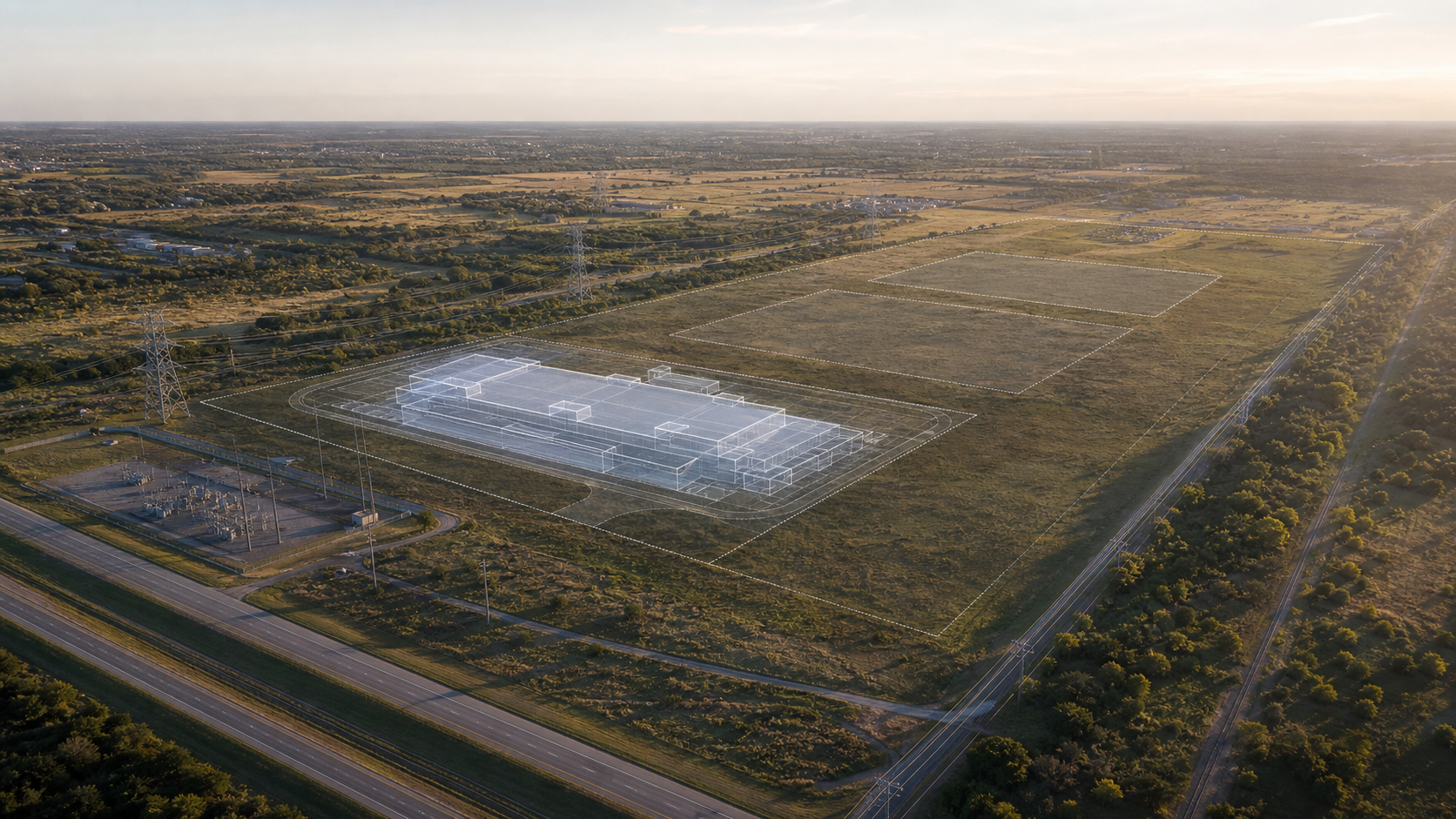
- Flexential acquired 110 acres in Kaufman County near Talty for a planned Dallas-area data-centre campus.
- The first building is planned at about 375,000 square feet with 36MW of secured utility power.
- Site work is expected to start in early 2027, with first-phase availability targeted for late 2028.
- The concept allows three 36MW buildings, or up to 108MW across the full campus; that total is potential capacity, not fully secured power.
- Dallas-Fort Worth has strong demand and preleasing, but grid interconnection and entitlement schedules remain a material execution risk.
The word “campus” often makes a future project sound like one indivisible asset. In practice, Flexential's Talty plan is a sequence. Land comes first. A secured block of utility power supports the first building. Site works, construction and commissioning must follow. Two additional buildings are options whose value depends on later power, permits, capital and tenants.
Reading the project in phases is not pessimism. It is the way to identify what the company controls today and what the market still has to supply.
The land moves the Dallas boundary south
Talty sits in Kaufman County, outside the best-known concentration of Dallas-Fort Worth data centres. The site gives Flexential 110 acres on which to stage construction rather than forcing all development into a mature cluster with scarcer parcels.
CBRE reports that Dallas-Fort Worth inventory reached 1,249.4MW in the first quarter of 2026 after 43.7% annual growth. A record 716.7MW was under construction and 88% of that pipeline was preleased. Those numbers explain why developers are looking farther south along I-35 as fibre improves.
They also warn against treating demand as the only constraint. CBRE says interconnection timelines had not materially improved in six to twelve months. A market can be commercially attractive while its electrical queue remains slow.
Flexential's land acquisition therefore establishes location control. It does not establish that all 108MW can be delivered on a common schedule.
Thirty-six megawatts is the first economic unit
The company describes approximately 375,000 square feet and 36MW of secured utility power for the first building. That is the portion with the clearest present power claim. The planned site-work start in early 2027 and late-2028 availability provide a timeline against which engineering progress can be measured.
Even that phase has several gates. Site preparation must handle drainage, roads and civil infrastructure. The utility connection must progress from commitment to energisation. The building must receive electrical and cooling systems, pass testing and become suitable for customer equipment. “Available” should ultimately mean capacity a customer can occupy under commercial terms, not merely a completed shell.
The release does not disclose a tenant, prelease, capital budget, construction contract or permit status. It also does not identify the structure of the secured-power arrangement. Those omissions do not invalidate the project; they define what remains unverified.
The other 72MW is option value
Three 36MW buildings produce the advertised ceiling of 108MW. Buildings two and three can reuse land planning, fibre routes and campus infrastructure, potentially lowering the cost of expansion. They also let Flexential wait for demand before committing all capital.
But arithmetic is not delivery. Later phases need power, and the announcement only calls the first 36MW secured. They may need additional permits, equipment and financing at prices not known today. Customer demand in 2028 or later may be strong, but the company has not named occupiers.
The right way to describe 108MW is therefore “campus potential.” It gives Flexential a growth route if the first phase converts and local infrastructure supports expansion. It should not be added to operating inventory or presented as a near-term grid load.
Phasing is a form of risk control. It prevents the company from building the entire vision before demand is visible. It also means the headline number will arrive only through repeated investment decisions.
Water design does not remove the energy question
Flexential targets zero operational water use effectiveness through a closed-loop cooling design. In a region where industrial water use can become a community and permitting issue, avoiding ongoing evaporative consumption is relevant.
The target still needs a defined measurement boundary. Closed-loop systems may sharply reduce operational water consumption at the facility while electricity generation and equipment manufacturing retain wider water footprints. “Zero” should refer to the operational metric claimed, not the total lifecycle of the campus.
Cooling choice also affects electricity, equipment cost and performance under hot Texas conditions. The article cannot infer those trade-offs because the release provides no engineering efficiency or power-usage-effectiveness result. The design is a stated target until the first building operates.
A late-2028 date creates useful checkpoints
The next evidence should come before opening day. Flexential can demonstrate site mobilisation in early 2027, permits, contracted construction, utility milestones and the physical progression of the first building. Leasing disclosure would show whether the 36MW block is converting from supply plan to customer-backed capacity.
By late 2028, the relevant test is not whether the campus rendering still shows three buildings. It is whether the first one has been energised, commissioned and made available on the promised scale. Only then does expansion into the remaining 72MW become a decision grounded in a working site.
Flexential has made a meaningful commitment by buying land and securing power for a first phase. The announcement also preserves a large option. The disciplined reading keeps those achievements separate: 36MW has a stated utility basis and schedule; 108MW describes what the site might eventually become.