
Topic
Network-resource Evidence
Within the Topic facet, Network-resource Evidence topic intelligence connects articles that share a specific subject, signal focus, or monitoring theme. The page gives readers a richer path through related reporting, source evidence, market actors, and infrastructure implications, with enough context to understand why the topic matters across company movements, governance decisions, regional exposure, and operational risk. Readers can compare recurring signals, affected organisations, public evidence, market context, service continuity, procurement, competition, compliance, and strategic planning questions behind the subject instead of stopping at a thin list of matching articles. It explains what the topic covers, which infrastructure actors or policies are involved, what evidence supports the coverage, and why the subject may matter for operators, customers, investors, and policy readers.

History
The Switch Offered a Shortcut. The Router Could Refuse: RFC 1953
In RFC 1953, the faster path began as a neighbor's request, not a command. A downstream node chose a label from its own local space and asked the upstream node to attach it to a defined IP flow. The upstream node could ignore the request. Even acceptance lasted only for a stated…

Story
AFRINIC's 8 September Snapshot Returned Four Old Resources to “Allocated.” It Cannot Say Why
Three ASNs and one /19 crossed AFRINIC’s public boundary together between two signed daily files. Their 2006 dates came back with them. That is evidence of a current state change, not evidence of a new allocation—and the distinction deserves a small public receipt.

Leaders
Osipenko Alexander Nikolaevich: What the Registry Shows—and What It Does Not
Osipenko Alexander Nikolaevich: What the Registry Shows—and What It Does Not intelligence summary explains the development, the public evidence available to readers, the organisations involved, the regional context, market exposure, and the infrastructure consequences that may…

IETF
The cost of a stateless relay lives elsewhere
A PANA relay can avoid keeping a record for every client without making network admission cheap, ownerless or continuously available. The useful economy is a placement decision: which component remembers the path, which validates the exchange, and which team must restore it.

IETF
Jonathan Rosenberg and the OPEN Status That Belonged to a Service, Not a Person
A green dot glows beside a name. A message goes unanswered. The apparent contradiction disappears once the dot is read at the level the presence standards actually describe: a communications service may be open to receiving a message while the human remains absent, occupied…
Europe and Middle East Institutional Trends
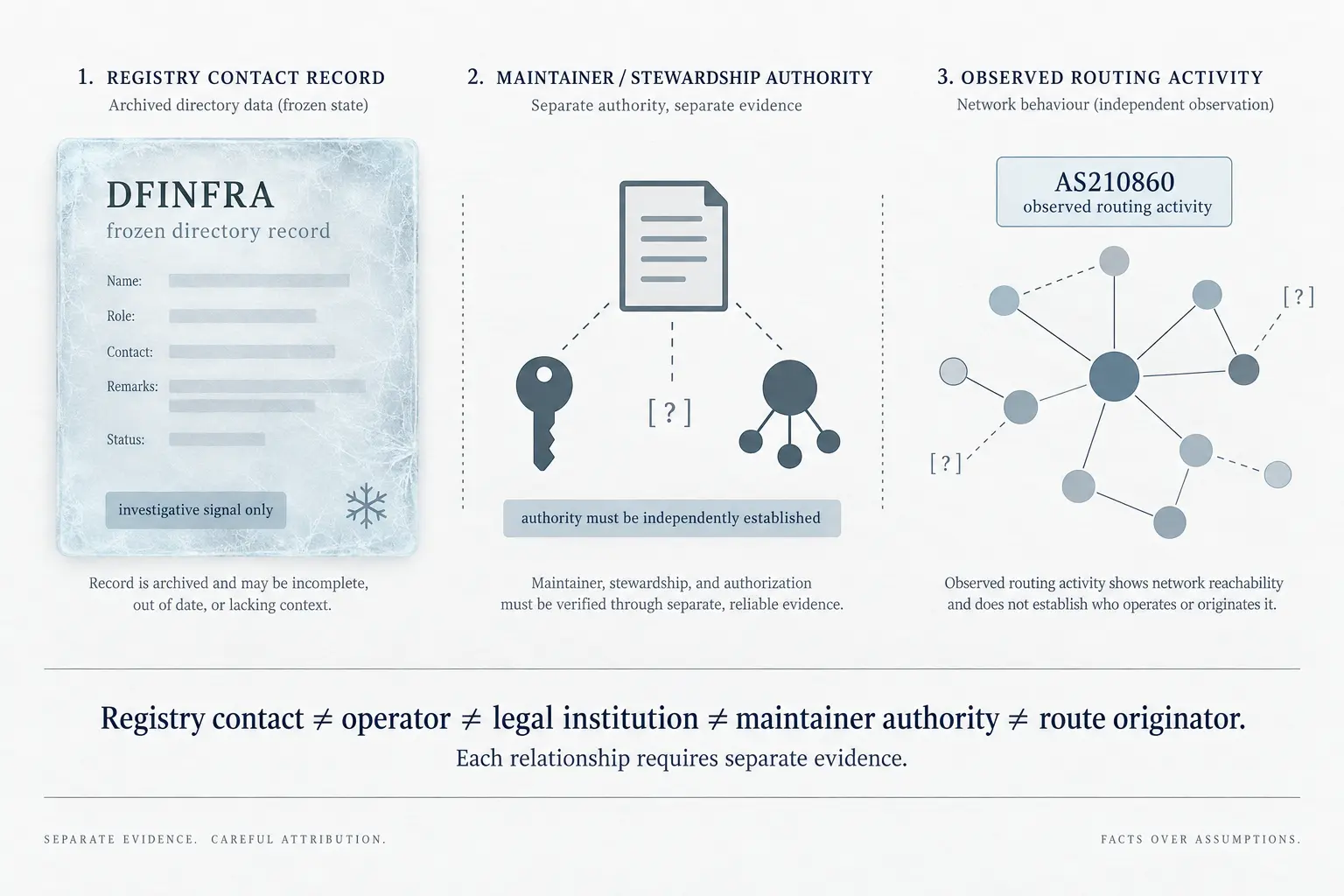
DFINFRA Is a Registry Signal, Not Yet Proof of an Operator
DFINFRA Is a Registry Signal, Not Yet Proof of an Operator intelligence summary explains the development, the public evidence available to readers, the organisations involved, the regional context, market exposure, and the infrastructure consequences that may follow. The Europe…

IETF
IPv6 Neighbor Discovery Puts Three Actions Behind One Boolean
A boolean is the smallest possible management choice. In the IPv6 Neighbor Discovery YANG model now in IETF Last Call, one such switch can authorize a much larger sequence: record a duplicate-address event, discard the triggering message and block the host that sent it. The draft…

History
The File Ended, Then Continued: RFC 1952 and Gzip's Member Boundary
A `.gz` filename suggests one entity. RFC 1952 describes something more interesting: a procession of self-closing members. Finish one, place another immediately after it, and a decompressor can continue as though the file had acquired a new chapter. The old compressed bytes need…

IETF
A migration measured in readable objects
Moving an old MIB into YANG can make a device easier to observe without moving the obligations attached to changing it. RFC 6643 makes that limited bargain explicit. The risk begins when a migration programme buys the first capability and declares the second complete.

Europe and Middle East Regional ISP Trends
AS210837’s Continuity Gap: What the Routing Record Can—and Cannot—Show
A documented historical network footprint has become a continuity question. For ROYA Communications and Internet Services Company Ltd, the difference between registry identity, historical routing visibility and current route evidence is more important than any single prefix…

Story
DATAMATIX and AS210973: What Public Routing Evidence Can—and Cannot—Prove
DATAMATIX and AS210973: What Public Routing Evidence Can—and Cannot—Prove intelligence summary explains the development, the public evidence available to readers, the organisations involved, the regional context, market exposure, and the infrastructure consequences that may…

IETF
Factory defaults can remove the way back
A factory reset can do precisely what its specification requires and still leave an operator unable to manage the device. RFC 8808 separates a return to preset configuration from two outcomes that the phrase “back to factory” tends to imply: a usable route back in, and data that…

IETF
A Cleared Incident Does Not Prove Which Command Cleared It
An incident client sends one `incident-resolve` request containing several incident numbers. Later, separate notifications arrive. Two records now say `cleared`; another remains `updated`. The network view is useful, but the decisive question has vanished between the command and…

History
The Key Centre Disappeared into the Tree. Its Authority Did Not: RFC 1949
Scaling usually sounds like subtraction: remove the bottleneck, spread the work, let the network carry the rest. RFC 1949 did spread multicast key distribution, but it could not subtract trust. By letting authenticated tree nodes pass group secrets and authorise later joins, the…

IETF
Ben Campbell and the Hundred-Percent Reduction That Did Not Prove Zero Traffic
The cleanest number on a Diameter console can be the most dangerous one. An overload report says `OC-Reduction-Percentage: 100`, and a post-incident slide turns that instruction into a finding: traffic fell to zero. Ben Campbell’s work on Diameter overload makes the narrower…

IETF
The old address plan survived the IPv6 launch
6rd let an operator introduce IPv6 without first replacing its IPv4 access network. The shortcut also gave an older address plan a continuing say over the size, lifetime and eventual migration of the new service.

IETF
A Capability Menu Is Not a Subscription Decision
An orchestrator sees a tidy answer before it opens a notification stream: this device supports HTTPS, XML or JSON, and two TLS versions. The discovery is valuable precisely because it is compact. It becomes dangerous only when a control system silently turns “listed” into…

History
The Password Was Correct Once. Acceptance Changed What Correct Meant: RFC 1938
Passwords usually sound like facts: either the claimant knows the right string or does not. RFC 1938 made that description incomplete. In its one-time-password system, a correct answer was consumed by success. The server replaced the value against which the next answer would be…

Story
ARIN’s RPKI Failover Test Left the Dependency Question Open
ARIN blocked access to its RPKI repositories for an hour, restored it, confirmed redundancy five minutes later and reported a return to baseline after another fifteen. That is unusually concrete resilience evidence. It is also narrower than the dependency question ARIN had…

IETF
The second login changes the security bargain
Keeping an IMAP connection open can save repeated setup work. It also removes a convenient security boundary: the assumption that one connection belongs to one user. The price of reuse is a complete account of what must be reset, what deliberately survives and who checks the next…