
Topic
Network-resource Evidence
Within the Topic facet, Network-resource Evidence topic intelligence connects articles that share a specific subject, signal focus, or monitoring theme. The page gives readers a richer path through related reporting, source evidence, market actors, and infrastructure implications, with enough context to understand why the topic matters across company movements, governance decisions, regional exposure, and operational risk. Readers can compare recurring signals, affected organisations, public evidence, market context, service continuity, procurement, competition, compliance, and strategic planning questions behind the subject instead of stopping at a thin list of matching articles. It explains what the topic covers, which infrastructure actors or policies are involved, what evidence supports the coverage, and why the subject may matter for operators, customers, investors, and policy readers.

History
RFC 2022: The Roster Named the Receivers, but the Packet Still Needed a Circuit
RFC 2022 did not turn an IP multicast group into one ATM connection. It split the problem in two: MARS reported the endpoints believed to be listening, while each sender still had to build and repair the one-way circuit that might reach them. The roster was actionable control…

Story
APNIC Will Automate Route-Record Alignment. The Roadmap Does Not Name the Conflict Winner
“Alignment” sounds like database housekeeping. In APNIC’s Q3 2026 roadmap, it means something harder: deciding how resource holdings, a route-management template, Whois route objects and RPKI authorizations should change when they disagree—and preserving enough evidence to show…

IETF
The Reply Came Back. It Did Not Prove the Path Was Measured: RFC 9779
RFC 9779 gives operators a standards-track way to measure loss and delay on SR-MPLS links and policies. Its most important operational lesson is less comfortable: a valid response can arrive by a route different from the traffic direction under examination. Protocol success, path…

IETF
A Path Can Parse and Still Prove Almost Nothing: The Boundary Proposed by ypath
The Internet-Draft `draft-jgc-netmod-yang-path-00` proposes one compact path notation for YANG schema nodes, data instances and filters. Its value is precision at the interface. Its danger begins when a valid string is mistaken for evidence that the named node exists, the…
Global Cloud Services
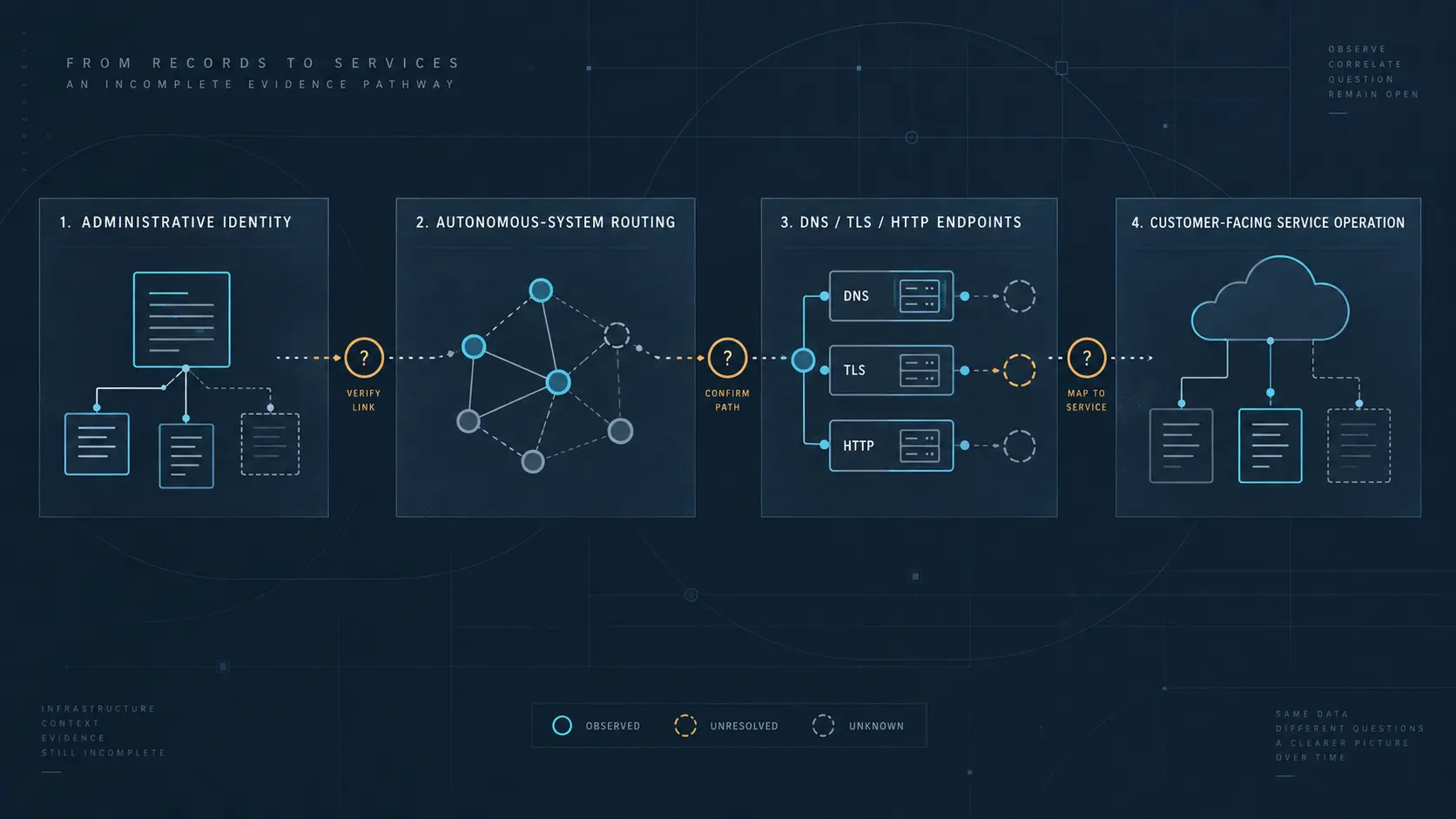
AlmazCloud’s AS210328: The Operating Chain Still Has to Be Demonstrated
AlmazCloud’s AS210328: The Operating Chain Still Has to Be Demonstrated intelligence summary explains the development, the public evidence available to readers, the organisations involved, the regional context, market exposure, and the infrastructure consequences that may follow.…

Story
ARIN Let Consultant Hiring Advance Before the Control Plane Vote.
ARIN’s draft Board minutes preserve an awkward but legitimate sequence: outside-consultant hiring could keep moving while the Registry Control Plane itself awaited a detailed plan and a later approval meeting. The issue is not whether preliminary expertise is useful. It is how…

Global Regional ISP
ROYA’s AS210837: The Evidence Chain Between Network Identity and Operation
ROYA’s AS210837: The Evidence Chain Between Network Identity and Operation intelligence summary explains the development, the public evidence available to readers, the organisations involved, the regional context, market exposure, and the infrastructure consequences that may…

IETF
The Schema Rejected the Sum. It Did Not Prove the Scope
A proposed YANG extension gives telemetry systems a disciplined reason to refuse an aggregation before it reaches a dashboard. That is a useful control. The harder question begins one step earlier: who proves that the scope written into the schema describes the network that…

History
The Catalogue Was Verified. The Training Material Could Still Be Gone: RFC 2007
In 1996, a volunteer directory tried to keep Internet training reusable by recording three different clocks: when a resource changed, when its catalogue entry changed, and when someone last checked it. RFC 2007 shows why those dates were useful—and why none was a promise about…

History
The Directory Could Name a Protocol. The Probe Still Had to Know Its Packets: RFC 2021
RFC 2021 made remote monitors configurable without pretending that a name in a table could replace packet-decoding code.

Global Cloud Services
AlmazCloud’s AS210328: The Operating Chain Still Has to Be Demonstrated
AlmazCloud’s AS210328: The Operating Chain Still Has to Be Demonstrated intelligence summary explains the development, the public evidence available to readers, the organisations involved, the regional context, market exposure, and the infrastructure consequences that may follow.…

Story
AIRRS Sends “amp;profile”. RIPEstat’s Real AFRINIC Profile Returns 500
A regional statistics portal can look complete while the choice that is supposed to make it regional never reaches the service under the expected name. AIRRS currently demonstrates that uncomfortable distinction: seven tabs can arrive, yet the evidence says they came through…

North America Cloud Services
Motorola Cloud Services Networking is visible in the routing table—but who controls the service behind it?
Motorola Cloud Services Networking is visible in the routing table—but who controls the service behind it? intelligence summary explains the development, the public evidence available to readers, the organisations involved, the regional context, market exposure, and the…

Story
APNIC 62 Had Seven Policy Proposals. Two Had No Consensus Call.
APNIC’s conference report does something more useful than recording winners and losers. It preserves a third procedural state. Prop-165 and prop-172 were discussed, but no consensus call was held. The next record should explain where that state leads without pretending it means…

Global Institutional
ISC-AGP1 and the Authority Chain Behind Internet Systems Consortium’s Network Identity
ISC-AGP1 and the Authority Chain Behind Internet Systems Consortium’s Network Identity intelligence summary explains the development, the public evidence available to readers, the organisations involved, the regional context, market exposure, and the infrastructure consequences…

IETF
The Rule Chose the Sub-Interface. The Wire Still Owed Proof
A six-step precedence order can make VLAN classification deterministic without making forwarding observable. Revision 18 closes one ambiguity at the configuration boundary; operators still need counters, captures and path evidence to close the operational claim.

Global Cloud Services
AlmazCloud’s AS210328: The Operating Footprint Still Has to Be Shown
AlmazCloud’s AS210328: The Operating Footprint Still Has to Be Shown intelligence summary explains the development, the public evidence available to readers, the organisations involved, the regional context, market exposure, and the infrastructure consequences that may follow.…

History
The MIB Saw the Binding. It Did Not See the Journey: RFC 2006
RFC 2006 gave operators a disciplined view of Mobile IP’s moving parts. Its tables, counters and alert could expose what a management agent believed had happened, while leaving delivery, identity, authority and continuity outside the frame.

Story
AFRINIC’s Co-Chair Calendar Leaves 7½ Days After Nominations Close. Its Suggested Vetting Period Is Two Weeks.
The number is not evidence of a rushed decision. It is evidence of an unexplained join. AFRINIC has published a precise closing time, a precise slate time and an indicative vetting duration that does not fit between them unless some work happens before the door closes.

Story
RIPE NCC’s AuthDNS Ledger Counts 43 Nodes but Not the Eyeball Coverage They Deliver
RIPE NCC has made the objective unusually clear: put AuthDNS where poorly served networks can actually reach it. Its public inventory can show that 43 hosted instances are operational. What it cannot yet show is whether each new map pin changed the anycast catchment that matters.