
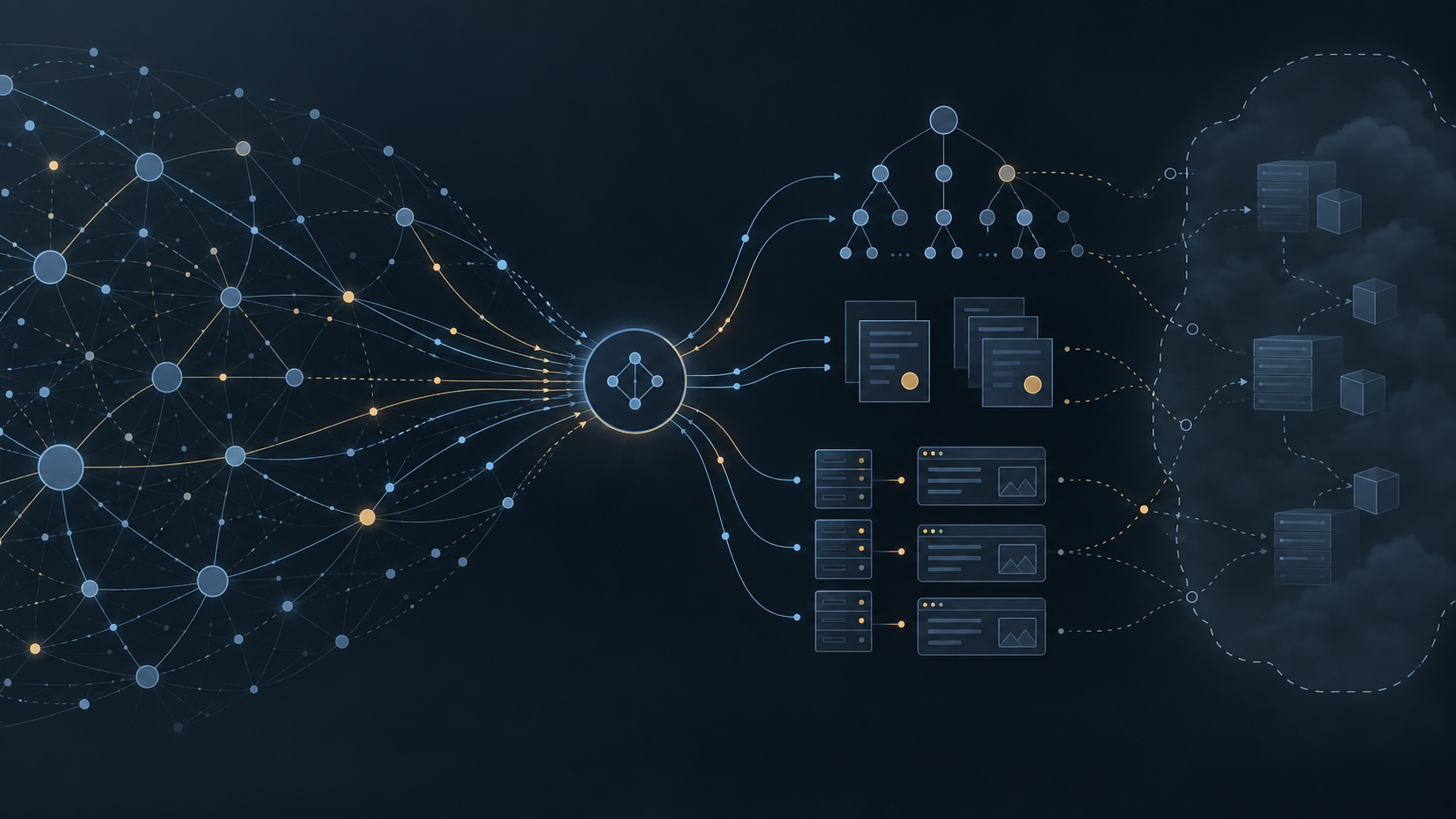
Summary
- The available research identifies 22 public candidate sources across registry, routing, DNS, TLS, HTTP, archive and first-party evidence, but the supplied snapshots do not expose current raw responses or query-time values.
- Registration, route visibility, endpoint behavior and customer provisioning are separate tests. Non-retrieval is uncertainty, not evidence that the ASN, domain or cloud service is inactive.
The claim has four different layers
A domain name and an autonomous system number create an apparent identity. They do not automatically create an operating story.
The first layer is administrative. A registry or RDAP record can show what a publisher lists for a domain, an autonomous system or a route object. Those records matter because they establish an accountable object, a holder label, an organisation reference or a maintained administrative relationship. They remain records of registration, however, rather than direct observations of packets, endpoints or customers. The relevant RIPE Database and RDAP URLs were preserved for this investigation, but the current field values, dates and response bodies were not exposed in the supplied source snapshots. RIPE Database aut-num record and RDAP domain record therefore identify the tests that should be run, not findings that can be asserted here.
The second layer is routing. An ASN becomes operationally meaningful when independent collectors observe prefixes originated by it over a named interval. Route objects and registry assertions can help explain intended origin, but they are not equivalent to a visible BGP announcement. RIPEstat’s overview, announced-prefixes, routing-status and routing-history endpoints, together with external BGP views, are appropriate cross-checks. The preserved research package does not provide a current announced flag, prefix list, collector observation, upstream, peer or last-seen value.
It follows that this article cannot say that AS210328 is currently routing, nor that it is not.
The third layer is endpoint continuity. A domain may have delegation without an address; an address may exist without a functioning service; a certificate may have been issued without a current TLS endpoint; and a web page may remain online without a working control plane. A current A, AAAA or NS answer, a TLS handshake, an HTTP status and a redirect or page body answer different questions. They should not be collapsed into the single phrase “the website works.” The preserved candidate set includes Google Public DNS A and NS checks, DNSViz, Certificate Transparency, SSL Labs and the first-party endpoint. Their snapshots do not expose current answers, handshakes, certificates, status codes or page content.
The fourth layer is customer operation. A cloud service is more than a branded page or a reachable server. The decisive evidence would be a reproducible workflow: an account or contract can be created, a resource can be provisioned, the resource can be used, its lifecycle can be managed, and the service can be connected to the claimed operating infrastructure where that connection is material. None of the supplied material establishes successful signup, billing, support activity, workload execution, resource allocation or customer continuity.
Why the layers cannot substitute for one another
Each layer has a different causal distance from the proposition being tested.
A registration record is close to administrative identity but far from service delivery. BGP visibility is closer to network operation, but it does not reveal whether the network carries customer traffic or hosts a cloud control plane. DNS and TLS show that a name can resolve or negotiate under particular conditions; they do not prove that a customer can obtain compute, storage, networking or support. A first-party website can describe an offering, but its own claims require separate corroboration and do not demonstrate that provisioning succeeds.
That separation also explains why a negative observation must be phrased carefully. An empty route result from one collector is not proof that no route exists. A missing DNS answer at one resolver is not proof of global non-resolution. A failed TLS scan may reflect blocking, rate limits or a transient endpoint condition. An absent PeeringDB record is not evidence that a network does not operate. Conversely, a positive signal should not be stretched beyond what it measures: a certificate is not a live service, an HTTP response is not a customer, and a route is not a cloud platform.
The evidence file for this run is consequently best understood as a test plan with preserved source provenance. It names the public systems capable of answering the questions, but it does not convert candidate URLs into observations. RIPEstat routing status can support a bounded routing claim only when its response, timestamp and observation scope are available. The first-party AlmazCloud endpoint can support a web-presence claim only when its response is actually captured and described. Neither condition is met by the supplied snapshots.
The missing link is continuity, not identity
The useful question is therefore narrower than “does AlmazCloud exist?” It is whether the same operational story survives each transition:
- An administrative record identifies AS210328 and almazcloud.network.
- Independent observers see the ASN or associated prefixes in routing.
- DNS connects the domain to reachable addresses or delegated infrastructure.
- TLS and HTTP show maintained endpoint behavior.
- A customer can complete a repeatable service workflow.
- The service and network evidence are contemporaneous enough to support the claimed relationship.
A break at any transition changes the conclusion. If the ASN is registered but not independently observed, the result is administrative identity without demonstrated routing. If routing is visible but the domain resolves elsewhere, the result may be a third-party frontend, a CDN or an unproven relationship between the domain and the ASN. If a page is reachable but no provisioning workflow works, the result is web presence without demonstrated cloud delivery. If provisioning succeeds but the route linkage is unclear, the customer-service claim may be stronger than the network-ownership claim.
This is not an argument that the service is absent. It is an argument against treating an incomplete chain as complete.
What would materially change the assessment
The administrative assessment would change with current raw RIPE or RDAP fields, response timestamps and a clear relationship between the domain, organisation and ASN. The routing assessment would change with repeated, dated observations from multiple collectors showing prefixes, origin, visibility intervals and, where relevant, upstream or peer context. The endpoint assessment would change with current A, AAAA and NS answers, a recorded TLS handshake, certificate details, HTTP responses and a captured redirect or page body.
The customer-operation assessment requires more. A reviewer would need a reproducible signup or account path, evidence that a resource was actually provisioned and usable, lifecycle or billing evidence, and enough contemporaneous infrastructure information to distinguish a functioning service from a static presentation. The public scan and archive sources could add historical continuity, but archived or user-submitted observations would still need to be dated and interpreted within their limits.
Until those observations are available, the strongest defensible conclusion is bounded: the research package preserves a broad set of public tests for examining almazcloud.network and AS210328, but it does not establish a current operating footprint or customer-facing cloud operation. That boundary is a finding about the evidence, not a finding that the underlying network or service does not exist.
Source coverage
The source set for this assessment includes RIPE Database aut-num, RIPE route search, RIPEstat AS overview, announced prefixes, routing status, routing history, BGPView ASN, BGPView prefixes, bgp.tools, Hurricane Electric BGP, PeeringDB, RDAP, Google Public DNS A, Google Public DNS AAAA, Google Public DNS NS, DNSViz, Certificate Transparency, SSL Labs, the first-party endpoint, urlscan.io, Internet Archive and Netcraft. These links identify the public tests; they do not convert unavailable snapshots into current observations.
Member Briefing
Deeper Profile Context
Sign in with the right membership level to unlock the full briefing and source notes.
Only for Strategic Circle
Strategic Circle
Open to all readers. Unlock profile briefings after joining and signing in.
Join Strategic CircleOnly for Leadership Alliance
Leadership Alliance
For qualified IP-asset owners and management; sign in to unlock alliance briefings.
Join Leadership Alliance