
Summary
- Public records provide distinct ways to test the relationship between almazcloud.network, AS210328, routing resources, DNS, certificates and web endpoints, but the research artifacts for this investigation did not retrieve current responses from those endpoints.
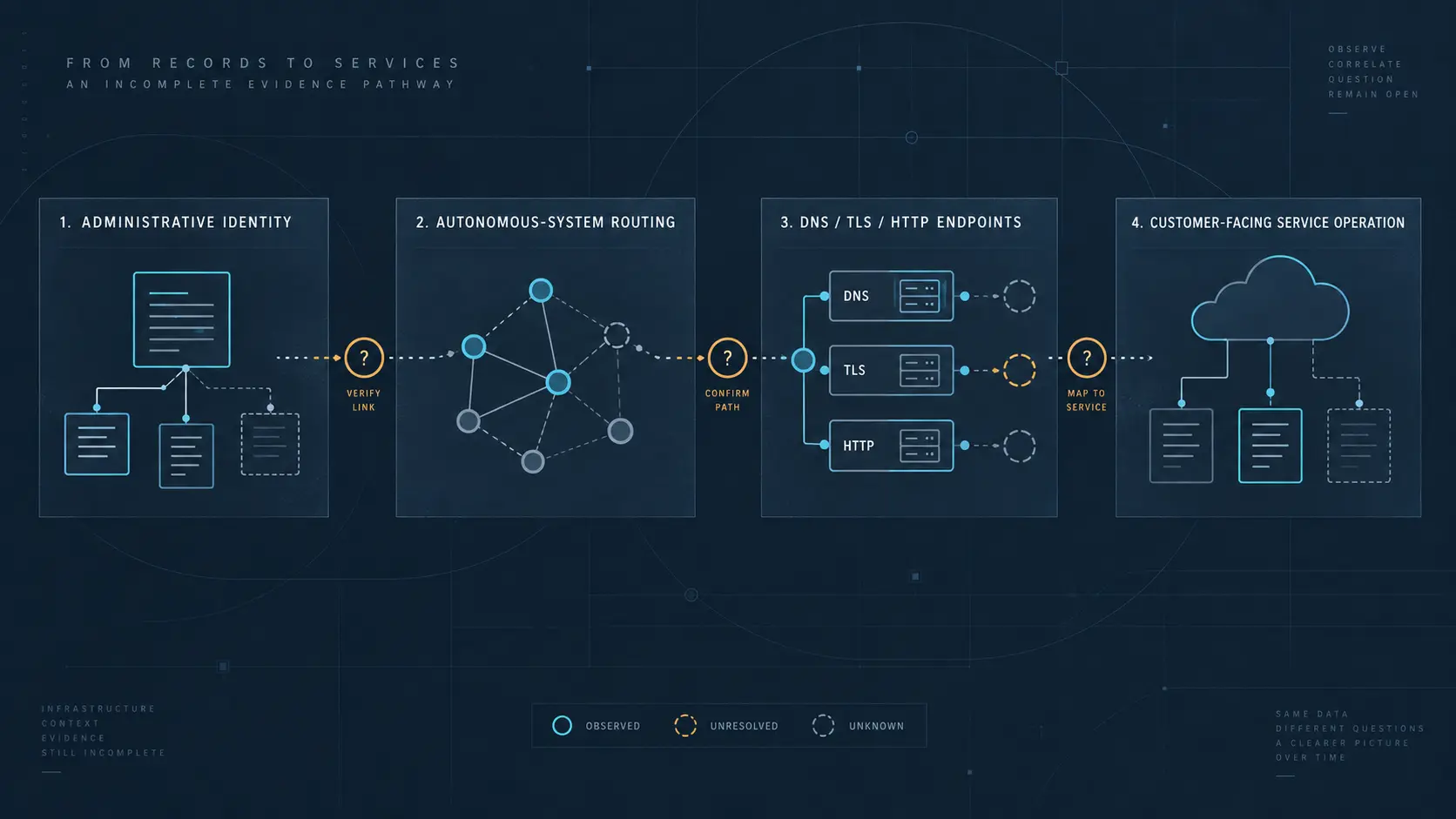
- A complete cloud-service claim requires more than an administrative identity: it requires a reproducible chain linking resources to observable deployment and, finally, to a customer-usable service.
The public record around almazcloud.network and AS210328 is easy to misread because several different propositions appear close together. A domain can be registered. An autonomous system can have an entry in a numbering registry. A route can be declared in an Internet Routing Registry. A prefix can be visible from one or more BGP collectors. A nameserver can answer. A certificate can have been issued. A web endpoint can respond. None of those facts, considered alone, proves that a company is currently operating a cloud platform for customers.
That distinction is not a semantic precaution. It is the mechanism that determines whether a cloud-service claim is independently testable.
For this investigation, the public sources identified a set of tests for AS210328 and almazcloud.network. They did not provide the current raw responses needed to complete those tests. The research artifact records that live web and API responses were not retrieved, that every candidate had a null retrieval timestamp, and that current registry values, prefixes, DNS answers, certificates, HTTP behaviour and customer-facing service operation must not be asserted. The result is therefore not a finding that the network is inactive, unavailable or fictitious.
It is a narrower finding: the operating chain remains un-demonstrated in the evidence preserved for this review.
The first layer is administrative identity
The RIPE Database aut-num object for AS210328 is the natural starting point. A live response could show the ASN’s current name, status, organisation handle, maintainers, routing-policy declarations, creation date and modification date. Referenced organisation, person and role records could add administrative context. A matching website or organisation label could support a relationship between the ASN and almazcloud.network.
That support would still be limited. Registry objects are records maintained for administrative and coordination purposes. They can identify how an operator presents a resource to a registry, but they do not prove that the resource currently originates routes, carries traffic or provides a service. An assigned ASN is not the same thing as a measured network operation.
The same limitation applies to route and route6 objects in the RIPE Internet Routing Registry. Such objects can declare that a prefix is intended to be originated by AS210328. They are useful for comparing declared routing policy with observed routing. They are not themselves observations of packets, paths or reachability. A declaration can be stale; a route can be visible without a corresponding object; and neither condition alone resolves operational control.
The second layer is observable routing
The next question is whether AS210328 appears in routing data independently of its registry entries. RIPEstat’s AS overview, announced-prefixes and routing-status services are candidates for answering that question. They can report whether the ASN is observed as announced, which prefixes appear associated with it, how long the observation corpus has seen the ASN, and what address space or neighbours are visible from RIPE’s vantage points.
BGP.tools, BGPView and Cloudflare Radar offer different comparison points. Agreement between them and RIPEstat would strengthen the claim that a prefix was visible at a particular time and from more than one measurement system. Disagreement would not automatically show that one source is wrong. It could reflect collector coverage, refresh intervals, route aggregation, regional visibility or a change between queries.
Even a confirmed BGP announcement would establish only a routing fact. It would show that an origin was visible from specified observation points during a specified period. It would not show that the announced space hosts the website, that it contains cloud workloads, or that the ASN has customer traffic. The causal link must be tested rather than assumed.
The link becomes more informative when an observed address can be connected to the domain and then to a service endpoint. That requires synchronized evidence: a DNS answer, an address-to-origin mapping, a contemporaneous route observation and a clear explanation of whether the address serves the apex domain, a subdomain, an API, a control panel or another function. Without that alignment, an ASN and a domain may simply coexist in the same investigation.
DNS is a control surface, not a cloud-service receipt
RDAP and DNS queries can clarify the domain’s administrative and technical perimeter. RDAP may provide registrar information, registration and expiry events, status codes and delegated nameservers. Google Public DNS queries can show visible NS, A, AAAA and DS answers, along with TTL and validation-related fields. DNSViz can add an independent view of delegation, authoritative servers and DNSSEC configuration.
Those records matter because DNS is a control surface. Delegation determines which nameservers can answer for a namespace; records determine where a resolver is directed; DNSSEC can provide evidence about the integrity of a validation chain. But control of a namespace is not proof of control over an autonomous system, and a domain answer outside AS210328 would not by itself disprove that other subdomains or customer systems use the ASN. Cloud providers frequently separate branding, control-plane, delivery and customer infrastructure.
The correct question is therefore not whether one DNS answer “matches” one ASN. It is whether a dated sequence of authoritative and recursive observations can explain the path from the domain to a service endpoint, and whether that endpoint is linked to the same operating identity by independent evidence.
Certificates and archives show traces, not necessarily deployment
Certificate Transparency records can reveal certificates issued for the apex and subdomains, including subject names, alternative names, issuers and validity dates. Names such as api, console, auth, panel, storage or regional service labels would be useful leads. They could identify an intended deployment surface that merits further testing.
But issuance is not deployment. A certificate may never have been installed, may have been issued for a short-lived test, or may remain in a log after the associated endpoint has disappeared. Censys, SSL Labs, URLScan and web-archive records can help connect certificates and hostnames to observed services, but only if their observations are retrieved with dates and preserved in a form that can be checked.
The same rule applies to malware and code-search databases such as OTX, VirusTotal, GitHub search and grep.app. A reference can reveal historical or technical context, but the presence of a string is not evidence that a cloud platform is currently operating. The source, timestamp, object being referenced and relationship to the target must all be established.
The customer-service threshold is different
The final layer is the one most easily implied and least easily proved: customer-facing cloud operation. To establish it, a review would need evidence that goes beyond network identity and endpoint presence. It would need to show a usable service surface—such as documented provisioning, authentication, an API, a console, a published product workflow or reproducible allocation of resources—and connect that surface to the operator under investigation.
A homepage can demonstrate a public web presence. It cannot, without more, demonstrate that customers can create virtual machines, obtain storage, use an API, receive support or maintain workloads. A public IP can demonstrate addressability. It cannot demonstrate capacity, reliability, tenancy or a commercial relationship. A PeeringDB record can provide operator-supplied information about network type, policy, facilities or exchanges. It cannot independently prove the service claims described by the operator.
This is why the operating chain must be treated as a series of conditional links:
- an administrative record identifies a resource;
- routing observations show whether the resource is externally visible;
- DNS, certificates and HTTP observations show whether named technical surfaces are deployed;
- service documentation or reproducible interactions show what those surfaces do; and
- independent evidence connects that function to a customer-facing cloud operation.
A break at any point does not prove that the next layer is absent. It means the claim has not yet been demonstrated by the available evidence.
What this investigation can and cannot conclude
The preserved research package identifies 28 public source candidates spanning RIPE registry and routing data, independent BGP aggregators, PeeringDB, CAIDA, Cloudflare Radar, RDAP, DNS, DNSSEC, certificate transparency, web archives, URLScan, OTX, VirusTotal, GitHub and grep.app. That inventory is useful because it defines a reproducible verification plan. It is not a substitute for the underlying observations.
The package can support a statement about the evidence boundary: the relevant public systems and tests have been identified, but the current values were not captured in this run. It cannot support a statement that AS210328 is currently announcing—or not announcing—specific prefixes; that almazcloud.network currently resolves to particular addresses; that certificates are deployed; that HTTP endpoints work; or that customers are receiving cloud resources.
For technical readers, this distinction prevents a source catalogue from being mistaken for telemetry. For general readers, it explains why an apparently simple question—“is this a cloud operator?”—requires several different kinds of proof. Administrative identity, routing visibility, technical deployment and customer service are related, but they are not interchangeable.
The next useful investigation would capture the raw responses concurrently, record UTC timestamps, preserve response hashes and compare multiple observation systems. It would then map any returned addresses to simultaneously observed origins, test named endpoints safely, inspect certificate and DNS relationships, and look for a reproducible customer workflow. Until that work is done, the strongest defensible conclusion is bounded: public records define how AlmazCloud’s operating chain could be tested, but the evidence preserved here does not yet demonstrate that the chain reaches a functioning customer-facing cloud service.
Sources and evidence boundary
This article uses the following public source candidates. The research package records that their live responses were not retrieved during this investigation; the links therefore identify the proposed evidence locations, not current values.
- https://rest.db.ripe.net/ripe/aut-num/AS210328.json
- https://rest.db.ripe.net/search.json?source=ripe&query-string=AS210328&inverse-attribute=origin&type-filter=route&type-filter=route6&flags=no-filtering
- https://stat.ripe.net/data/as-overview/data.json?resource=AS210328
- https://stat.ripe.net/data/announced-prefixes/data.json?resource=AS210328
- https://stat.ripe.net/data/routing-status/data.json?resource=AS210328
- https://stat.ripe.net/data/asn-neighbours/data.json?resource=AS210328
- https://bgp.tools/as/210328
- https://www.peeringdb.com/api/net?asn=210328
- https://api.bgpview.io/asn/210328/prefixes
- https://api.asrank.caida.org/v2/restful/asns/210328
- https://radar.cloudflare.com/routing/as210328
- https://rdap.org/domain/almazcloud.network
- https://dns.google/resolve?name=almazcloud.network&type=NS
- https://dns.google/resolve?name=almazcloud.network&type=A
- https://dns.google/resolve?name=almazcloud.network&type=AAAA
- https://dns.google/resolve?name=almazcloud.network&type=DS
- https://dnsviz.net/d/almazcloud.network/dnssec/
- https://crt.sh/?q=%25.almazcloud.network&output=json
- https://search.censys.io/search?resource=certificates&q=names%3a%20almazcloud.network
- https://www.ssllabs.com/ssltest/analyze.html?d=almazcloud.network
- https://almazcloud.network/
- http://almazcloud.network/
- https://urlscan.io/api/v1/search/?q=domain%3aalmazcloud.network
- https://web.archive.org/cdx/search/cdx?url=almazcloud.network%2f%2a&output=json&fl=timestamp%2coriginal%2cstatuscode%2cmimetype%2cdigest&filter=statuscode%3a200&collapse=digest
- https://otx.alienvault.com/api/v1/indicators/domain/almazcloud.network/passive_dns
- https://www.virustotal.com/gui/domain/almazcloud.network/details
- https://github.com/search?q=%22almazcloud.network%22&type=code
- https://grep.app/search?q=almazcloud.network
Member Briefing
Deeper Profile Context
Sign in with the right membership level to unlock the full briefing and source notes.
Only for Strategic Circle
Strategic Circle
Open to all readers. Unlock profile briefings after joining and signing in.
Join Strategic CircleOnly for Leadership Alliance
Leadership Alliance
For qualified IP-asset owners and management; sign in to unlock alliance briefings.
Join Leadership Alliance