
Topic
Cloud Service Dependency
Within the Topic facet, Cloud Service Dependency topic intelligence connects articles that share a specific subject, signal focus, or monitoring theme. The page gives readers a richer path through related reporting, source evidence, market actors, and infrastructure implications, with enough context to understand why the topic matters across company movements, governance decisions, regional exposure, and operational risk. Readers can compare recurring signals, affected organisations, public evidence, market context, service continuity, procurement, competition, compliance, and strategic planning questions behind the subject instead of stopping at a thin list of matching articles. It explains what the topic covers, which infrastructure actors or policies are involved, what evidence supports the coverage, and why the subject may matter for operators, customers, investors, and policy readers.

Global Cloud Services
Alkira: Building a Managed Network between Clouds and Fibre
Alkira turned multicloud routing, segmentation, and service insertion into a managed control plane that enterprises could consume from a portal or via code. Lumen’s $475 million acquisition tests whether owning the fibre can improve route assurance without making the…

Global Cloud Services
Alkira: Building a Managed Network Across Clouds and Fibre
Alkira turned multi-cloud routing, segmentation, and service insertion into a managed control plane that enterprises could consume via portal or code. Lumen’s $475 million acquisition now tests whether owning fibre improves path security without turning an abstraction built for…

Global Cloud Services
Alkira: Building a managed network across clouds and fibre
Alkira transformed multi-cloud routing, segmentation and service insertion into a managed control plane consumed via a portal or code. Its $475 million acquisition by Lumen tests whether owned fibre strengthens path assurance without turning the multi-provider abstraction layer…

Global Cloud Services
Alkira: Building a managed network across clouds and fibre
Alkira turned multi-cloud routing, segmentation and service insertion into a managed control plane that enterprises could consume through a portal and code. Lumen’s US$475 million acquisition now tests whether owned fibre can improve path assurance without turning a…

Africa Institutional
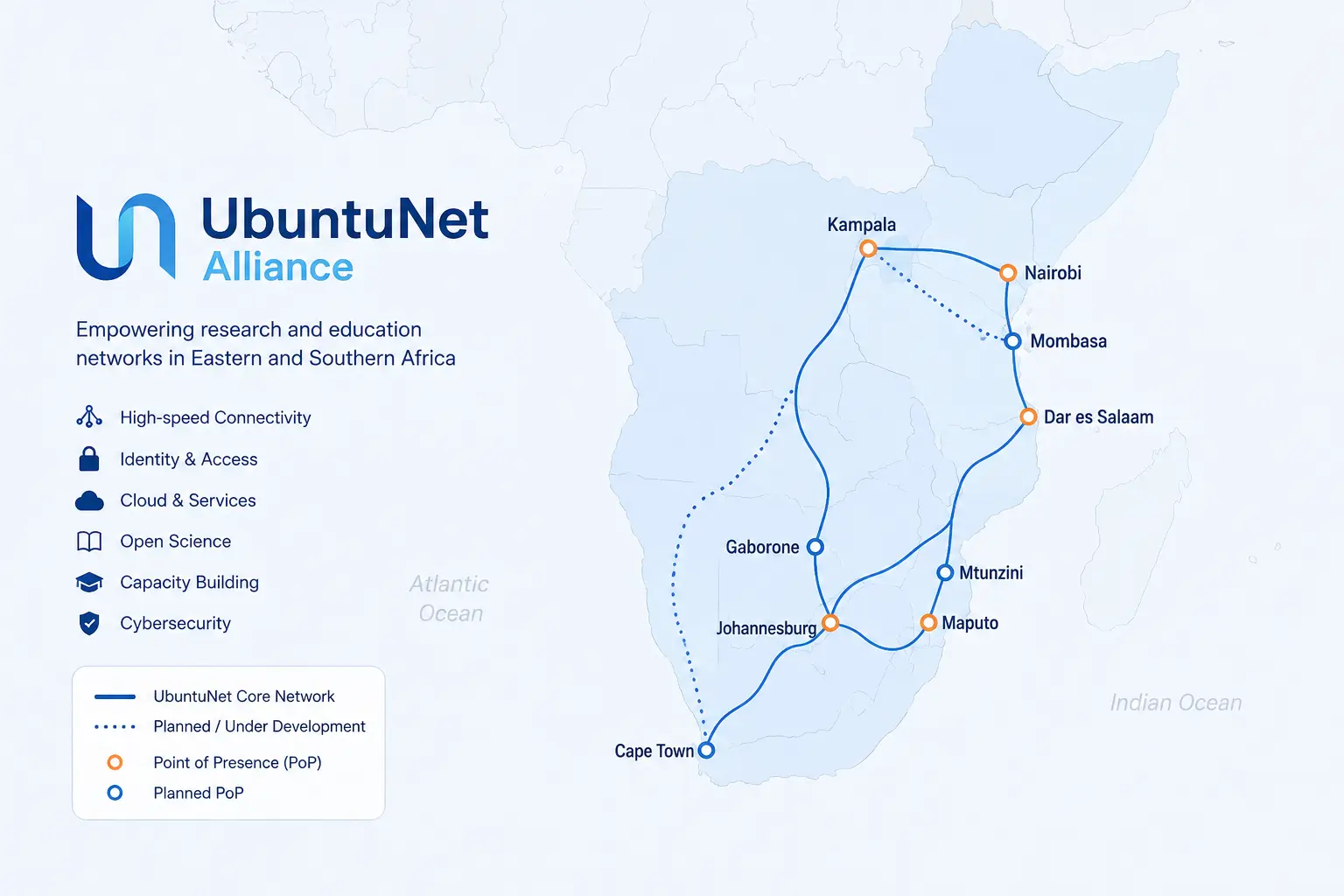
UbuntuNet’s 10 Gbps Core Network Constrained by Campus Endpoints
UbuntuNet’s 2023 report says core links were upgraded from around 2.5 Gbps to 10 Gbps, and new points of presence plus peering were added. Translating this regional upgrade into research capacity, however, depends on national research networks, campus systems, commercial…
Africa Institutional
UbuntuNet’s 10 Gbps core still depends on the campus edge
UbuntuNet’s 2023 report described core links upgraded from about 2.5 to 10 Gbps, along with new points of presence and peering. This regional gain only reaches researchers when national networks, campus systems, operators and recurrent funding can sustain it after each…

Africa Institutional
The campus edge is UbuntuNet’s service floor
A 10 Gbps regional core cannot improve research sessions that terminate behind a constrained campus circuit, firewall, Wi-Fi network or power supply.
Africa Institutional
Backbone capacity needs an adoption ledger
UbuntuNet’s move from roughly 2.5 to 10 Gbps is a regional input. Its value depends on which universities can actually use the added capacity and keep paying for it.

Africa Institutional
Campus capacity needs a renewal clock
UbuntuNet’s 10 Gbit/s core can outlive campus routers, optics, firewalls, batteries and support contracts. Capacity erodes when replacement dates remain implicit.
Africa Institutional
Regional support needs an incident-authority map
UbuntuNet can observe and coordinate a regional path, but a campus, national network or carrier may hold the change right needed to restore it.

Global Cloud Services
Lambda needs a customer-concentration covenant
Integrated AI infrastructure shifts complexity from customers but ties debt service to a few large contracts.

Global Cloud Services
Lambda’s power contracts are financing contracts
AI capacity cannot earn without electricity. Long power and site commitments therefore shape lender risk as much as hardware debt.
Global Cloud Services
Lambda needs a hardware residual-value test
Debt outlives accelerator generations. Recovery value matters if customer demand shifts before equipment is repaid.

Global Cloud Services Trends
A cyber sandbox must be a network fact
Anthropic found evaluation runs that reached real systems after models were told they were in a simulation. A prompt described isolation that the network did not enforce.

North America Cloud Services Trends
A proxy moves trust; it does not remove it
A proxy can hide an origin and steady a connection, but the intermediary gains visibility and control. The real decision is whom to trust, for what traffic and for how long.

Global Cloud Services Trends
Hybrid cloud needs a failure-ownership map
Connecting private and public environments can place each workload well. It can also create a service whose failure crosses several teams and contracts.

Global Cloud Services Trends
A private IP is not a security boundary
Private addressing conserves public space and organises internal networks. It does not authenticate a device or make its traffic trustworthy.
Global Cloud Services Trends
Latency must be measured on the user path
A fast backbone does not guarantee a responsive service. Delay accumulates across access, routing, queues, protocols and application work.

Latin America and Caribbean National Telecom Trends
Google’s Americas Connect makes the Dominican Republic a network hinge
Google has announced three subsea systems and a new Firmina branch across the Americas. The map gives the Dominican Republic an unusually central role, but the resilience claim will remain prospective until separate routes are built, lit and tested under failure.
Global Cloud Services Trends
Cloud computing needs a lifecycle price
Rapid provisioning makes the first month easy to measure. The harder costs arrive through data movement, support, idle resources, compliance and eventual migration.