
Summary
- Founded in 2018 by Amir Khan and Atif Khan after their time at Viptela, Alkira extended software-defined networking from branch sites to a managed mesh between clouds, headquarters, partners and services.
- Its Cloud Exchange Point is a customer-specific virtual point of presence: the customer expresses topology and policy via portal or code, while Alkira operates the underlying routing and service nodes.
- Alkira had reported $176 million in funding before Lumen Technologies bought it for $475 million in cash on 7 July 2026; Lumen Connect remained an integration direction.
- The purchase tests whether owning the fibre can improve assurance and accountability without hiding alternative routes, weakening partner neutrality or making the customer’s network model more expensive to move.
Lumen Paid $475 Million for a Model of the Customer’s Network
On 7 July 2026, Lumen Technologies completed the acquisition of Alkira for $475 million in cash. The buyer already owned fibre and private connectivity. What it acquired was a software-defined control plane that represented an enterprise’s network — its clouds, sites, segments, routes and services — as entities that could be created and modified from a portal, via APIs and with Terraform.
Since its founding in 2018, Alkira had been shifting responsibility away from intermediate routers operated by the customer. The company described the outcome it wanted: connect these clouds, isolate those segments, exchange only certain routes with partners, and send this traffic through a firewall. Alkira deployed and operated the virtual routing and service environment under that intent. The interface, lifecycle and capacity model resembled software as a service, although packets still crossed infrastructure of clouds, operators and other providers.
Lumen said it would combine that orchestration with its fibre and private connectivity to evolve towards Lumen Connect. The business logic is clear. An operator that controls the software relationship and part of the physical path can provision a larger portion of the service, observe more faults and capture more revenue. The same integration also gives it an incentive to steer demand towards its own network.
At the research cut-off date of 2 August 2026, the deal was less than a month old. Alkira’s brand, website and direction during the acquisition remained visible, but the final reporting lines, packaging, billing and long-term brand treatment had not been publicly resolved. Lumen Connect continued to be a roadmap and an integration programme, not a finished global operational plan.
The acquisition thus turns Alkira’s product promise into an operational test. Lumen must preserve the speed and cross-provider flexibility that gave the platform value, while adding route assurance, support and transport economics. Success would demonstrate that an operator can facilitate network consumption without hiding where it runs or who controls the alternatives. Failure would leave a modern interface over slower processes and a more captive underlying layer.
Alkira Is Now a Platform within Lumen
As of 2 August 2026, Alkira was a platform and an operational team of Network Infrastructure-as-a-Service owned by Lumen, founded in San Jose in 2018. The transaction had ended its status as an independent venture-backed start-up, although the Alkira name and product identity continued during the initial integration phase.
The distinction between company and platform is important. Historically, Alkira, Inc. was the private company created by Amir Khan and Atif Khan. Its original platform was introduced as Cloud Services Exchange, often abbreviated as CSX. Over time it adopted broader categories: Cloud Network-as-a-Service, Cloud Backbone-as-a-Service and, finally, Network Infrastructure-as-a-Service. These terms describe stages of functional scope and commercial positioning; they are not distinct legal entities.
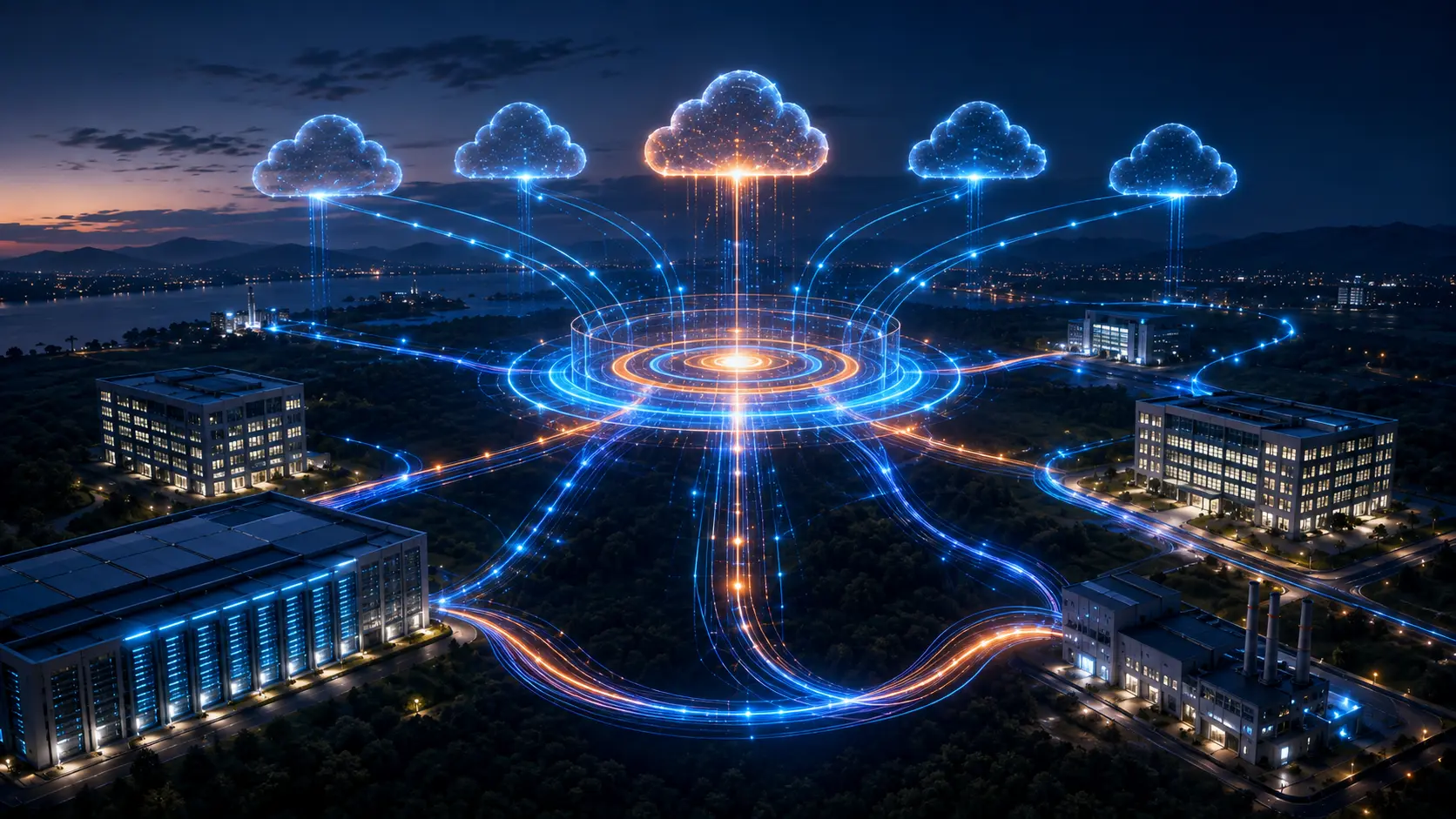
The Cloud Exchange Point, or CXP, is the central architectural construct. The name can be misleading because a conventional point of presence is a physical location with routers, cross-connects and transport. An Alkira CXP is a virtual point of presence, hosted in the cloud and specific to the customer. It contains a managed routing stack, segmentation and integrated network service capability. Multiple CXPs can be connected into a global fabric to which the customer’s clouds, sites, users, partners and services are attached.
A CXP is distinct from a conventional internet exchange point: it is not a peering exchange managed by its members. AWS, Microsoft Azure and Google Cloud remain the owners and operators of their own infrastructure, so Alkira is not a hyperscaler. Nor is it merely a dashboard that writes templates into the customer’s accounts; Alkira operates virtual routing and service nodes as part of the managed service. Before the acquisition, its global offering relied on cloud-hosted infrastructure, public networks, private links and partner transport, not its own fibre.
The founders’ background at Viptela explains Alkira’s software-centric approach, but the product addressed a different layer from a conventional SD-WAN appliance. SD-WAN primarily coordinated branch and WAN routes. Alkira focused on the network between clouds, data centres, applications, partners, security services and distributed users.
Nor did the platform eliminate all enterprise routers. It can avoid the deployment of Alkira-specific virtual routers in each cloud, while branches and data centres continue using routers, SD-WAN equipment, circuits or other connectivity elements. The service reassigns ownership and operation of certain functions; the physical and logical dependencies remain.
Viptela Solved Branch Control; Alkira Took the Problem to the Clouds
Amir Khan and Atif Khan founded Alkira after being involved in the creation of Viptela, the software-defined WAN company later acquired by Cisco. That background matters because it brought a technical vision and a clear sense of what SD-WAN did not solve.
The SD-WAN movement separated policies from individual branch routers. Instead of configuring each device as an isolated entity, the operator could express route preferences, segmentation and application policy through a central system. The approach made the wide-area network more programmable and reduced dependence on a single transport type. However, enterprise infrastructure changed again with the acceleration of public cloud.
The new problem was no longer a set of branches connected to a corporate WAN. Enterprises accumulated AWS VPCs, Azure VNets, Google Cloud VPCs, SaaS services, private endpoints, internet egress, acquired companies, partner networks and security stacks. Different business units built different cloud transit designs. Each hyperscaler exposed its own route tables, gateways, connectivity products and operational conventions. An organisation could modernise its applications while, at the same time, recreating device-era complexity through fleets of virtual routers and cloud-specific hubs.
Alkira’s founders argued that this was the wrong abstraction boundary. If every customer had to install, size, patch and operate a virtual routing layer in each region, the cloud network would replicate the hardware era in software form. The alternative was to move the network node to a managed service. The customer would consume routing, segmentation and security functions, while the provider handled the lifecycle of the infrastructure running them.
The proposition was stronger than mere central orchestration. A controller that only configures customer-owned gateways still leaves the customer responsible for capacity, upgrades, high availability, failure domains and cost optimisation. Alkira’s model took on the operation of the virtual network environment itself. That shift made the SaaS analogy credible at the consumption boundary.
The founders’ prior success also influenced investor confidence. At the April 2020 launch, Alkira reported $30 million in funding from investors connected to enterprise networking and cloud infrastructure. The reputational signal was useful, but it did not prove the platform worked at scale. The relevant evidence would come from the architecture, product expansion, reported adoption and, ultimately, a large operator’s willingness to pay for the control plane.
The Viptela heritage should be understood as intellectual and professional context, not as a guarantee. Alkira reused the principle of separating policy from device-by-device configuration and applied it to a larger problem: making a distributed cloud network function as a single managed environment.
The 2020 Launch Sold Multicloud Routing as a Managed Service
Alkira was founded in 2018 and publicly unveiled on 15 April 2020 with Cloud Services Exchange and $30 million in declared funding. The launch proposition was straightforward: enterprises should be able to build a multicloud network on demand in minutes, rather than spending months assembling cloud transit, virtual appliances and operator services.
The first product connected cloud networks and on-premises sites via Cloud Exchange Points. A visual portal allowed the creation of segments, placement of connections and definition of policies. Alkira then instantiated the routing and service environment needed to make the design work. That division of labour was central: the customer retained architectural intent and governance; Alkira operated the intermediate infrastructure.
The launch came as many enterprises were discovering that “multicloud” did not mean a single shared network. Each cloud offered its own local components. Connecting them required decisions about transit hubs, addressing plans, routing domains, firewalls, internet egress and private connectivity. The work could repeat in every region and provider. Alkira tried to turn that repeated construction into a reusable service presence.
Later in 2020, the company announced a $54 million Series B. The round supported product development, sales and international expansion. It also brought additional strategic relationships into the governance and commercial ecosystem. Since neither revenue nor valuation were published, it should be read as evidence of willingness to fund the category, not as proof of profitability.
The early expansion was important because the usefulness of a global network depends on proximity to the environments the customer needs to reach. More regions and integrations reduce indirect routing. At the same time, each location adds cloud dependencies, operations and support that Alkira must manage consistently.
The stage also defined a commercial choice. Alkira could present itself as an alternative to customer-built networks, as a complement to operators and interconnection providers, or as a platform that coordinated both. That intermediate position brought flexibility but demanded enough neutrality that partners would not see the service solely as a direct competitor.
A CXP Moves the Point of Presence to the Cloud
The Cloud Exchange Point is the most important idea in Alkira’s architecture because it shifts the operational boundary of the enterprise network. The customer selects a location and creates a CXP. Alkira instantiates a highly available virtual environment with integrated routing and services. The customer then connects cloud networks, sites, users, partners or security functions.
Logically, the CXP belongs to the customer’s network design. Operationally, it runs on Alkira-managed infrastructure. That difference allows it to be treated as a network entity without managing the lifecycle of the underlying node. Capacity, updates, availability design and service integration become provider responsibilities.
A CXP can host multiple isolated segments. Policy determines which networks can communicate, which routes are exchanged and which services traffic must traverse. The model resembles virtual private cloud segmentation, but on a larger scope that crosses clouds and external environments. Instead of building separate transit hubs in each provider and reconciling them later, the customer creates a common policy environment on top of Alkira’s fabric.
The concept also explains the company’s global reach. Alkira did not need to build a conventional physical point of presence for each customer. It could deploy service infrastructure in selected cloud regions and connect those locations using available underlays. A relatively concentrated corporate organisation could thus offer a geographically distributed service.
The abstraction has real limits. A virtual PoP still runs somewhere. Its availability depends on cloud regions, compute capacity, software and connectivity. External sites need a path to it. Cloud attachments depend on hyperscaler permissions and native mechanisms. Traffic between CXPs must use cloud backbones, public internet paths, private links or partner transport. The provider can automate and manage those dependencies, but cannot make them disappear.
The CXP must therefore be understood as a managed network node, not a fictional one. It creates a new service boundary: the customer owns the intent and logical policy, while Alkira takes on much of the operational implementation. This can reduce deployment time and specialisation burden, but it also concentrates trust in the control plane and the provider’s processes.
The Lumen acquisition changes the CXP’s potential underlay. Before the deal, Alkira relied on third parties for the physical path. Under Lumen, the same virtual element can increasingly be connected via owned fibre and private transport. That could improve route assurance and service-level control, but also reduce neutrality of selection. The CXP remains virtual; its economic context is now tied to an operator.
A Topology Diagram Turns into Production Infrastructure
The feature closest to SaaS in Alkira is how the customer interacts with the network lifecycle. The platform offers a portal, APIs, an SDK and Terraform workflows. A team can describe segments, attachments, services and relationships via software, rather than treating each connection as a separate device or operator project.
The visual interface is more than a diagram when linked to an execution system. The customer can place a cloud attachment, define a segment, insert a firewall or create a partner connection. The platform translates those entities into routing, policy, address translation and service-chain state within the managed infrastructure. The result is a network assembled from intent.
Programmatic interfaces extend the model. APIs and SDKs allow the platform to be integrated with enterprise automation. Terraform enables topology and policy entities to be represented as code, versioned and deployed repeatably. This brings networks closer to cloud platform engineering, where infrastructure is expected to be declarative and reproducible.
The comparison with ordinary SaaS must remain nuanced. A mistake in a customer database can be local and reversible. A mistake in a network policy can expose routes, disrupt applications or alter traffic across multiple clouds. Network infrastructure as code needs stronger controls than the generic enthusiasm for automation suggests.
A mature flow requires peer review, policy validation, phased deployment, state locking, drift detection, change windows and rollback. It needs clear ownership of both desired and observed state. It must distinguish a successful API response from a correct production outcome. The platform must also expose dependencies outside its control, such as cloud provider acceptance, external routing and security service health.
That is where the managed model can add value. Because Alkira operates the CXP infrastructure, it can correlate intent, topology, service state and routing across the platform. The customer does not have to aggregate every telemetry stream from separate virtual routers. However, centralisation widens the blast radius: a faulty control-plane change or a permission error can affect multiple locations at once.
The diagram matters because it is connected to an execution system for a distributed network. Product quality depends on faithful translation between declared intent and forwarding state, safe changes and rollback, and clear exposure of physical or provider-specific limitations.
Routing Policy Turns Intent into Packet Movement
Routing is the mechanism that turns Alkira’s visual abstraction into packet movement. The CXPs contain an enterprise-grade stack and exchange routes among cloud attachments, sites, partners and services. The platform allows multiple segments to share the same managed infrastructure while remaining logically isolated.
Segmentation is essential because a multicloud network is rarely a single trust domain. An enterprise may separate production from development, regulated workloads from general applications, acquired businesses from the parent network, partners from internal systems, and geographic or organisational units from each other. The value lies not merely in isolating, but in communicating in a controlled way. Policy can permit selected flows between segments and require traffic to traverse specific services.
This central model reduces the work of dealing with route tables in each cloud. Instead of maintaining different interpretations of the same business relationship in AWS, Azure and Google Cloud, the enterprise can express it at the fabric layer. This can improve consistency and make change auditing easier.
The trade-off is concentration. When policy is distributed across many local hubs, errors may stay local but the environment is hard to manage. When it is centralised, the system becomes more comprehensible, though a mistake can reach a much larger portion of the infrastructure. The same abstraction that reduces the number of configurations increases the consequence of a control-plane failure.
Routing also preserves provider-specific realities. Cloud route limits, private connectivity mechanisms, advertised prefixes, return paths and security rules do not become identical because a common interface sits on top. Alkira can normalise the experience and operate the intermediate environment, but the implementation must respect each endpoint.
The platform must maintain an accurate model of intended and observed state. It needs to know which prefixes belong to each segment, where translations occur, which services are inserted and how a return route should behave. Diagnosis depends on that model being current and explainable.
The post-acquisition opportunity is to join logical policy and more deterministic transport. If Lumen can expose private routes, assurance and service levels through the same control plane, the customer will get a stronger relationship between routing intent and physical performance. The risk is that the system becomes commercially biased towards the parent network or that traditional provisioning constraints reappear behind a modern interface.
Overlapping Addresses Turn Corporate History into a Network Constraint
One of Alkira’s most practical capabilities addresses a problem that clean diagrams often ignore: large enterprises frequently have overlapping private IP address spaces. Acquisitions, partner relationships, independent units and separate cloud teams can use the same ranges. Renumbering can be expensive, disruptive or politically difficult.
Alkira supports address translation and policy within a CXP or across multiple CXPs so that overlapping networks can communicate selectively. The capability is useful in mergers, acquisitions, cloud migrations and inter-company connectivity. It allows an operational relationship to be created before redesigning all the underlying addressing plans.
It is a good example of the difference between platform feature and business outcome. NAT can solve the immediate reachability conflict, but by itself does not resolve ownership, identity or long-term architecture. Translated addresses complicate logging, security policy and diagnosis. Operators must keep the relationship between original and translated context; incident responders need to know which endpoint a logged address represented at a particular point in the path.
The policy model must also avoid accidental broad connectivity. Two overlapping networks should not become mutually reachable simply because the platform can translate them. The enterprise needs explicit route exchange, service insertion and access controls. Partner agreements, data obligations and incident procedures remain outside the platform, even though the connection can be created quickly.
The SaaS-like value is in consuming translation and segmentation as part of the managed fabric, rather than deploying a separate device project for each relationship. The operational burden shifts to Alkira, which must scale and monitor the translation infrastructure and deliver usable telemetry.
The feature also illustrates why the network does not become generic software in the same way as a productivity application. Addressing decisions carry historical and organisational meaning. A platform can automate the mechanism, but it does not remove the need to understand identity, trust and return-path behaviour.
For Lumen, support for overlapping addresses can accelerate customer migration to a combined platform. It can connect legacy networks while a longer integration proceeds. The leadership risk is allowing a temporary translation to become permanent complexity without clear ownership, documentation or exit plans.
Service Insertion Puts Security on the Same Control Plane
Alkira went beyond connectivity by allowing network and security services to be inserted within the CXPs. Traffic can be directed through firewalls, load balancers or other functions according to policy. Services can be shared, centralised or placed closer to particular segments and regions.
Service insertion solves a common problem in cloud networking. An enterprise may need consistent inspection across multiple clouds, but deploying and managing a separate security stack in each provider generates cost and policy drift. A chain at the fabric layer can provide a single control model and reduce the number of virtual appliances the customer operates.
The architecture still depends on third-party products, licensing and scaling behaviour. An integrated firewall is still a firewall with performance limits, state, software and support. A load balancer may differ from a specialist platform in functional depth and availability. Alkira automates placement and routing, but does not erase the operational properties of the inserted service.
Service health becomes part of route health. If policy requires traversal of a firewall and that firewall is unavailable, the route may also become inoperative if no bypass or failover is defined. The controller must coordinate routing updates, service state and capacity. It must avoid asymmetric routes that break stateful inspection and provide enough information to understand why traffic followed a particular chain.
Centralising security creates leverage and concentration. Consistent policy can reduce local errors and improve governance. A single incorrect shared configuration can expose many environments. Control-plane credentials and permissions become high-value assets because they can modify network and security behaviour across the infrastructure.
The broader NIaaS positioning depended on this layer. A service that only connects clouds competes largely on reach and convenience. One that also provides routing, security, visibility and governance becomes an operating environment. This increases commercial value but widens responsibility and attack surface.
After the acquisition, Lumen can combine service insertion with its transport and managed services. The opportunity is an end-to-end service where the customer chooses route and security policy from a single interface. The governance question is whether the platform will preserve transparent component selection or steer the customer towards a vertically integrated stack whose exit cost grows over time.
Internet Exits and Extranets Introduce External Trust into the Mesh
The product expansion addressed several relationships at the edge of the enterprise network. Internet Exit Connectors provide per-segment egress, so different groups use different public addresses, inspection policies and routes. Instant Extranet offers controlled connectivity with partners. Zero Trust Network Access extends the platform to user-to-application connections.
Per-segment exits can reduce central backhaul and make external traffic policy more explicit. A production segment may require a particular inspection chain and public identity, while a development segment uses another. The team can place the exit near the workloads and manage it in the same topology model.
The mechanism creates practical dependencies. Public IP reputation affects application reachability. Return symmetry matters for stateful security services. Cloud and provider egress charges can change the economics of placement. The platform must show not just that an exit exists, but how traffic reaches it and what costs or failure domains follow.
Instant Extranet applies the same model to partners. Instead of building a physical extranet or a bespoke router project for each organisation, the enterprise can create a segmented relationship via CXPs. Support for overlapping addresses and selective route exchange is important because partners rarely share a coordinated addressing plan.
The network can be established before the legal and trust relationship. Identity, data access, contractual accountability and incident escalation still require human decisions. A platform must not turn technical reachability into an assumption of authorisation.
Zero trust access introduces another control plane: user identity and application policy. Alkira’s entry into this category extends the service beyond sites and clouds, but also pits it against specialist ZTNA and SASE products. The decisive questions become identity integration, application discovery, policy granularity, device posture, performance and operational accountability.
Together, these functions explain why Alkira adopted Network Infrastructure-as-a-Service. The service moved from a single multicloud transit product to a shared environment for external traffic, partners, users and application services. The strategic benefit is a common policy graph. The risk is that a single platform accumulates so many high-consequence functions that governance and resilience become harder, not easier.
The “Backbone” Was Built with Infrastructure Alkira Did Not Own
Alkira described a global backbone connecting CXPs and enterprise endpoints. Customers could consume the service without building their own WAN or a separate cloud transit hub in each region. It is one of the most compelling parts of Network Infrastructure-as-a-Service and one of the easiest to misinterpret.
Before the Lumen purchase, Alkira did not own a worldwide fibre backbone. Its service used cloud-hosted infrastructure, hyperscaler networks, public internet paths, private connectivity and partner transport. The platform selected and managed the available mechanisms to produce the customer experience. Calling the result a backbone described the logical service, not the ownership of all physical paths.
The distinction matters for performance and accountability. If traffic crosses a hyperscaler backbone, the cloud provider controls part of the path. If it traverses the public internet, route conditions and congestion can vary. If it uses private connectivity, capacity and service level depend on the operator or interconnection provider. Alkira can observe, steer and support the service, but some failure domains remain outside its direct control.
Even so, the model provides value. The customer does not have to negotiate and operate each intermediate component. It can buy an outcome and let Alkira manage the combination of infrastructures. This shifts capital expenditure, specialisation burden and lifecycle responsibility to the provider.
The consumption economics are more complex than a simple pay-per-use slogan. Cloud compute, data processing, egress and cross-region transport remain real costs. A utilisation-based service can reduce idle capacity when demand varies, but prove expensive for sustained high-volume traffic. Alkira did not publish gross margin or unit economics, so the efficiency with which it converted cloud cost into revenue cannot be independently assessed.
Lumen changes the physical equation. Owned fibre and private network assets can provide more deterministic paths and let the combined company capture transport revenue. They can also support differentiated service levels and reduce reliance on public paths. The risk is underlay preference: Lumen has an economic incentive to use its network even when another route offers better reach, price or neutrality.
The acquisition therefore does not invalidate Alkira’s software model. It exposes its physical foundation. A network can be consumed like SaaS while remaining, underneath, a capital-intensive transport service. The most durable platform may be the one that makes both layers visible so the customer can choose rationally.
Each Product Name Broadened the Promise
The product language changed as the scope widened. Cloud Services Exchange described the original platform. Cloud Network-as-a-Service emphasised multicloud connectivity and the global fabric. Cloud Backbone-as-a-Service highlighted WAN replacement or extension. Network Infrastructure-as-a-Service became the broadest category, encompassing routing, connectivity, security, visibility and governance.
The evolution was not just marketing. The platform added capabilities that took it beyond mere cloud-to-cloud connectivity: segmentation, overlapping address translation, internet exits, partner extranets, integrated security services, zero trust access, load balancing and AI-assisted operations. Each function increased the number of business problems that could be addressed from the same control plane.
Category expansion also changed the competitive set. A multicloud platform competes with software providers and hyperscaler-native services. A backbone competes with operators and on-demand interconnection providers. A platform with security competes with SASE and cybersecurity. A broad NIaaS offering competes with all of them and can partner with them at the same time.
The overlap can create strong distribution. Security vendors, SD-WAN companies, operators, colocation providers and cloud platforms can become integrations or channels. It can also create tension: a partner may be an endpoint in Alkira’s fabric while simultaneously competing for the customer’s network budget.
The broader category raises expectations. The customer will compare the managed service not only to the cost of virtual routers, but to the reliability, support, security and operational flexibility of an enterprise network. The provider must deliver transparent fault management, migration paths and service accountability.
The 2024 Series C brought $100 million and raised total declared funding to $176 million. The round backed the expansion into this category. The company later reported fast growth and satisfaction, but did not publish audited revenue, margins or customer numbers. The ambition is well documented; the underlying economic scale is only partially visible.
The Lumen transaction can be read as category validation. An operator concluded that cloud control, routing and orchestration were strategic enough to buy, not just build internally. But the acquisition transforms the category from independent service to component of a vertically integrated networking company. The future of NIaaS at Alkira will depend on how much of the original abstraction survives.
AI Depends on an Authoritative Network Model
In 2025 and 2026, Alkira expanded its positioning towards AI-assisted network operations and Model Context Protocol-oriented integration. The most important asset in that direction is not a generic conversational interface, but the structured, authoritative model of the network that the platform maintains.
An operations system needs to know intended topology, actual attachments, segment relationships, route state, inserted services and policies. Traditional environments spread that information across configurations, cloud consoles, spreadsheets, tickets and monitoring tools. Alkira’s plane already represents much of it as entities and relationships. That graph can give an AI system more reliable context than unstructured documentation alone.
An assistant could help an operator ask which segments reach an application, where a route changes, which chain applies or what impact a proposed modification would have. It could accelerate diagnosis and planning by connecting natural-language questions with the authoritative state.
The value depends on the boundary between explanation and execution. Reading topology carries less risk than modifying it. An agent authorised to create connections, change routes or delete policies can cause large-scale disruption or exposure. A safe design demands tools with least privilege, explicit scopes, deterministic validation, human approval for high-impact changes and full audit trails.
Model Context Protocol can expose network functions to AI tools in a standardised way, but it does not provide governance by itself. The owner must decide which operations are exposed, which identity can invoke them and what confirmation is needed. Prompt injection, ambiguous intent and incomplete context remain relevant even when the network state is accurate.
The AI direction also intensifies the value of central data. An operator that owns both the software model and physical telemetry can diagnose path and service problems more effectively than an isolated overlay. The Lumen purchase gives strategic weight to that possibility.
It also increases surveillance and lock-in concerns. A unified platform can know application relationships, cloud topology, partner connections and transport behaviour. Customers need clear rules on data governance, retention, permission boundaries and export capability. The network is easier to operate when a model sees more, but leaving the platform is harder if the model cannot be reproduced elsewhere.
AI adds value when the structured control plane makes intended topology and current state legible to operators or agents. Its usefulness depends on explanations grounding in authoritative data and on every consequence-bearing action remaining subject to permissions, review and rollback.
The Customer Stops Owning Nodes and Starts Buying Accountability
Alkira’s commercial proposition rests on shifting accountability. In a self-built environment, the enterprise owns or controls virtual routers, transit gateways, route tables, firewall deployments, capacity planning, upgrades, high-availability design and much of the diagnosis. Under Alkira, the provider operates the CXP infrastructure and the global fabric while the customer consumes logical capabilities.
This can reduce procurement delays and eliminate repetitive device-lifecycle work. The enterprise does not need to size a router for each region or coordinate upgrades across multiple hubs. It can request capacity and functions as a service. The model is especially attractive when the cloud footprint changes rapidly or when specialist multicloud engineers are scarce.
Accountability does not disappear; it moves. Alkira must operate routing software, cloud capacity, integrations, isolation, upgrades and availability. It becomes accountable for a larger shared platform. The provider’s operational discipline is part of the product.
The customer retains important obligations. It must define segmentation, identity, access and route intent. It must know which applications can communicate and which security services are required. It must manage cloud and partner permissions, test changes and maintain an incident model that includes the provider.
The shared-responsibility boundary must be explicit. A managed network can fail because the platform is unavailable, because a cloud attachment is misconfigured, because the customer’s policy is wrong, because an inserted firewall is degraded or because the underlay has a problem. A useful service must make those layers distinguishable during an incident.
The as-a-service model also changes procurement. Instead of buying devices and licences separately, the enterprise acquires a recurring service with usage and capacity components. This can align cost and demand, but makes it harder to compare long-run spend and exit cost. A fair evaluation includes cloud egress, third-party licences, migration effort, support and the value of reduced internal operations.
Lumen can take accountability for a larger portion of the physical path and thus strengthen the service, but it also becomes a larger single dependency. The relevant comparison pits the accountability the customer gives up against the transparency, incentives and fault management of the operator that receives it.
Abstraction Reduces Work, Not the Need for Network Judgement
A successful abstraction does not justify ignorance. Alkira can hide much of the implementation, but enterprises still need enough network knowledge to govern the outcome. The platform simplifies operations; it does not make routing, security or path economics irrelevant.
Customers must understand the segmentation model. A diagram with coloured zones is only useful if the organisation knows the trust and business rules they represent. They must understand propagation and return, especially with stateful services or NAT. They need to know where egress occurs and which public identity, inspection policy and cost model apply.
They must also understand failure domains. A CXP can be highly available within a region, but a regional outage, an underlay failure or a control incident can affect the service. Redundancy requires real diversity of regions, paths and providers, not duplicated entities that share a hidden dependency.
Service insertion requires capacity planning and failover. A logically present firewall can become a bottleneck for multiple applications. A load balancer may not offer the depth of a specialist service. A partner connection can create contractual and security exposure beyond the route.
Infrastructure as code requires governance. Terraform state, credentials and pipeline permissions can be as critical as administrator access to routers. Automated changes must be reviewed and tested. A platform that makes it easy to deploy also makes it easy to propagate a mistake.
Customers must know the commercial boundaries. The service can be carrier-agnostic in technical design while the owner has transport incentives. Pay-per-use pricing can reduce capex and increase variable cost. Cloud charges may be passed through or bundled. Integration with Lumen can create bundling advantages and make independent comparison harder.
Finally, the enterprise needs an exit plan. It should know how to export topology, routes and policies, how to migrate applications, public addresses and partner relationships, and what contractual terms apply. The goal is not to avoid commitment, but to ensure the abstraction remains a service rather than an irreversible checkpoint.
The more the network resembles SaaS, the more relevant the familiar SaaS governance questions become: data portability, provider concentration, continuity, pricing power and control of the operating model. Network expertise remains necessary because the consequences appear in production traffic, not just in an interface.
Partners Extend Reach and Test Neutrality
Alkira’s ecosystem was broad because the platform sat between enterprises and numerous infrastructure providers. AWS, Microsoft Azure and Google Cloud were core integration targets. Security vendors offered services insertable into CXPs. SD-WAN partners, operators and colocation companies helped connect sites. Distributors and channels extended the company into regional markets, including Japan.
These relationships should not be lumped into a single category. A hyperscaler is both substrate and endpoint. A security vendor is an integrated service and may compete for policy control. An operator can be an underlay partner, a channel or a substitute. An investor can bring credibility without being a customer.
Funding included Kleiner Perkins, Sequoia Capital, GV, Koch Disruptive Technologies, Tiger Global and other investors from the 2024 Series C. The relationships brought capital and access to enterprise or cloud ecosystems. They did not reveal the full ownership structure, control rights or commercial terms.
Alkira grew through enterprise references and channel relationships, not a consumer self-service model. Global networks often need architecture, migration and operational support. Even if the platform deploys a topology via software, the customer may need consultancy and managed services to redesign routes, addressing and security.
This creates a distinction between product speed and programme speed. A CXP or connection can be instantiated quickly when accounts, permissions and design are ready. A transformation can take months because applications, contracts, address conflicts and processes must change.
Lumen adds a large sales organisation, fibre and enterprise services. The combined company can sell Alkira to connectivity customers and attach transport to platform customers. This can accelerate adoption and broaden commercial reach.
The same integration affects partner incentives. Independent operators and managed providers may promote a competitor-owned platform less if Lumen favours its own network. Hyperscalers may benefit from the consumption Alkira drives while competing with native services. Security vendors may value the integration while defending their own planes.
The combined ecosystem will be governed by neutrality signals. Customers and partners will watch whether third-party routes remain visible, whether APIs stay open, whether pricing distinguishes software and transport, and whether support treats non-Lumen underlays fairly. The acquisition turns ecosystem management into a strategic capability.
The Growth Figures Stop Short of Unit Economics
Alkira reported three major milestones before the acquisition. It had raised $30 million at the April 2020 public launch, announced a $54 million Series B in October 2020 and raised $100 million in a Series C in May 2024. The company said total funding reached $176 million.
The capital base was substantial for an enterprise networking start-up. It funded engineering, global deployment, sales, partners and the expansion to NIaaS. It also created expectations of scale and a future liquidity event.
In November 2025, Alkira claimed 74th place in North America and 14th in the Bay Area on the Deloitte Technology Fast 500, based on 1,261% revenue growth over the period. In March 2026 it repeated the figure and reported 98.7% satisfaction for 2025.
The indicators are useful but limited. A percentage does not reveal the starting or ending base. A company can grow fast from a low base. The ranking uses information submitted by entities, but Alkira did not publish audited accounts. Satisfaction depends on method, sample and timing, which were not fully disclosed.
At the cut-off date, there were no independent, verified revenue, profit, gross margin, customer count, concentration or unit economics. A defensible revenue multiple for the $475 million cannot be calculated, nor can it be determined whether the service was profitable.
The price was roughly 2.7 times the declared funding, but that ratio is not a return calculation. Rounds include dilution, preferences, employee equity and possible secondary transactions. How the proceeds were distributed is unknown.
The evidence supports a narrower conclusion. Alkira attracted significant capital, reported rapid growth and acquired enough strategic value for Lumen to buy it. It does not support claims about absolute scale, margin quality or investor returns.
This discipline matters because software narratives can make infrastructure businesses look asset-light without showing cloud and transport costs. Alkira did not own fibre, but consumed infrastructure and partner capacity. The economic quality of NIaaS depends on how efficiently those inputs are managed. The purchase allows Lumen to internalise part of the underlay, but integration cost and transport economics will decide whether strategic value turns into financial value.
Lumen Bought Orchestration Capable of Steering Demand Towards Fibre
Lumen announced the deal on 5 May 2026 and completed it on 7 July. The consideration was $475 million in cash. The purchase ended Alkira’s independent ownership and placed its platform inside an operator with a large fibre and enterprise networking footprint.
Lumen described Alkira as the control plane for cloud connectivity. The idea was to combine on-demand orchestration with physical infrastructure and move towards a unified platform for cloud, data centre and AI traffic. The deal addressed a gap in each company.
Alkira had a sophisticated plane but relied on external transport. Lumen owned transport and enterprise relationships but needed a cloud-native experience that made cross-provider connectivity programmable. The combination could create more value than either layer alone.
There was also immediate commercial logic. Lumen could sell Alkira’s capabilities to its network customers. Alkira’s customers could consume Lumen private connectivity. The operator could capture induced transport revenue, rather than letting the software steer demand towards others.
That logic creates the central tension. Alkira had positioned itself as operator-neutral. Its architecture can still use multiple underlays, but the owner now benefits when traffic uses Lumen. Technical and commercial neutrality are no longer the same question.
Integration requires more than adding a product to the catalogue. A unified operating plane needs common inventory, ordering, route selection, assurance, support, billing and service-level systems. It needs a single identity and a coherent incident model. Until those functions are integrated, Lumen and Alkira are connected products, not a single platform.
The cut-off was too early to judge. Lumen had begun integration and cross-selling, but there was no evidence that all traffic had moved to Lumen fibre or that Lumen Connect was complete. Claims of a unified platform must remain prospective.
The transaction is nevertheless strategically clear. Lumen paid for a model of the customer’s network: clouds, segments, services, policies and connections represented in software. It wants to connect that to physical routes it can operate and monetise. It is a bet that the future operator will not be just a circuit seller or just a software overlay, but a platform that controls the relationship between intent and transport.
Rivals Differ in Who Owns Transport, Control and Support
Alkira competes in several categories because the enterprise cloud network can be assembled in different ways. Aviatrix and other multicloud platforms offer transit, segmentation, security and observability. Their deployment and operation boundaries vary, including the presence of customer-managed gateways.
Native services such as AWS Cloud WAN, Azure Virtual WAN and Google Cloud Network Connectivity Center provide routing and policy within their ecosystems. They can have lower incremental cost and greater integration for single-cloud-focused customers. Their limit appears when the enterprise wants a common model across clouds and external networks.
On-demand interconnection platforms like Megaport, Equinix Fabric and Console Connect give API access to clouds, data centres and networks. They have a more direct relationship with physical ports and circuits. They can complement Alkira as an underlay or compete for the same network-as-a-service budget.
Cisco, HPE, Palo Alto Networks and other incumbents combine large portfolios, channels and security or WAN products. Cisco has particular relevance because of Viptela, but does not own Alkira’s architecture. Incumbents can bundle branch, campus, cloud and security in ways that are hard for a start-up to match.
Traditional managed network providers offer customised WAN and cloud services. Their model may be more human- and contract-led than cloud-native, but it offers deep support. For some enterprises, tailored accountability and service matter more than a uniform portal.
The internal alternative is to build transit directly. An organisation can create native hubs, routing, firewalls and infrastructure-as-code flows. It avoids platform dependency and can be rational for single-cloud or small environments. The cost is skills, repeated engineering and operational accountability.
After the purchase, the competitive unit is Lumen plus Alkira. It can challenge operators without orchestration and software providers without owned transport. It also competes against much larger integrated ecosystems and against hyperscalers that control the endpoints.
An API is already a basic requirement. Differentiation comes from the operating model: how quickly a correct network is created, how clearly route and cost are shown, how reliably a fault is managed and how easily the customer retains alternatives. Networks as a service are becoming common; reliable abstraction is not.
Abstraction Concentrates Both Failure and Convenience
A platform that controls routing, segmentation, service insertion and egress occupies a high-consequence position. Alkira’s model can reduce drift and deliver consistent controls, but it also concentrates operational and security risk.
Multi-tenant isolation is fundamental. The specific CXPs and segments are designed to separate data and control, but there was no complete independent audit of resilience or isolation in the material. Customers must evaluate contractual, architectural and operational evidence, not assume security because it is a managed service.
The control plane is a critical target. Credentials, tokens and Terraform pipelines can create or modify relationships. Role-based access, least privilege, auditing and approvals are necessary. Agent interfaces add permission and intent risk.
Central policy increases the blast radius. A single change can alter reachability across multiple clouds. Phased deployment, validation and rollback are not luxuries; they are part of the security architecture.
Insertion creates third-party dependencies. A firewall failure can become a route failure. A misordered policy can prevent inspection or create asymmetry. Capacity limits can appear far from the affected application.
Underlay diversity must be verified. Multiple logical connections may share a region, an operator or a fibre route. Lumen can reduce dependency on public paths and increase dependency on a single combined provider and system.
Cloud cost opacity also affects resilience, because an unexpected charge can force changes. The on-demand network must show processing, egress and private charges so the customer can forecast cost under failure and failover.
Continuity also depends on the organisation. The Alkira team, Lumen groups, operations and support must create a single incident model. Integration can temporarily raise risk while inventories, permissions and processes change.
The platform must be judged by its behaviour under pressure, not just by provisioning speed. Isolation boundaries, recovery objectives, regional failover, change safety, third-party management, transparency and exit matter. An SaaS-like network can reduce routine work; it must not hide failure until the abstraction breaks.
The Acquisition Turns a Category Promise into an Operational Test
The network increasingly resembles SaaS in several precise senses. The customer can express intent via portal or code, consume capacity and functions without buying a device for each location, and offload upgrades, availability and scaling to a shared provider.
That does not turn the network into pure software. Packets still traverse cloud regions, fibre, private circuits, internet paths and physical facilities. Latency, congestion, failures, power and capacity remain real, and each owner of the underlying layer brings its own incentives and pricing.
Lumen’s $475 million purchase makes that relationship explicit. The operator paid for a software model because it expects it to increase the value and utilisation of the physical infrastructure. Transport did not lose importance; it received a better layer of control and consumption.
Alkira’s lasting proposition is a division of accountability. The customer stops operating each intermediate node, and the provider delivers those nodes as a managed service. The model is only trustworthy when route, cost, failure and exit remain visible through the abstraction.
The next tests will come from operations, not category language. A common ordering, assurance, support and billing process would demonstrate that Lumen has connected the control plane to the underlying layer. Continued route choice, partner participation and policy portability would demonstrate that the integration did not turn convenience into captivity.
Member Briefing
Deeper Profile Context
Sign in with the right membership level to unlock the full briefing and source notes.
Only for Strategic Circle
Strategic Circle
Open to all readers. Unlock profile briefings after joining and signing in.
Join Strategic CircleOnly for Leadership Alliance
Leadership Alliance
For qualified IP-asset owners and management; sign in to unlock alliance briefings.
Join Leadership Alliance