
Summary
- UbuntuNet is a not‑for‑profit member‑governed organisation registered in Malawi, serving national research and education networks in Eastern and Southern Africa; its records use “association” and “Trust”.
- It has built regional capacity through contracts with operators, points of presence, member routes, and AfricaConnect programmes, including 10 Gbps core links and larger national connections.
- The portfolio extends beyond transport to cover identity, cloud and storage, open science, cybersecurity, and NREN development, with services at varying degrees of maturity.
- Aggregating demand and knowledge creates value, but weak campus links, payment defaults, supplier power, conflicts, funding cycles, and incomplete disclosure can prevent capacity from reaching researchers.
Network 3 brought the core to the 10 Gbps operational band
The 2023 Report describes the move from links close to 2.5 Gbps to 10 Gbps main links. It also mentions at least 20 Gbps total capacity through redundancy. The two formulations refer to different layers.
The most coherent interpretation is an architecture with redundant 10 Gbps links on core segments, not universal 20 Gbps on every route or for every member. Rates depend on the section, the carrier and the national access.
The advance is important for cost and capacity, although it remains smaller than networks of hundreds of gigabits or terabits. The comparison should consider regional economics, not just a speed race.
Unit price reduction resulted from infrastructure
The 2023 report showed reductions between 50% and 71.5% compared with 2022. Some NRENs moved from services in the 130 Mbps–4 Gbps range to 500 Mbps–8 Gbps, depending on the case.
The drop came from collective procurement, long‑term contracts and more efficient use of the core. It shows that the goal was to increase value delivered per budget, not merely to announce capacity.
When savings are passed on to members, the Alliance keeps a smaller cushion for exchange rate, failures and delays. A lower price must be accompanied by regular payment and understanding of the recurring cost.
BotsREN and ZIMREN show how regional upgrades reach national networks
BotsREN entered at 10 Gbps in 2023 and increased to 20 Gbps in January 2026. ZIMREN connected at 10 Gbps in June 2025. These are NREN access rates, not total network capacity.
Nevertheless, they demonstrate that core investment converts into national service. The impact depends on how many institutions are connected behind the NREN and on the quality of local circuits, equipment and teams.
A 20 Gbps national link may coexist with campuses limited by 1 Gbps, unstable power or firewalls. Announcements should be accompanied by usage, loss, availability and coverage.
The regional layer begins where national networks reach the borders
A student or researcher rarely sees the name UbuntuNet Alliance. The first network perceived is that of the campus or institute. Then traffic enters a national NREN, such as KENET, RENU, TENET, ZAMREN, TERNET or MoRENet. UbuntuNet starts to matter at the next layer: when the national network needs to exchange traffic with another country, access a scientific facility, reach GÉANT, or use a common service too expensive to replicate in each country.
That explains why the Alliance is important without appearing to be a retail provider. It does not sell residential broadband, does not connect all universities directly, and does not control local Wi‑Fi. It operates a regional layer of routes and services above autonomous national systems. Other regional networks, operators, clouds, exchange points and the final destination complete the path.
The user sees a single session, but operational authority is distributed. UbuntuNet can change routes, expand a core link, monitor a regional service and coordinate incidents. It cannot restore a campus’s power, fix an institutional directory, compel a domestic operator to repair fibre, or guarantee the capacity of a remote application. The challenge is to make independent domains work coherently enough for research.
Federation is the design, not a provisional step towards centralisation
The UbuntuNet Alliance is an alliance of NRENs, not a holding company. Each member maintains its legal personality, staff, budget, national infrastructure, institutions served, government relationship and pricing policy. The regional layer exists because these organisations choose to buy certain capacity jointly, exchange traffic in common locations, operate shared services and represent converging interests.
The model suits a region with widely differing telecommunications markets, currencies, university systems, procurement rules, languages and technical maturity. A centrally controlled academic network across all countries would require a political authority that UbuntuNet neither possesses nor needs. Federation combines national autonomy and regional scale, while also allowing mature NRENs to help emerging networks.
Complexity does not disappear; it migrates to the interfaces. A slow transfer may involve a campus firewall, national circuit, regional PoP, international operator and target system. Each party sees a fraction of the problem. That is why service boundaries, shared telemetry, escalation contacts, change processes, contribution rules and viable exit are necessary.
The legal registration is functional, though public terminology is not uniform
Current materials describe UbuntuNet as a not‑for‑profit association registered in Malawi. The 2023 Annual Report and historical documents also use the expression not‑for‑profit Trust, governed by members and Trustees. Since the current statutory instrument has not been located, the difference should be preserved.
Practical governance is clearer. The organisation has members, not ordinary shareholders. The documented structure comprises the Members’ Assembly, Board of Trustees and Secretariat led by the CEO. The entity employs people, receives funds, signs contracts, leases or owns equipment, and provides services. There is no evidence of distributable equity or conventional commercial valuation.
Calling it a private telecommunications company would imply investor control. Reducing it to an informal community would ignore contractual and fiduciary responsibilities. The safest description is a not‑for‑profit associative organisation registered in Malawi, with the caveat that its sources use “association” and “Trust”.
The original problem was economic and geographic, not lack of internet
Universities already had internet access before UbuntuNet. What was missing was a lasting regional mechanism to aggregate academic demand, exchange research traffic and reach global R&E networks on terms designed for education and science. Institutions bought small volumes of international capacity at high cost, and traffic between African countries could pass through Europe.
A commercial connection provided general access, but it did not automatically create direct routes between neighbouring NRENs, predictable paths for large data sets, federated identity, common security, or collective bargaining power. Emerging networks struggled to demonstrate value before they could gather institutions and capacity.
The Alliance changed the purchasing unit. Campuses aggregate demand in the NREN; NRENs aggregate it in the regional organisation. This collective buyer can plan PoPs, sign long‑term contracts, organise operations and negotiate with global partners. UbuntuNet does not eliminate the market; it acts within it as a coordinated buyer and a public‑mission operator.
Five NREN initiatives formed the initial coalition
The UbuntuNet Alliance was conceived in the second half of 2005 by initiatives in Kenya, Malawi, Mozambique, Rwanda and South Africa. The founding base is associated with KENET, MAREN, MoRENet, RwEdNet and TENET, in their institutional forms at the time. They had different degrees of maturity.
TENET and KENET brought operational experience. MAREN provided a link to the country that would host the Secretariat. MoRENet represented a government‑supported model. RwEdNet would show the promise and fragility of an NREN: its collapse and reconstruction demonstrated that the regional layer does not replace a sustainable national institution.
This combination was important. Only mature networks could create a narrow club; fragile initiatives alone would lack traffic and credibility. The coalition made it possible to build production and develop national capacity at the same time.
Francis Tusubira helped turn a network proposal into an institution
Francis “Tusu” Tusubira is linked to the founding phase and to the African NREN movement. The work went beyond selecting equipment. Universities, ministries, regulators, operators, funders and engineers needed to accept that a regional research network should survive as an institution, not as a temporary project.
It was necessary to create a legal personality, membership rules, accounts, contractual capacity, an annual forum and a common explanation of why an NREN is not merely a cheaper ISP. Tusubira’s contribution was part of a collective build with founding networks, Boards, technical communities and international partners.
The result was an organisation capable of receiving funds, negotiating long‑term capacity and representing the region. That institutional structure made the AfricaConnect phases possible.
Amsterdam offered the first legal vehicle; Malawi became the regional seat
Registration documents were filed in Amsterdam in 2006. For an organisation still taking shape, a Dutch entity was familiar to European partners and eased contracts and projects before a legal base within the region was consolidated.
As it matured, a European headquarters came to be at odds with the mission. A new constitution was adopted in Malawi in 2012, registration occurred in 2013, and historical documents record the transfer of assets and liabilities. The Secretariat now operates in Lilongwe.
The move brought governance closer to members, but preserved the ambiguity between association and Trust. The correct chronology separates conception in 2005, initial formalisation in the Netherlands and later transition to Malawi.
Early transit to GÉANT proved useful before a full backbone
Historical records indicate that an R&E transit service to GÉANT was implemented in 2008. Though limited, it gave members access to European and global research networks and showed that a regional entity could deliver value before assembling a mature backbone.
The relationship also provided experience in procurement, project management, identity, security and operations, as well as access to European programmes. This cooperation accelerated development, but tied expansion to EU cycles and priorities.
The correct reading is neither fully imported infrastructure nor absolute independence. UbuntuNet used international partners to build regional capacity governed by members.
Long‑term operator contracts turned aggregated demand into infrastructure
The fifteen‑year contracts with WIOCC in 2013 and SEACOM in 2016 gave UbuntuNet a more predictable horizon than small‑scale annual purchases. Long terms can reduce unit cost, secure routes and ease upgrades.
They also create obligations. The organisation is exposed to operator performance, technology, maintenance, exchange rates and periodic payments. An international invoice is due even when a member is late with its contribution.
These agreements show how a federation becomes infrastructure: it aggregates needs, contracts on behalf of several members, installs equipment and coordinates restoration. But the Alliance does not come to own all the fibres, cable stations or transport networks.
The 2014 activation moved the Alliance from promise to operation
In July 2014, UbuntuNet Alliance and DANTE announced 622 Mbps regional links. The figure is modest today, but was significant for networks that were buying much less at high prices.
From that point, real traffic, incidents, configurations, duty rotas and expectations emerged. A failure was no longer just a project issue; it now affected institutions and researchers.
The initial operation also created processes, PoPs, carrier relationships and charging mechanisms that could be expanded in the following phases.
AfricaConnect2 expanded the programme and strengthened eastern resilience
AfricaConnect2 was announced in 2015 as a €26.6 million programme involving UbuntuNet, WACREN, ASREN and GÉANT. That figure is not UbuntuNet‑only revenue; it covers several regions and partners.
For the Alliance, the phase expanded routes and members and supported the SEACOM Kampala–Dar es Salaam–Amsterdam contract. The path strengthened diversity in the east and reduced dependence on a single route.
The phase also consolidated the federated pan‑African logic: different RRENs develop their infrastructure within a common framework, with results that vary according to national maturity and market.
AfricaConnect3 made services as important as the backbone
AfricaConnect3, a €37.5 million programme that ended in April 2025, sustained the network, prices, capacity building, identity, cloud and open science. The mission was no longer measured only in circuits; it came to include the ability of members to use the infrastructure.
The phase produced Network 3, new PoPs, faster national access and price reductions. It also strengthened federated identity, repositories, Utafiti Africa, AfricArXiv and cybersecurity.
This broadening is logical, because fibre without storage, identity and personnel may lie idle. At the same time, each service adds software, data, security risks and maintenance costs.
AfricaConnect4 opens a new investment window and a sustainability deadline
AfricaConnect4 started in 2026 with a further €40 million in European support over four years for sub‑Saharan Africa’s regional networks. The amount is for the programme as a whole, not a dedicated UbuntuNet grant.
The phase includes national and campus components, security, weather and climate data stations, EUMETCast, federated computing, GPUs and open science. The leadership recognises that a fast core is limited public evidence if campuses cannot use it.
The horizon to 2030 also forces the question of who will maintain stations, repositories, identities, cloud and clusters after the grant. Each service needs a permanent operator, budget, charging model, staff and closure or migration plan.
AS36944 defines UbuntuNet’s public routing edge
UbuntuNet uses AS36944. PeeringDB and BGP observers confirm identity, some peers, prefixes and RPKI validity of observed origins. They show the public edge, not all private connections.
PeeringDB displays a self‑declared traffic range of 5–10 Gbps, 1,200 IPv4 prefixes and 150 IPv6. bgp.tools observes a smaller set of directly originated prefixes. They are different scopes.
Neither metric replaces core capacity or an NREN’s access. The ASN proves operational participation in BGP, not availability, peak traffic or physical diversity.
PoPs and peering create options, but the map is not an asset inventory
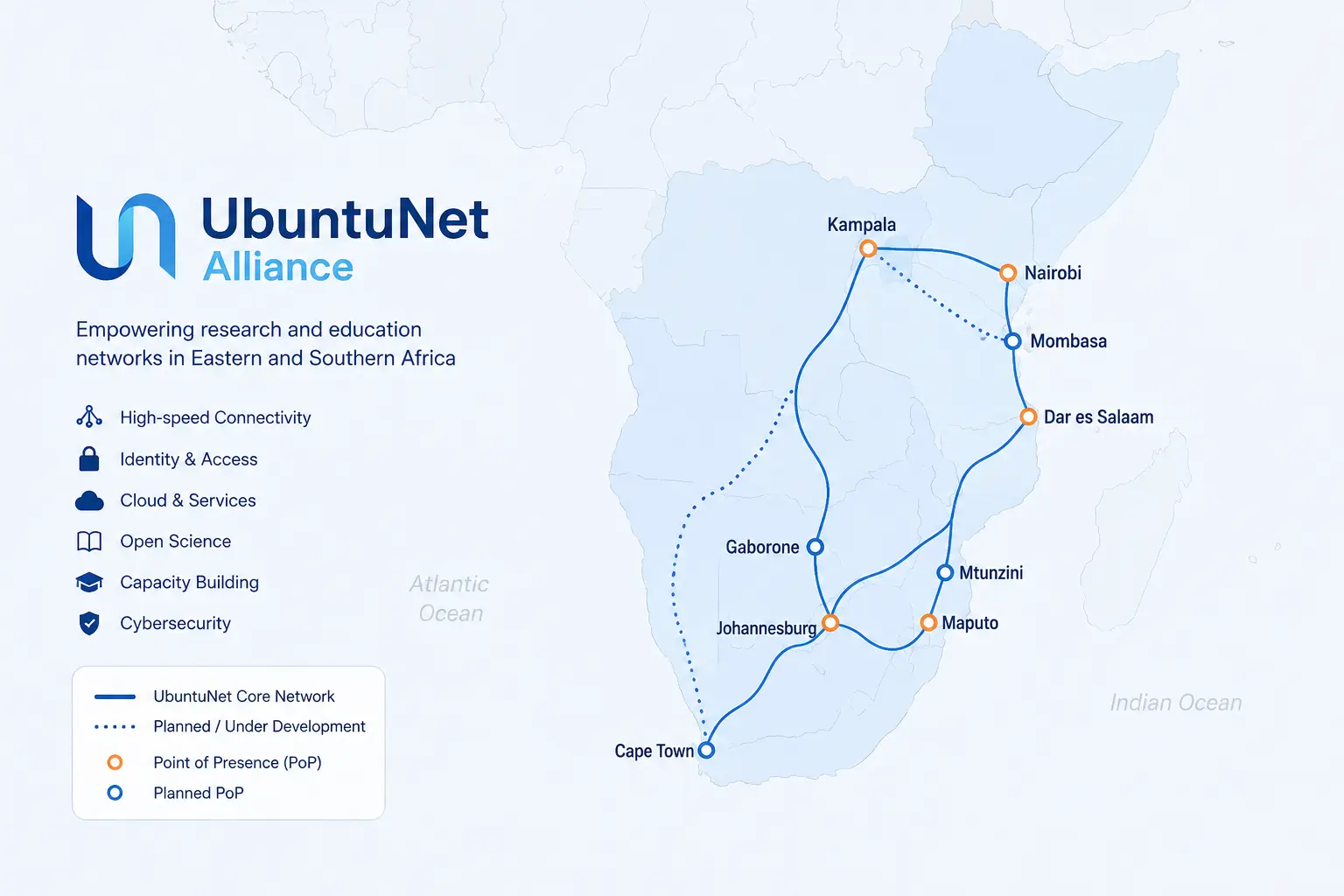
The 2023 report mentions Cape Town, Mtunzini, Maputo, Dar es Salaam, Nairobi, Amsterdam, Gaborone and Johannesburg, with Djibouti and Mombasa planned or under development. Older pages mention London and other points.
The differences may result from dates, PoP categories, handoff and peering, or route changes. A point does not reveal who owns the router, fibre, rack, port or contract.
The Johannesburg PoP and peering at NAPAfrica expanded options. Real resilience depends on duct diversity, operators, power, colocation and software; two lines on the map may share the same risk.
Lagos–Cape Town made pan‑African federation more concrete
Developments in 2025–2026 connected WACREN to the South African environment via ZAOXI, SANReN and TENET and, from there, to UbuntuNet. Partners called the route the first effective direct interconnection between African RRENs on African soil without going through Europe.
The statement should remain attributed and restricted to regional research networks. It does not mean that commercial or private connections never existed on the continent. What is new is the R&E institutional arrangement.
The route may keep more research traffic in Africa and reduce detours. It still depends on carriers, exchanges, BGP and national partners. No single actor controls the whole path.
Membership numbers represent different categories and dates
The 2023 report recorded 15 active members, over 3.5 million users and more than 1,000 institutions across 13 countries. An audit RFP from March 2026 listed NRENs from 18 countries; the public page showed 16 profiles. These may be counts of legal members, active, connected or displayed.
Lesotho was admitted in November 2025, and Trustee elections took place in 2026. Every count should carry a date and a definition.
Being a member does not prove an active link, and a connected country does not mean parity across all campuses. In conflict contexts, legal status and operations may diverge.
Campus infrastructure is the critical test of regional investment
A fast core does not fix limited public evidence local fibre, old Wi‑Fi, unstable power, a saturated firewall or lack of personnel. Experience is limited by the weakest link.
That is why AfricaConnect4 includes national and campus components. Regional capacity may be underused if institutions lack adequate storage, servers, transfer tools and internal networks.
Responsibility is shared: UbuntuNet coordinates the regional level; the NREN builds the national level; the university maintains the campus; governments, carriers and donors shape the conditions. Impact must be measured all the way to the researcher.
Lilongwe concentrates governance; Kampala, network operations
The Secretariat is in Lilongwe, Malawi, while organisational documents locate the NOC in Kampala, Uganda. The separation suits a distributed regional institution.
The Secretariat handles members, contracts, projects and finances. The NOC monitors links, opens tickets, coordinates suppliers and supports NRENs. The model demands secure access, continuity and well‑defined responsibilities.
It also requires documentation, duty rotas and succession. A small organisation cannot depend on a single person to understand critical systems.
Shared operations should strengthen, not replace, national capacity
Not every NREN can maintain a 24‑hour NOC. UbuntuNet can provide monitoring, preventive maintenance and first‑ or second‑level support. The national network keeps its customers, policies, suppliers and domestic authority.
The service works when it fills a gap and transfers knowledge. It becomes a risk if the member stops understanding its own configuration or cannot exit. Rights of action, change windows, logs, escalation, costs and transition must be clear.
The regional NOC diagnoses and coordinates; it does not repair national fibre without the operator. Its advantage is correlating evidence and retaining operational memory.
Federated identity is a second network built on institutional trust
The physical network moves packets; the federation allows a service to trust an identity authenticated by another institution. The university maintains the account, the national federation coordinates rules and metadata, and regional and global layers interlink the trust.
UbuntuNet does not store all the region’s passwords. It operates or supports proxies, federations and integration with eduGAIN. Quality depends on directories, account de‑provisioning, MFA, certificates and local attributes.
The benefit is using home credentials in libraries, clouds, repositories and compute. The risk is the propagation of a compromised identity. The federation must include audit and revocation.
eduroam turns campus identity into mobility
eduroam allows students and researchers to use their credentials at visited institutions. The request may traverse local, national, regional and global proxies before returning to the identity provider.
Visible simplicity depends on RADIUS, certificates, realms, secure Wi‑Fi and up‑to‑date accounts. UbuntuNet can operate the regional layer, but it cannot fix an expired password or a misconfigured access point.
Success should be measured by active institutions, authentications, incidents and resolution time, not by installed servers.
EduID.africa and eduGAIN create a path to larger trust systems
EduID.africa, operated with WACREN and ASREN, works as a home federation and a model for NRENs that do not yet have a mature national federation. It reduces the delay of waiting for every country to build the whole infrastructure on its own.
MAREN and TERNET joined eduGAIN in 2025, connecting Malawi and Tanzania to the global interfederation. Admission proves institutional interoperability, not uniform maturity across every campus.
The regional layer is best when it accelerates national capacity and allows migration. It would be problematic if it became a permanent, opaque and hard‑to‑leave substitute.
Research4Life turns federation into concrete access to knowledge
The 2025 pilot allowed institutions in Kenya, Malawi, Uganda and Zambia to use institutional credentials to access Research4Life resources remotely. Follow‑up reported 66 institutions integrated across 15 countries.
This reduces the use of shared passwords, which are hard to revoke and audit. Access can be linked to the person and affiliation without creating accounts on every resource.
The figure is time‑stamped and does not mean universal coverage. Institutions remain responsible for identities, and Research4Life for eligibility. Nevertheless, the case demonstrates a direct benefit of federation.
Cloud services combine regional infrastructure and commercial procurement
One strand includes community‑operated or hosted infrastructure: UbuntuNet Open Science Cloud, file transfer, Drive, hosting, collaboration and experimental compute. The other uses commercial channels, such as the 2024 Redington/AWS agreement.
A regional cloud preserves more local control and competence; the hyperscaler offers breadth. UbuntuNet aggregates demand and support, but does not own AWS nor control prices, availability or roadmap.
The 2023 report mentioned installation in Lusaka and equipment for Kigali, without consolidated capacity, utilisation, tenant numbers or current SLA. Installed equipment is not a mature multi‑region cloud; orchestration, identity, backup, security, support and funding are decisive.
Support services address everyday friction beyond big science
Utafiti Africa aggregates funding and training opportunities and passed 1,100 active users in 2024. It does not award grants; it reduces the cost of finding opportunities.
File transfer, Drive, Meet, Learn and hosting can avoid duplicate procurement and ease collaboration. Maturity varies, and older pages mix current service with planning.
Transferring a large file is not the same as sustaining telescope or climate data. Intensive workloads need tuned endpoints, storage, monitoring and sometimes dedicated circuits. The portfolio should be evaluated by use case.
Open science became a second layer of infrastructure
Connectivity does not make an output discoverable, citable or preserved. Repositories, metadata, identifiers and teams depend on hosting, storage, identity, certificates and backup.
UbuntuNet and Access 2 Perspectives have hosted the AfricArXiv infrastructure since late 2023. AfricArXiv remains community‑based; it is not the exclusive property of the Alliance. UbuntuNet also acts as the Southern Node of the Africa Open Science Platform.
A repository has a long lifecycle: software, rights, content, security and preservation need continuity and portability. An abandoned scholarly record can suffer permanent damage.
Curation of repositories and identifiers requires ongoing institutional work
The Research Repository Stewardship Programme trains librarians and data stewards. The first Portuguese‑language workshop was held in Mozambique in July 2026, showing that localisation is part of the infrastructure.
Institutions need a deposit policy, metadata, rights, support, backup, upgrade, preservation and a budget. Multi‑tenant platforms reduce duplication and create a shared failure domain. The Network Adoption Fund aims to turn NRENs into sustainable providers.
DataCite, DOI, ORCID and the 2026 DOCiD agreement with TCC Africa add identity to people, institutions and entities. An identifier does not fix poor metadata. UbuntuNet can coordinate acquisition and integration while keeping global governance and local responsibility visible.
Cybersecurity capacity is distributed across people and institutions
The Alliance promotes bootcamps, national workshops and training in identity and systems. There is no evidence of a single regional SOC for all members. The model strengthens national teams, contacts and common practices.
Laws, data and incident authority remain national or institutional. The regional layer can share tools, but cannot automatically remediate a compromised server on campus.
The 2026 financial training, with entities from 15 countries, shows that resilience also demands budget, exchange‑rate management, compliance and contribution collection. Administration is part of the infrastructure.
Governance maintains continuity despite public gaps
The Assembly is the supreme body, the Board of Trustees oversees and the Secretariat executes. Madara Ogot was appointed CEO for four years from 1 February 2022 and still appears as CEO in 2026, with no separate renewal announcement. Hellicy Ng’ambi took over as the fourth Chairperson on 1 January 2024.
Miriam Chahuruva and Sabelo Dlamini were elected Trustees on 29 May 2026. Sources do not present a fully reconciled list after the election, nor all corresponding departures.
This does not prove vacancy, but limits precision beyond verified roles and reinforces the need for an up‑to‑date public register.
The 2023 accounts show a large mission and little financial headroom
UbuntuNet reported US$2,404,779 in revenue, US$2,393,911 in expenses and a surplus of US$10,868. Connectivity generated US$1,902,318, or 79.1%, and network operation costs were US$928,032.
The margin is small for the mission and the risk. An exchange‑rate shift, an invoice or a delay could consume it. Passing savings on to members fulfills the mission, but reduces reserves.
The CEO reported that delays in operations and maintenance contributions severely affected the ability to meet obligations. No later audited statements have been found; programme figures do not allow an estimate of the current position.
Donors, carriers, currencies and conflict remain in the operational model
AfricaConnect finances large expansions; carriers supply physical infrastructure; clouds control platforms; contracts are paid in hard currencies; and some members operate under conflict.
RwEdNet collapsed in 2018 and was rebuilt in 2024, proof that a national institution can fail despite the existence of the regional layer. A conflict‑affected country’s adhesion does not prove uninterrupted service.
These dependences define the work: diversify, train, document, build reserves and avoid mistaking sovereignty for isolation. UbuntuNet widens choices, but does not eliminate the global ecosystem.
Public evidence is strong on programmes and weak on current operations
There is consistent documentation of contracts, connections, elections, training and launches. Missing are a route inventory, availability history, full traffic series, per‑link utilisation, an incident database, current staff numbers and accounts beyond 2023.
PeeringDB, bgp.tools, core capacity and access rate measure different things. A PoP may signify technical or contractual presence without revealing the physical asset. An independent SLA cannot be calculated from these data.
Absence of an incident report does not mean absence of failure, and a lack of metrics does not prove poor quality. Publishing availability, restoration time, utilisation and adoption would improve accountability.
Regional autonomy is created by choices, not by eliminating external dependencies
UbuntuNet increases control by aggregating procurement, keeping more traffic in Africa, training engineers and operating identity and repositories. It does not eliminate global standards, commercial cables, vendors, hyperscalers or scientific partners.
WACREN, ASREN, SANReN, TENET and GÉANT show a pan‑African federation without a single owner. Lagos–Cape Town improves traffic localisation and still depends on carriers, exchanges and routing policies.
Every choice has a trade‑off: AWS eases access and increases dependence; a regional repository improves governance and requires software and staff; a long‑term contract lowers price and raises currency and supplier risk.
The test is the ability to change. Can a member switch providers, export data, move workloads and keep its identity? Autonomy grows when exit is real.
UbuntuNet turns separate networks into a usable research environment
The main result is institutional and technical. Independent NRENs aggregate demand, share operations, connect globally and develop services that would be expensive or non‑existent individually. Backbone, identity, repositories, cloud and training are different layers of a response to fragmentation.
The organisation is still incomplete. Capacity is modest against climate, astronomy and AI ambitions; public information is stronger on milestones than on performance; national finances are uneven; and suppliers, donors and services at different maturities remain in the system.
These limits make the case more real. UbuntuNet is neither a separate African internet nor a finished continental platform. It is the common layer that makes a larger system possible. Success will depend on whether members can use, fund, observe and exit services without losing autonomy.
Member Briefing
Deeper Profile Context
Sign in with the right membership level to unlock the full briefing and source notes.
Only for Strategic Circle
Strategic Circle
Open to all readers. Unlock profile briefings after joining and signing in.
Join Strategic CircleOnly for Leadership Alliance
Leadership Alliance
For qualified IP-asset owners and management; sign in to unlock alliance briefings.
Join Leadership Alliance