Summary
- UbuntuNet is a member-governed non-profit registered in Malawi, serving national research and education networks in East and Southern Africa; its public records use both “association” and “Trust” terminology.
- It stitches together regional capacity through operator contracts, points of presence, member routing, and AfricaConnect projects, including 10 Gbps core links and larger national connections.
- Services have expanded from transit to identity, cloud and storage, open science, cybersecurity, and NREN development, but the maturity of each service varies.
- Aggregating demand and expertise can create value, but weak campus access, arrears, supplier power, conflict, grant cycles, and limited disclosure may prevent regional capacity from actually reaching researchers.
Network 3 elevates the core to 10 Gbps level
The 2023 annual report states that principal core links were upgraded from around 2.5 Gbps to 10 Gbps, while also describing at least 20 Gbps total core capacity in terms of redundancy. These two figures describe different layers and should not be combined into “a unified 20 Gbps across the entire network.”
A more reasonable interpretation is that the relevant core segments use redundant 10 Gbps links, rather than every path and every member receiving 20 Gbps. Actual speeds vary by specific route, operator, and national access point.
The upgrade significantly improved pricing and headroom, but still falls short of hundreds-of-gigabit or terabit-scale networks in wealthier regions. Comparisons should highlight regional procurement conditions and institutional progress rather than treating speed as the sole ranking.
Falling unit prices are themselves an infrastructure achievement
The 2023 report states that, compared to 2022, unit prices for different NRENs fell between 50% and 71.5%. Some networks that previously used around 130 Mbps to 4 Gbps services were able to upgrade to 500 Mbps to 8 Gbps.
The cost reduction comes from aggregated procurement, long-term contracts, and core network efficiency gains. The real achievement is not merely announcing higher bandwidth, but enabling members to obtain more capacity with the same or smaller budgets.
However, passing savings to members also means the alliance retains a smaller financial buffer. Exchange-rate fluctuations, operator billing, or member arrears could quickly erode the headroom. Low prices are sustainable only when recurring costs are understood and paid on time.
BotsREN and ZIMREN demonstrate how regional upgrades flow into national networks
BotsREN initially connected at 10 Gbps in 2023 and upgraded to 20 Gbps in January 2026. ZIMREN joined at 10 Gbps in June 2025. These are access rates for national NRENs, not the total speed of the entire regional network.
Nevertheless, these cases prove that core investment can translate into identifiable member services. The ultimate value depends on how many institutions in a country are connected behind the NREN, the quality of domestic links, campus equipment, and operational capacity.
A 20 Gbps national entry point may still be followed by a 1 Gbps campus connection, unstable power, or firewall bottlenecks. Connection announcements therefore need to report utilization, packet loss, availability, and institutional coverage alongside the headline speed.
The regional layer begins beyond the borders of a national research network
Students and researchers generally do not encounter the name UbuntuNet Alliance in their daily services. They first connect to a campus or research institution network; traffic then enters a national research and education network such as KENET, RENU, TENET, ZAMREN, TERNET, or MoRENet. Only when a national network needs to exchange research traffic across borders, connect to large scientific facilities, reach GÉANT, or use shared services that a single country cannot afford alone does UbuntuNet become a critical link.
This also explains why it matters yet does not resemble a retail ISP. UbuntuNet does not sell home broadband, does not connect every university directly, and does not control the Wi‑Fi on a user’s campus. It sits above the national networks, providing a regional routing and public services layer. Other regional networks, commercial carriers, cloud platforms, internet exchange points, and the target institutions complete the end‑to‑end path.
What users see is a single session, but real control is dispersed among multiple actors. UbuntuNet can change its own routing, expand core links, monitor regional services, and coordinate fault response, but it cannot restore campus power, fix an expired university identity directory, force a domestic carrier to repair fibre, or guarantee sufficient capacity in a remote cloud application. The real problem it sets out to solve is not creating the illusion of “one owner” but enabling multiple independent control domains to collaborate with clear responsibilities.
Federalism is by design, not a transitional stage towards central ownership
UbuntuNet Alliance is a confederation of national NRENs, not a holding company. Each member retains its own legal identity, staff, budget, domestic network, campus clients, government relationships, and pricing mechanisms. The regional layer exists because members voluntarily procure some capacity together, interconnect at common locations, operate shared platforms, and voice collective requirements internationally.
This model suits a region where telecoms markets, currencies, university systems, procurement regimes, languages, and technical maturity differ markedly. Concentrating ownership of all national academic networks in a single entity would require political power that UbuntuNet neither possesses nor should possess. The federal structure balances national autonomy with regional scale, and allows more mature NRENs to mentor emerging networks.
The complexity does not vanish; it concentrates at the hand‑offs. A single research transmission may traverse a campus firewall, a national circuit, a regional PoP, an international carrier, and the target system. Each party sees only part of the evidence, so service boundaries, shared telemetry, escalation contacts, change processes, cost rules, and enforceable exit mechanisms all become part of the infrastructure.
The legal framework is operational, but public terminology is not fully uniform
Available materials describe UbuntuNet as a non‑profit association registered in Malawi; the 2023 annual report and historical transition documents also use the language of a non‑profit Trust, with members and Trustees forming the governing bodies. The research material did not obtain the latest constitutional deed, so one should not arbitrarily choose one term and treat the other as mistaken.
What is clearer is the actual governance: UbuntuNet has members rather than ordinary shareholders; its structure includes a Members Assembly, a Board of Trustees, and a Secretariat led by a CEO. The organisation can employ staff, receive grants, sign operator contracts, lease or own equipment, and deliver services. Public sources reveal no distributable equity or traditional commercial valuation.
Calling it a “private telecoms company” would wrongly imply investor control and profit distribution; referring to it merely as a “volunteer community” would understate the contract, compliance, and fiduciary duties. The most robust description is: a non‑profit, member‑governed membership organisation registered in Malawi, while noting that its official documents use both “association” and “Trust” legal language.
The founding problem was the economics and direction of connectivity, not a total absence of internet
Before UbuntuNet existed, universities in East and Southern Africa already had internet access. What was missing was a long‑term, stable regional mechanism for aggregating academic demand, exchanging research traffic, and connecting to global R&E networks in ways suited to education and science. Many institutions bought small volumes of international bandwidth individually at high unit costs; traffic between two African countries could even detour via Europe.
Commercial internet connections could reach public websites and cloud services, but they did not automatically provide direct paths between neighbouring NRENs, predictable capacity for data‑intensive research, federated identity, shared security practices, or collective bargaining power. Small academic networks lacked purchasing power, and nascent NRENs found it hard to prove their worth before they had enough members and capacity.
UbuntuNet changed the purchasing unit. Campus demand is aggregated first at the national level, then national demand at the regional level. A larger community can plan PoPs, sign long‑term contracts, build operations teams, and negotiate with global partners. It did not exclude the commercial market; it entered the market as a coordinated buyer and public‑mission operator.
Five NREN initiatives formed the original Alliance
UbuntuNet Alliance was launched by NREN initiatives in Kenya, Malawi, Mozambique, Rwanda, and South Africa during the second half of 2005. The founding base was related to the then KENET, MAREN, MoRENet, RwEdNet, and TENET, but their maturity levels differed.
TENET and KENET brought more mature operational experience and member university bases; MAREN gave the later Secretariat in Malawi a local anchor; MoRENet exemplified a government‑backed national network pathway; RwEdNet demonstrated both the potential and fragility of an emerging NREN—its later collapse and rebuilding demonstrate that a regional backbone cannot permanently substitute for a sustainable national institution.
That mix was, in fact, a strength. An alliance of only mature networks might have been a small interconnect club; one of only fragile initiatives would have lacked traffic, engineering capacity, and credibility with carriers. The five‑party foundation combined operating networks with institution‑building.
Francis Tusubira helped turn a network vision into an institution
Francis “Tusu” Tusubira is closely associated with the founding phase of UbuntuNet and the African NREN movement. The task was not simply choosing routers or circuits; it was persuading universities, ministries, regulators, operators, funders, and engineers that a regional research network should be a permanent institution, not a project that ends when a grant does.
That required a legal entity, membership rules, financial systems, contracting capacity, annual meetings, and a shared explanation of why an NREN is not just a discounted ISP. Tusubira’s contribution should be understood within that collective institution‑building, not as overshadowing the roles of founding NRENs, the Board, the technical community, and international partners.
The truly enduring achievement was creating an organisation that could receive project funds, sign long‑term capacity contracts, and represent a regional community. The successive AfricaConnect phases were built on that institutional capability.
Amsterdam provided an early legal vehicle; Malawi became the regional headquarters
In 2006 the Alliance filed registration papers with the Amsterdam Chamber of Commerce. For a regional organisation still taking shape, a Dutch entity offered a framework familiar to European partners for contracts and project relationships, and allowed cooperation before a domestic African legal foundation was fully mature.
As the organisation matured, the mismatch between a European legal seat and a regional mission grew. In 2012 the Alliance adopted new statutes in Malawi; registration was completed in 2013. Historical materials record the transfer of assets and liabilities to the Malawi structure. The Secretariat now sits in Lilongwe.
This transfer brought formal governance closer to members, and left the coexistence of “association” and “Trust” terminology. An accurate narrative should distinguish three phases: conception in 2005, early legalisation in the Netherlands in 2006, and the legal and administrative migration to Malawi in 2012–2013.
An early GÉANT connection proved value before a full regional backbone existed
Historical records show that UbuntuNet established an R&E transit link to GÉANT in 2008. Even with limited scale, it let members reach European and global research networks, proving that a regional entity could begin delivering practical value without waiting for a complete backbone.
The GÉANT relationship brought more than bandwidth; it brought procurement, project management, identity, cybersecurity, operational experience, and access to EU development programmes. That cooperation materially accelerated construction, while also tying long‑term expansion to European programme cycles and priorities.
The most accurate view is neither “infrastructure entirely imported from Europe” nor “UbuntuNet is fully independent.” It used international partnerships to build capacity governed by regional members. The critical question is whether that capacity can move into steady‑state operations after project funding ends.
Long‑term operator contracts turn aggregated demand into sustainable infrastructure
Fifteen‑year contracts signed with WIOCC in 2013 and with SEACOM in 2016 gave UbuntuNet a more stable planning horizon than short‑term, small‑scale internet procurement. Long‑term contracts can lower unit costs, secure specific paths, support redundancy, and provide a basis for upgrades.
At the same time, they lock in long‑term obligations. The Alliance must bear supplier performance, technology change, maintenance, foreign exchange, and continuing payment risk. International carrier invoices must be paid on time even when member NRENs are late.
These contracts illustrate how the federation translates into infrastructure: one organisation can pool demand from multiple members, contract, deploy equipment, and coordinate restoration. But that does not mean UbuntuNet owns every fibre, submarine landing station, or underlying carrier along the path.
Entering production in 2014 moved the Alliance from promise to operational provider
In July 2014 UbuntuNet Alliance and DANTE announced that the regional high‑speed links had entered service at 622 Mbps. That figure is small by today’s standards; for networks that could then only buy tens or a few hundred megabits at high prices, it was a substantial leap.
Entering production meant real traffic, faults, configurations, on‑call duties, and member expectations. From that point on, a routing mistake or an outage was no longer just a project team’s problem; it directly affected universities, laboratories, and researchers.
That first phase also established the PoPs, NOC processes, carrier relationships, and billing mechanisms that could be extended. Later projects did not start from scratch each time; they upgraded an existing production system.
AfricaConnect2 expanded coverage and strengthened eastern path resilience
AfricaConnect2 was announced in 2015 with a total project envelope of €26.6 million, involving multiple regional and partner organisations including UbuntuNet, WACREN, ASREN, and GÉANT. This was not UbuntuNet’s sole income; it was a multi‑regional project budget.
For UbuntuNet, this phase extended connectivity and membership, and supported the long‑term SEACOM Kampala–Dar es Salaam–Amsterdam path. A new eastern route increased diversity and reduced reliance on a single corridor.
AfricaConnect2 also reinforced the federal pan‑African model: different regional RRENs retained independent governance and built their own networks under a shared programme. Because national markets and institutional maturity varied, results were uneven.
AfricaConnect3 made the service platform as important as the backbone
The AfricaConnect3 project, with a total of €37.5 million, ran until April 2025 and supported networking, pricing, training, identity, cloud, and open science. The Alliance no longer measures itself by link counts alone; it must also ask whether members actually use the common infrastructure.
This phase produced Network 3, new PoPs, higher‑speed national access, and lower unit prices, while also advancing federated identity, research repositories, Utafiti Africa, AfricArXiv, and cybersecurity capacity.
Such expansion has its own logic: without identity, storage, and people, fibre can lie idle. But every new service adds software, data, security responsibilities, and ongoing costs, and must have clear operational boundaries.
AfricaConnect4 brings a new investment window—and a sustainability countdown
AfricaConnect4 launched in 2026, with the EU providing an additional €40 million over four years for sub‑Saharan regional research networks. That figure covers the entire project and should not be written as funding that belongs to UbuntuNet alone.
The new phase includes national and campus layers, cybersecurity, climate sensors and data, EUMETCast, federated computing, GPUs, and open science. This signals a recognition that a fast regional backbone on its own does not produce research output unless the campus end can absorb it.
By 2030, equipment, storage, identity platforms, weather stations, and compute clusters may still be in use while the initial grant has ended. Every service needs a long‑term operator, a recurrent budget, a charging model, staffing, and clear conditions for decommissioning or migration.
AS36944 marks UbuntuNet’s public routing boundary
UbuntuNet uses AS36944. PeeringDB and BGP observations confirm its network identity, some peering relationships, prefixes, and observed RPKI validity. They indicate the public boundary but do not reveal all private links.
PeeringDB reports a self‑declared traffic range of 5–10 Gbps and about 1,200 IPv4 and 150 IPv6 prefixes; bgp.tools sees fewer direct origin prefixes. The difference stems from what is being counted: advertised customer routes, direct origins, and what a collector sees are not the same thing.
Neither metric substitutes for core capacity or member access rates. The ASN proves UbuntuNet participates in BGP operations, but does not equate to availability, peak traffic, or physical path diversity.
PoPs and peering add choice, but a map is not an asset inventory
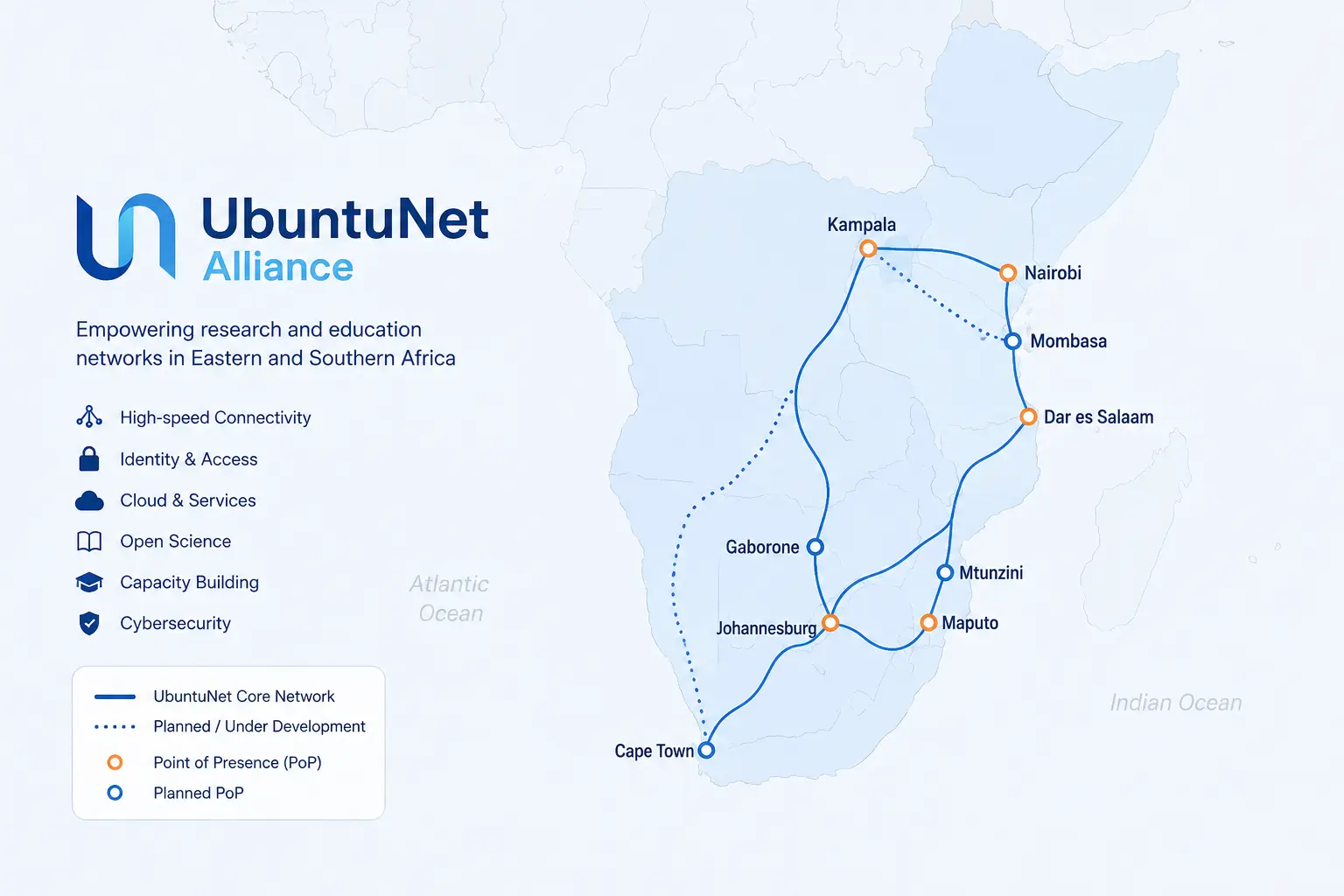
The 2023 report lists core locations including Cape Town, Mtunzini, Maputo, Dar es Salaam, Nairobi, Amsterdam, Gaborone, and Johannesburg, and describes Djibouti and Mombasa as planned or under construction. Older pages also mention London and other historical sites.
Differences may arise from timing, the definition of a core PoP versus an access point, operator hand‑off, or path adjustments. A dot on a map does not reveal who controls the routers, fibre, cabinets, ports, and contracts.
The Johannesburg PoP and NAPAfrica peering add southern choices, but genuine resilience depends on independence of ducts, suppliers, power, data centres, and the control plane. Two lines on a diagram may share the same physical bottleneck.
The Lagos–Cape Town route makes the pan‑African research network federation more concrete
Construction during 2025–2026 connects WACREN into the South African environment through ZAOXI, SANReN, and TENET, and on to UbuntuNet. Partners describe it as the first effective direct interconnection of African regional research networks entirely on the continent, without transiting Europe.
This claim should be retained with its source and qualified as between RRENs. It does not imply that no commercial or private north–south African connectivity existed before. The novelty lies in the institutional and operational relationship between regional research networks.
This path can keep more African research traffic on the continent, reduce some European detours, and support cross‑regional projects. Yet it still relies on carriers, exchange infrastructure, BGP policies, and national partners; no single organisation controls the entire path.
Member counts reflect different categories and points in time
The 2023 report states there are 15 active members covering 13 member countries, over 3.5 million users, and more than 1,000 institutions. An audit tender in March 2026 listed NRENs in 18 countries, while the website shows 16 member profiles. These may correspond to legal members, active members, connected networks, or web‑page maintenance status.
Lesotho joined in November 2025, and Trustee elections took place in 2026, so the composition is still shifting. Any total should carry a date and a definition.
Membership is not the same as a production connection; nor does a nationally connected country mean every university receives equal service. Countries in conflict especially may show legal membership without corresponding operational reality.
Campus infrastructure determines whether regional investment is actually used
A fast core network cannot fix inadequate campus fibre, ageing Wi‑Fi, unstable power, overloaded firewalls, or staffing shortfalls. User experience is defined by the weakest segment.
That is why AfricaConnect4 includes national and campus layers. If a university lacks storage, servers, data‑transfer tools, and a good LAN, regional capacity may sit idle over a long term.
Responsibility must be layered: UbuntuNet handles regional coordination, the NREN builds the national network, the university runs the campus, and governments, operators, and funders shape the environment. Assessment should follow the chain all the way to the researcher, not stop at a national access point on a map.
Lilongwe governs, Kampala concentrates network operations
The Secretariat is in Lilongwe, Malawi, while organisational and recruitment materials place the NOC in Kampala, Uganda. This distributed arrangement fits the nature of a regional organisation.
The Secretariat handles members, contracts, projects, and finance; the NOC monitors links, opens tickets, coordinates with carriers, and supports NRENs. Separation can improve resilience, but it also demands secure access, clear authority, and business continuity plans.
Documentation, on‑call rosters, credential backups, and personnel succession are equally important. A small organisation cannot afford to concentrate system knowledge in a single person.
Shared operations should strengthen national capacity, not replace it
Not every NREN can maintain a 24×7 NOC. UbuntuNet can offer monitoring, preventive maintenance, and first‑ and second‑line support, but the national network still controls customers, policy, suppliers, and domestic responsibilities.
Shared services are most effective when they fill a capability gap and transfer knowledge; when a member cannot understand its own configuration or cannot exit, new dependencies form. Operating permissions, change windows, logs, escalation procedures, charges, and hand‑over plans must be explicit.
A regional NOC can diagnose and coordinate, but it cannot repair domestic fibre without operator cooperation. Its strength is correlating evidence from multiple parties and building a shared operational memory.
Federated identity is a second network built on institutional trust
The physical network moves packets; identity federation lets services trust that a person was authenticated by another organisation. The university maintains the account, the national federation coordinates rules and metadata, and the regional and global layers connect the trust domains.
UbuntuNet does not hold a centralised password store for the region. It operates or supports proxying, federation, metadata, and access to eduGAIN. Security quality still depends on local directories, account life‑cycle, multi‑factor authentication, certificates, and attribute management.
The benefit is that researchers can use their home credentials to access libraries, clouds, repositories, and compute platforms. The risk is that a compromised identity provider can propagate misplaced trust to many services. Federated trust must be accompanied by federated audit and revocation processes.
eduroam turns campus identity into a mobile service
eduroam allows students and researchers to keep using their home credentials when visiting another institution. Authentication requests may traverse the campus, national, regional, and global RADIUS hierarchy, finally returning to the identity‑issuing institution.
The apparently seamless experience depends on certificates, realms, secure Wi‑Fi, and accurate accounts. UbuntuNet can supply a regional proxy but cannot fix expired accounts or misconfigured access points.
Success should be measured by active institutions, successful authentications, failure counts, and resolution times—not merely whether a server has been installed.
EduID.africa and eduGAIN offer paths into larger trust fabrics
EduID.africa, jointly operated by UbuntuNet, WACREN, and ASREN, serves as an on‑ramp and template for NRENs that have not yet built mature national federations. It allows participation without requiring every country to replicate the full infrastructure stack first.
MAREN and TERNET joined eduGAIN in 2025, bringing Malawi and Tanzania federations into global interfederation. Joining proves institutional interoperability, but does not mean every campus has equally mature directories, attributes, or assurance levels.
The regional layer should help national capacity grow and keep a clear migration path. If it becomes a long‑term opaque substitute that is hard to leave, it erodes member autonomy.
Research4Life turns federated trust into practical knowledge access
A 2025 pilot let institutions in Kenya, Malawi, Uganda, and Zambia access Research4Life resources remotely with their home credentials. Later reports state that 66 institutions in 15 countries had completed access.
This reduces reliance on shared institutional passwords. Shared passwords are hard to revoke, audit, and attribute, whereas federated access ties permissions to an individual and their current affiliation.
Numbers should carry a time window and do not imply universal coverage of all members. Institutions still maintain identity, and Research4Life retains eligibility rules. Nevertheless, the case clearly shows that identity infrastructure can deliver direct value to researchers.
Cloud services combine regional infrastructure with commercial procurement
One path is community‑owned or hosted infrastructure: the UbuntuNet Open Science Cloud, file transfer, Drive, hosting, collaboration platforms, and experimental compute. Another path is commercial procurement frameworks, most prominently the 2024 Redington/AWS collaboration.
Regional cloud can keep more capability and control close to members; hyperscale cloud offers product breadth that a small regional organisation cannot match. UbuntuNet can aggregate demand and offer support, but it does not own AWS and does not control AWS pricing, availability, or product roadmap.
The 2023 report records an installation in Lusaka and equipment delivery in Kigali, but does not disclose current total capacity, utilisation, tenant counts, or a unified SLA. Hardware in place does not equal a mature multi‑region cloud; orchestration, identity, backup, security, support, and continued funding determine service quality.
Research support services address both day‑to‑day friction and large‑scale research needs
Utafiti Africa collates research funding and training opportunities and had over 1,100 active users in 2024. It does not award grants; it reduces the cost for researchers to discover opportunities.
File transfer, Drive, Meet, Learn, and hosting can reduce duplicate procurement and support collaboration. Different services have differing maturity, and older service pages may blend existing capability with historical plans.
Transferring a single large file once is not the same as continuously supporting telescope, climate, or genomic data. Those demand tuned endpoints, storage, monitoring, and sometimes dedicated circuits. A service portfolio is credible only when the boundaries of each capability are clear.
Open science becomes a second layer of infrastructure
Connectivity can move papers or datasets, but it does not automatically make them findable, citable, preservable, and reusable. Repositories, metadata, persistent identifiers, and people likewise depend on hosting, storage, identity, certificates, backup, and enduring institutions.
UbuntuNet and Access 2 Perspectives have co‑hosted the AfricArXiv infrastructure since late 2023. AfricArXiv remains community‑driven; it should not be described as owned by UbuntuNet. UbuntuNet was also selected as the Southern Node of the Africa Open Science Platform.
Research repositories require long‑term maintenance of software, content, rights, security, and preservation, and should allow data export when partnerships change. Abandoning a scholarly record system can cause harm that is harder to reverse than replacing a circuit.
Repository operations and persistent identifiers depend on long‑term institutional labour
The Research Repository Stewardship Programme trains librarians and data stewards. The first Portuguese‑language workshop took place in Mozambique in July 2026, illustrating that localisation is itself operational infrastructure.
Institutions need storage policies, metadata standards, rights workflows, user support, backup, upgrades, preservation, and continuing budgets. A multi‑tenant platform can reduce duplication but also creates a common fault domain. The Network Adoption Fund aims to make NRENs sustainable repository service providers.
DataCite, DOIs, ORCID, and the 2026 DOCiD collaboration with TCC Africa add an identifier layer over people, institutions, and research entities. Identifiers cannot fix poor metadata; UbuntuNet’s role is to coordinate procurement, integration, and regional practice while keeping global governance and local responsibility transparent.
Cybersecurity capacity is distributed across people and institutions
UbuntuNet’s cybersecurity work includes regional bootcamps, national workshops, identity and systems training, and participation in the global R&E security community. Existing evidence does not show a central SOC monitoring all members. A more accurate pattern is strengthening national and institutional teams, building trusted contacts, and developing shared incident‑handling approaches.
Legal, data, and incident‑response authority remains at the national or institutional layer. A regional body can share tools and knowledge but cannot automatically remediate a compromised device on a campus.
Training for finance staff from 15 countries in 2026 shows that operational resilience also covers budgeting, foreign exchange, project compliance, and member billing. A router whose support or circuit contract cannot be renewed does not possess genuine resilience; administrative capacity is infrastructure too.
Governance is continuous while public information remains incomplete
The Members Assembly is the highest governance body, the Board of Trustees provides oversight, and the Secretariat executes projects, contracts, and services. Professor Madara Ogot began a four‑year CEO term on 1 February 2022; public materials in 2026 still refer to him as CEO, though no separate renewal announcement has been found. Professor Hellicy Ng’ambi has been the fourth Chairperson since 1 January 2024.
Miriam Chahuruva and Sabelo Dlamini were elected Trustees on 29 May 2026. Public sources have not provided a fully aligned list of current office‑holders after that election, nor do they account for all departures.
This does not indicate a governance vacuum, but it limits the precision of what can safely be stated and underscores the need for timely, verifiable public governance records.
2023 finances show a large mission with a very small buffer
UbuntuNet recorded 2023 revenue of US$2,404,779, expenditure of US$2,393,911, and a surplus of only US$10,868. Connectivity services income was US$1,902,318, or 79.1%; network operations cost US$928,032.
Relative to the regional mission and risks, that margin is extraordinarily thin. Exchange‑rate movements, a single operator invoice, or member arrears could wipe it out. Passing procurement savings to NRENs is consistent with the mission, but it shrinks the organisation’s own reserves.
The CEO report notes that late payment of operational and maintenance contributions by members seriously impairs execution capability. The research did not locate full audited accounts after 2023, so AfricaConnect project sums cannot be used to infer current cash or solvency.
Donors, carriers, currencies, and conflict remain in the operating model
AfricaConnect funds major expansion; commercial carriers deliver much of the physical transport; cloud suppliers control their platforms; contracts are typically denominated in euros or dollars while member budgets may be in local currencies; conflict can make it impossible for a national NREN to function normally.
RwEdNet’s cessation of operations in 2018 and rebuilding in 2024 is direct evidence of national institutional fragility. The regional link could not prevent its collapse; recovery required domestic policy and organisational rebuilding. Conflict‑affected countries that retain membership do not automatically enjoy continuous campus service.
These dependencies do not negate the Alliance; they define its work: diversifying procurement where possible, building reserves, raising national capability, clarifying responsibilities, and understanding digital sovereignty as the power to choose rather than isolation from the world.
Public evidence is stronger for project milestones than for current operations
UbuntuNet has published extensive information on contracts, connections, elections, training, and service launches, enough to reconstruct its development journey. Harder to obtain are current operational details: no full route‑by‑route asset inventory, multi‑year availability history, continuous traffic series, per‑link utilisation, public incident log, current total staff count, or audited financials beyond 2023.
PeeringDB traffic ranges, bgp.tools origin prefixes, the 20 Gbps core description, and member access statements at 10 or 20 Gbps describe different entities. A PoP may merely be a carrier hand‑off or an exchange presence, not a full account of all assets and failure domains.
The absence of a public fault log does not mean the absence of faults, and absent metrics do not prove poor service quality. More transparent data on availability, restoration times, utilisation, member payments, and service adoption would help members and funders judge whether project outputs have been converted into sustainable operations.
Regional autonomy comes from more choices, not from eliminating all external dependencies
UbuntuNet increases regional control through bulk procurement, keeping more traffic on the continent, growing engineering capability, and operating identity and repository services. It cannot make global standards, commercial fibre, equipment supply chains, hyperscale clouds, or international research partnerships disappear.
The collaboration with WACREN, ASREN, SANReN, TENET, and GÉANT shows that the pan‑African research network is a multi‑governance federation, not a single‑owner network. The Lagos–Cape Town route increases localisation but still depends on carriers, exchange infrastructure, and coordinated routing policy.
Every choice brings new dependencies: the AWS framework improves procurement while increasing platform risk; regional repositories improve local governance while depending on software, identifier systems, and people; long‑term circuit contracts lower unit prices while raising supplier and foreign‑exchange risk.
The strategic test is whether members can genuinely change: can they switch carriers while keeping the regional relationship? Can they export repository data, migrate workloads, and retain identity federation? When the answer is yes, autonomy has genuinely increased.
UbuntuNet’s significance lies in turning disparate networks into a usable research environment
UbuntuNet’s core achievement is a combination of institutional and technical elements. Independent national networks have been able to pool demand, share operations, connect globally, and build services that a single country could rarely afford alone. The backbone, identity, repositories, cloud, and training are different products, yet they all respond to the problem of regional fragmentation.
The organisation is not finished. Capacity is still limited relative to data‑intensive targets such as climate modelling, astronomy, or AI; the public record is better at showcasing milestones than utilisation and availability; member finances vary widely; suppliers, funders, and services of differing maturity remain.
These constraints do not diminish its value. UbuntuNet is not an “African internet” separate from the global internet, nor a completed continental platform. It is a shared regional layer that allows a larger research system to form. Long‑term success should be measured by whether members can reliably use it, understand the costs, retain local authority, migrate data and identities, and exit a service when necessary.
Member Briefing
Deeper Profile Context
Sign in with the right membership level to unlock the full briefing and source notes.
Only for Strategic Circle
Strategic Circle
Open to all readers. Unlock profile briefings after joining and signing in.
Join Strategic CircleOnly for Leadership Alliance
Leadership Alliance
For qualified IP-asset owners and management; sign in to unlock alliance briefings.
Join Leadership Alliance