
Profile
Research
Research profile intelligence connects person, company, institution, and other entity coverage for readers comparing the subjects behind BTW.MEDIA reporting. The page helps compare public profiles, related events, evidence packs, role changes, operating footprints, governance exposure, organisational links, and market relevance while keeping organisation and people records distinct from ordinary news chronology. Readers can understand the subject behind the headline, the evidence supporting that profile, and the infrastructure or market relationships that make the profile relevant. They can see who or what the profile represents, which public sources support it, how it connects to companies, markets, governance bodies, or events, and what changes may deserve continued attention as the subject evolves.
History
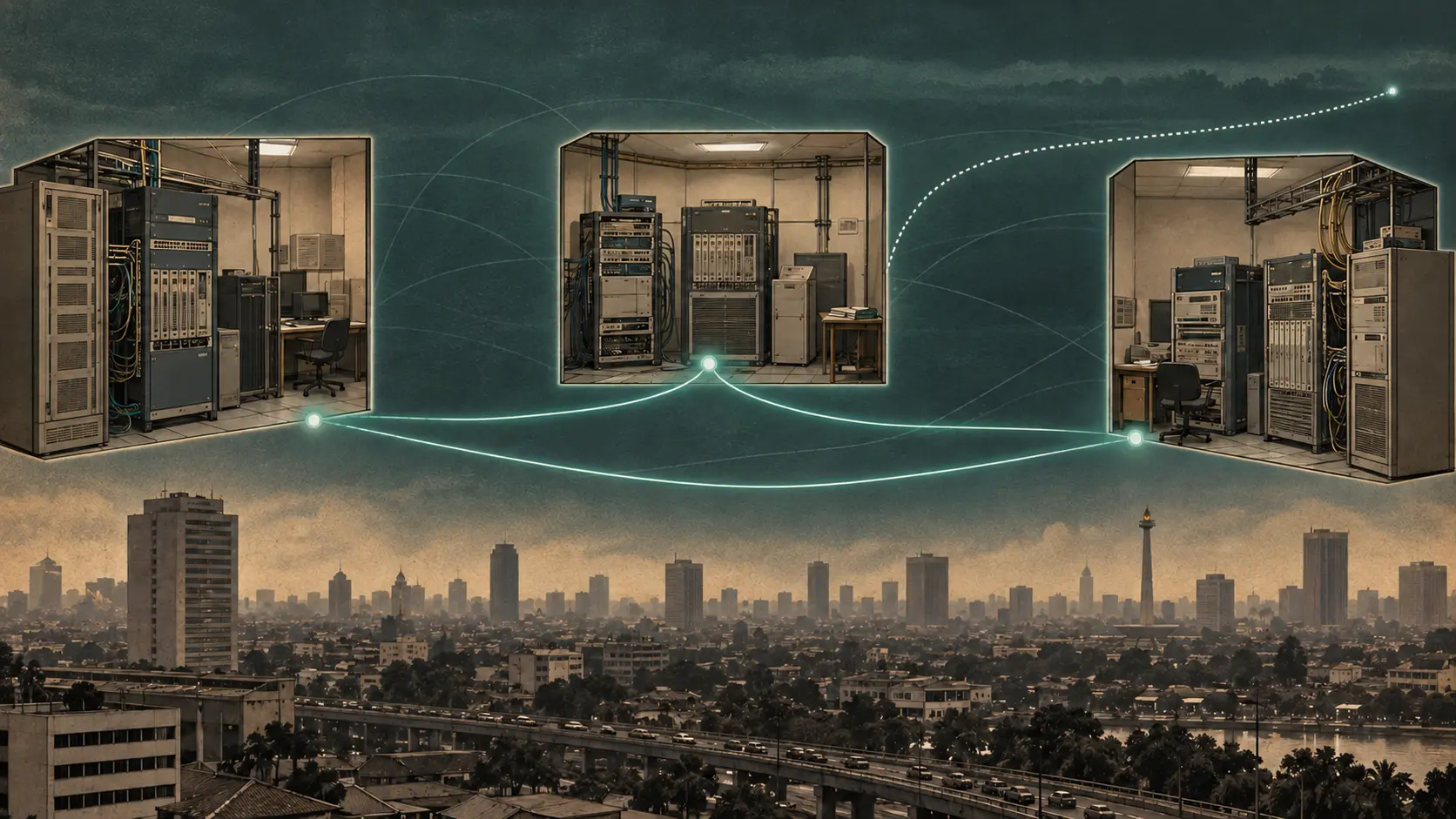
Local Traffic Had to Cross Borders: Indonesia’s 1997 Internet Exchange
In 1997, Indonesian network operators faced an odd routing fact: a message between two users in the same country could depend on international links. APJII’s answer was not one national backbone, but a federation of three carrier-hosted exchange sites where providers could meet…

History
35 of 124 Municipalities: Buenos Aires Rebuilt Government Links with TCP/IP
A provincial decree made one satellite message service the official route for government communications. The project team’s later account shows how narrow that route was, and how a new IP network grew over the carrier links already in place.

History
The Traffic Meter Was Not the Bill: EARN’s 1990 Funding Vote
In 1989, EARN tested whether countries should contribute according to network traffic. The Board approved a 1990 budget, then sent the traffic formula back for more work.

Leaders
Paul Rendek Put the IANA Transition on RIPE’s Open Agenda
On 17 April 2014, Paul Rendek’s message gave RIPE entities a map into the IANA stewardship discussion: a mailing list, a remotely accessible meeting session, regional operator gatherings, government roundtables and a global forum. The map made participation easier to find. It did…
History
85 Cities, More Than $8 Million in Losses: Telenet’s 1977 Network Bet
When Telenet went to public investors in December 1977, the reported 85-city footprint sounded like national scale: local access was said to be possible for about 80% of the US population. The same account reported more than $8 million in accumulated losses. The gap between reach…

History
One Link for Two Universities, One Bill at First: Mexico’s 1989 NSFNET Connection
A shared satellite channel joined UNAM and ITESM to a US research network. Its agreement spread equipment duties, but the first bill landed with one university.

History
The Call to Amsterdam: How EUnet Carried Europe’s Mail and Usenet
For one Belgian university department, the nearest European Usenet host was in Amsterdam, but the estimated international telephone bill kept the department offline. EUnet’s early history is easiest to see from that distance: a shared network depended on local links that…

Leaders
Andrei Robachevsky and the RIPE Database Migration That Put Every User in Scope
On 14 May 2001, a RIPE Database user could no longer send RIPE-181 updates to the familiar `auto-dbm` address. RPSL was now required there; a separate `auto-181` path would translate legacy updates until 15 October. The change was not a single overnight conversion. It was a…

History
The Index File Was an Exit Plan: ALIWEB’s Web Search Experiment, 1993–94
ALIWEB let each Web server describe selected resources in a small index file, then gathered those files into one searchable database. Its more durable bet was that the descriptions could move to a better system if the central service stopped being useful.

North America Institutional Trends
ARIN’s rewrite keeps IPv6 aggregation on top
ARIN’s proposed cleanup would give general number-resource principles one home while preserving a distinct IPv6 priority. The harder question is whether the draft’s own wording makes that hierarchy and its decision-maker clear enough to audit.

History
The Petition Was Not the Transfer: IANA’s 2000 .pn Report
Between 1997 and 2000, Pitcairn’s residents asked for a change in who managed .pn. IANA recommended redelegation; the U.S. Government later implemented the root-zone change.

History
A 25-Year Capacity Right Still Needed Maintenance: KPNQwest’s 2002 Bankruptcy
When KPN Telecom asked KPNQwest’s bankruptcy trustees to keep its contracted capacity operational, it was asking a question more exact than “who owns the cable?” A 2004 Dutch judgment treated the right to use specified capacity as a continuing obligation, with operations and…

History
RARP Found the Address, Not the Configuration: RFC 903
A diskless workstation could wake knowing the number stamped on its network interface but not the Internet address needed to use IP. In 1984, RFC 903 gave it a narrow question for the local link: which protocol address had a server mapped to this hardware address?

History
RFC 1 Was a Working Proposal, Not a Finished Host Protocol
Steve Crocker’s first Request for Comments described ideas that separate computers would need in order to communicate across the ARPA Network. Its opening pages also say plainly that the agreements were tentative. The history that followed is a record of proposals, revisions and…

Academics
Milton L. Mueller Helped Make the IPv4 Address Market Measurable
A market can be real before anyone can count it well. Milton L. Mueller’s work on IPv4 transfers joined registry records, court filings and sampled routing data to make a disputed market visible. The method clarified what could be observed—and why a transfer count still could not…

History
Postel’s 1998 Root Test Targeted Zone Transfers, Not DNS Queries
In January 1998, Jon Postel asked root-server operators to obtain a copy of the root zone from an IANA server at USC/ISI. His message was about how servers received that copy. It said the data would match the version already available from NSI’s A-root and that the existing rules…

History
MILNET Was Split Logically Before Its Circuits Were Physically Separated
The Defense Department’s separation of research traffic from unclassified military operations was a staged operating change. MILNET service began first, software controls divided the communities in 1983, and the physical network partition followed in 1984. Controlled gateways…

Academics
Xinu Turned Operating Systems Into a Lab Students Could Run
An operating-systems course can name the interfaces without ever letting students see a system assembled. Douglas Comer’s Xinu work tried to close that gap with a small, hierarchical operating system and a Purdue lab that automated the path from build to board. The records show…

History
LINX Carried Traffic Before Its Company Existed
The London Internet Exchange became useful in 1994 before the company that now bears its name was incorporated. That gap is more than a footnote: it separates a working interconnection, member coordination and the legal organization that came later.

History
JUNET’s Name Tree Came Before DNS—and Survived the Move to .jp
Before Japan’s academic networks used TCP/IP and DNS, JUNET made hierarchical email names work over UUCP and telephone lines. The convention gave volunteers a way to keep organization names legible as the network grew—and a structure that could be carried into `.jp` when a wider…