
Primary Domain
Internet Infrastructure
Within the Primary Domain facet, Internet Infrastructure intelligence groups reporting by primary domain so readers can follow a focused area of internet infrastructure, governance, connectivity markets, or digital capital. The page brings together related articles, public evidence, institutions, companies, people, regional exposure, operating dependencies, and market context that may otherwise sit across separate category pages. It explains the domain, the likely actor class, the market or governance context, and the source material readers should use when comparing signals. Operators, analysts, and governance readers can see how the same domain appears across events, profiles, market shifts, public-source evidence, regional dependencies, and longer-cycle infrastructure decisions over time.

Global Datacenter
Equinix Fabric and the limits of programmable interconnection
Equinix has spent more than a decade turning private connections among data centres, clouds and network services into software-addressable products. Its 2026 push into agent-assisted operations and geographic path controls makes the platform more useful, while making the ports…

Global Institutional
RouteViews and the infrastructure that makes the internet’s routing system observable
RouteViews began in 1995 as a practical way for network operators to inspect how their routes appeared from outside their own organisations. Three decades later, the University of Oregon-hosted project operates a globally distributed BGP collection, archive and access platform…

North America Institutional
Fastly and the programmable edge that reshaped content delivery
Fastly was founded on the proposition that content delivery should not be a remote utility configured outside the software-development process. It built a CDN around programmable cache behaviour, rapid invalidation, real-time telemetry and an intentionally concentrated network of…
Global Institutional
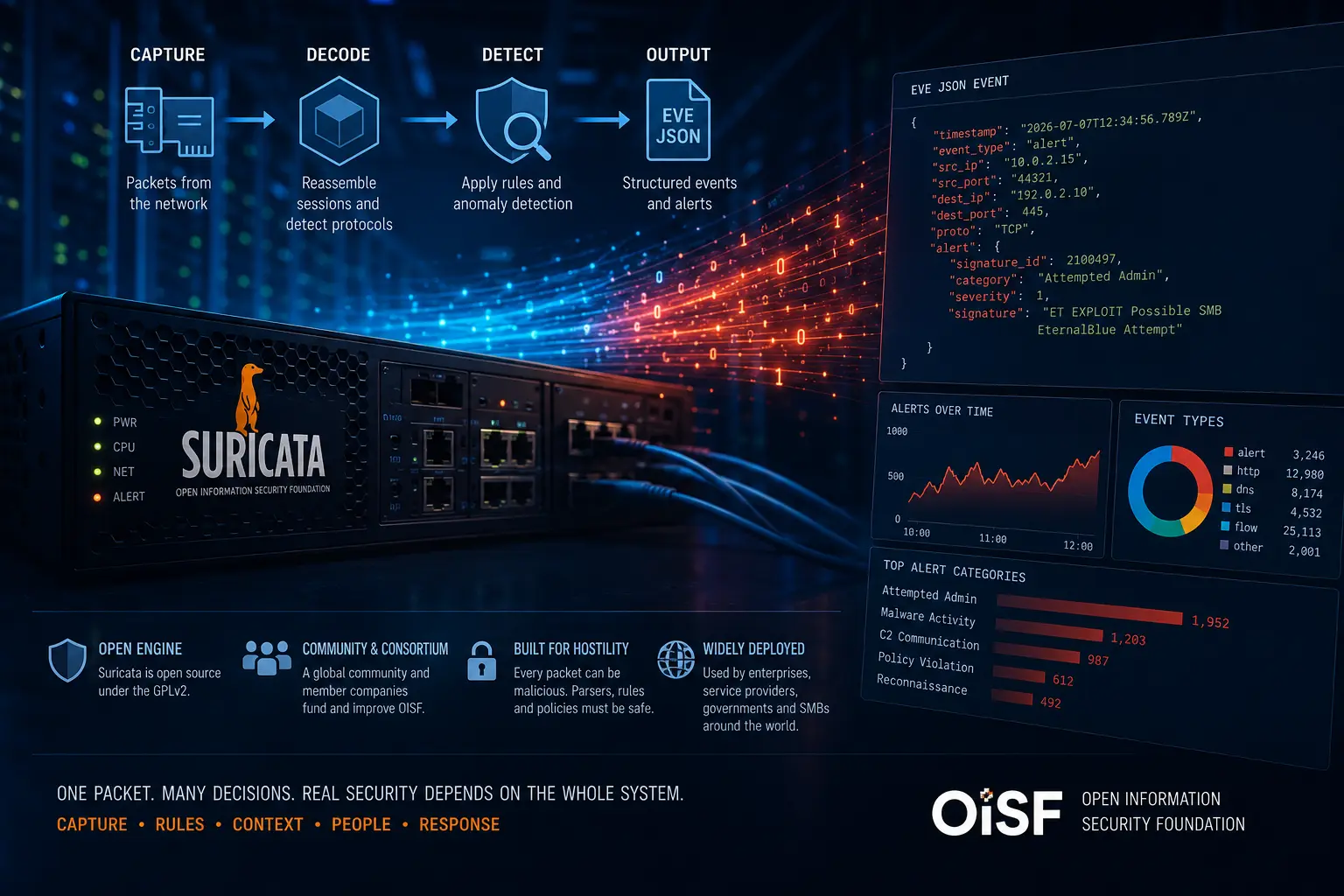
Suricata and the small nonprofit guarding a hostile packet surface
Suricata tracks flows, rebuilds streams, parses protocols, applies rules and emits telemetry inside sensors and commercial products. OISF maintains that public engine on a budget small beside its downstream reach, while every packet, parser and rule can become a failure point.

Global Institutional
Nmap and the limits of what a network scan can know
Nmap turned hosts, ports, filters, services and operating-system fingerprints into a shared operational vocabulary. Nearly three decades later, its value still depends on a restraint many automated systems lose: each result describes one probe, from one vantage point, at one…
Global Institutional
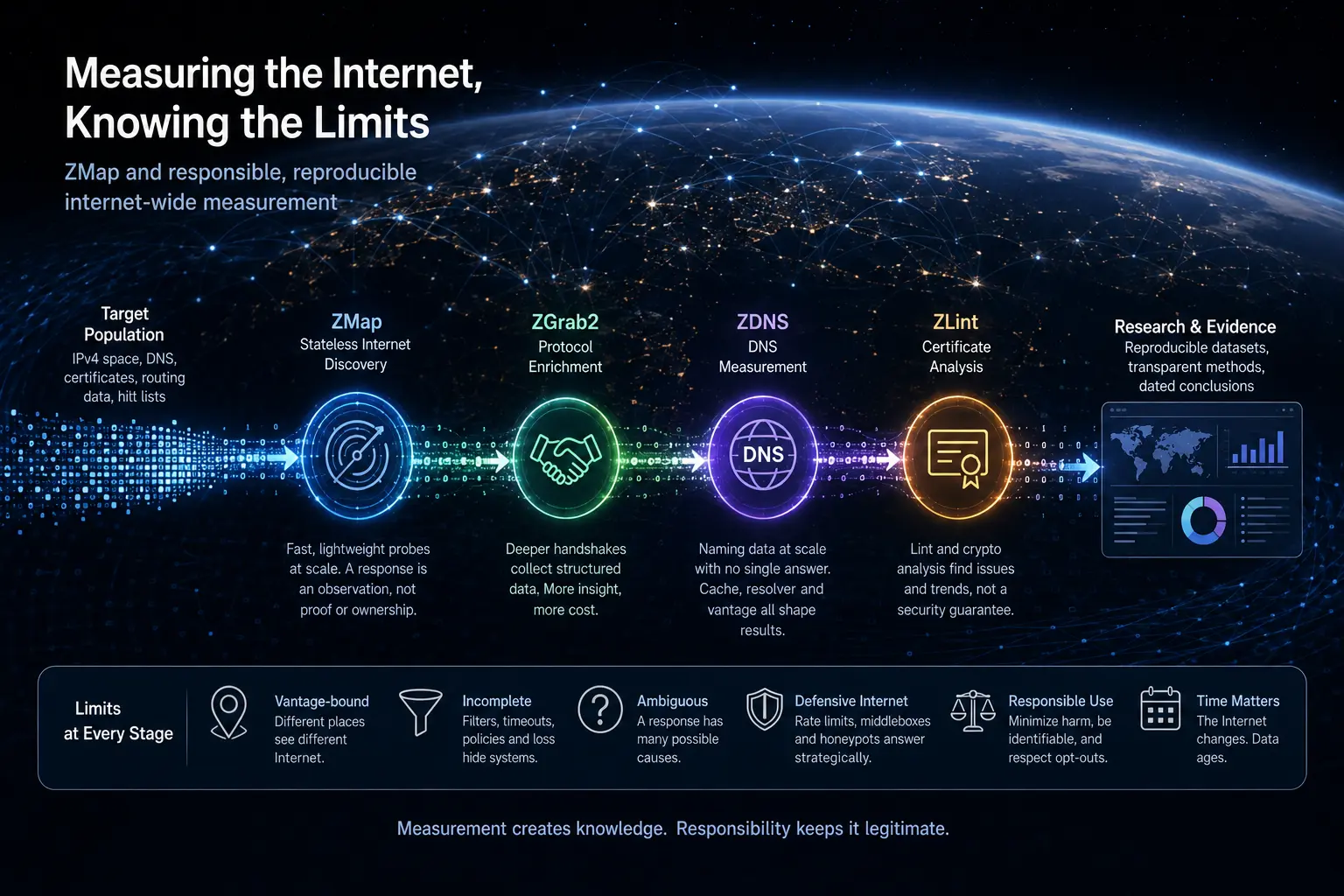
ZMap and the limits of an internet-wide census
ZMap made public IPv4 surveys repeatable by separating a fast stateless probe from deeper protocol analysis. The same design makes every result depend on target selection, vantage point and responsible operation: a response is an observation, not proof of ownership or…
Global Institutional
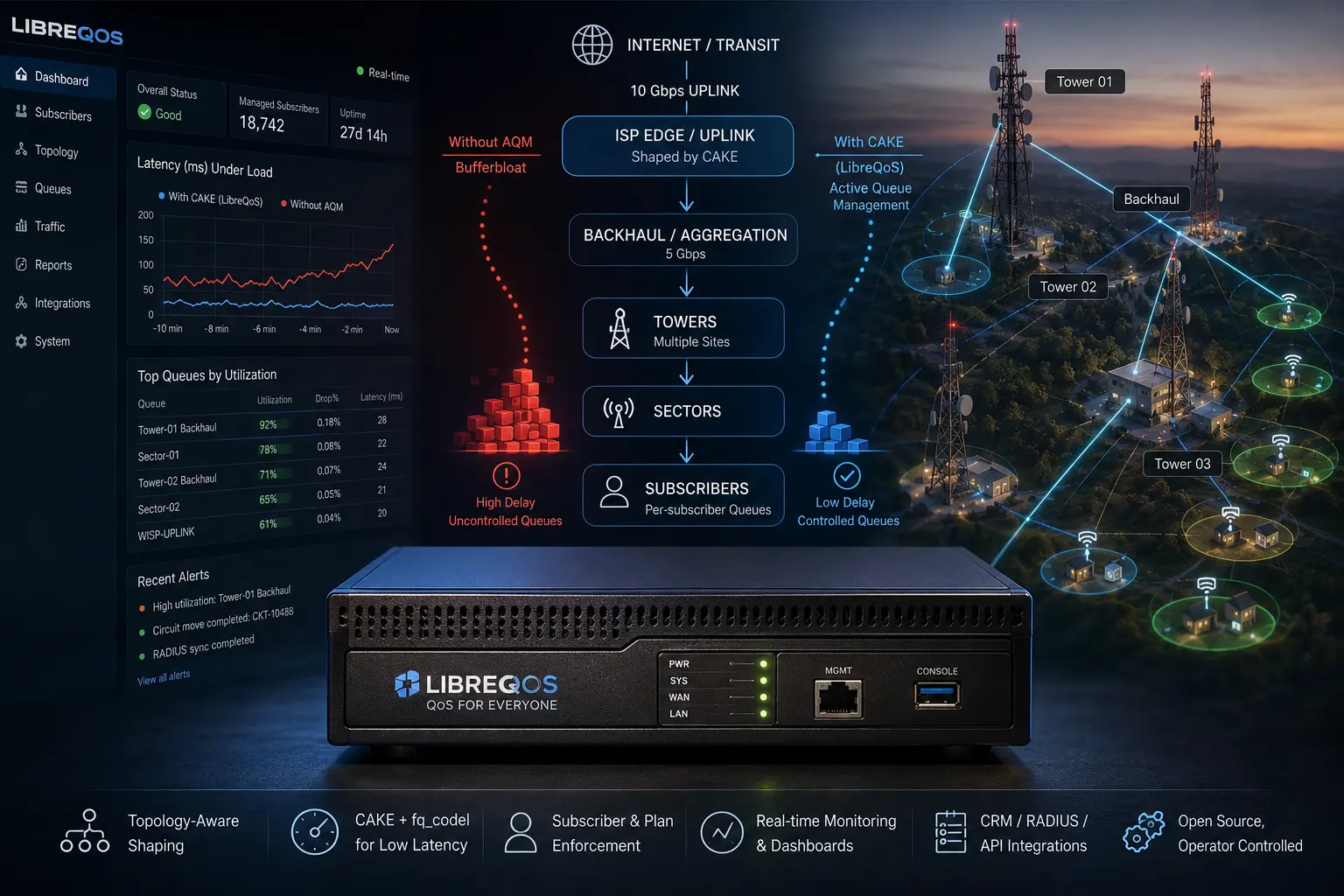
LibreQoS and the topology that decides where broadband slows
LibreQoS puts a Linux shaper inside the traffic path, using CAKE and an operator’s model of subscribers, towers and backhauls to keep queues short under load. Its advantage depends on a hard condition: the network model and capacity values must be more accurate than the…
Global Institutional
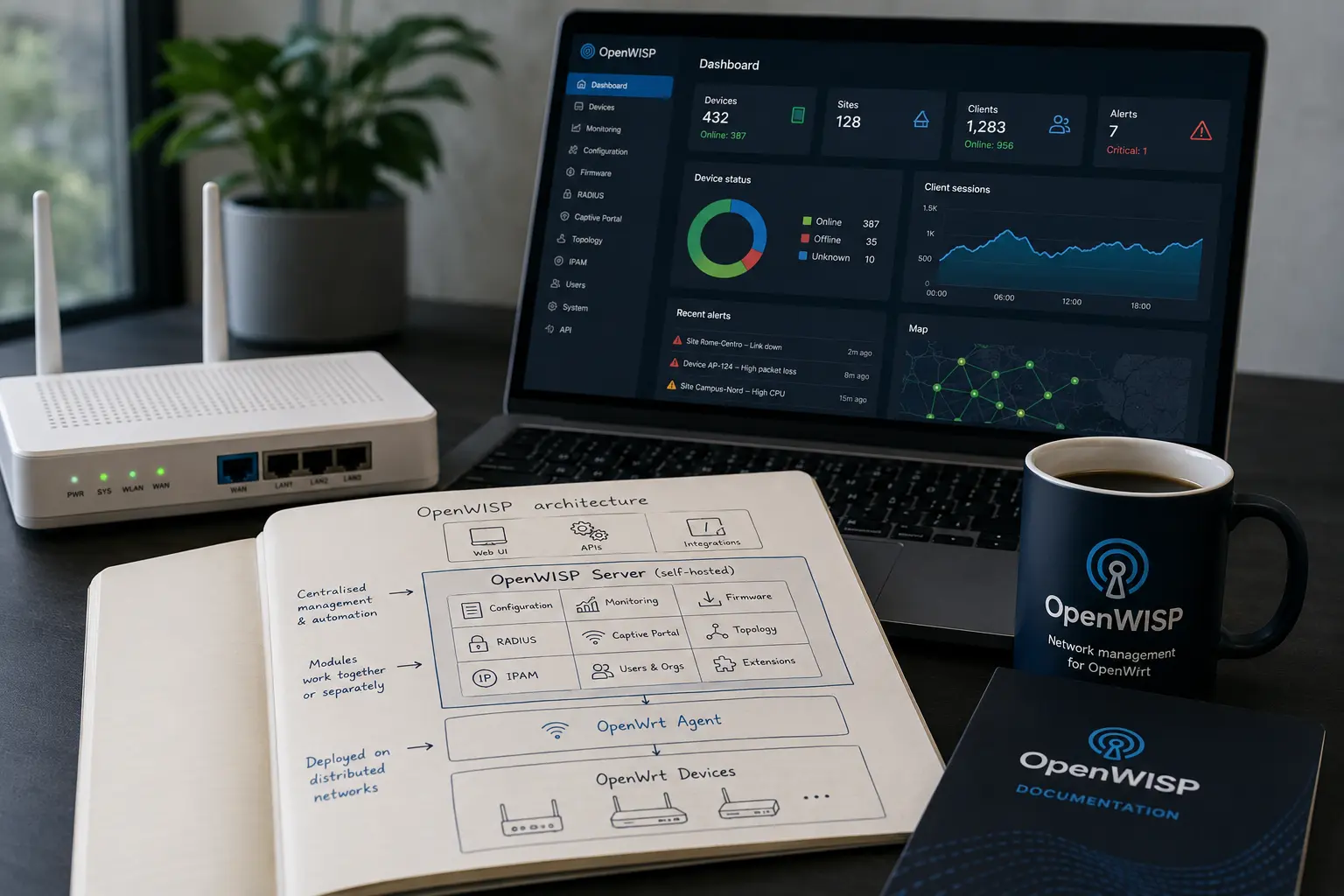
OpenWISP and the control room small networks must build for themselves
Born from a public Wi-Fi programme around Rome, OpenWISP now manages distributed OpenWrt fleets through configuration, monitoring, firmware, identity and topology modules. Self-hosting removes a proprietary controller from the chain, but leaves the operator responsible for the…

Global Institutional
prpl Foundation and the hard limits of an open broadband gateway
prpl Foundation coordinates an OpenWrt-based carrier stack designed to move services across gateway vendors. Its test is whether common APIs and certification can survive proprietary radio firmware, chipset software and the integration work operators still have to buy.

Creators
Jamal Hadi Salim and the contract behind programmable Linux networking
Linux Traffic Control began as a queueing framework and now carries classification, redirection and hardware offload. Salim’s work across `tc`, Netlink, ForCES and P4TC shows how hard it is to add programmability without breaking the interfaces operators already trust.

Europe and Middle East Institutional
GÉANT and the Federated Infrastructure Powering European Science
GÉANT does not replace national research and education networks in Europe, nor does it operate a separate internet from the public network. Instead, it provides those networks with a shared continental layer that includes optical and IP connectivity, identity federation, cloud…

Europe and Middle East Institutional
GÉANT and Europe’s federated research infrastructure
GÉANT gives Europe’s national research networks a shared continental layer for optical and IP connectivity, identity, cloud access, security and global collaboration without replacing national control. Its importance lies in federation: independently governed networks can operate…

Europe and Middle East Institutional
GÉANT and the Federated Infrastructure Sustaining European Science
GÉANT does not replace Europe’s national research networks nor operate a separate internet. It provides a common continental layer — optical and IP connectivity, federated identity, cloud procurement, security coordination, and global links — so that universities and scientific…

Europe and Middle East Institutional
GÉANT and the network Europe chose not to centralise
GÉANT gives Europe’s national research networks a shared layer for optical capacity, routing, identity, cloud access, security and global collaboration. Its power comes from coordinating independently governed systems, but the same federation means that no single organisation…

Latin America and Caribbean National Telecom
Hispamar's Brazil Control Centre Shows Why Satellite Links Still Need Local Operating Proof
Hispamar's Brazil Control Centre Shows Why Satellite Links Still Need Local Operating Proof intelligence summary explains the development, the public evidence available to readers, the organisations involved, the regional context, market exposure, and the infrastructure…

North America Datacenter Trends
Big Tech commits $1.09tn to future leases
Microsoft, Meta, Oracle, Amazon and Alphabet have signed leases for facilities that are not yet available for use, mostly data centres.

Leaders
Mohamed Nasr and the Route-Diversity Decisions Behind Egypt's Subsea Crossing Hub
The useful question about Egypt's place in international connectivity is not whether cables touch its shores. It is what an operator can actually choose after they arrive. A landing can be a geographic fact without becoming a flexible transit option. A collection of systems can…

Asia-Pacific Datacenter Trends
LG Uplus adds $896m to Paju AI data centre
LG Uplus is adding fresh capital to its Paju project as construction advances on the first building of the planned 200MW campus.

North America Institutional
ESnet and the Network That Makes Distant Scientific Facilities Work as a Single Machine
The Energy Sciences Network connects US Department of Energy laboratories, instruments, supercomputers, and international collaborators through a dedicated scientific network. Its importance lies less in a speed figure than in the combination of fibre, routing, measurement…

Europe and Middle East National Telecom Trends
UK full-fibre coverage reaches 85% in H1 2026
UK full-fibre coverage rose again in the first half, although more construction took place in areas where fibre was already available.