
Summary
- The AFNOG 3 report documents 53 engineers from 23 countries training in Lomé in May 2002, with practical instruction in French and English and OIF-funded simultaneous translation.
- Pierre Ouédraogo's record links technical education to regional institutions; the evidence supports a role in enabling participation, not a claim that training or recognition gave one person continental authority.
A network can fail at a very ordinary point: the person on call has never had the chance to configure the service, trace a fault, or ask a peer how they handled the same failure. That gap is hard to see in a diagram of cables and routers. It is also one reason technical training belongs in the history of internet governance.
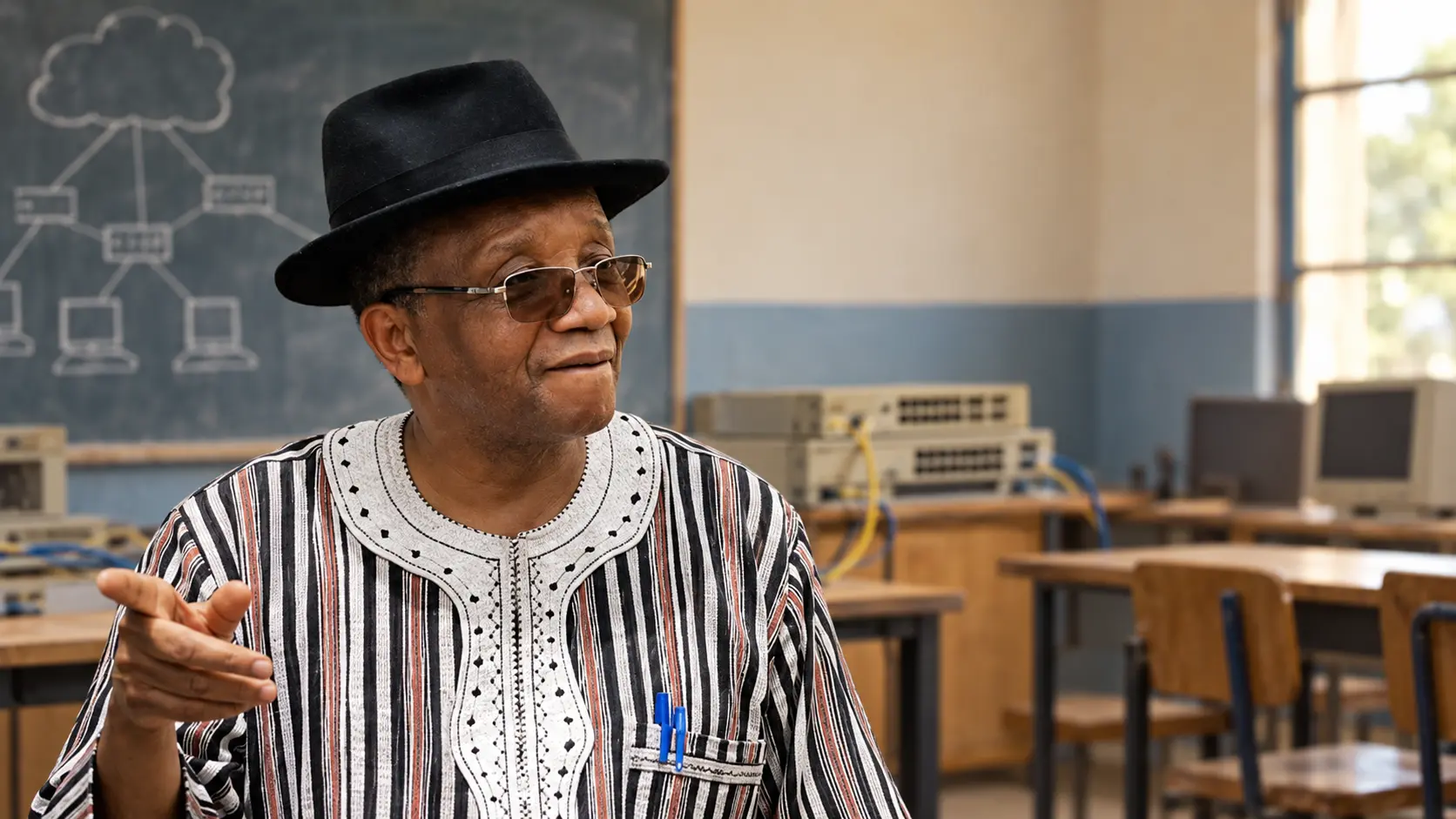
The official AFNOG 3 report records a workshop in Lomé from 5 to 14 May 2002. It lists 53 network engineers from 23 countries and describes hands-on network operations training. The report says technical subjects were taught at equivalent detail in French and English for the first time; the Organisation internationale de la Francophonie funded simultaneous interpretation. It also names a “train people who will train others” goal. Those are concrete design choices: who can follow the material, who gets practice, and whether knowledge is expected to travel beyond the room.
The report attributes joint leadership to Ouédraogo, then working with OIF, Nii Quaynor, the Network Startup Resource Center and local hosts. That phrasing matters. An event with multiple organizers cannot responsibly be reduced to one founder's story. Nor does the attendance figure tell us whether participants later trained colleagues, ran networks, or gained influence in policy forums. The report documents the workshop, not a longitudinal outcome study.
The Internet Society's 2012 Postel Service Award announcement places this work in a longer institutional career. It identifies Ouédraogo as OIF Director of Digital Francophonie and recognizes sustained service, training young engineers, and support for regional organizations. It also names his involvement with AFNOG, AfriNIC, AfTLD, AF-CERT and AfrICANN. The announcement is evidence of how the award committee described his contribution, not a full accounting of who built each institution.
That distinction between access and authority runs through his public remarks. At the award ceremony, Ouédraogo said the recognition honored Burkina Faso, Africa and volunteers in regional Internet organizations. He emphasized open standards and the ability to access the Internet in the world's languages. In 2018, the first West African School on Internet Governance in Ouagadougou added another documented setting: the IGF report records eight sessions and lists Ouédraogo among several trainers, crediting him with a session and a security discussion. The report does not call him the school's sole founder. An Internet Society memorial later credits him with establishing a Francophone school; that attribution should remain attached to the memorial.
The institutional mechanism is larger than a classroom. Shared exercises create a language for describing faults; local peers can compare operating practice; bilingual delivery lets a technical conversation cross a language boundary without requiring every participant to abandon their strongest working language. Those are plausible effects of the design, not measured outcomes in the cited reports. The material gap in the public record is what happened next: how many participants taught others, where they worked, and whether their experience changed decisions.
The case also resists a familiar shortcut. Technical competence can make it possible to contribute to a debate about infrastructure, but it does not confer a mandate to represent an entire region. Institutions need separate ways to establish whom they serve, how participants are selected, and who can speak for them. Ouédraogo's work is most useful when read as part of a network of organizers, trainers, participants and institutions that made participation more possible.
Sources and evidence limits
The AFNOG report supports the dates, attendance, bilingual instruction, funding and joint leadership. The award announcement and Ouédraogo's remarks document recognition and his own framing. The IGF report and ISOC memorial support later education work with different levels of attribution. None measures alumni outcomes or proves that training alone changed regional governance. The OIF’s public memorial also records his Digital Francophonie role and award. The public Internet Society photograph used as the portrait’s identity reference supports likeness only; it is not evidence of a training event.
Member Briefing
Deeper Profile Context
Sign in with the right membership level to unlock the full briefing and source notes.
Only for Strategic Circle
Strategic Circle
Open to all readers. Unlock profile briefings after joining and signing in.
Join Strategic CircleOnly for Leadership Alliance
Leadership Alliance
For qualified IP-asset owners and management; sign in to unlock alliance briefings.
Join Leadership Alliance