
Content Type
Research
Within the Content Type facet, Research intelligence gathers BTW.MEDIA articles that share the same editorial format, helping readers compare briefings, profiles, risk notes, market analysis, and event coverage without mixing different kinds of evidence. The page explains how this content type frames internet infrastructure events, company movements, governance decisions, operational signals, and public evidence across the site. Readers can compare which actors or infrastructure systems appear most often, how source quality changes interpretation, and whether the material is a durable profile, a time-sensitive event, a strategic market signal, or a governance development. The result is a useful search page for operators, investors, customers, analysts, and policy stakeholders who need to understand the consequence, timing, and evidence behind similar article formats.
Story
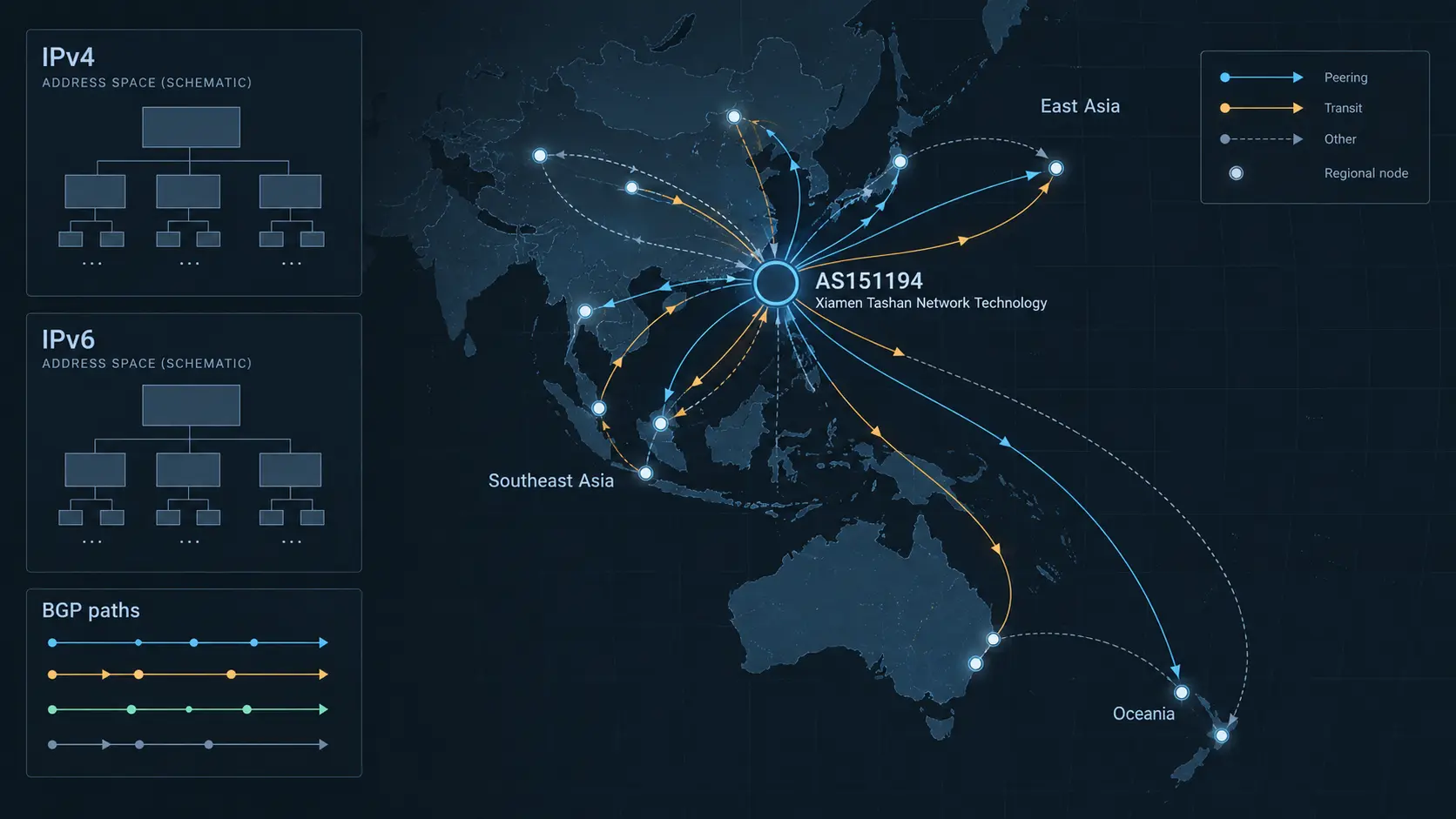
Xiamen Tashan Network Technology and the Evidence Gap Around AS151194
Xiamen Tashan Network Technology and the Evidence Gap Around AS151194 intelligence summary explains the development, the public evidence available to readers, the organisations involved, the regional context, market exposure, and the infrastructure consequences that may follow.…

IETF
A Newer Date Can Belong to the Wrong Branch
Revision 17 of the YANG module-versioning draft makes revision history honest about forks, marks potentially incompatible steps and lets servers describe their treatment of retired nodes. Its metadata can expose risk early. It cannot tell an operator that the selected dependency…

Global Regional ISP
ROYA’s AS210837: From Network Identity to Evidence of Operation
ROYA’s AS210837: From Network Identity to Evidence of Operation intelligence summary explains the development, the public evidence available to readers, the organisations involved, the regional context, market exposure, and the infrastructure consequences that may follow. The…

IETF
Lixia Zhang and the Reservation That Expired Without a Refresh
A reservation sounds like something placed and possessed. In RSVP, it was something more disciplined: distributed state that had to keep earning the present tense.

Global Institutional
DFINFRA and AS210860: The Missing Continuity Loop
A registry association can identify where to investigate, but continuity is demonstrated only when routing, reachability, recovery authority and customer consequence align in time.

Global Institutional
What AS33169 Can Prove About Utherverse Network Operations — and Where Continuity Still Disappears
What AS33169 Can Prove About Utherverse Network Operations — and Where Continuity Still Disappears intelligence summary explains the development, the public evidence available to readers, the organisations involved, the regional context, market exposure, and the infrastructure…

History
The Activity Could Travel. Execution Stayed with the URAgency: RFC 2016
RFC 2016 imagined an Internet task as a durable entity that another person could inspect, change and run again. Yet the entity did not execute itself. A URAgency still decided how its type became runnable code, which dependencies were trusted, where targets pointed and what a…

ICANN
How ICANN Turned a .COM Renewal Into an Operative Contract
ICANN’s 2024 renewal of the .COM registry agreement shows where authority in internet governance actually changes form: community input becomes a proposal, the Board authorizes an institutional act, delegated officers complete the transaction, and a contract becomes the operating…

IETF
A Valid Federation Signature Cannot Audit the Decision to Admit a Member
A machine can verify that a federation operator signed today’s member list. It still cannot see who admitted a member, which rule they applied, what evidence they accepted, or whether an exception has expired.

IETF
The Package Resolved. The Running Schema Was Still Unproven
Revision 09 of the YANG Packages draft gives a schema collection a name, a version and deterministic recursive rules. That is a major improvement over an informal folder of modules. It is also the point at which a clean resolution result can be mistaken for evidence that no…

IETF
Leslie Daigle and the URN Namespace That Needed a Steward, Not a Resolver
A persistent name is easy to mistake for a durable hyperlink. Leslie Daigle’s work on the rules for Uniform Resource Name namespaces made the harder bargain visible: the name survives only if an institution keeps assigning it consistently, never recycles it and preserves the…

Leaders
Noor Helmi’s Decision Surface: What IX Telecom’s Public Record Can—and Cannot—Attribute
A people-and-leadership investigation of the boundary between Noor Helmi’s observable executive role, IX Telecom’s institutional operating model and the evidence required to show that capability survived beyond the founder.

IETF
The BIER Attribute Reached the Border. The Neighboring Domain Was Not Authorized: RFC 9793
RFC 9793 gives BGP a way to carry the identifiers and encapsulation inputs from which a BIER router can calculate forwarding state. It also draws a harder line than the attribute's transitive flag suggests: at an EBGP administrative boundary, carriage is denied by default, and a…

IETF
HTTP/2 Rapid Reset: The Protocol Was Revised. Who Proves the Repair Reached the Internet?
The HTTP/2 Rapid Reset episode exposed a gap that standards documents cannot close on their own. A protocol rule can permit a sequence of actions; a security researcher or operator can show how that sequence becomes an attack; a working group can review the behavior; and vendors…

History
Before Email Could Be Signed, the Gateway Had to Stop Editing It: RFC 2015
A mail gateway could preserve every sentence a person cared about and still destroy a digital signature. RFC 2015 made that uncomfortable fact part of PGP/MIME's design: the evidence was not an abstract message but an exact MIME entity—content headers, transfer encoding…

ICANN
ICANN’s Authority Chain: From Institutional Mandate to Contractual Remedy
ICANN’s power over the domain-name system is easiest to misunderstand when it is treated as a single grant of authority. The public record describes something more layered: institutional powers and accountability rules in the Bylaws, operational obligations in registry and…

IETF
Three Names, One File, No Proof of What Loaded
An unversioned YANG module, a revision-dated copy and a semantic-version copy can be byte-for-byte identical. That is useful repository hygiene. It is not a load receipt, a compatibility verdict or permission to roll the schema into production.

Global Institutional
DFINFRA and AS210860: The Missing Link Between Registration and Operational Control
DFINFRA and AS210860: The Missing Link Between Registration and Operational Control intelligence summary explains the development, the public evidence available to readers, the organisations involved, the regional context, market exposure, and the infrastructure consequences that…

IETF
A Previous HTTP Upgrade Success Cannot Confirm the Next Protocol Transition
The proxy has seen this transition work a thousand times. It sends an HTTP/1.1 CONNECT request, expects the familiar success, and lets the application’s first bytes follow immediately. On attempt 1,001 the destination is unavailable and the proxy rejects the tunnel. The bytes…

IETF
Neal Cardwell and the Loss Detector That Trusted Time Over Duplicate ACKs
Three duplicate acknowledgments once served TCP as a rough witness to loss. They are not a clock, and they say little when a transfer ends before a third witness arrives. RFC 8985 replaces that counting habit with a temporal test: later-sent data must be known delivered, then…