
Summary
- Public records associate ROYA Communications and Internet Services Company Ltd with AS210837, but the available research package does not verify current prefixes, route visibility, AS-path relationships, reachability or commercial activity.
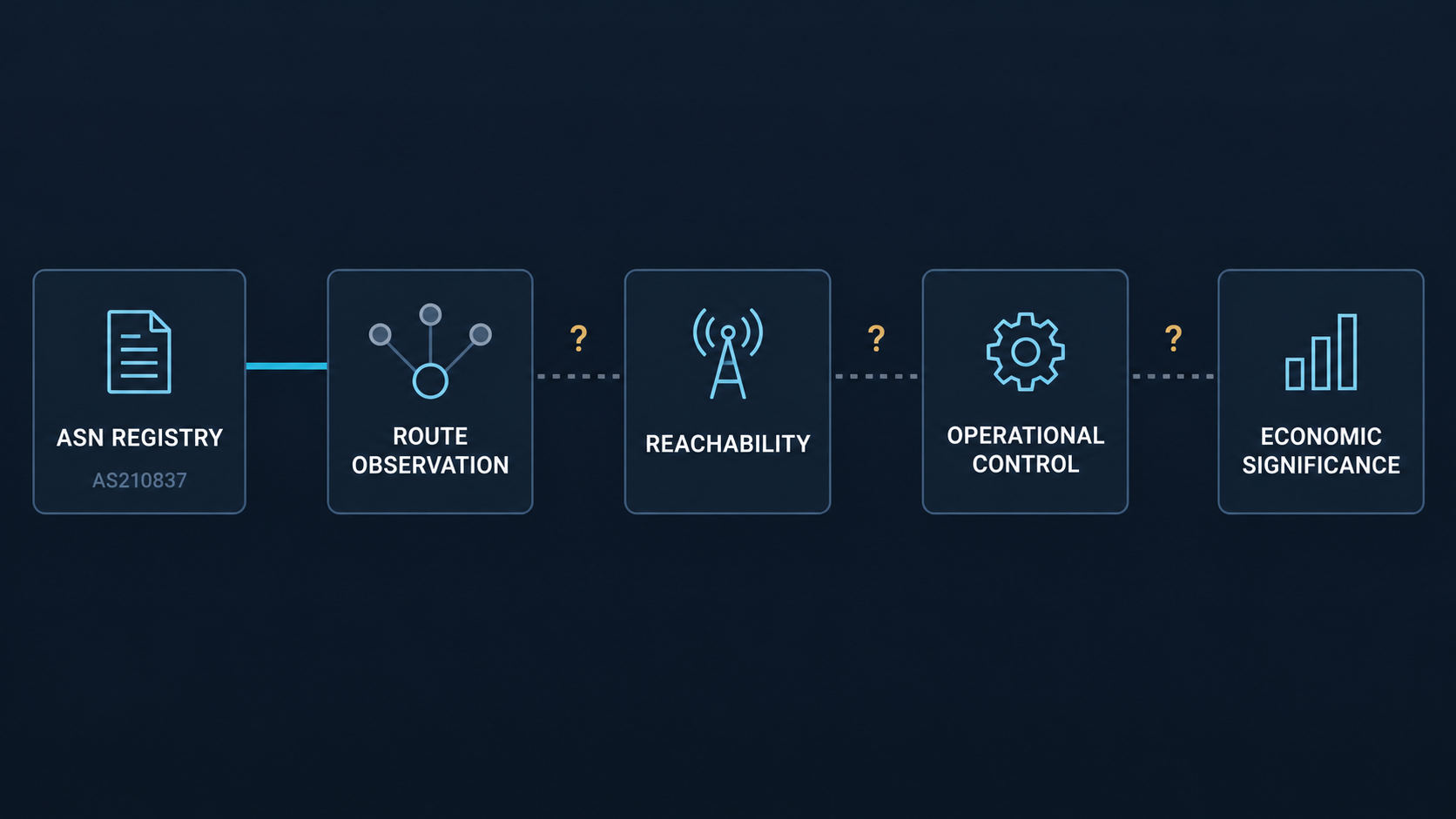
- The decisive test is a chain of evidence: repeated timestamped observations by independent collector families, data-plane reachability, continuity or failover, attributable operational control and separate evidence of customer or economic materiality.
ROYA’s AS210837 should therefore be read as an investigative lead rather than a completed business case. The public record establishes an administrative identity. It does not, by itself, establish a functioning regional internet service, a current upstream relationship, a customer base or bargaining power in transit and peering markets.
That distinction matters because an autonomous system number is both a technical identifier and an administrative object. It can remain registered after operations change. It can be used by a provider or contractor on behalf of another organization. It can appear in historical routing data without being visible today. It can also be visible in the control plane while the associated prefixes are not reliably reachable in the data plane. Each step from registration to economic significance requires a different kind of evidence.
The current research run identified public endpoints that can test those steps. They include RIPEstat APIs for announced prefixes, routing status, neighbours and routing history; BGPView endpoints for prefixes, peers and upstreams; PeeringDB; bgp.tools; Hurricane Electric’s BGP Toolkit; Cloudflare Radar; CAIDA AS Rank; RIPE RDAP; RIPE Database route searches; BGPStream; Route Views; RIS; and IPinfo. These sources define a credible verification path. They do not themselves provide a verified current finding here: no live endpoint response was retrieved during this runtime.
That limitation narrows the conclusion rather than eliminating the investigation. The strongest defensible statement is that ROYA’s association with AS210837 is publicly recorded and that the number can be tested against independent routing and operational evidence. Whether the system is currently active, who controls it, what it reaches and whether it matters commercially remain open questions.
The first state difference is administrative, not operational
The starting point is an association between ROYA Communications and AS210837 in public records. Administrative records can identify a registered holder, sponsoring registry, linked organization or related route objects. They can show that the number exists as a resource in the Internet numbering system. They do not establish that the named organization currently has access to routers, BGP sessions, routing credentials, address space or incident-response authority.
The RIPE RDAP record and RIPE Database searches are therefore relevant evidence of registration and intended authorization, not proof of live operation. A route object can state an intended origin for a prefix while no route is being announced. Conversely, a visible announcement may be made through infrastructure operated by a third party, with the registered organization lacking day-to-day control. Registration and operation can align, but they must not be treated as interchangeable.
The practical question is not whether AS210837 exists. It is whether an observation can connect the administrative identity to a persistent and independently visible operating footprint. That requires a declared observation window, a clear distinction between IPv4 and IPv6, and a record of which collectors or services actually saw the route.
Route origination would be a meaningful but limited step
If a named BGP collector observes a prefix with an AS path ending in AS210837, the observation would establish that the collector received an announcement carrying AS210837 as the route origin at a stated time. That would be stronger than a registry entry because it would show a control-plane event visible outside the registry.
It would still not prove everything that a reader might infer from it. One observation does not establish global visibility. A route may be accepted by one collector and absent from another because of geography, filtering, timing or propagation. A short-lived announcement may reflect testing, migration, a temporary service or an error. Multiple public dashboards may also rely on overlapping feeds, so the number of screens showing a route is not the same as the number of independent observations.
A robust finding would compare collector families rather than count websites. RIPE RIS and Route Views are particularly useful as separate observation systems when their data lineage and timestamps are declared. BGPStream can help inspect event records, while RIPEstat can provide a structured view of status and history. Aggregators such as BGPView, bgp.tools, Hurricane Electric and Cloudflare Radar can help discover candidate prefixes or relationships, but their values should be reconciled against collector-level evidence when the claim concerns current operation.
The observation must also be time-bounded. “Current” is not a permanent property of an ASN. A prefix visible on one date may have been withdrawn later. A route absent from a default query may have been withdrawn recently or may fall outside the service’s refresh window. The correct question is whether AS210837 was observed during a stated interval, by which collectors, for which prefixes and with what recurrence.
A path is not yet a service
Even a recurring origin announcement establishes control-plane visibility, not successful delivery of traffic. Reachability requires usable paths accepted by remote networks and a functioning data plane. Distributed probes would need to test responsive destinations inside the observed prefixes, with the results tied to the same observation window. The probes should record where they ran, whether the destination responded and whether the path remained stable enough to support the claimed service.
This distinction is central to the economic interpretation. A network can announce a prefix without offering a customer-facing service from it. A route can be visible while hosts are unreachable, firewalled or inactive. A service can be reachable through an arrangement in which another provider controls the infrastructure and ROYA has limited operational authority. A route announcement is therefore a necessary possible link in the chain, not the chain’s conclusion.
The same logic applies to resilience. One visible path does not demonstrate redundancy. A network may appear to have several adjacent ASNs while all paths depend on one hidden upstream, one facility, one cross-border link or one operator. Resilience requires persistence, viable alternatives or an observed withdrawal and recovery event. A declared failover, followed by successful reachability through a distinct path, would be more informative than a static list of peers.
Neighbours indicate paths, not contracts
AS-path adjacency can help identify likely relationships. If the same AS repeatedly appears immediately before AS210837 in observed paths, that recurrence may be consistent with a transit relationship. If an ASN appears on paths in another position, the interpretation may differ. Route servers, prepending, partial transit and limited collector coverage can all make path position difficult to classify.
For that reason, labels such as “upstream,” “peer” or “customer” should be used carefully. BGPView may classify a relationship using an inferred model. CAIDA AS Rank may provide a topology inference. RIPEstat may return neighbouring ASNs without asserting a commercial relationship. PeeringDB may contain operator-contributed information about facilities, exchanges, policy or traffic, but voluntary directory data does not independently prove active sessions or route origination.
The commercial mechanism is also more specific than adjacency. If ROYA depended on a transit provider, the relevant consequence would involve payment, capacity, route acceptance, service obligations or exposure to that provider’s outage and pricing decisions. If it operated a settlement-free peering arrangement, the mechanism would involve reciprocal traffic exchange and the ability to maintain that interconnection. If a contractor controlled the sessions, ROYA’s economic position could differ sharply from the position implied by the ASN’s registered name.
The next evidence must therefore identify not just which ASNs appear in paths, but how consistently they appear, in what direction, across which prefixes and over what period. Any description of a contract or payment arrangement requires separate documentation.
The control question is harder than the registration question
Operational control means the ability to initiate or reverse announcements, alter BGP sessions or policy, manage route authorization, operate relevant equipment and respond to incidents. Public routing data can show what was observed. It generally cannot show who held the credentials or who pressed the operational controls.
A contractor, hosting provider or upstream carrier may announce routes for an organization whose name appears in registry data. Conversely, the registered organization may retain direct control while outsourcing facilities or transport. The observable route alone cannot resolve that distinction.
Evidence of control would need to combine technical and organizational material. Useful indicators could include consistent routing contacts, matching operational records, documented route authorization, infrastructure disclosures, incident responses, or a demonstrated ability by the named organization to cause and reverse a routing change. None of these should be assumed from the existence of AS210837. They must be shown.
This is also where route authorization matters. RPKI or route-object evidence can strengthen the case that a prefix-AS pair was authorized in an administrative system. It does not prove who controlled the announcing router. Authorization and execution are related but separate questions: one concerns whether an origin is permitted; the other concerns who actually exercised the ability to originate it.
Economic significance requires demand-side evidence
The final step is the one most easily overstated. Even persistent routing and attributable control would not automatically establish commercial importance. Economic significance requires evidence of customers, traffic, capacity, revenue, dependent services, continuity value or switching costs.
A small operator may run a technically real network with limited market power. A dormant ASN may have a large historical registration footprint but no current customers. A network may be strategically important to one organization without being visible in aggregate routing measures. The relevant question is what changes for customers, suppliers or competitors when AS210837 is available, withdrawn or transferred.
That can be tested through observable consequences. Do customer-facing prefixes remain reachable during an upstream change? Does a withdrawal interrupt a named service? Is there evidence of capacity purchased, traffic carried or sites connected? Can a customer switch to another provider without material delay or cost? Does ROYA have contractual obligations that make continuity of the ASN economically significant? Public BGP alone cannot answer these questions.
The absence of such evidence should not be turned into a negative claim that the company has no customers or no commercial activity. It means only that the present evidence package does not establish those facts. “Unverified” is the correct description until demand-side records are found.
What would confirm durable operation?
A stronger conclusion would require several conditions to converge. First, timestamped observations would need to recur across disclosed independent collector families, with AS210837 appearing as the origin for identified prefixes. Second, the prefixes and paths would need to persist over a declared window or show a documented withdrawal, recovery or failover pattern. Third, distributed probes would need to demonstrate reachability to responsive destinations within the observed space.
Fourth, evidence would need to identify the party able to control announcements, sessions, policy, authorization and incident response. Fifth, separate customer, service, traffic, capacity, revenue, continuity or switching-cost evidence would need to establish material demand-side significance.
These conditions are deliberately cumulative. They prevent one registry field, one dashboard or one AS-path relationship from carrying more meaning than it can support. They also create a falsifiable research plan. If no independent collector observes AS210837 during a representative disclosed window, the operating-footprint hypothesis weakens. If the ASN appears only briefly at one vantage point, continuity remains unproven. If routes are visible but probes fail consistently, reachability is not established.
If a third party demonstrably controls routing while ROYA cannot independently cause or reverse changes, registered association should not be described as operational control. If technical operation persists but no demand-side evidence appears, economic materiality remains unresolved.
The bounded conclusion
The public record currently supports a narrow conclusion: ROYA Communications and Internet Services Company Ltd is associated with the administrative identity AS210837, and a defined set of public sources can be used to test whether that identity corresponds to current routing activity. The available research package does not verify current prefixes, visibility, neighbours, upstreams, peers, reachability, control or commercial significance.
That is not a finding that AS210837 is inactive. It is a boundary on what can responsibly be claimed without live, timestamped observations. The next decisive step is not another directory lookup. It is a synchronized comparison of collector data, route history, reachability tests, authorization records, operational-control evidence and demand-side indicators.
Until those layers converge, AS210837 remains an investigative lead rather than proof of a working network or a measurable business advantage.
Sources and method
The research path includes RIPEstat announced prefixes (https://stat.ripe.net/data/announced-prefixes/data.json?resource=AS210837), routing status (https://stat.ripe.net/data/routing-status/data.json?resource=AS210837), ASN neighbours (https://stat.ripe.net/data/asn-neighbours/data.json?resource=AS210837), routing history (https://stat.ripe.net/data/routing-history/data.json?resource=AS210837) and BGPlay (https://stat.ripe.net/widget/bgplay#w.resource=AS210837); BGPView prefixes (https://api.bgpview.io/asn/210837/prefixes), peers (https://api.bgpview.io/asn/210837/peers) and upstreams (https://api.bgpview.io/asn/210837/upstreams); PeeringDB (https://www.peeringdb.com/api/net?asn=210837); bgp.tools (https://bgp.tools/as/210837); Hurricane Electric (https://bgp.he.net/AS210837); Cloudflare Radar (https://radar.cloudflare.com/routing/as210837); CAIDA AS Rank (https://asrank.caida.org/asns/210837); RIPE RDAP (https://rdap.db.ripe.net/autnum/210837); RIPE route-object search (https://rest.db.ripe.net/search.json?query-string=AS210837&type-filter=route&inverse-attribute=origin); BGPStream (https://bgpstream.caida.org/); Route Views (https://archive.routeviews.org/); RIS (https://data.ris.ripe.net/); and IPinfo (https://ipinfo.io/AS210837).
The associated directory record is available at ROYA Communications and Internet Services Company Ltd. The source inventory identifies relevant public endpoints, but no live endpoint response was retrieved in this research run. Current values therefore remain unverified.
Member Briefing
Deeper Profile Context
Sign in with the right membership level to unlock the full briefing and source notes.
Only for Strategic Circle
Strategic Circle
Open to all readers. Unlock profile briefings after joining and signing in.
Join Strategic CircleOnly for Leadership Alliance
Leadership Alliance
For qualified IP-asset owners and management; sign in to unlock alliance briefings.
Join Leadership Alliance