
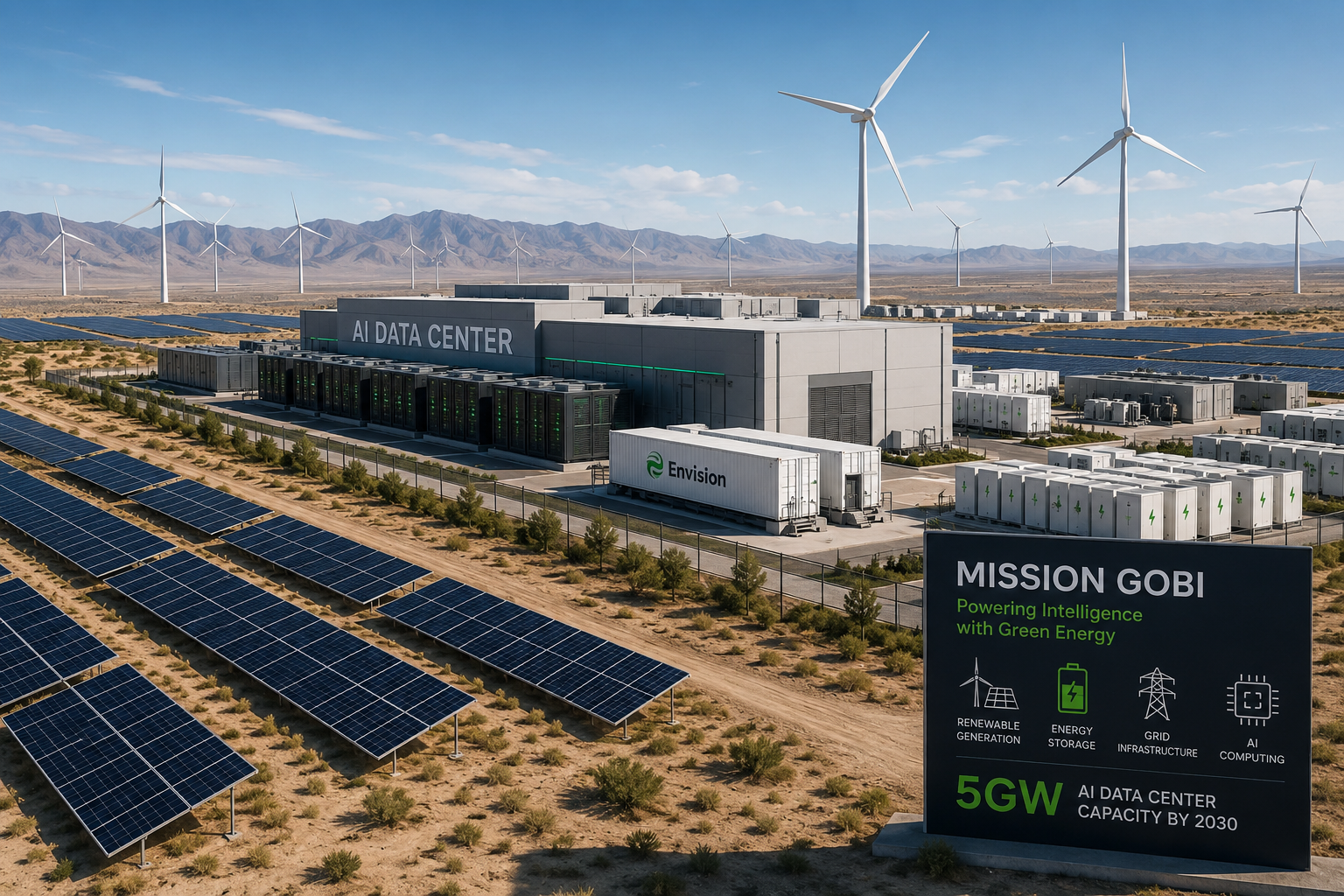
•Announced at VivaTech, the initiative targets desert and arid regions globally by 2030
•Envision plans to integrate renewable generation, storage, grid infrastructure and computing, but has not linked its 5GW target to specific projects
The fact
Envision Energy announced Mission Gobi at VivaTech on 18 June, targeting 5GW of AI data-centre capacity in desert and arid regions by 2030. The renewable-energy systems provider said the programme would bring together renewable generation, storage, grid infrastructure and computing. Envision plans to work with governments, utilities, technology companies, infrastructure investors and local partners, but has not named the sites, capacity allocations, or construction timetable.
The company said its AI data centre in Chifeng, China, runs on directly supplied renewable power. It is also building the Galaxy Campus in Ulanqab, which it describes as a gigawatt-scale AI data centre using directly connected renewable energy. Envision presented both projects as examples of the power model it intends to use for Mission Gobi.
The assessment
Mission Gobi is a development framework, not yet a pipeline of confirmed data centres. Envision is proposing to plan computing capacity and the power system supporting it as one package, but it has not shown how the 5GW target will be divided into individual projects or delivered across different markets. The company points to its Chifeng facility—running on directly supplied renewable power—and the Galaxy Campus under construction in Ulanqab as working examples of the model.
For BTW readers, the distinction matters because desert-located data centres depend on dedicated transmission to population centres. Until Envision names sites, discloses grid connections and shows how renewable output reaches end users, the 5GW figure remains a portfolio ambition rather than deliverable capacity.
What to watch
Watch for Envision to identify the first Mission Gobi sites and disclose the capacity, partners, power arrangements and delivery timetable for each. Site-specific financing, permits or construction starts would show whether the 5GW programme is beginning to translate into deliverable projects.