Summary
- Germany's data-centre statute defines a regulated facility by a rated 300-kilowatt connection, not by what it consumes, and defines the efficiency ratio by naming a DIN standard whose arithmetic the text does not print.
- Set §3 against §12(3) and the public-body certification threshold equals the definitional floor: 300 kilowatts for a centre owned by or operated for a public body, 1 megawatt for anyone else.
A German statute answers the question every efficiency regime fumbles — who is regulated, and who supplies the number — and it answers both with documents rather than instruments. The Energieeffizienzgesetz decides membership from a rated connection, grades members against a ratio defined elsewhere, and takes the operator's own measurements and own filing as the public record.
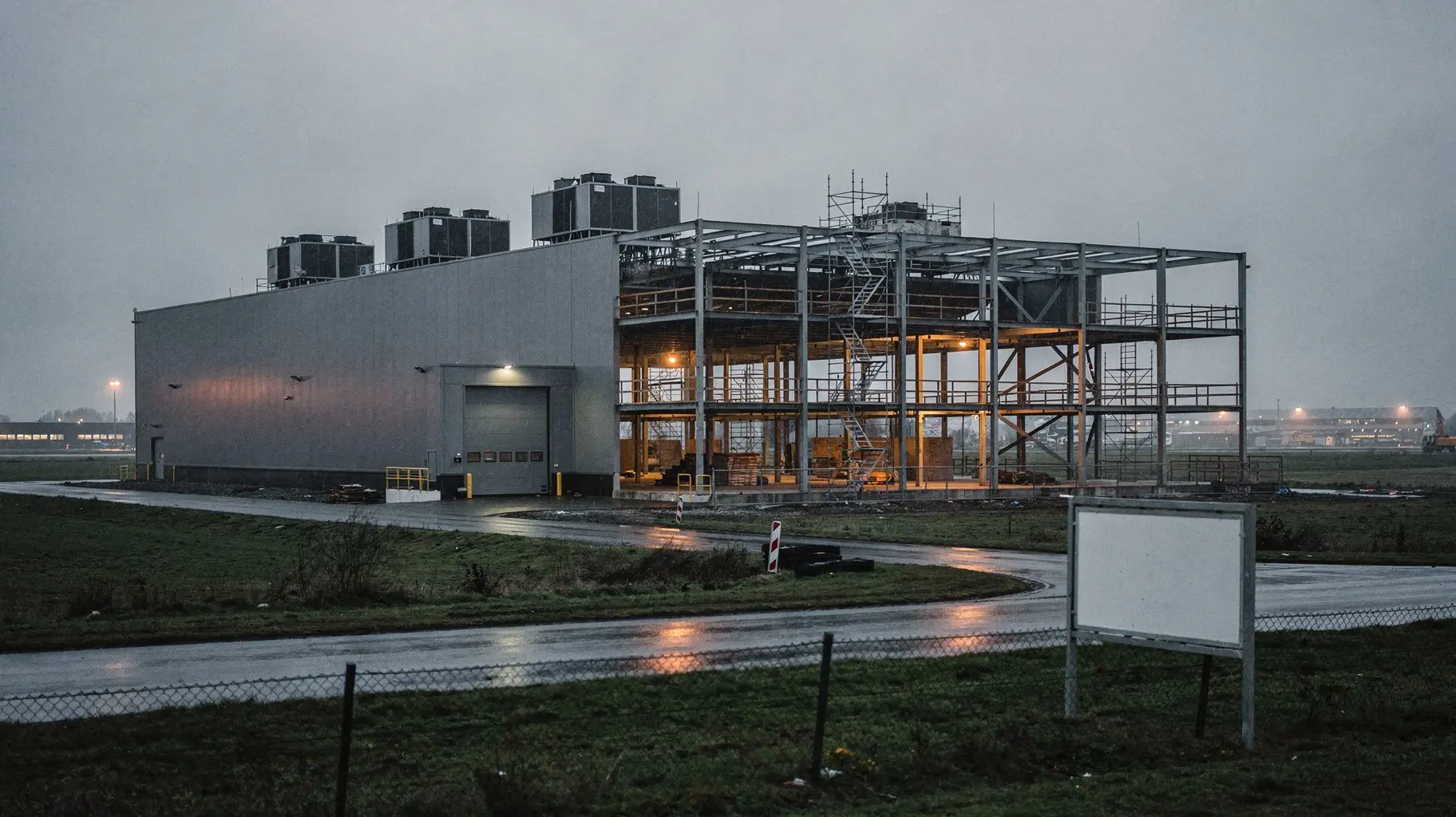
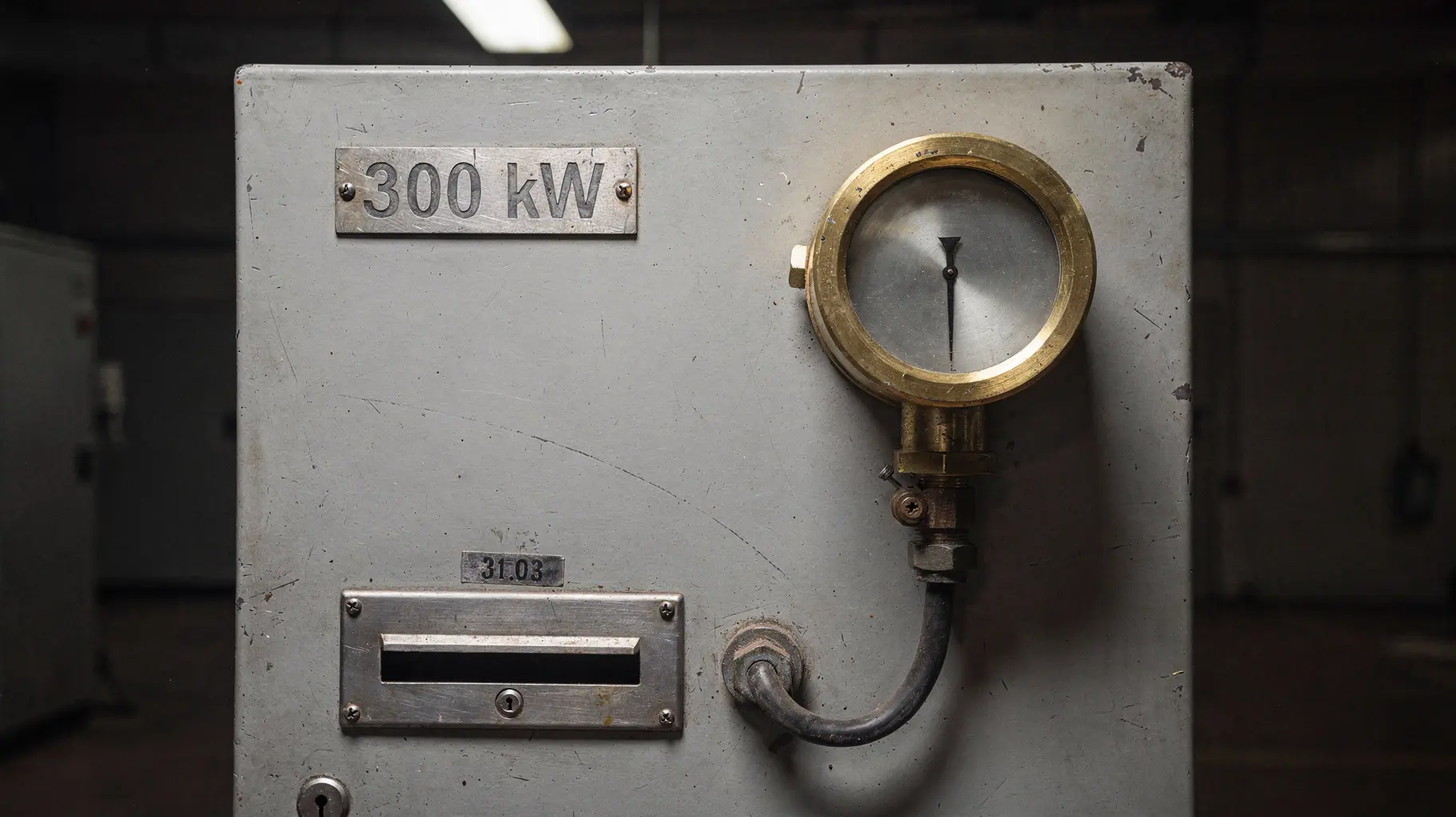
The door is a nameplate. §3 Nr. 24(a) defines a Rechenzentrum as a structure or group of structures for the central housing, connection and operation of IT and network telecommunications equipment, "mit einer nicht redundanten elektrischen Nennanschlussleistung ab 300 Kilowatt" — with a non-redundant electrical rated connected load of 300 kilowatts or more (§3 EnEfG). Nennanschlussleistung is what the supply is engineered to deliver, not what the racks drew last quarter. Nothing in the definition asks for a measurement.
The yardstick is cited, not printed. The same section defines Energieverbrauchseffektivität as the ratio of the whole centre's annual energy demand to the energy demand of the information technology, "im Sinne der DIN EN 50600-4-2, Ausgabe August 2019". The statute names the standard and stops. Both terms of the fraction — what counts as whole, what counts as IT — are settled in a document the law points at (§3 EnEfG).
The pass marks are dated, not sized. §11(1) requires centres already running before 1 July 2026 to reach a ratio of 1,5 or less from 1 July 2027 and 1,3 or less from 1 July 2030, "im Jahresdurchschnitt dauerhaft" — as a lasting annual average (§11 EnEfG). §11(2) puts centres beginning operation on or after 1 July 2026 at 1,2 or less and adds a share of reused energy under DIN EN 50600-4-6 of at least 10 percent, rising to a planned 15 percent for starts from 1 July 2027 and 20 percent for starts from 1 July 2028.
Read the two together and the ceiling follows the commissioning date, not the load. A modest hall switched on in the autumn of 2026 faces 1,2; a far larger campus that was already drawing power has until July 2027 to reach 1,5. That is my comparison of two printed figures — the statute itself makes no such statement — but it is the arithmetic of the dates in the text.
The proof is the operator's own instruments. §12(2) requires, within the energy or environmental management system, "kontinuierliche Messungen zur elektrischen Leistung und zum Energiebedarf der wesentlichen Komponenten des Rechenzentrums" — continuous measurement of the electrical power and energy demand of the centre's essential components (§12 EnEfG). The meters are on the operator's components, reading the operator's load.
And the public number is a filing. §13(1) obliges operators to publish information about their centre under Anlage 3 for the preceding calendar year and transmit it to the Bund by the end of 31 March, in the template the Bund provides (§13 EnEfG). §14 has the federal government run an Energieeffizienzregister in which "die von den Rechenzentren nach § 13 Absatz 1 in Verbindung mit Anlage 3 übermittelten Informationen" are stored and passed to a European data-centre database (§14 EnEfG). The register's input, by the section's own wording, is what the operators sent.
Where ownership becomes a threshold. §12(3) creates the validation-or-certification duty from 1 January 2026 for centres with at least 1 megawatt of non-redundant rated load, and for centres "die im Eigentum öffentlicher Träger stehen oder für diese betrieben werden" at 300 kilowatts (§12 EnEfG). Put that beside the definition and the two numbers coincide: a publicly owned or publicly operated centre is a Rechenzentrum at 300 kilowatts and must certify at 300 kilowatts, while a privately held centre of the same size is a Rechenzentrum that need not certify until it reaches a megawatt. The ownership clause is not decoration. It is a threshold in its own right, and it is the one fact in this chain that a regulator cannot read off a meter.
That is the shape of the regime: the population is a rated figure, the pass mark is a standard, the evidence is self-generated, and the disclosure is self-filed. Nothing in the five sections read assigns a reading to an authority.
What this archive holds on the operator is thinner than the statute. The Leibniz-Rechenzentrum appears in this directory as a RIPE NCC membership and number-resource governance record, with the standing disclaimer that this documents a resource-holder footprint and service-area context and is not proof that the entity sells ISP, IP transit, cloud, registry or managed-network services (directory entry). It appears there, that is, as an address holder, not as a regulated energy consumer.
So the honest position on the centre itself: no document read on 18 November 2026 gave a rated connected load, an annual electricity consumption or an efficiency ratio for it. The operator material obtained that day was its front page (lrz.de). Which public body owns it or operates it for a public body was not established either — and that is the fact §12(3) turns on. This article therefore applies the statutory test and does not place the centre on a rung.
Three other gaps belong beside their claims. Anlage 3, which fixes what operators must publish and send, was not read. §11(3), which carves exceptions out of the reused-energy requirement, was not obtained as text. The DIN standards the statute names were not read; this piece asserts only that the law refers to them, never what they contain.
A search of this archive on 18 November 2026 returned no article on the German data-centre efficiency statute, and none on this operator in this context.
Why the chain matters more than any single number. A regime that measured first would need inspectors, sampling protocols and disputes about whose meter is right. This one moves the argument upstream: define the facility by what it is built to draw, define the ratio by reference to a published standard, require the operator to measure its own components continuously, and take an annual return. Compliance becomes a documentation question before it becomes an engineering one — and the party best placed to define the number is the party being measured. The register at the end of the chain is a store of submissions, not a set of findings.
That does not make the ceilings soft. It makes them textual. The enforceable artefact is the certificate, the template and the 31 March file, and the question a reader can actually check is who wrote each of the four quantities — load, ratio, measurement, return — rather than what any hall happened to draw.
Member Briefing
Read the full trend briefing
Members read the full briefing with the source notes behind every finding.
Strategic Circle
A daily briefing in your language, built from changes we have verified.
Join for USD 20/monthCancel anytime.
Members also get the full research library, a daily briefing on the networks they follow and the private forum.