Summary
- Digital Realty's printed occupancy percentage is its own occupied-megawatt row divided by its own capacity row, and that division ties to one decimal in five of the six quarterly columns reviewed.
- The only definition of a megawatt in those pages belongs to a different table, one quarter's signed leases are priced at $272 and $224 per kilowatt per month with the cash total printed nowhere, and the like-for-like pool has a printed membership rule and no printed roster.
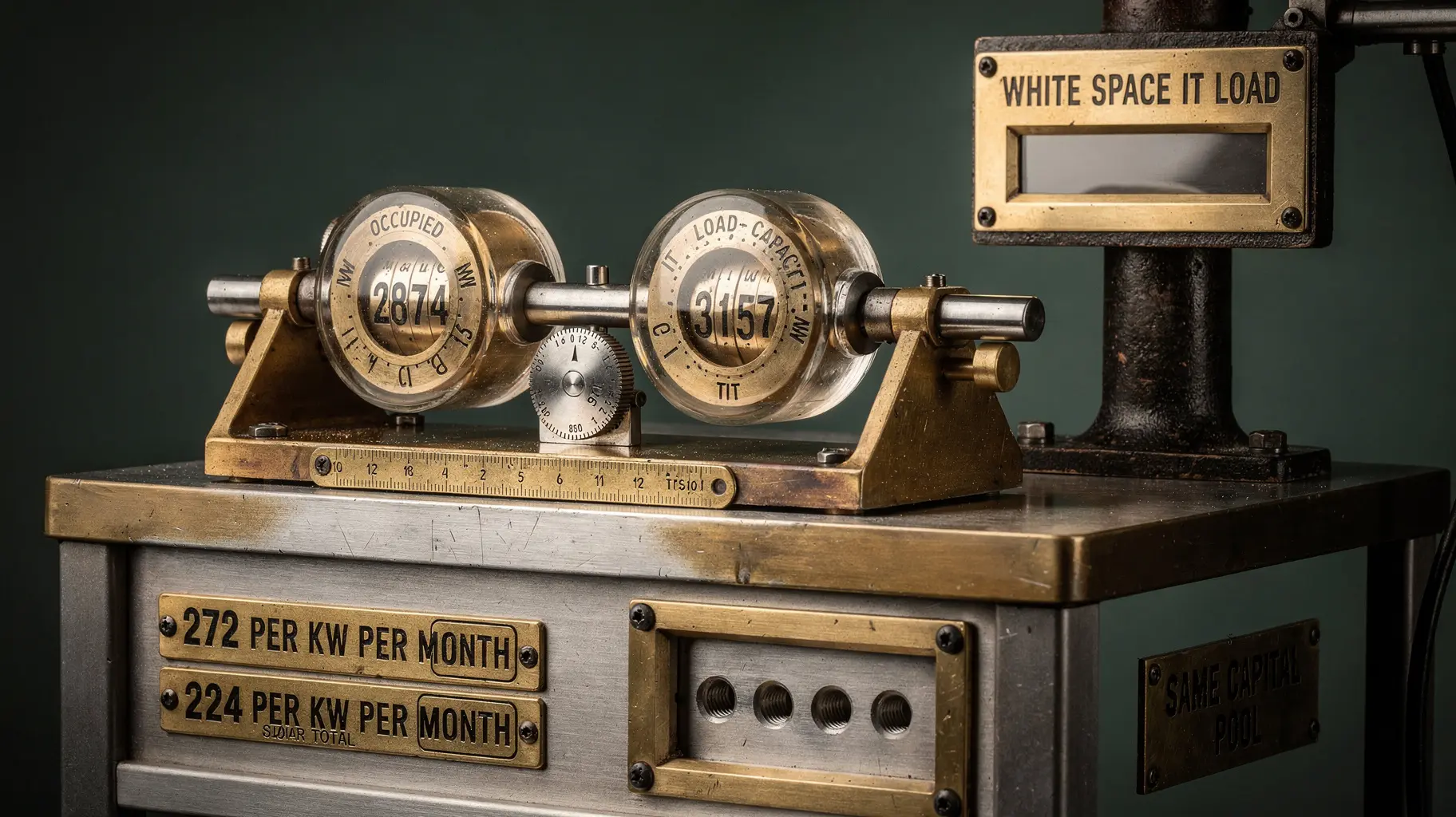
Two rows sit three lines apart on the portfolio page of the third-quarter 2026 financial supplement: occupied megawatts of 2,874 and IT load capacity of 3,157, with occupancy printed beside them at 91.1 per cent (3Q26 supplement). Divide the first by the second and you get 91.04 per cent. Run the same division down the four earlier columns and it keeps tying: 90.23 against a printed 90.2, 90.11 against 90.1, 89.88 against 89.9, 90.38 against 90.4. One quarter further back, where the June 2025 column still appears, 2,565 over 2,858 gives 89.75 against a printed 89.7 (2Q26 supplement). The division is mine. Five of six columns agree to one decimal, and the newest sits 6 basis points above its own quotient.
What those rows count is another matter. The only definition of a megawatt in the pages I read sits under the Occupancy Analysis table, not under the portfolio rows:
(1) White Space IT Load represents UPS-backed utility power in megawatts dedicated to Digital Realty’s operated data center capacity.
And the footnote attached to the occupancy percentage itself describes a calculation that is not this division:
Occupancy and same-capital occupancy exclude capacity under active development and capacity held for development. Occupancy represents our consolidated portfolio in addition to our managed portfolio of unconsolidated entities and non-managed unconsolidated entities. For some of our data centers, we calculate occupancy based on factors including available power, required support capacity and common area. Excludes data centers held for sale and contribution.
So the percentage reproduces its own two rows while the company's own footnote says that for some sites the measurement runs on available power, required support capacity and common area. The division is a consistency test, not the formula. Neither "Occupied MWs" nor "IT Load Capacity MWs" carries a line-item definition in the supplement text I retrieved on 25 November 2026; whether one sits on a page retrieval did not return, I cannot say.
One date can carry two fullness numbers. The 2025 Form 10-K describes the portfolio as approximately 84.7 per cent leased at 31 December 2025, including unconsolidated investments (Form 10-K). The supplement prints occupancy of 89.9 per cent for the same date. Five point two points, two stated populations, and no printed sentence joining them.
One page on, the supplement prices leases instead of dividing them. The leasing table reports annualized GAAP rent of $603,808 thousand for the quarter at Digital Realty's share on 184,834 units, and prints two per-unit rates beneath it: $272 on a GAAP basis and $224 of initial stabilized cash rent per kilowatt per month (3Q26 supplement). Multiply the GAAP rate by twelve months and by the printed quantity and you get $603,298,176 against the printed $603.808 million, 0.08 per cent apart, which is what a rate and a count should do. Multiply the cash rate the same way and you get $496,833,792, a total no page in the reviewed set prints. The two rates sit $48 per kilowatt per month apart, $106.5 million of annualized rent on this quarter's volume, and the cash rate is 82.3 per cent of the GAAP rate. Those three figures are mine, built from two printed prices and one printed count.
The quantity row is labeled "Kilowatt Leased / NRSF (in thousands)", and it carries two denominators at once: kilowatts in the data-center columns, square feet in the Other columns. The Other columns close only on an annual reading, where 9,000 square feet at $63 gives $567,000 against the $587,000 printed.
The same row group prints a weighted average lease term of 16.1 years for the data-center total, 5.5 years for 0 to 1 MW and 17.9 years for greater than 1 MW, with its weighting stated:
Weighted average lease term excludes renewal options and is weighted by annualized GAAP rent.
Weight it that way myself and the total comes out lower. Rent weights of 21.47 and 78.53 per cent give 15.24 years, 100 per cent-share rent weights give 15.79, and quantity weights give 15.14. The year-to-date and trailing columns repeat the gap: 11.87 against a printed 13.2, and 11.08 against 12.6. The two buckets tile the total exactly, $129,628 thousand plus $474,180 thousand against the $603,808 thousand printed, so no third bucket is missing from the arithmetic. An unprinted weight could produce 16.1. What is printed, under its own stated weighting, is a total my arithmetic does not reach.
The like-for-like pool is where the definitions live, and it prints its rule twice, as a footnote to the portfolio page and as footnote one to the Same-Capital Operating Trend Summary:
Represents data centers owned as of December 31, 2024, with less than 5% of total rentable square feet under development. Excludes data centers that were undergoing, or were expected to undergo, development activities in 2025-2026, data centers classified as held for sale and contribution, and data centers sold or contributed to joint ventures for all periods presented. Prior period results have been adjusted to reflect current same-capital pool.
What the rule does not come with is a roster. No count of properties inside the pool appears in the pages reviewed; the only count there is 311 data centers, 88 of them held as investments in unconsolidated entities (3Q26 supplement, company copy). The pool is restated rather than fixed. The second-quarter supplement reports same-capital rental revenues of $860,191 thousand and cash NOI of $697,508 thousand for the three months to 30 June 2026 (2Q26 supplement); the third-quarter comparative column for those same three months reports $860,870 thousand and $696,658 thousand. $679 thousand and $850 thousand moved inside a closed quarter, which the printed sentence about adjusting prior period results explains and no column flags.
Backlog is counted in dollars and never in megawatts. Signed-but-not-commenced leases are $852 million of annualized GAAP base rent at Digital Realty's share at 30 September 2025 (3Q25 exhibit) and $817 million at 31 December 2025 (4Q25 release); the first-quarter 2026 announcement carries $1.8 billion of total backlog at 100 per cent share and $1.0 billion at share (1Q26 supplement). Three documents, one line name, one unit, and no megawatt attached to it anywhere in the set.
The building count does something similar. Data centers run 311, 310, 309, 310, 311 across the five columns, ending where they began in a year in which capacity rose 278 megawatts; 3,157 divided by 311 is 10.15 megawatts per printed data center and 2,874 divided by 311 is 9.24, neither quotient printed. A third-party table circulating the series prints an "Available MW" of 283 for the quarter, which is 3,157 minus 2,874 and is labeled there as a subtraction rather than a company row (Sterling KPI table). The earnings call, as a third party rendered it on 30 October 2026, opens with 3.2 gigawatts across 311 data centers and roughly 1.5 gigawatts under construction (call transcript); that is a transcript's figure, not a filed one.
A tenant signing a fifteen-year lease, a lender sizing a loan against contracted rent and an analyst compounding a growth rate are all reading ratios whose denominators belong to the publisher. The questions are narrow. Which megawatt is on the row, UPS-backed utility power dedicated to operated capacity, or available power with support capacity and common area folded in? Which rent basis prices the lease at signature, and does the cash figure total when the same quantity is multiplied out? What weight produces a 16.1-year term, and does the pool behind the like-for-like number hold the same properties this quarter as last? Digital Realty answers the first two in the same document, in two tables, in two vocabularies, and prints the third as a rule it leaves the reader to staff. Its directory record sits at Digital Realty.
Member Briefing
Read the full trend briefing
Members read the full briefing with the source notes behind every finding.
Strategic Circle
A daily briefing in your language, built from changes we have verified.
Join for USD 20/monthCancel anytime.
Members also get the full research library, a daily briefing on the networks they follow and the private forum.