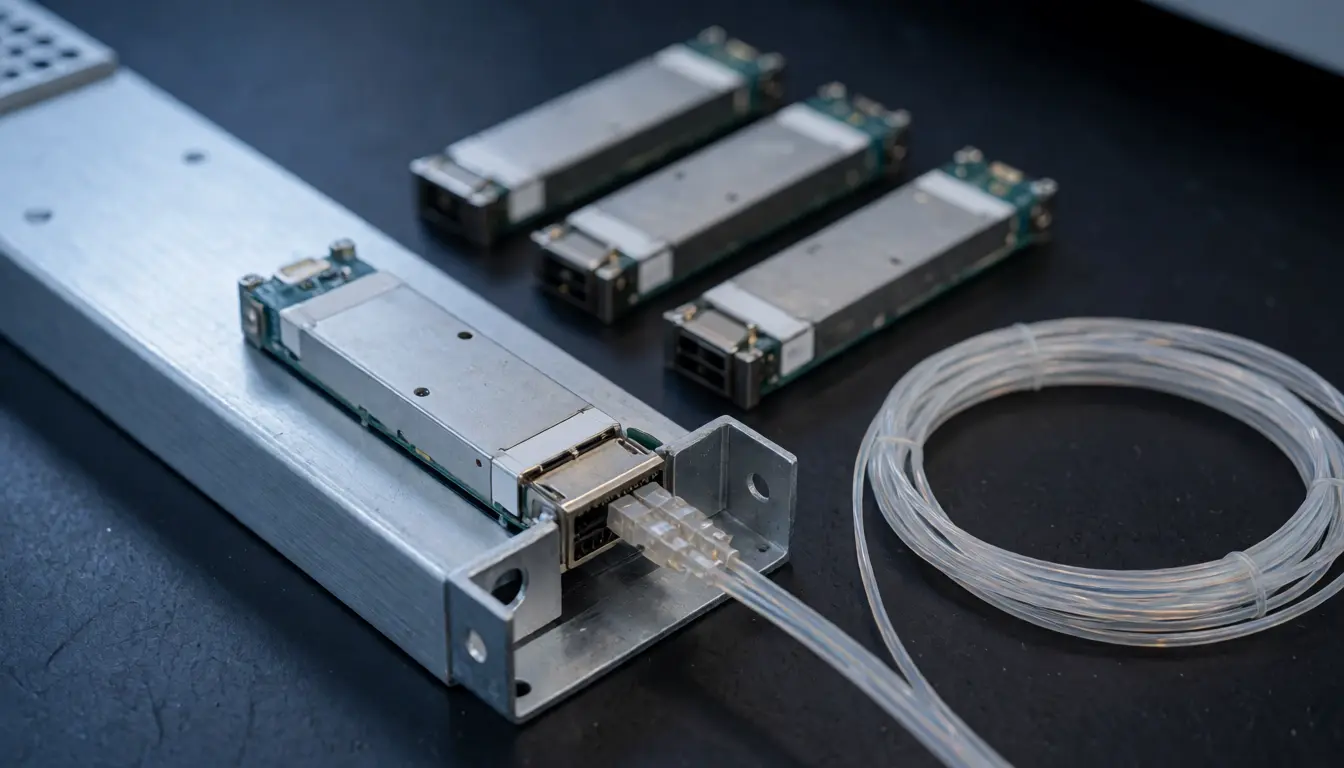
Summary
- Coherent's own page for its 400G ZR+ module prints an operating distance of more than 600 km, a -10 dBm launch power, and not one of the other numbers a link budget needs: no required optical signal-to-noise ratio, no receiver sensitivity, no power consumption in watts, no amplifier count.
- At the 0.275 dB per kilometre that ITU-T G.652 prints as typical for the C band, the only span-loss budget anywhere in the set, OIF's 11 dB, is exactly 40.0 km, while the 120 km the same interface agreement names costs 33.0 dB, three times that budget.
The page prints a length
Coherent sells the FTCD3313R1PCL as a 400G, 300G and 200G QSFP-DD coherent module, and its product page prints a specification table worth reading line by line: an operating distance of more than 600 km over duplex single-mode fibre; a transmitter optical output power of -10 dBm; tuning across 5 THz of the C band; DP-16QAM, 8QAM and QPSK; 478 Gb/s; CMIS. That is a thorough description of a product. It is not a description of a link, and the difference between the two is three numbers long.
A link between two of these modules is an arithmetic chain. The transmitter puts out a stated power. The receiver needs a stated optical signal-to-noise ratio to decode what arrives. The forward error correction buys a coding gain, in decibels, that relaxes how much noise the receiver can tolerate. Everything the fibre and the amplifiers take away between the two ends must fit inside what is left. Divide that remainder by the fibre's attenuation per kilometre and you have a distance. The module owns the launch power and the required noise ratio. A standards body owns the loss budget it assigns to an application.
The fibre maker owns the coefficient. The operator owns the connectors, the splices, the aging and the margin.
So the kilometre is the one number in the chain that nobody in the chain owns, which is presumably why it is the number printed on the page.
A reach is a budget wearing a length
The mechanism is not exotic. Every decibel of span loss is a factor of about 1.26 in optical power, and every fibre kilometre spends a fixed fraction of a decibel. At 0.275 dB per kilometre, one decibel buys 3.64 km and ten decibels buy 36.4 km. A span of 120 km spends 33.0 dB before any connector, any splice, any ageing and any margin. The module's job is to survive that; the fibre's job is to set the price per kilometre; and the page's job, apparently, is to state the answer without either operand.
That is why the interesting question about a printed reach is never whether it is true. It is which budget it spends, which amplifier arrangement the budget assumes, and which coefficient converted the budget into the length. Three questions, and the pages that answer them are rarely the page that makes the claim.
The only budget in the set belongs to another case
The one place in twenty-three documents that prints a span-loss budget in decibels for this class of module is OIF's own announcement of the 400ZR implementation agreement, and it prints the number in a sentence about a different application: "Unamplified, single wavelength links with a loss budget of 11dB". The agreement itself scopes 400ZR to 120 km or less, amplified, point-to-point, 100 GHz DWDM noise limited links, to unamplified single-wavelength loss-limited links, and to 120 km or less amplified at 75 GHz. The 11 dB is the unamplified case. The 120 km is the amplified case, and the amplified case is labelled noise limited, which is a way of saying the distance is set by accumulated noise rather than by loss.
Run the unamplified budget against the fibre the industry actually deploys. ITU-T G.652, in its 08/2024 edition, prints 0.275 dB per kilometre as the typical concatenated attenuation for 1530 to 1565 nm, with maxima of 0.30 for G.652.D in the same window and 0.35 for G.652.B at 1550 nm. Eleven decibels divided by 0.275 is 40.0 km exactly. The division is mine; no page in the set performs it and states the result. But 40.0 km is precisely the distance one vendor prints beside that same budget.
At the maxima the same budget buys less: 36.7 km at 0.30 and 31.4 km at 0.35, a spread of 8.6 km, which is 21.5 per cent of the 40.0 km the typical value gives. The standard's typical figure is not a guarantee, the maxima are not predictions, and the gap between them is the first place a quoted reach becomes a range.
Two pages do divide, and one argues with itself
Flexoptix's operation-mode table pairs application codes with distances: 80 to 120 km for the amplified code, about 40 km for the 11 dB budget, about 8 km for a 2 dB budget. It prints no coefficient. Run the two distances backwards and they only close at two different fibres: 2 dB is exactly 8.0 km at 0.25 dB per kilometre, and 11 dB is exactly 40.0 km at 0.275. No single coefficient reproduces both. Either the page assumes two different fibres in one table, or one of the distances carries an unnamed reserve, and the page says which in neither case.
Arista's DENOG12 slide is bolder: it prints the coefficient, states that the 11 dB application code "achieve[s] 40km reach with 0.25 db/km fiber", and its own operands divide to 44 km. Four kilometres above its own answer, 10 per cent of the 40 it prints, with no reserve, no span count and no rounding basis on the slide to explain the difference.
Put those two pages together and the finding is not that nobody divides. Two public pages do. The finding is that the divisor printed beside a stated distance contradicts that distance, and the divisor that reproduces the distance is printed nowhere.
What the amplified case costs, and what it declines to print
The amplified case is where the marketing kilometres live, and it is exactly where the decibels stop. A 120 km span spends 33.0 dB at 0.275 dB per kilometre. That is 3.00 times the only printed budget, which is the arithmetic reason the amplified case cannot be specified as a loss-limited link: at the distance the agreement names, the fibre alone has already spent three times the loss the unamplified application may tolerate, and what remains is a noise question.
Scale it up. The 600 km on Coherent's page costs 165.0 dB of span loss at 0.275 dB per kilometre, fifteen times the only printed budget, and because 600 km is a bound the 165.0 is a lower bound. What the page never says is how many spans that is. Eight spans of 75 km and fifteen spans of 40 km spend the same decibels and produce very different noise, because each amplifier adds its own. The span count is the number that would turn decibels into a noise figure, and it is absent.
Scale it down to a single standard span and the same arithmetic bites. An 80 km span, the span length one MSA whitepaper uses in its reference simulation, costs 22.0 dB at 0.275 dB per kilometre, which is exactly the whole unamplified 400G 16QAM loss budget Arista's data sheet prints for that mode. One standard span, one fibre, no connectors, no splices, no margin, and the budget is gone. At the whitepaper's own 0.22 dB per kilometre the span costs 17.6 dB, which is where the simulation's headroom comes from.
And when a sheet does print a decibel for the amplified class, the decibel and the kilometre refuse to agree. Arista prints 25 dB maximum span loss for its 400ZR modules and places those modules in the 120 km class. Twenty-five decibels at 0.275 dB per kilometre is 90.9 km. Reaching 120 km on 25 dB requires 0.208 dB per kilometre, which is 24.4 per cent below the standard's typical coefficient. Two readings survive: the deployed span is better than typical concatenated fibre, or the reach label is longer than the loss behind it. The sheet does not choose.
A correction: neither 0.22 nor 0.25 is a fibre specification
I have to correct my own reservation here, because I built it on two coefficients that turn out to be something else.
Neither 0.22 nor 0.25 dB per kilometre is a fibre rating in this set. The 0.22 appears as a reference-simulation assumption inside the OpenZR+ whitepaper, which models 80 km G.652 spans at 0.22 dB per kilometre with a 5.5 dB amplifier noise figure. The 0.25 appears on a conference slide as a design assumption. The recommendation in force prints 0.275 as the typical concatenated value for the C band, and prints 0.30 and 0.35 as maxima depending on the fibre sub-category.
That distinction decides my own arithmetic. My reservation claimed one decibel of coding gain buys four to five kilometres at 1550 nm. At the standard's typical 0.275, one decibel buys 3.64 km; at the 0.30 maximum, 3.33 km; at the 0.35 maximum, 2.86 km. My 4.0 km sits 9.9 per cent above the 3.64 km the typical coefficient gives, and my 4.5 km sits 23.6 per cent above it. Both figures were quotients of a decibel by a design assumption, and I presented them as properties of the fibre. The correction is not a rounding; it is the difference between a simulation input and a standard.
The code carries no distance, and the standard says why
My reservation expected the optical transport interface recommendation to print an application code carrying a distance designator beside a loss budget. It does not, and the omission is documented rather than accidental.
In ITU-T G.698.2, the code letters name an application family, a spectral excursion, a channel spacing in gigahertz, whether the black link is dispersion-uncompensated, the highest optical tributary signal class, whether the link may contain optical amplifiers, the fibre type, the band, and the FEC requirement. None of those fields is a distance and none is a loss. The recommendation's parameter table prints, for its 100G DP-DQPSK wide-excursion class, a minimum optical signal-to-noise ratio of 24 dB referenced to 0.1 nm, a receiver tolerance of 19 dB referenced to 0.1 nm, a mean channel output window of -8 to -3 dBm at the source and a mean input window of -18 to 0 dBm at the receiver, plus ripple, residual dispersion, differential group delay, polarisation-dependent loss and crosstalk limits. There is no distance column. There is no link-loss budget.
The power windows do yield one, if a reader does the subtraction: the gap between the minimum output and the minimum input is 10 dB of insertion loss, which is 36.4 km at 0.275 dB per kilometre. That subtraction is mine, and it is the only way to get a length out of the table.
Why the omission? An IEEE 802.3 contribution about that recommendation says it plainly: as a result of the black-link methodology, the parameter tables contain no references to distance, and link losses are not specified, mainly because the link may contain optical amplifiers. A black link is a promise about optical interfaces, not about a route. The join I predicted does not exist at the standard. The reason it does not exist is the subject of this article.
The receiver's number and the missing ruler
Where the numbers do appear, they arrive without their unit of measurement in most of the places that print them. Three pages state a receiver requirement of 26 dB for the 400ZR class: an OIF market-focus deck, Cisco's 400G coherent data sheet, and Juniper's JCO400 sheet. Arista prints 22.5 dB minimum receive OSNR for amplified 400G 16QAM. The OpenZR+ whitepaper prints 24 dB at 400G, 21 dB at 300G, 16 dB at 200G and 12.5 dB at 100G.
The only place in the set that prints the reference bandwidth beside the figure is OIF's OFC 2025 plugfest white paper: 26 dB per 0.1 nm, measured across a hundred transmitter and receiver combinations at 193.7 THz and -10 dBm output, with most meeting it, two pairs between 26.2 and 26.38, and measured values clustering between 23.5 and 24 dB per 0.1 nm. A 0.1 nm window at 1550 nm spans 12.5 GHz, which is my arithmetic and is stated on no page. So the same number, 26 dB, means a requirement measured in one width and quoted in another, and a sheet that prints neither has printed a number without a ruler.
The code is worth 0.8 dB, which is not a reach class
Here is the arithmetic that closes the question. EXFO's 400G poster prints both coding gains at 16QAM on one page: C-FEC at 10.8 dB with 14.8 per cent overhead, oFEC at 11.6 dB with 15.3 per cent overhead. The difference is 0.8 dB, which is 2.91 km at 0.275 dB per kilometre. The code construction behind the lower figure is documented in an IEEE 802.3 B10K contribution: a soft-decision Hamming inner code with a hard-decision staircase outer code, 10.8 dB of net coding gain at 16QAM, 14.8 per cent overhead, a pre-FEC error rate of two in a hundred for a post-FEC floor of one in a thousand trillion, and about 4 ms of latency. The OpenZR+ technical specification prints the oFEC figure at 11.6 dB for DP-16QAM at a pre-FEC threshold of two in a hundred, and launch classes of -10 dBm, with a 0 dBm class in two variants.
Now compare that with the labels. The gap between the 120 km class and a claim of more than 1,000 km is 880 km of my subtraction. At 2.91 km, the code accounts for at most 0.33 per cent of it. Measured against the further claim of more than 2,000 km at lower data rates, the share falls to 0.15 per cent.
The vendor rows agree that the code is not the step. On Cisco's table the receiver requirement relaxes from 26 dB for 400ZR to 23.1 dB for 400G ZR+ 16QAM with transmit shaping, a relaxation of 2.9 dB. The code accounts for 0.8 dB of that and shaping for another 0.6, since the same table prints 23.7 dB without shaping and 23.1 dB with it. That leaves 1.5 dB unaccounted on the pages I read. And the modulation order does what the code cannot: the OpenZR+ whitepaper prints 24 dB at 400G against 12.5 dB at 100G, a relaxation of 11.5 dB, which is 14.4 times what separates the two code generations.
So my reservation's "firmware rather than optics" was too strong. The honest statement is narrower and better: the firmware is a rounding term, the modulation order is the purchase, and the kilometres are the fibre's answer to a noise question.
What the reach costs in watts
The same reservation claimed the coding gain is paid for in watts, and there the mechanism survives with an invoice larger than the gain.
Nokia's page is the only one in the set that sells all three variants and prints a wattage for each: 17.5 W typical for the 400ZR, 20.9 W typical for the 400ZR+, 23.5 W typical for the high-power 400ZR+, with launch powers of -10 dBm, -10 dBm and +3 dBm. The move from 400ZR to 400ZR+ at the same launch costs 3.4 W, and the code difference available to explain it is 0.8 dB, so that decibel is invoiced at about 4.25 W. The move to the high-power variant buys 13 dB of launch power for 2.6 W, or 0.2 W per decibel. The ratio is about 21 to one: a decibel of coding gain is priced at more than twenty times a decibel of launch power on the one page that sells all three.
The wider picture is messier. Arista prints 16 W typical and 20 W maximum for its 400ZR modules and 23 W maximum for the OpenZR+ one; Juniper prints 19 W maximum; Cisco's low-power sheet prints "QSFP-DD type 2B compliant" and no watt at all; Coherent's page prints nothing. Five sheets, one nominal 400G class, a range from 16 W to 23.5 W, and no two figures on the same basis: two typical, two maximum, one that prints both for one part and a form-factor statement for another. Averaging them would invent a number the set does not contain, so I do not.
The simulation that buys the kilometres
The closest the MSA material comes to a worked budget is a simulation, and it is worth reading as one. The OpenZR+ whitepaper sets a worst-case back-to-back OSNR tolerance of 24 dB at 400G, a transmission impairment penalty of 1.5 dB for EDFA-only links and 2 dB with Raman, and a noise-limited receive sensitivity of -12 dBm. It then models 80 km G.652 spans at 0.22 dB per kilometre with 5.5 dB amplifier noise figures, and reaches 480 km with EDFA only and 1,040 km with EDFA and Raman.
Hold everything there constant except the fibre and the answer moves: the same noise allowance at 0.275 dB per kilometre buys about 384 km. That is a scalar equivalence, not a measurement, and it is the cleanest demonstration available that the difference between one quoted kilometre figure and another can be the fibre table rather than the module.
The same whitepaper also explains something the vendor pages leave implicit. Its -10 dBm launch power mandates an amplifier in the add path, and it states its reach in kilometres per span count, not as a maximum span loss. When a page says "over 1,000 km" without a span count, the reader has been given a distance and denied the one number that converts it into noise.
Two 800G claims, one label, no amplifier count
The longer class produces a genuine contradiction. Coherent's 800G general-availability release says the module delivers more than 500 km in ZR mode, beyond 1,000 km in ZR+ modes with probabilistic shaping, and over 2,000 km at lower data rates, with -7 dBm for OIF 800ZR and 0 dBm for ROADM-based line systems. Cisco's 800G sheet places 800ZR at up to 120 km amplified DWDM and 800G ZR+ over 1,000 km amplified, with transmit power above +1 dBm. Either the two ZR labels name different applications, or one of them is a marketing word. Neither document prints an amplifier count, a span loss or a required noise ratio behind the figure, so the contradiction cannot be closed from the pages.
The earlier milestone has the same shape. II-VI's 2022 shipment announcement, now Coherent, describes a 400G ZR+ module at 0 dBm output within QSFP-DD power-consumption requirements, qualified by Windstream, built on indium phosphide. It prints a launch power and a customer and no wattage. It arrived on a financial platform host rather than the issuer's own domain, which is worth grading down, and it is used here only for the 0 dBm milestone.
The countercases, at full strength
The decibel budget does exist and it is the standards body's own: 11 dB for the unamplified single-wavelength link, printed in the same breath as the 120 km objective it does not apply to. My reservation said the conversion factor lives in a third-party document; in fact the budget lives in the interface agreement's own announcement, and the coefficient lives in a fibre recommendation. Both halves exist. They are just not on the same page.
An amplified case does print a span loss: 25 dB maximum for one vendor's 400ZR modules. So my premise survives only in a narrower form. Where a decibel is printed for the amplified class, it does not reproduce the kilometre printed for that class, and the sheet prints no coefficient.
One sheet prints the whole set at once. Juniper's JCO400 data sheet states 120 km for amplified DWDM noise-limited links and under 40 km for single-wavelength unamplified loss-limited links, a -10 dBm transmitter minimum, receiver windows of -12 to 0 dBm amplified and -20 dBm unamplified, a receiver requirement below 26 dB typical and 26 dB worst case end of life, the code by name, and 19 W maximum. Nothing in my opening survives as a claim about the industry. It survives only as a claim about which page a buyer is handed.
Two public pages do perform the division, as described above, and their disagreement is the finding rather than the refutation.
The application code exists as a compact specification, and one code in it is loss-limited: 0x02, the unamplified case. It is a better instrument than a kilometre, because it names the amplifier assumption, the fibre type and the decoding requirement in one string. What it cannot do is give a distance, because the black link is allowed to contain amplifiers.
The long-reach variants really are partly different optics. One high-power variant launches at +3 dBm against -10 dBm, a difference of 13 dB that costs 2.6 W, and the MSA gives the 0 dBm class its own interface identifiers.
The ITU does print a coherent optical power budget template, with beginning-of-life and end-of-life margins, repair margins, and amplifier parameters from small-signal gain to gain flatness, in G.977 on optically amplified submarine cable systems. It is scoped to repeatered submarine cable. The terrestrial buyer's template exists in the ITU catalogue; it is filed under the sea.
And the missing reference bandwidth is a vendor habit, not a universal one: the standards print the window, and the vendor sheets mostly do not. This article names which is which rather than generalising from either.
What is not answered, and what that costs the reader
Every absence in this article is a count over the twenty-three documents I read on 26 November 2026, not a claim about what is unpublished anywhere. Several of them matter to the argument.
Coherent's page says to consult the datasheet for full ranges, and that PDF was not obtained for this reading, so the absence of a wattage, a receiver sensitivity and a required noise ratio is stated for the page and not for the company. The amplifier arrangement and span count behind "over 600 km" are not printed at all, so the figure cannot be converted into a span budget or a noise figure. The conference slide that prints 40 km where its own operands give 44 explains neither a reserve nor a rounding nor a span count. The table that prints two distances re-derives at two coefficients and names neither.
Whether one vendor's "ZR mode" and another's 800ZR class are the same application cannot be settled from either page. The exact column alignment of the interface recommendation's parameter table is not visually confirmed in the extracted text, so only the values with unambiguous row labels are quoted. Whether the MSA technical specification prints a span-loss table in a section the extraction did not reach is an open not-found rather than a proof of absence.
Whether the 5.5 dB amplifier noise figure in the reference simulation is beginning-of-life or end-of-life decides how much of that 480 km survives ageing, and the whitepaper does not say. And whether the 12.5 dB at 100G is referenced to 0.1 nm is unstated in the retrieved passage, which is why this article prints it without a window.
One more boundary earns its place. No page in this set prints a deployed span's measured loss. The promise is never tested against a measurement here, and the missing measurement is exactly the number a buyer would need to close the question.
What a buyer would need
Strip the marketing away and the purchase is described three ways at once. Kilometres, decibels and watts are one thing: a noise allowance converted into distance by a fibre coefficient, delivered by a module in a cage with a thermal limit.
A buyer who wants to know whether a link will work needs four numbers and is usually offered one. The measured loss of the span, not its length. The number of spans and the noise figure of each amplifier. The fibre's coefficient at the operating wavelength, measured or contractual rather than typical. And the receiver's required noise ratio in a stated reference bandwidth, end of life, with the code named.
Give those four and the distance is an output. Omit them and the distance is an input, which is why it fits so comfortably on a product page. The page prints the kilometres. It prints neither the decibels those kilometres cost, nor the coefficient that converts one into the other, nor the amplifier that decides which budget applies. A length that nobody in the chain owns can be claimed by anybody in the chain, and the buyer is the party who finds out which one was telling the truth.
Sources
- Coherent, FTCD3313R1PCL 400G/300G/200G QSFP-DD digital coherent transceiver
- Coherent, 800G ZR/ZR+ general availability release, 28 March 2025
- II-VI, now Coherent, 400G ZR+ shipment announcement, 8 February 2022
- OIF, Implementation Agreement 400ZR, revision 03.0.1
- OIF, publication announcement for the 400ZR implementation agreement
- OIF, 400ZR and 800ZR interoperability white paper, OFC 2025 plugfest
- OIF, ECOC 2022 market focus presentation
- ITU-T, Recommendation G.652 (08/2024), characteristics of a single-mode optical fibre and cable
- ITU-T, Recommendation G.698.2 (11/2018), amplified multichannel DWDM applications with single channel optical interfaces
- IEEE 802.3, contribution on the revised G.698.2, November 2018
- IEEE 802.3 B10K, contribution on concatenated FEC, 8 May 2018
- OpenZR+ MSA, technical specification revision 3.0
- OpenZR+ MSA, 400G digital coherent optics for multi-haul, whitepaper, 29 September 2020
- Arista Networks, 400ZR DCI solution data sheet
- Arista Networks, DENOG12 presentation on next-generation optics
- Flexoptix, 400G ZR operation modes, 12 August 2021
- Cisco, 400G digital coherent optics QSFP-DD data sheet
- Cisco, QSFP-DD 400G ZR/ZR+ low-power coherent optics data sheet
- Cisco, QSFP-DD and OSFP 800G ZR/ZR+ coherent optics data sheet
- Nokia, 400ZR/ZR+ coherent modules
- Juniper Networks, JCO400 coherent optical transceivers data sheet
- EXFO, 400G technical poster
- ITU-T, Recommendation G.977 (01/2015), characteristics of optically amplified optical fibre submarine cable systems
Member Briefing
Read the full trend briefing
Members read the full briefing with the source notes behind every finding.
Strategic Circle
A daily briefing in your language, built from changes we have verified.
Join for USD 20/monthCancel anytime.
Members also get the full research library, a daily briefing on the networks they follow and the private forum.