
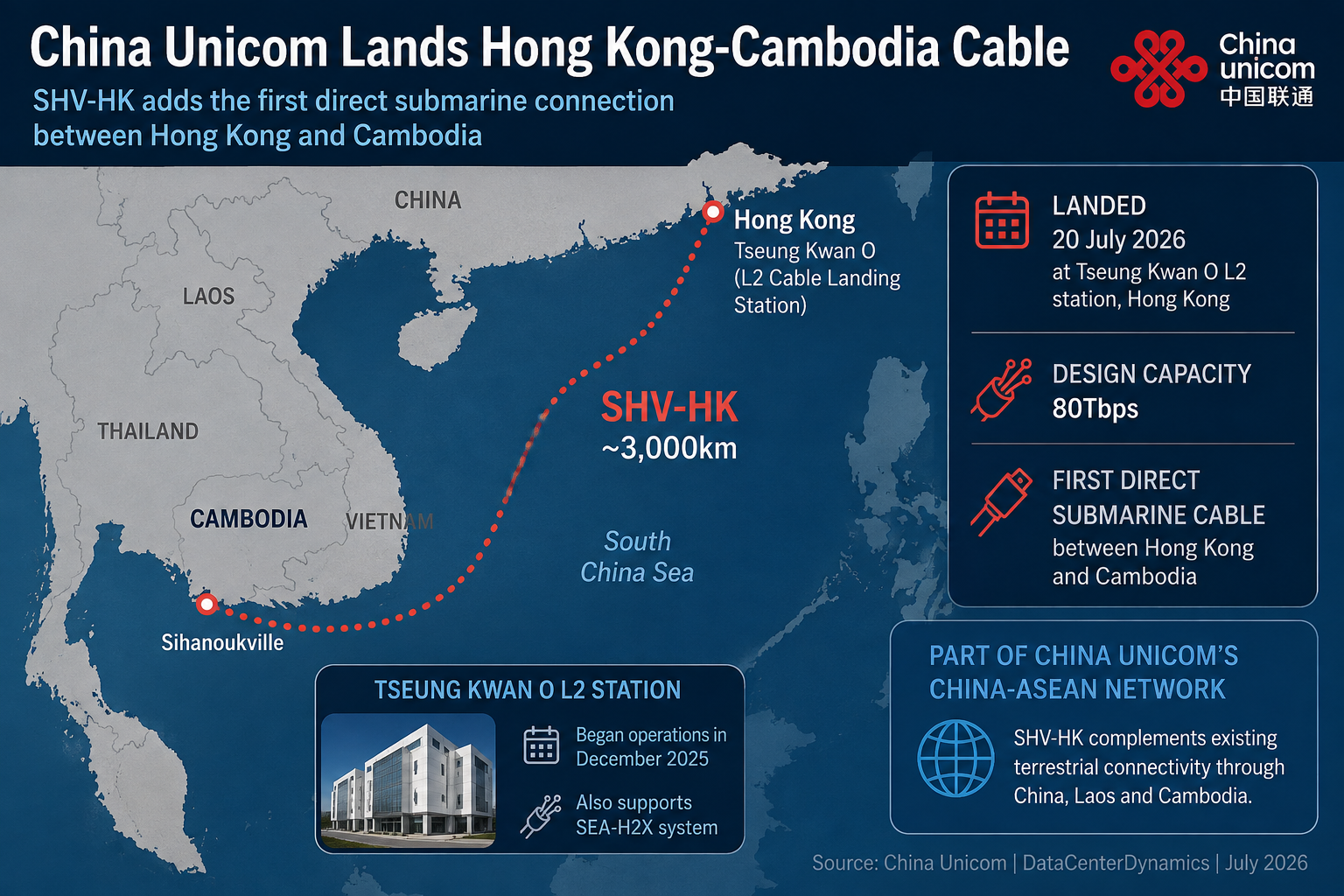
- The nearly 3,000km route links Tseung Kwan O with Sihanoukville, with the Hong Kong landing completed on 20 July
- HV-HK is designed for 80Tbps and is the first direct submarine connection between Hong Kong and Cambodia
The fact
China Unicom has landed the SHV-HK submarine cable at its L2 cable landing station in Tseung Kwan O, Hong Kong. The company said the landing was completed on 20 July. The nearly 3,000km system is designed to connect Hong Kong directly with Sihanoukville, Cambodia, with a design capacity of 80Tbps. China Unicom describes it as the first direct submarine cable between Hong Kong and Cambodia.
The project follows a landing cooperation agreement signed in October 2023. China Unicom says SHV-HK will form part of its wider China-ASEAN network, which also includes terrestrial connectivity through China, Laos, and Cambodia. Its Tseung Kwan O L2 station began operating in December 2025 and also supports the SEA-H2X regional cable system. No ready-for-service date, initial lit capacity or customer commitments have been disclosed in the available reporting.
The assessment
SHV-HK adds a subsea path alongside China Unicom’s existing terrestrial connectivity into Cambodia. Once the cable is commissioned, network planners will have another physical route when allocating capacity and routing traffic between Hong Kong and Cambodia. The change is therefore in the network paths available to operators, not simply in the cable’s headline capacity.
The operational effect remains uncertain. The cable has landed, but the available sources do not give a ready-for-service date, initial lit capacity or confirmed customer use. Its 80Tbps figure is design capacity, not bandwidth already available to carry traffic. For BTW readers, the landing changes the physical route map before it changes live network operations. Its practical value will become clearer when China Unicom activates capacity and carriers begin using SHV-HK for traffic between Hong Kong and Cambodia.
What to watch
SHV-HK’s ready-for-service date and initial lit capacity will show when the system moves beyond the landing stage. The first carrier or customer deployments will then provide evidence of how the direct Hong Kong-Cambodia route is being used in live networks.