Summary
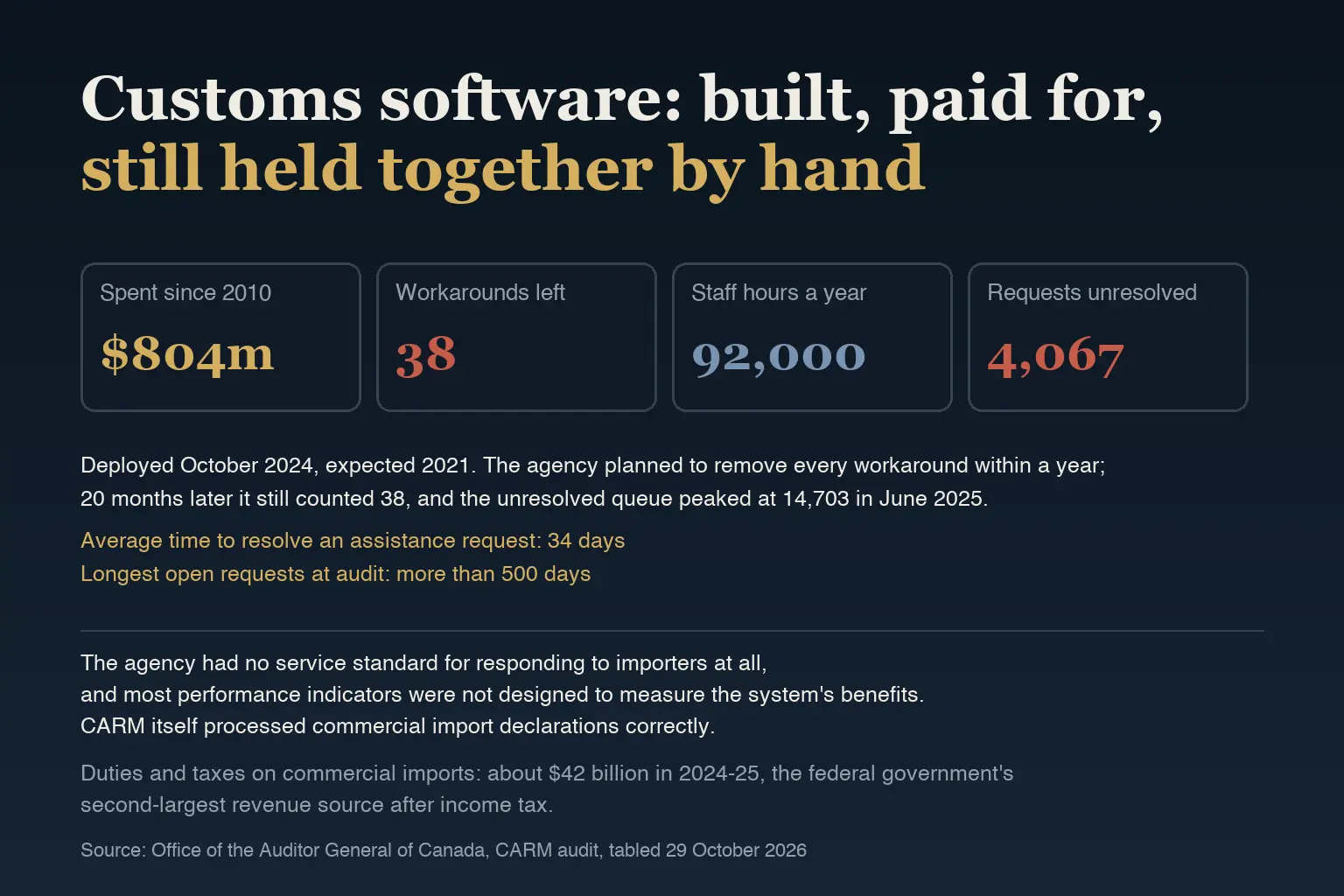
- The Auditor General of Canada's report, tabled on 29 October 2026, examines the Canada Border Services Agency's Assessment and Revenue Management (CARM) system, which has cost about $804 million to develop and maintain since 2010.
- CARM was expected in 2021 and arrived in October 2024. It processed commercial import declarations correctly, and the duties and taxes it handles are the federal government's second-largest revenue source, about $42 billion in 2024–25.
- Twenty months after deployment, the agency still relied on 38 manual workarounds and on legacy systems, at an expected cost of at least 92,000 employee hours a year.
- Assistance requests ran at about 19,000 a month with more than 4,000 unresolved as of June 2026, an average resolution time of 34 days and no service standard at all, and most performance indicators were not designed to measure CARM's benefits.
A working system that needs thirty-eight bypasses
Start with what the audit says plainly: CARM works. It takes importer declarations, calculates duties and taxes, and moves the money. For a country where customs is the second-largest revenue source after income tax — roughly $42 billion in 2024–25 — that is not a small thing, and the Auditor General does not pretend otherwise.
Then comes the sentence that matters. To make CARM function as intended, employees relied on 38 manual workarounds and kept using legacy systems alongside it. The agency planned to remove every workaround within a year of deployment. Twenty months later it was still counting 38, at an estimated 92,000 hours of employee time a year.
That number is the real price list. A workaround is not a bug report; it is a permanent job created by a missing feature. It has an owner, a procedure, a queue and an opportunity cost the report names: time spent stepping around the system is time not spent assessing riskier declarations. Customs has two jobs, collecting and checking. Workarounds are paid for out of the second one, quietly.
$804 million, three budget increases and a $60 million hole
The money story is more embarrassing than the technical one. Cumulative cost reached $804 million by 2025–26: $499 million of development and $305 million of maintenance. The original 2010 budget was $551 million. It was raised to $593 million in 2020–21, $706 million in 2022–23 and $743 million in 2025–26, leaving an accumulated funding shortfall of about $60 million by the end of 2025–26, with more forecast.
Maintenance is where the arithmetic went soft. The maintenance budget was $178 million for most of the period, raised to $217 million in 2025–26, against accumulated maintenance spending of $305 million — a shortfall of about $88 million. The agency covered part of the gap by moving about $88 million from its non-CARM budget. A project that keeps its name while being funded out of somebody else's line is a project that has stopped being measured honestly.
Three years of delay did part of the damage: CARM was expected in 2021 and arrived in October 2024, and holding project staff longer than planned pushed development costs up.
92,000 hours is a staffing decision hiding in an IT report
Strip the technology away and the finding is about capacity. The agency needs at least 92,000 hours a year to operate the bypasses. At a standard working year, that is roughly fifty full-time employees doing work the system was bought to remove. None of them appear as a CARM cost. They appear as customs officers, helpdesk staff and compliance personnel who are not doing the other job.
The same hours are the reason the risk side of the story is not hypothetical. Compliance officers review risky declarations for accuracy. Every hour spent re-keying, re-checking or hand-carrying a case across a gap is an hour not spent on the declaration that should have been looked at. The Auditor General makes the link explicitly, which is why this is a governance finding and not a user-experience complaint.
A support queue with no standard
The transition landed on businesses too. Many importers said they were not well prepared or supported, and the agency fielded about 19,000 assistance requests a month. It could not keep up. The unresolved queue peaked at 14,703 in June 2025 and stood at 4,067 in May 2026, with more than 4,000 still open as of June 2026. Average resolution took 34 days. Some requests had been open for more than 500 days. The agency had never set a service standard for responding to any of them, so nobody could say what on time meant.
This is the part that reads like a management choice rather than an accident. A service standard is cheap: publish a target, measure against it, report the result. Not having one removes the possibility of failing it. For importers, the practical effect is a system that takes their declaration instantly and answers their question in about a month, if at all.
Indicators that count activity, not benefit
The audit's sharpest institutional criticism is about measurement. Most of the agency's performance indicators were not designed to measure CARM's benefits to Canadians, so the agency is not positioned to say whether the system delivers value for money. One indicator meant to track the retirement of legacy systems, which is a reasonable proxy for the benefit, was not being met.
That is how a project can spend $804 million, report progress for years and still be unable to answer the only question Parliament asked. The recommendation follows: build indicators that measure the benefit, with accurate baselines and all the activity in the process counted — including the workarounds.
What would change the judgement
Two things, both cheap relative to the system. First, a published workaround register with an owner, a cost in hours and a closure date for each of the 38, so the count can fall in public instead of being discovered by an audit. Second, service standards for assistance requests and IT incidents, reported monthly against actual performance.
The agency has agreed to track workarounds with their full cost and to do cost-benefit analysis before upgrading. That is the right answer. The test is whether the number of workarounds, the hours they consume and the age of the oldest open request appear in the next departmental report, or only in the next audit.
The $42 billion still gets collected. The point of the report is that it gets collected with an $804 million receipt, fifty-odd people holding the machine together by hand, and no published standard for answering the businesses that keep the money coming.
Sources
Member Briefing
Read the full trend briefing
Members read the full briefing with the source notes behind every finding.
Strategic Circle
A daily briefing in your language, built from changes we have verified.
Join for USD 20/monthCancel anytime.
Members also get the full research library, a daily briefing on the networks they follow and the private forum.