Summary
- The NAO's 25 November report examines the £298 billion Defence Investment Plan published on 30 June 2026, which covers ten years to 2035-36 with detailed plans for the four years to 2029-30.
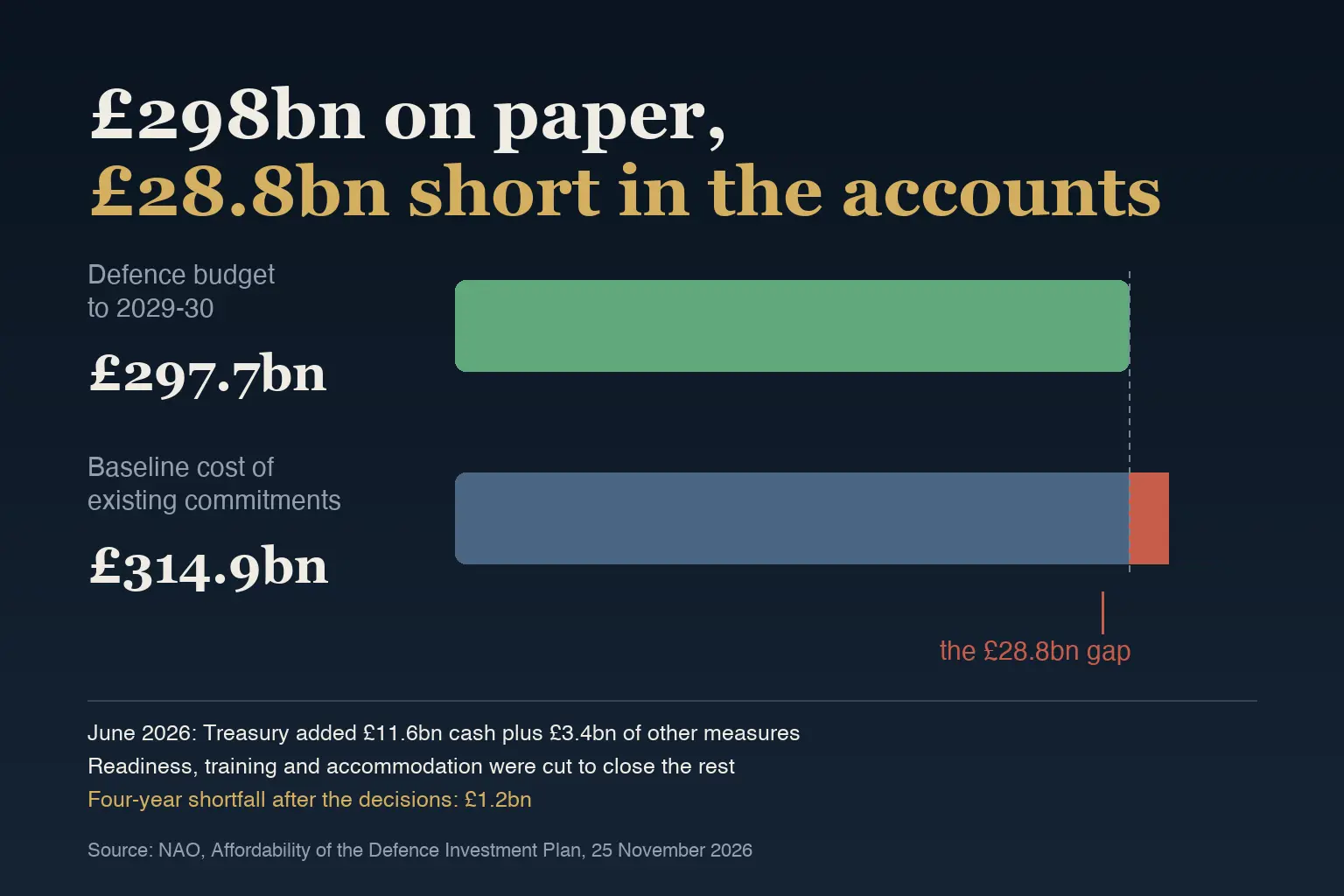
- A bottom-up cost review in summer 2025 put the baseline cost of existing commitments at £314.9 billion, £28.8 billion above the MoD's budget and far above the £1.4 billion gap forecast in June 2025.
- In June 2026 the Treasury added £11.6 billion of cash plus £3.4 billion of other measures, and the MoD cut or deferred spending on equipment, accommodation and training. The four-year shortfall fell to £1.2 billion.
- The plan promises £10.7 billion of efficiency savings by 2029-30 but had mature delivery plans for only £2.4 billion, and the NAO says the MoD has limited assurance it can deliver everything the plan contains.
The gap was £1.4 billion until somebody counted properly
In June 2025 the gap between the Ministry of Defence's commitments and its budget looked like £1.4 billion. A year later the published plan was £298 billion, and the department had discovered along the way that its existing programmes and commitments would cost £314.9 billion — £28.8 billion more than the money it had.
The number did not appear because costs were hidden. It appeared because somebody finally did the sum from the bottom up. The MoD's summer 2025 review built its estimates in more detail than the work behind the Strategic Defence Review, and detail is expensive: when you price each project instead of each ambition, the bill grows. Government, HM Treasury and the Cabinet Office settled on the £314.9 billion baseline in November 2025, five months after the £1.4 billion comfort figure.
That sequence is the whole story of the Defence Investment Plan in miniature. The plan was not affordable, then it was not affordable by a wider margin, then it was made to fit by moving money, cutting activity and assuming future budgets that do not exist yet.
Fifteen billion pounds, then the cuts
By February 2026 the department had a candidate plan that still cost £18.3 billion more than its four-year budget. Civil servants cannot solve that, so the process went where hard choices go: the NAO records that the MoD, the Treasury and the Cabinet Office agreed only the Prime Minister and the Chancellor could take the decisions needed. In June 2026 the Treasury put in £11.6 billion more cash and agreed other measures worth £3.4 billion. The plan was published on 30 June with the four-year shortfall down to £1.2 billion.
The rest of the arithmetic came out of the plan itself. The MoD reduced or deferred spending on military equipment, on accommodation and on training. It accepts that those choices create capability gaps and reduce readiness. It also accepts that spending less on accommodation pushes cost into future maintenance and may make recruitment and retention harder. Readiness is the line item a plan can cut without the total moving, which is exactly why it is worth watching when the total is the thing being defended.
The delay has its own ledger. Resolving the funding position pushed publication back by six months, and decisions had to be taken before the plan was finished. On 2 March 2026 the MoD announced 23 medium-lift helicopters from Leonardo's Yeovil factory, with £680 million of expected spending in the four years to 2029-30 — a commitment made inside a plan whose costs were still being negotiated.
Affordability is a promise about 2030 to 2036
The 2029-30 years are the documented part. The MoD's budget to that point is £297.7 billion. For the last six years of the plan, to 2035-36, it assumes £611.9 billion. That assumption is where the plan's affordability lives: the NAO records the department's own recognition that if defence spending does not rise as government has committed, the plans are likely to be unaffordable.
The spending path runs through 2.7% of GDP in 2027-28 and 3% later. Those are political commitments, not appropriations. Between now and then, the budget for military activity rises only in line with an economy-wide measure of inflation, while the things military activity buys — fuel, equipment maintenance — get more expensive faster. The gap between those two rates is not a hypothetical; it is a cost the plan does not carry.
There is one more quiet problem. The MoD is already forecasting that capital spending will exceed the available budget and contingency in the first two years. A plan that runs out of contingency in year two has not been made affordable; it has been made to fit on paper with the help of the years it has not costed.
£10.7 billion of efficiencies, £2.4 billion of plans
The plan's efficiency ambition is £10.7 billion by 2029-30. The NAO found mature delivery plans for £2.4 billion of it. The difference is not fraud and it is not a rounding error; it is the standard distance between a savings target and a savings programme, and it is exactly the distance an audit exists to measure.
Add the delivery side and the picture sharpens. The procurement arm is already operating unsustainably, workforce reductions are under way, and spending deferred beyond 2030 will land on a later department, a later Parliament and an industry that has to hold capacity in the meantime. Potential obligations such as the Afghan resettlement scheme would also fall on contingency if they materialise.
The NAO's conclusion is measured and uncomfortable: the plan is a foundation for the Strategic Defence Review, delivered through a more transparent process and better cost estimation than before, and the department still has limited assurance that it can do all of it.
What Parliament should ask for every year
The NAO's two recommendations are unglamorous: keep accurate cost data, and monitor delivery closely with regular, transparent updates to Parliament. Both are procedures that only matter if the numbers arrive on a schedule and are comparable year to year.
A useful annual return would show the current cost of the same programme list, the cash actually received, the readiness and training positions that were traded away, capital spending against contingency, and every promise deferred into the years after 2030. Gareth Davies, the head of the NAO, put the test plainly: monitor the plan closely, keep accurate cost information, and be transparent with Parliament about emerging pressures.
The interesting question is not whether £298 billion is a lot of money. It is who signs the sentence that says the plan is affordable, on which date, against which assumption — and what happens to that signature when the assumption fails.
Sources
Member Briefing
Read the full trend briefing
Members read the full briefing with the source notes behind every finding.
Strategic Circle
A daily briefing in your language, built from changes we have verified.
Join for USD 20/monthCancel anytime.
Members also get the full research library, a daily briefing on the networks they follow and the private forum.