Summary
- The NAO's 18 November report finds that central government has strengthened risk guidance, systems and skills, largely through the Government Risk Profession and the Risk Centre of Excellence in HM Treasury.
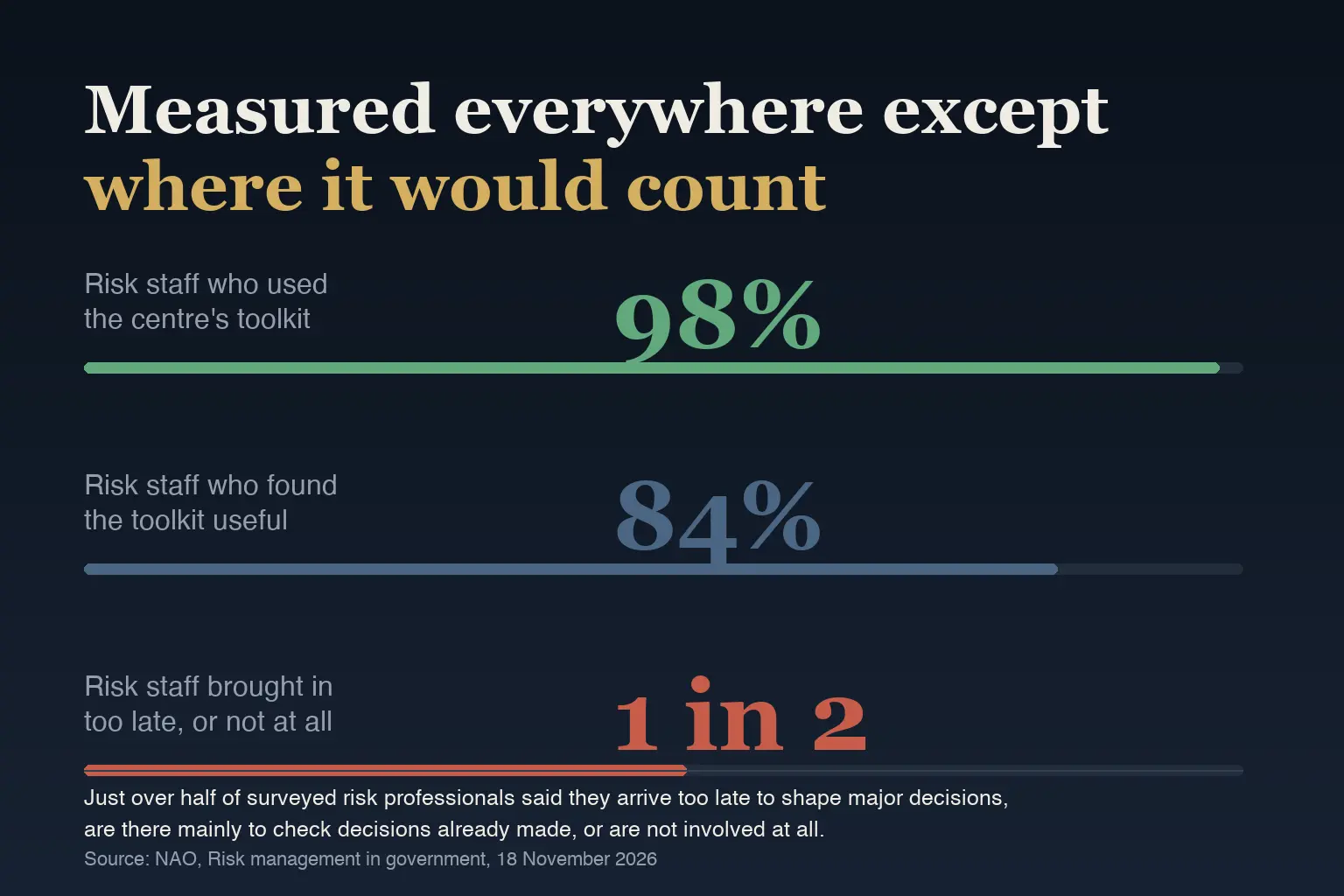
- Of the surveyed risk professionals who answered questions about the centre, 98 per cent had engaged with its tools and guidance and 84 per cent agreed its work was useful.
- In the same survey, just over half said they were typically involved too late to shape major decisions, primarily to check and approve decisions already made, or not at all.
- The NAO found limited evidence that major decisions or organisational direction changed because of input from risk professionals, and uneven oversight of risks that cross departmental, arm's-length body, supplier and local government boundaries.
The toolkit is a hit. The decision is somewhere else.
Count the adoption first, because the numbers are good. A profession exists, training exists, a centre of excellence sits in the Treasury, and the people who are supposed to use it do use it. Ninety-eight per cent engagement is the kind of figure a programme office puts on a slide, and 84 per cent finding the work useful is the sentence that keeps the funding.
Now count the thing the toolkit is for. The NAO looked for cases where a major decision, or the direction of an organisation, changed because a risk professional said something. It found limited evidence. In the survey, just over half of risk professionals described themselves as arriving too late to shape big decisions, being there mainly to check and approve what had already been decided, or not being there at all.
Both results can be true at once, and together they describe a common institutional arrangement: assurance is bought, delivered and counted, while advice is optional. A risk function used to approve a decision after the fact still produces documents, meetings and sign-offs. It just does not change the decision, which is the only output that would show up in an audit of influence rather than activity.
What "too late" looks like in practice
Too late has a specific shape. The policy is chosen, the money is committed, the contract is drafted, and then a risk assessment records what could go wrong. At that point the register is not a warning system; it is a description of exposure that has already been accepted. The organisation keeps a record, which is useful for accountability, and loses the option to choose differently, which is the point of managing risk before rather than after.
The NAO is precise about the consequence: where senior leaders do not see risk management as something that helps them decide, they give it limited priority, and concerns get overlooked, addressed too late, or the opportunities are missed. That is a leadership finding, not a paperwork finding. A department with perfect registers and a leadership team that reads them after the vote has the same practical risk position as a department with no registers and honest conversations.
Two places where it changed something
The report does contain working examples, and they are worth naming because they show what influence looks like when it exists. At the Bank of England, a transparent "no surprises" culture encouraged staff to raise concerns during the modernisation of a critical payments system, strengthening collaboration and shared accountability. At the UK Hydrographic Office, a risk dashboard gave leaders a clearer view of risks and how they were being handled, and helped them follow up with teams until outstanding actions dropped significantly.
Neither example is about a better template. One is about a culture where raising a problem early is normal, and the other is about a leader being able to see the same picture as the team and chase the open items. Both put risk information in front of the person who can change the decision, at the moment the decision can still change.
The boundary is where risks actually live
Government risk rarely respects an org chart. The NAO found that bodies frequently lack the oversight needed for risks running across departments, arm's-length bodies, suppliers and local government, and that some arm's-length bodies had limited contact with their sponsor department's risk team. A shared risk that nobody owns is not managed; it is described twice in two registers that never meet.
This is the part that scales badly. Departments can improve their own practice with training and toolkits. Cross-boundary risk needs something harder: agreed ownership, a route to escalate, and a body with the authority to make one organisation accept a constraint for another's benefit.
Devolution makes the boundary problem bigger
The NAO points forward as well as back: central government is transferring more responsibilities to mayors and local government, so the ability to identify, escalate and respond to risks across organisational and geographical lines matters more, not less. A devolved system with strong local risk practice and a weak centre for shared risks can still fail at the seam, and the seam is where failures travel.
The recommendations follow that logic. Clearer expectations and practical training so senior leaders understand risk, welcome challenge and build cultures where concerns surface early; stronger arrangements for the risks that cross boundaries. Neither is exotic. Both require someone with standing to insist that a risk professional is in the room before the decision, not after it.
What to measure next time
If adoption is 98 per cent and influence is unmeasured, the next audit should measure influence. A decision log that records when risk advice arrived, who gave it and what changed is not difficult to keep. The harder question is whether a department can name a decision it would have made differently, and whether the person who raised the concern was thanked or managed.
Gareth Davies, the head of the NAO, framed the stakes simply: the government must put risk management at the heart of how it plans, spends and delivers, and that will matter more as decisions and spending are devolved. The register is not the point. The decision is.
Sources
Member Briefing
Read the full trend briefing
Members read the full briefing with the source notes behind every finding.
Strategic Circle
A daily briefing in your language, built from changes we have verified.
Join for USD 20/monthCancel anytime.
Members also get the full research library, a daily briefing on the networks they follow and the private forum.