Summary
- The published Defence Investment Plan costs £298.8 billion, £1.2 billion above the revised £297.7 billion budget, and it is balanced partly on £10.7 billion of efficiency savings of which only £2.4 billion has a developed delivery plan.
- To close the earlier £28.8 billion gap, the MoD cut £11.3 billion from the Armed Forces' readiness projections and £3.1 billion from accommodation, accepting what it calls capability gaps and readiness reductions.
- The National Audit Office gives the department only "limited assurance" that it can deliver the plan, records that the armaments organisation already operates unsustainably, and finds no detailed plan for the six years after 2029-30.
A plan that balances because the savings are still being invented
Britain published its Strategic Defence Review on 2 June 2025 and its Defence Investment Plan on 30 June 2026, a year late. The plan covers ten years, with the detail concentrated on the four years to 2029-30 that the spending review actually funded. Its cost is £298.8 billion, and the revised budget agreed in June 2026 was £297.7 billion. The gap the department had to close was £1.2 billion.
That is not the interesting number. The interesting number is what it took to get there.
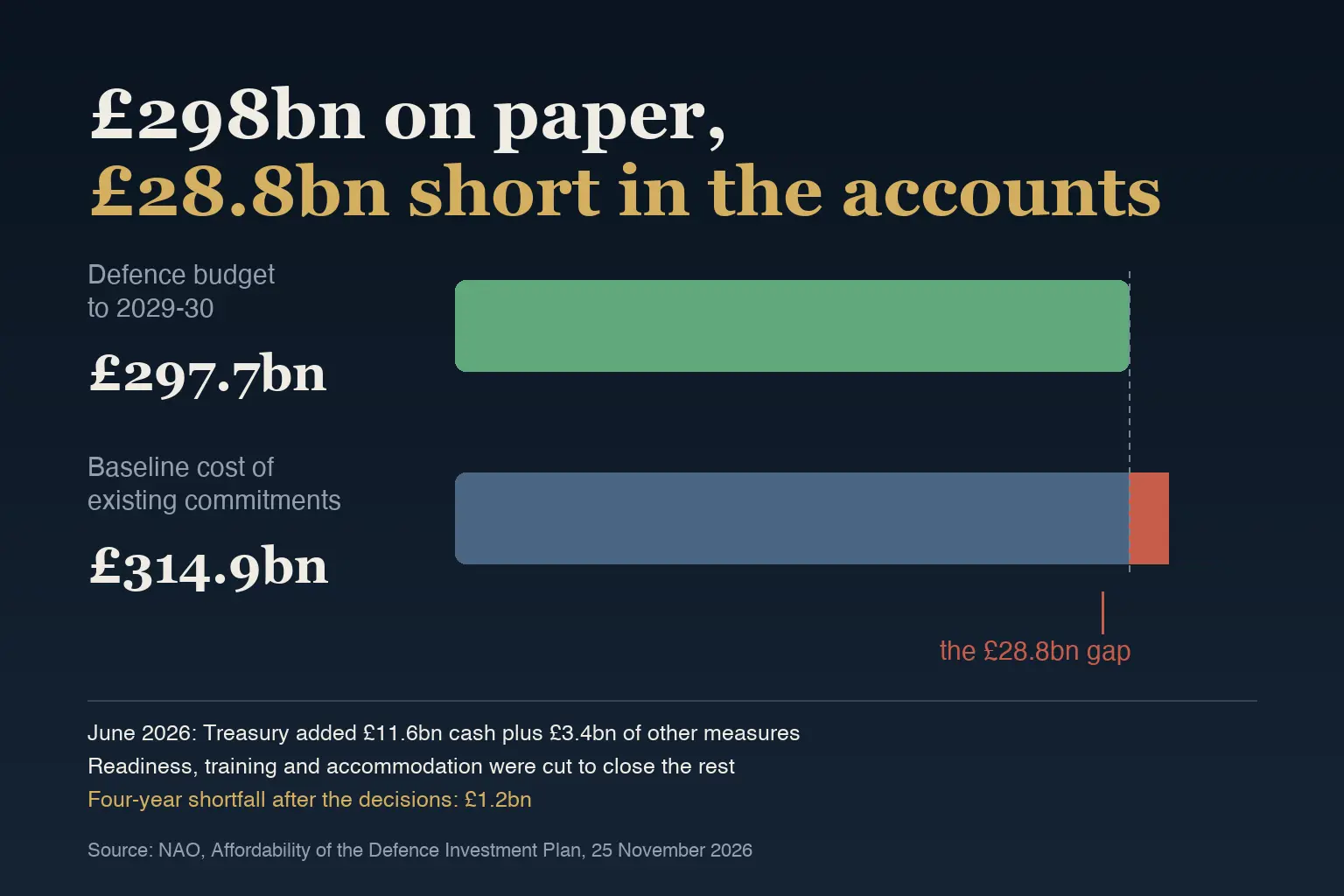
The National Audit Office's report, published on 25 November 2026 as HC 770, reconstructs the chain. The review's own forecast for 2026-27 to 2029-30 was £287.4 billion against a budget of £286.0 billion. Then the bottom-up costing arrived: pay awards for military and civilian staff above budget, higher nuclear costs, index-linked contract clauses running hotter than forecast. The baseline came out at £314.9 billion — £28.8 billion more than the money available.
The department's first answer was a £10.6 billion package of efficiency and reform measures. Its second was a "candidate" plan in February 2026 that still cost £18.3 billion more than the budget; the cross-government oversight board could not agree it. The final plan closed the gap with savings agreed so late that the department had not decided how to deliver them, and with reductions to readiness, training and accommodation.
£10.7 billion promised, £2.4 billion planned
The published plan commits to £10.7 billion of efficiency savings over four years. Its own reporting says £2.4 billion of that has highly developed delivery plans. That leaves £8.4 billion to be identified, including £0.8 billion against day-to-day spending in the current financial year. Of the total, £3.3 billion of measures were agreed at the end of the process with no decision on how they will be delivered — deliberate delays to capital spending and further running-cost savings.
The oversight board ratified those targets in October 2025 while the department was still working out how to split them between day-to-day and capital budgets. HM Treasury allowed a contingency of no more than 2 per cent in any year before 2029-30 and told the department to identify lower-priority spending it could pause or cancel.
Read those three sentences together and the arithmetic of the plan is clear: nearly four-fifths of the savings that make it affordable do not yet exist as decisions, and the reserve that would cover the failure of those savings is capped at 2 per cent.
The cut fell on readiness and housing
Every plan that balances by inventing savings takes the money from something. The audit names it.
The Armed Forces' initial proposals to deliver the review's vision included £11.3 billion more on readiness than the final plan provides, including £8.6 billion more on training personnel and military activity. That was reversed. The Armed Forces will now spend £11.3 billion less on readiness from 2026-27 to 2029-30 than their September 2025 projections, and the budget for military activity will rise only with economy-wide inflation while fuel and equipment maintenance costs rise faster. The department accepted the measures knowing they would create capability gaps or readiness reductions.
Housing went the same way. The plan spends £3.1 billion less on accommodation over the first four years, including £1.1 billion less on the estate optimisation portfolio, and £0.8 billion less this Parliament than the review's £7 billion housing commitment. The concrete consequences: 2,400 new service family homes delayed, replacement of 7,000 bedspaces for unaccompanied personnel put off, and spending that would release land for 43,000 homes pushed beyond 2030. The deferrals also add pressure to a maintenance budget that now has older buildings to keep standing.
A defence plan that protects the equipment programme and pays for it with readiness is a choice, and it can be a defensible one — equipment takes years to build, readiness can be bought back faster. What makes it a governance problem is that the trade was made without the savings that were supposed to avoid it, and that the auditor cannot find the record showing the trade was priced.
Limited assurance, and a bow wave
The audit's verdict on delivery capacity is one phrase: "limited assurance".
Shortly before the plan concluded, the National Armaments Director Group warned that it was already operating unsustainably and that planned workforce reductions would make the problem significantly worse. It also flagged a serious risk that deferring spending — deliberately, or because capacity is absent — creates a "bow wave" of undelivered projects beyond 2030, piling work onto a delivery system that is already expected to run well above current levels.
Then there is the far half of the plan. The department has no detailed plan for the six years from 2030-31. Its assumption is that the budget grows by an average of 5.9 per cent a year from 2026-27 to 2034-35 and then by 23 per cent in the final year, reaching £611.9 billion over six years so that the review's ambitions can be paid for. The government has told NATO it will spend 3.5 per cent of GDP on defence by 2035. The department does not know how and when its budget gets there. For the years that carry most of the promised capability, the plan is a growth rate.
In June 2026 the department itself estimated that day-to-day costs for 2026-27 could be about £1 billion higher and capital spending £400 million higher than assumed, partly because of the Middle East conflict, and said it now forecasts a much smaller overspend. Every one of those revisions moves the £1.2 billion gap.
The one date that matters
The audit makes two recommendations: keep cost data current through the annual planning cycle, and build a monitoring and control system that reports progress, enables timely correction and publishes results in annual updates to Parliament. The first of those updates is due in July 2027.
That is the test. A plan balanced on savings that do not exist yet is not a scandal on the day it is published; it is a promise with a deadline attached, and the deadline is the annual report. In July 2027 the department should be able to show the £8.4 billion of savings as decisions, the readiness gap as a measured number rather than a reversal of an earlier projection, and the armaments organisation as either staffed or restructured.
If the update lists progress in percentages of an efficiency target and never shows a single capability that was delayed, the plan will have been tested by the only institution that could test it, and passed on presentation.
The fact that would change this judgment is a first annual update that reconciles the plan's cost, the savings actually delivered, the readiness actually bought and the projects actually moved past 2030, in one table, signed by the accounting officer.
Sources
- National Audit Office, Affordability of the Defence Investment Plan, HC 770, Session 2026–27, published 25 November 2026.
Member Briefing
Read the full trend briefing
Members read the full briefing with the source notes behind every finding.
Strategic Circle
A daily briefing in your language, built from changes we have verified.
Join for USD 20/monthCancel anytime.
Members also get the full research library, a daily briefing on the networks they follow and the private forum.