Summary
- The Accra Convention opened for signature on 26 October 2026. The Treaty Collection listed 26 signatories and no ratification, acceptance, approval or accession instruments as of 30 October; the Convention was not yet in force.
- Entry into force requires the tenth deposited instrument and then 180 days. A later-joining State gets its own 180-day period.
- Once in force, the Convention can let rights to goods travel with a negotiable cargo document across international journeys. Each issuance still requires agreement between a transport operator and a consignor.
- An electronic cargo title has to remain identifiable, controllable and intact. The treaty leaves system technology open and makes evidence of reliability the test.
A signature is not the switch
United Nations General Assembly adopted the United Nations Convention on Negotiable Cargo Documents in resolution 80/162 on 15 December 2025. The resolution recommended the name Accra Convention on Negotiable Cargo Documents and authorized the ceremony that opened signature in Accra on 26 October 2026. The United Nations Treaty Collection status page, marked as at 30 October, showed 26 signatories, no deposited instruments and the status “not yet in force.”
Article 25 sets a more demanding clock than the signature count suggests. The Convention enters into force 180 days after the tenth instrument of ratification, acceptance, approval or accession. A State depositing its instrument after that tenth one waits 180 days from its own deposit. The treaty is open to all States; signature and accession are separate routes, and signatories must still ratify, accept or approve it.
That distinction matters because this is a legal framework for a document that can stand in for a physical handover. United Nations General Assembly adopted the text. Governments now decide whether to become bound. Only after the entry-into-force threshold does the new legal regime begin to apply for its parties.
The document carries rights; the truck carries the goods
The Convention is designed for negotiable cargo documents in international transport by one or several modes. UNCITRAL describes its purpose as extending the benefits of negotiable documents beyond maritime transport. A single document can cover an entire journey, including transfers between road, rail, air and sea.
Article 1 draws the map carefully. The document must refer conspicuously to the Convention, and the place where the goods are taken in charge, delivered, or the document is issued must be in a State Party. The rules address the issuance, transfer and legal effect of the document. They preserve the existing law governing transport operations and the underlying transport contract, including the operator’s rights, obligations and liability.
The distinction is economic. A holder may demand delivery of the goods at destination. The Convention says issuance and transfer of possession have the same effect, for acquiring rights to the goods, as physically handing over the goods. Delivery is demanded against surrender of the document. The container remains on the route; the claim to it can move to a buyer, lender or other holder.
The text also tells operators when a document earns that role. Article 3 makes issuance conditional on agreement between the transport operator and consignor. The parties agree on the medium and the method. They can mark an existing transport document so it becomes negotiable from a stated date, or issue a stand-alone document when no transport document exists or the earlier one has been cancelled. The Convention does not force every carrier to convert every consignment note. Contracting parties choose whether to create this transferable claim.
The required details are practical: the operator, the goods, their quantity or weight, their apparent condition, where and when they were taken in charge, and whether freight is prepaid or due at destination. Some missing details do not automatically destroy the document's legal effect if it still meets the treaty's definition. The operator remains liable under applicable law for deficiencies. A third party who takes the document in good faith gets stronger protection against later proof that contradicts information the operator did not qualify.
An electronic title has to survive its own copies
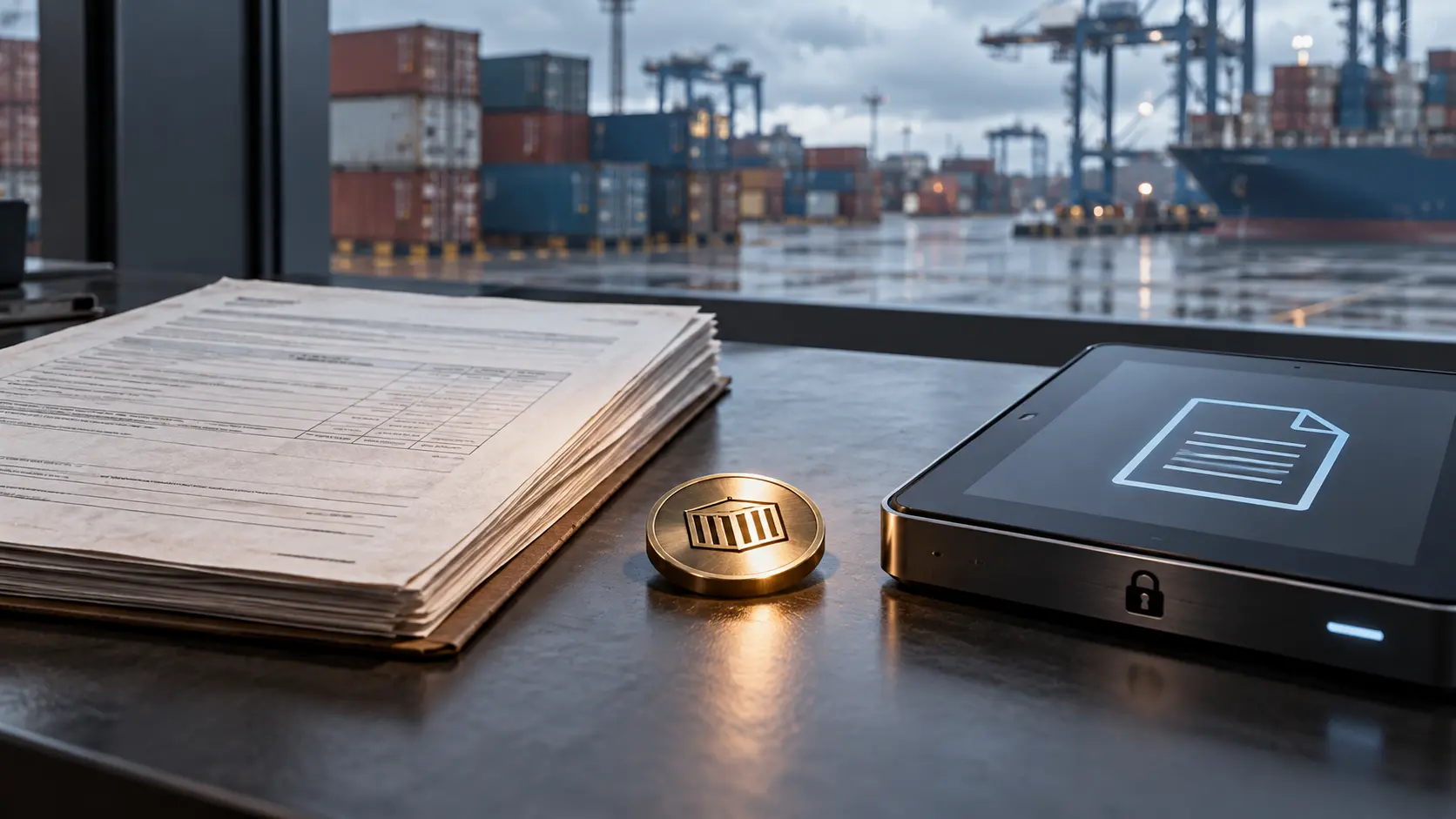
Paper gives possession a visible form. An electronic file can be copied, so the Convention asks for a reliable method that performs the work of the paper original. Article 12 requires a method to identify the record as the negotiable cargo document, keep it capable of control from issuance until it expires, and retain its integrity. Article 15 requires exclusive control by an identifiable person; transferring control transfers possession.
Article 18 measures reliability against the method's function and circumstances. Relevant evidence may include operational rules, data-integrity safeguards, access controls, hardware and software security, independent audits, a supervisory or accreditation declaration, a voluntary scheme, an industry standard, or proof that the method has worked. The UNCITRAL Secretariat explanatory note says the treaty is system-neutral: centralized registries and distributed-ledger systems can both qualify, as can later methods that meet the standard.
This is where the treaty's digital promise becomes an operating burden. A lender needs to know who controls the record. A carrier needs to know whose surrender releases the goods. A consignor needs to know that a transferred title cannot keep circulating as a second live claim. A software label such as “blockchain” answers none of those questions by itself.
Changing media is an even sharper test. If a paper title becomes electronic, or an electronic title becomes paper, Article 17 requires surrender of every original in the old medium. The new document must say that it replaces the old one, and the old originals must become inoperative. Conversion is a legal cancellation and replacement, not a file export.
The treaty supplies the legal functions. It does not pick a vendor, a ledger, a registry operator or a certifier. Those decisions will sit in the reliability evidence, the parties' issuance agreement and the laws of States that join.
A framework can wait on paper
The current count of 26 signatures is a measure of participation in an opening ceremony, not a usable date for trade. The United Nations General Assembly resolution calls on interested governments and regional economic integration organizations to consider becoming parties. The signature page contains no instrument that starts Article 25's clock.
That leaves two adoption gates. States must deposit instruments and wait through the treaty's entry period. Transport operators and consignors must then agree to issue documents under the framework. A digital platform may meet Article 18's reliability test, but that does not substitute for either decision.
The Convention matters because the right to receive physical goods can follow a record rather than a truck. Its authors have defined what the record must do and how a paper-to-electronic switch must extinguish the old version. Whether that design becomes ordinary trade practice rests on the depositary's next entries and on private agreements that put the document into circulation.
Sources
Member Briefing
Deeper Profile Context
Sign in with the right membership level to unlock the full briefing and source notes.
Only for Strategic Circle
Strategic Circle
Open to all readers. Unlock profile briefings after joining and signing in.
Join Strategic CircleOnly for Leadership Alliance
Leadership Alliance
For qualified IP-asset owners and management; sign in to unlock alliance briefings.
Join Leadership Alliance