Summary
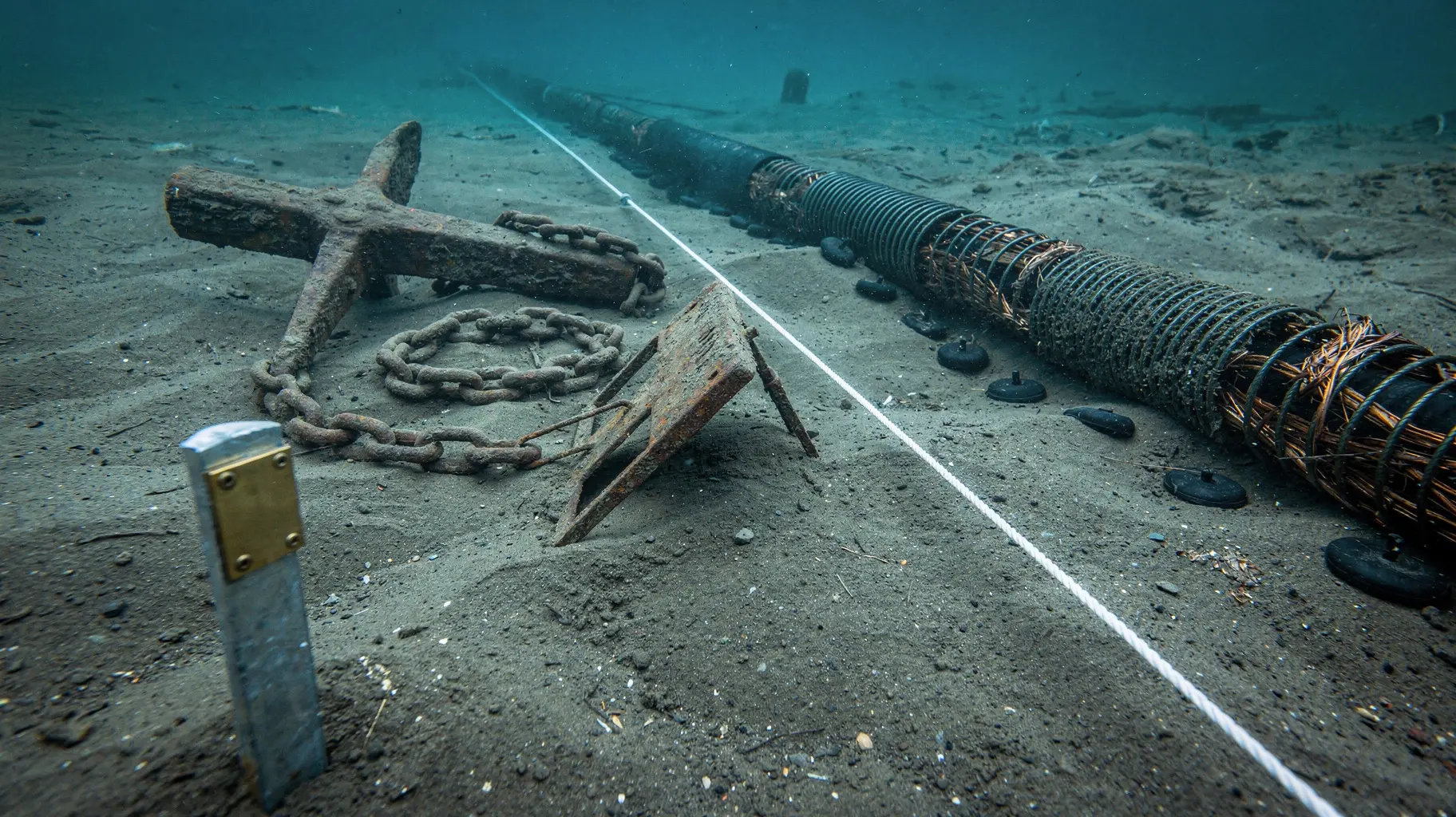
- Inside a protected area, anchoring or operating fishing gear of any kind is an offence, and the sanction turns on whether the offender is a person or a body corporate rather than on the value of what the cable carries.
- The protected area is not defined in the operative offence at all. It is declared by order, in respect of areas specified in a Schedule, and that Schedule was not in the text retained for this reading.
The offence sentence is short, and it names objects rather than owners: “Every person commits an offence against this Act who, within a protected area, anchors or operates a fishing gear of any kind...” That sentence, ellipsis included, is the whole of the conduct in the fragment retained from the Act page.
The penalty below it splits in an unusual place. “(2) Every person who commits an offence against this Act is liable on conviction to imprisonment for a term not exceeding 1 year or a fine not exceeding $100,000, or both...”, and then, after the ellipsis, “...in the case of a body corporate, to a fine not exceeding $500,000.”
Read them in order and the shape is plain. One year, or a hundred thousand, or both, against a person. Half a million against a body corporate, and nothing else printed in that limb. My reading of the words retained — mine, and labelled as mine, because the transitional words between the two limbs sit inside an ellipsis — is that the imprisonment limb is written against a natural person and the corporate limb is a fine and only a fine. Five hundred thousand divided by a hundred thousand is five. That ratio is my own arithmetic on two printed maxima, not a relationship the instrument states anywhere.
No currency code appears in the fragment. The figures print with a dollar sign and are reported that way. They are maxima available on conviction, never amounts imposed: no prosecution, conviction, sentence, infringement notice or court decision was read for this article.
What the offence does not do is describe the place where it applies. A protected area is a status created somewhere else. The operative sentence of the order retained for this reading says so in one line: “This order declares the areas specified in the Schedule to be protected areas for the purposes of the Submarine Cables and Pipelines Protection Act 1996.” That is the order page, and it is as much of the order as this reading had.
Which leaves the Schedule holding the map. How many protected areas exist, where their boundaries run, what depths they cover and which cables each one names are not established by anything read here. That is not a small omission in a piece about cable protection; it is the document the offence points at. A master working out his exposure cannot do it from the Act, because the Act's operative words are a pointer and the Schedule is the thing pointed at.
The order also declines to settle its own name. The page retained is regulation/public/2002/0329 and prints a publication date of 10 October 2002. A provider-written summary attached to the same retrieval calls that document the Submarine Cables and Pipelines Protection Order 1992, and adds that the order covers the Southern Cross cable system.
Both statements are reported as they stand and neither is adopted here: the printed date and the summary's title do not agree, the amendment and consolidation status of the instrument is not established by anything read, and the claim about Southern Cross sits in a summary rather than in retained text.
That last point governs this briefing's filing. It is filed against Southern Cross Cable Network, and the directory entry is an anchor for filing rather than a location claim. Neither retained excerpt names the network. Nothing read for this article establishes that any part of it lands in New Zealand or lies inside a protected area — and the directory record itself carries no country, no announced services and no named people to check against.
The asymmetry that follows is worth stating plainly. A protected area, once declared, is published: the order names the areas and the Schedule carries them, and a third party can in principle find out where the status bites. What binds the cable owner or operator is not in the passages retained for this reading. Whether the Act imposes any duty on an owner at all is not established, and this article does not assert that it does or does not. The check this instrument makes easy runs one way: it tells you what a vessel owes a cable. In the words read, it does not tell you what a cable owes anyone.
Four things would change the picture, and none of them was read. The Schedule itself. The provision that empowers a declaration and the test it applies. Whether a protected area may be declared before a cable is laid, and what the Act provides if one never is. And whether any permit, exemption, licence, consent or defence exists for a vessel operator, a fishing skipper or a maintenance contractor — the fragments retained show no such route, which is a statement about two excerpts and not about the Act.
Until the Schedule is read, the honest description of New Zealand's cable protection is two numbers and a pointer: half a million for the entity that cannot be jailed, and a map held somewhere the offence never prints.
Member Briefing
Read the full trend briefing
Members read the full briefing with the source notes behind every finding.
Strategic Circle
A daily briefing in your language, built from changes we have verified.
Join for USD 20/monthCancel anytime.
Members also get the full research library, a daily briefing on the networks they follow and the private forum.