
Summary
- Cable Color publishes unusually specific colocation claims for Honduras: a Tier II facility, a 99.741% service level, 48 hours of energy, an N+1 backup generator, dual AC buses at each cabinet, independent fibre and Cat6A drops, monitored cabinet loads and containment cooling.
- Those facts stop short of demonstrating independent failure paths. No public source reviewed here identifies the utility topology, generator and fuel ratings, cooling redundancy, tested IT load, building location, two physically separate fibre entrances, carrier delivery routes, maintenance configurations or a customer failover exercise.
- Cable Color's network is visibly active and substantial. AS27884 originated 202 IPv4 and four IPv6 routes on 16 July 2026, had broad route-collector visibility and declared a 10 Gbps PIT Honduras port. But AS paths, regional fibre totals and a DWDM ring rating are network facts, not proof that the data centre can preserve power, cooling and external reachability during one common regional event.
- The useful purchasing metric is therefore not marketed normal-state capacity. It is the IT load and network throughput that remain usable after the largest credible shared failure, with fuel, cooling, access, carrier headroom and recovery labour all constrained at the same time. Cable Color does not publish enough evidence to calculate it.
The second bus in the rain
Start at the most concrete promise on Cable Color's colocation page: every cabinet has a dual AC power bus. In a sales meeting, that phrase can sound like a complete answer. A server with two power supplies can be connected to two rack power paths. One side can fail and the other can continue carrying the load. The arrangement is sensible, visible and easy to explain.
Now move outside the cabinet.
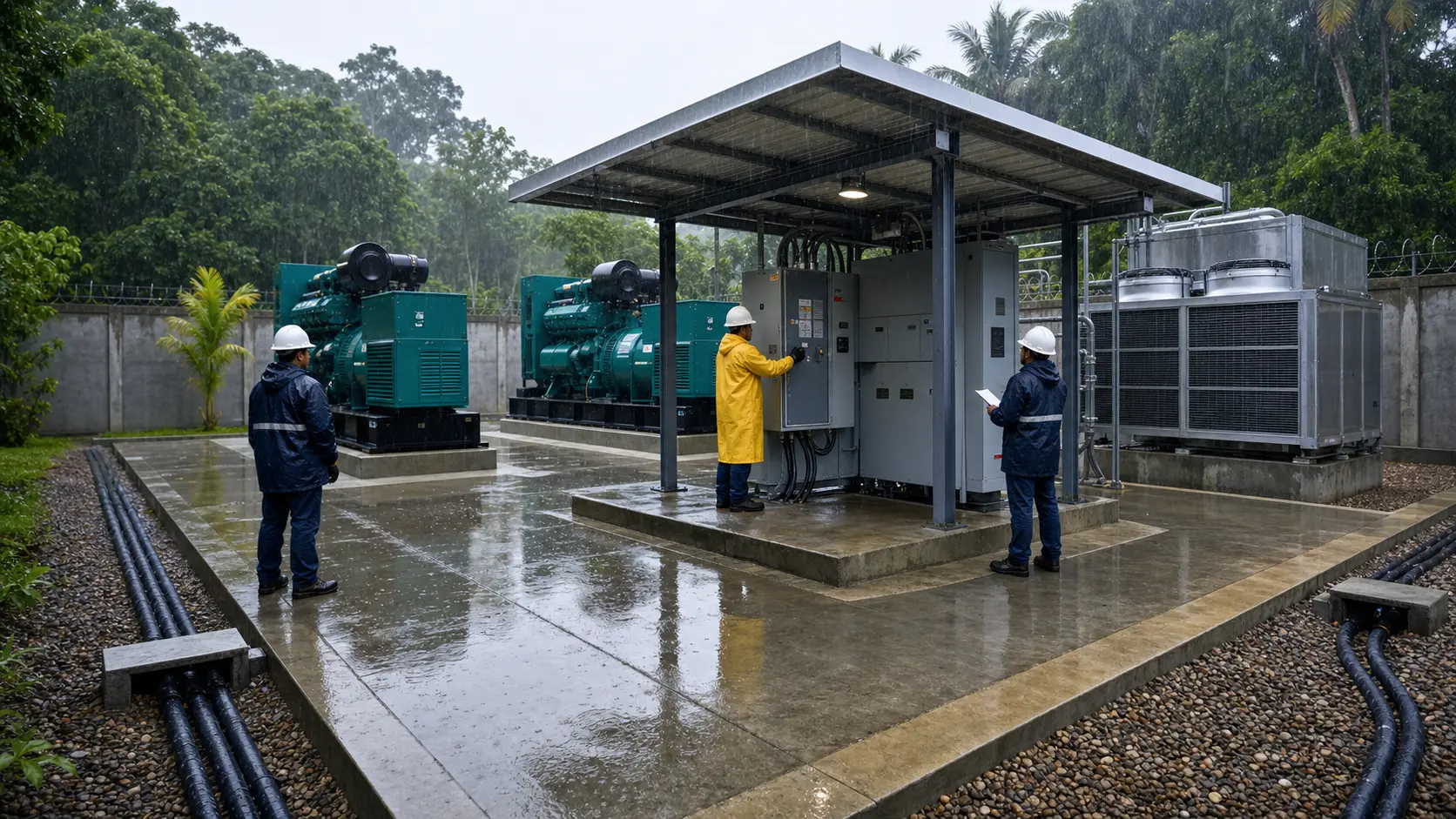
Imagine a night of tropical rain over an unidentified Honduran facility. This is a resilience scenario, not a claim that a particular Cable Color site or outage has been documented. Utility power becomes unstable and then disappears. The uninterruptible power system must carry the critical load while transfer controls call the generators. The generators must start, synchronise as designed and accept not only the servers but the cooling, pumps, controls, security systems, lighting needed for safe work and every network device required to reach the outside world. Fuel must be usable, not merely present.
If the interruption lasts, more fuel must arrive while roads, suppliers and staff may be dealing with the same weather.
At the same time, a fibre duct outside the building may be flooding, a pole route may be damaged, or both nominal carriers may be riding the same regional transport corridor. The second cabinet bus can remain energised while the room loses cooling. Both buses can remain energised while external routes disappear. The servers can stay powered while the recovery team cannot reach the site, while the fuel transfer system fails, or while a maintenance configuration has already removed one component from service.
That is the central distinction in Cable Color's public record. The company describes duplicate or redundant elements at several points. It does not publish the dependency chain that would show whether those elements are independent of one another. Two cabinet feeds are valuable only to the extent that their upstream switchgear, UPS modules, distribution paths, generators, fuel systems and controls do not collapse into the same failure. Two logical network choices are valuable only if they enter by different physical routes, terminate on sufficiently separate equipment and have enough spare capacity to take the failed path's load.
The question is not whether Cable Color owns serious infrastructure. Its current corporate homepage markets more than 3,800 kilometres of terrestrial fibre and a 500 Gbps DWDM ring, while its public routing footprint is easy to observe. The question is narrower and more demanding: how much of the advertised data-centre service remains usable when the building and the regional network are stressed at the same time?
A specific product with an incomplete engineering boundary
Cable Color's data-centre page is more informative than the generic “secure, always on” copy common to small colocation offers. It names CC Colocation, Intra-Facility and Cross-Connect services. It describes standard 42U cabinets, 19-inch rack width and 1,045 millimetres of depth. It says each cabinet receives independent data drops over fibre and Category 6A copper, has two AC buses, can receive DC power according to the required load, and includes smoke and humidity detection. Loads can be monitored. Aisles are covered by cameras. Cooling uses containment.
At facility level, the page claims a 99.741% service level in Tier II installations, 48 hours of energy and an N+1 backup generator “with the same characteristics”. It also names automatic fire detection and suppression, biometric access, a raised floor and UPS-backed LED lighting. These are not empty claims. They identify systems a buyer can ask to inspect and test.
Yet almost every number needed to turn those features into a failure-time capacity estimate is absent. The 42U specification describes one cabinet, not the number of cabinets installed or occupied. There is no published floor area, total critical IT load, utility service rating, UPS rating, battery autonomy, generator nameplate, generator count, fuel-tank volume, refuelling contract, cooling tonnage, power usage effectiveness, average load, peak load or reserved electrical headroom. There is no dated commissioning report or load-bank result.
The phrase “48 hours of energy” is particularly important because it sounds like a duration guarantee. Runtime, however, is a function of load and boundary. Forty-eight hours at what IT load? Does it include the full cooling plant, pumps, network rooms, security systems and offices, or only a defined critical bus? Is the claim based on on-site fuel at the start of an event, a replenishment agreement, or a combined assumption? What fuel quality checks, transfer pumps and day tanks sit between storage and engines? What derating applies in maintenance or high ambient conditions? The page does not say.
The 99.741% figure also needs a contract definition. Applied continuously across a 365-day year without exclusions, it corresponds to about 22.7 hours of unavailability. That arithmetic does not establish that Cable Color has historically delivered the result. It does not reveal whether planned maintenance, utility events, carrier failures, force majeure or customer equipment are excluded. Nor does it show whether the service level applies to power at the cabinet, temperature, cross-connect availability, internet reachability or the full end-to-end service.
Cable Color launched the product publicly in 2020. A contemporary report from Honduras en Sociedad said executives presented “Smart Data” at the company's main offices in Edificio Rosenthal in Tegucigalpa and described colocation, cross-connect and intra-facility services. The venue is not proof that the data centre sits in that building. The report does not give a facility address, utility feed, generator rating, carrier entrance or cooling diagram.
A December 2020 Revista Summa article added promotional detail: redundant AC and DC energy, battery banks and a double generator, while describing the facility as a hub of Cable Color's operation. That account is useful historical context, but it supplies no equipment schedule, tested load or physical topology. It also illustrates why the present N+1 wording needs clarification. “Double generator” could mean two equal units, one duty and one standby, two partial-capacity sets, or another arrangement. The public material does not resolve the configuration.
The evidence therefore supports a real commercial product with identifiable rack and facility features. It does not support a complete capacity model. The line between those two conclusions matters because a data centre can look highly redundant inside a sales tour while retaining one shared switchboard, one fuel transfer path, one chilled-water loop, one building entrance or one operational team.
Tier II is not two independent versions of everything
Cable Color repeatedly uses “Tier II” or “Tier 2” in its public material. The term is often treated in marketing as a compact synonym for high availability. The Uptime Institute's own Tier explanation is more precise. Tier II adds redundant capacity components for power and cooling, including items such as generators, energy storage, chillers, cooling units, UPS modules, pumps, heat rejection equipment and fuel tanks. It does not turn every distribution path into an independent route. Uptime states that an unexpected shutdown of a Tier II facility can affect the system.
That distinction fits the question raised by Cable Color's dual cabinet bus. Redundant components can improve maintenance and absorb some equipment failures. They do not by themselves establish that the path carrying power or cooling from those components to the IT load is concurrently maintainable or fault tolerant. A cabinet can expose A and B receptacles even if the two branches converge farther upstream. A second generator can exist while sharing controls, fuel transfer, exhaust constraints or a switchboard.
Containment cooling can be well designed while still depending on one distribution element that must be shut down for maintenance.
The certification language also needs care. Uptime says it is the sole source of its Tier Certification, and its public awards page for Honduras listed projects for BAC-Credomatic, Banco Central de Honduras and Telefónica Celular when reviewed for this article. Cable Color did not appear on that country page. Absence from a public list is not proof that no assessment, design standard or other certification exists. It does mean that Cable Color's public “Tier II” wording is not corroborated there by a named Uptime award.
Cable Color also says it complies with European data-centre design standards, but does not name a standard, edition, auditor, certificate number or scope. “Designed to”, “category”, “certified design”, “certified constructed facility” and “operated in accordance with” are materially different claims. A buyer cannot safely substitute one for another.
The appropriate conclusion is not that the facility fails Tier II. No such finding can be made from outside. It is that Tier II, even when accurately used, answers a more limited question than the marketing impression of complete dual-path resilience. It can support redundant capacity components while leaving distribution and operating dependencies that matter during maintenance and unplanned failure.
This is why the public evidence should be read layer by layer:
- Published fact: Cable Color markets Tier II colocation, 48 hours of energy, an N+1 backup generator, dual cabinet AC buses and containment cooling.
- Supported inference: the company has invested in more than a bare room with utility sockets; it has a purpose-built or materially adapted critical environment.
- Unresolved: whether the utility, UPS, generator, fuel, cooling and distribution systems preserve the stated IT load through the relevant single failures and maintenance states.
- Not established: an Uptime Institute Tier II award, two independent end-to-end electrical paths, or a tested 48-hour full-load run.
The distinction is not semantic. It determines whether a customer should architect a workload to survive one server or power-supply failure inside the room, or to survive the loss of the entire site elsewhere.
Forty-eight hours has to include the fuel road and the cooling load
Backup generation is frequently discussed as a machine problem: does the generator start? In a long interruption it becomes a system problem. The engine needs controls, starting power, clean fuel, transfer equipment, cooling, ventilation and maintenance. The site needs staff who can diagnose alarms and safely operate the equipment. The load must remain within the surviving configuration. Replenishment must arrive before on-site autonomy is consumed.
Uptime Institute's guidance on fuel-system design and reliability uses failures during Superstorm Sandy to show why fuel topology and logistics are part of critical power. A nominal runtime can be defeated by inaccessible storage, transfer problems, weather damage or an inability to move fuel where it is needed. That lesson is not specific to Honduras, but its engineering logic is universal.
Honduras adds a relevant hazard context. The World Bank's country climate and development report describes the country as highly vulnerable to extreme natural hazards. Its public summary notes exposure to hurricanes, tropical storms, floods, droughts, earthquakes and landslides, while a related World Bank country page says more than 60% of the road network is exposed to natural hazards. Those national facts do not locate Cable Color's facility or prove its access road is vulnerable. They explain why a 48-hour energy claim should be tested against simultaneous regional disruption rather than a clean utility outage on an otherwise normal day.
The Honduran electricity regulator, CREE, continues to publish quality-of-service supervision reports covering interruption frequency and duration. A 2025 report calculated SAIFI and SAIDI from maintenance and switching records supplied by the national utility. Again, that is system context, not evidence about the unnamed data-centre feed. It establishes that utility interruptions are an operating condition to be engineered around, not an exotic hypothetical.
For a customer, the useful generator evidence would be a dated sequence rather than a label:
- utility loss is detected;
- UPS and batteries carry the defined critical load;
- automatic transfer operates within the specified interval;
- the required generator set starts and accepts the actual electrical load;
- cooling continues without an unsafe temperature excursion;
- the remaining set can carry the load if one unit is unavailable;
- fuel transfer works under the same configuration;
- on-site autonomy is measured at a stated load;
- replenishment can occur during a regional emergency;
- utility return and generator cool-down do not trigger a second interruption.
Cable Color publishes none of those test results. It may perform them internally. The gap is one of public evidence, not proof of neglect.
Cooling belongs in the same calculation. The page's containment claim suggests attention to airflow efficiency, but containment is not a redundancy count. No source identifies the number of cooling units, N+1 status, heat-rejection path, control architecture, maintenance isolation, generator supply to cooling or temperature ride-through during transfer. A server can remain electrically energised while inlet temperature rises beyond an acceptable envelope. In that state, the correct protective action may be to shed IT load, which reduces usable capacity even though the generators are still running.
Failure-time usable IT load is therefore bounded by the weakest surviving layer. In simplified form, it is the minimum of surviving electrical capacity, cooling capacity and network capacity, after subtracting committed load and maintenance derating. Cable Color publishes no inputs for that calculation. The 48-hour claim supplies a clock without the load and system boundary needed to interpret it.
The data drop is not the building entrance
Cable Color's page says each cabinet receives independent data drops over fibre and Cat6A. That is useful inside the room. It does not show how many external fibre entrances reach the building, whether they approach from different streets, whether ducts and manholes are separate, or whether two carriers share the same metro or long-haul route before arriving.
The difference can be visualised as four nested layers:
- a patch from customer equipment to a cabinet or meet-me point;
- an internal run from the cabinet to network equipment;
- a building entrance and outside-plant route;
- a carrier or operator path beyond the property.
Independence at one layer does not create independence at the next. Two cabinet fibres can terminate on one switch. Two switches can use one edge router. Two carriers can lease the same underlying transport. Two building entrances can join the same duct outside the perimeter. Conversely, a facility may have strong physical diversity that is simply not published. The available material does not decide.
The product names make carrier choice especially important. Cross-connect and intra-facility services normally become more valuable when customers can reach several networks or other tenants without leaving the site. Yet Cable Color's public page does not list on-net carriers, meet-me-room operators, cross-connect delivery times, entrance diversity or carrier-neutrality terms. No facility entry for the site was found in the operator's PeeringDB record.
An official Honduran procurement document shows what sophisticated buyers may ask for. An INJUPEMP data-centre specification required a Tier I-or-higher certified facility, perimeter security, emergency generators, resistance to specified seismic and hurricane conditions, and access for all communications providers. It separately said a 10 Mbps dedicated link would be installed by INJUPEMP through Cable Color, its existing service provider. That document is not evidence that the proposed facility was Cable Color's, that Cable Color won the hosting work, or that Cable Color's own data centre satisfies every requirement. It is useful because it separates the data-centre venue from the link provider and treats multi-provider access as an explicit requirement rather than an assumed feature.
Cable Color's present offer does not make that separation visible. The company sells the room, network, cloud products, hosting and support under one brand. Vertical integration can be an advantage: one team can coordinate the site and network, and customers can buy a simpler service. It can also hide shared dependencies. If the same regional backbone, edge platform, staff or power site supports both the data centre and the connectivity sold to its tenants, buying two services from the same provider may not create two failure domains.
The minimum public evidence for physical carrier diversity would not require exposing sensitive route coordinates. A sanitised diagram could show two building entrances, their separation until the public right of way, the number of carrier networks delivered over each, whether any carrier is resold over Cable Color transport, and which edge devices and power zones terminate them. A letter of authorisation or carrier inventory could identify commercial choice without disclosing customer circuits.
Until then, the safest reading is narrow: Cable Color advertises independent cabinet drops, but the number and independence of external entrances and carrier paths are unknown.
A substantial network can still be one shared operating surface
The network behind the data-centre offer is not imaginary. Cable Color's corporate homepage currently claims more than 3,800 kilometres of terrestrial fibre, points in major Central American cities, several submarine “sockets” and a 500 Gbps DWDM ring. Its connectivity page carries a different set of figures in the current site bundle: 3,731 kilometres, five submarine cables and a 400 Gbps ring. A 2022 La Prensa profile, built largely around executive statements, also described five submarine cables and a redundant northern-triangle ring.
The differences may reflect expansion, stale page copy or differently defined scope. No dates or measurement boundaries accompany the current web figures. A ring rating could refer to equipped optical capacity, lit wavelengths, aggregate bidirectional line rate or another engineering convention. Kilometres can count owned fibre, leased strands, routes or cable length differently. “Connected to five submarine cables” does not establish five independent landing systems available to every service or to the data centre.
Those qualifications do not erase the network. They define what the numbers can safely support. Cable Color operates a regional telecommunications platform and markets enterprise connectivity, national and regional links, SD-WAN, cloud, cybersecurity and colocation. Its corporate support page offers 24-hour support, ticket creation and bandwidth monitoring. Its about page lists operations across numerous Honduran cities. CONATEL's public operator material identifies Cable Color, S.A. de C.V. as an internet-access operator.
Public contracting records provide additional operating evidence. In 2021, the Honduran armed forces awarded Cable Color a contract covering satellite uplink, data links, internet and television signal services after a technical evaluation. That establishes the company as a provider to a demanding public-sector customer at that time. It does not place the customer's systems in Cable Color's data centre or reveal path diversity.
An ONCAE preventive-annotations page also records, in its 2017 sanctions section, a Banco Central de Honduras penalty relating to a 22-hour-and-42-minute delay in internet-link and private-data services. The entry is historical and sparse. It should not be called a data-centre outage, a generator failure or evidence about the current Smart Data facility, which was launched later. Its value is narrower: public evidence of operational performance exists for a connectivity service, but it does not document the failure mechanism, restoration path or modern colocation failover.
The network can therefore be described as active, regionally ambitious and commercially consequential. What cannot be inferred is that its scale automatically protects the data centre. A large backbone may offer more route choices. It may also concentrate many products on shared ducts, optical systems, edge routers, power sites and personnel. The resilience question is not the total size of the network in normal operation. It is whether the portion that survives a common event has sufficient independent capacity for the data centre's committed load.
Three autonomous systems, two legal jurisdictions and no fibre map
Cable Color's public routing identity requires careful boundaries. LACNIC's record for AS27884 names CABLECOLOR S.A. as registrant in Tegucigalpa. The number was registered in 2007 and remained active when reviewed. AS22869, registered in 2001, carries the same LACNIC registrant name and administrative contact. They are two autonomous systems associated in registry records with the Honduran company, not two physical routes or two data centres.
A third number, AS398947, has a different legal boundary. ARIN's record names CABLE COLOR LLC in the United States, with the AS name CABLECOLOR-MIA-01. Its PeeringDB profile lists a presence at Equinix MI1 in Miami. A related PeeringDB organisation page cross-references Cable Color networks in Honduras, Guatemala and other Central American markets. Shared branding, contacts and group presentation support an operational relationship. They do not make the US LLC's Miami facility, contracts or equipment assets of CABLECOLOR S.A. in Honduras.
That distinction becomes important in the live route view. At 08:00 UTC on 16 July 2026, RIPEstat's routing-status snapshot for AS27884 reported 202 IPv4 prefixes covering 49,664 unique IPv4 addresses and four IPv6 prefixes representing 65,536 /48 equivalents. All 326 responding IPv4 route-collector peers and all 321 responding IPv6 peers saw the origin. This is strong evidence of normal-state routing operation. It is not a customer count, traffic figure, circuit inventory or facility map.
The AS-neighbour view observed AS22869, AS23520 and AS398947 prominently on the left side of AS27884, with a much smaller observation involving AS266853. In routing data, “left” is a path-position classification, not a contract label. AS23520 is registered to Columbus Networks USA and is widely associated with the Liberty Networks platform. AS398947 is the US Cable Color LLC number. AS22869 shares the Honduran LACNIC registrant. None of those identities reveals where a circuit enters the data centre or whether two paths share a cable landing, metro duct, building entrance, router or power feed.
Representative prefix snapshots make the logical choices more concrete. For 190.92.0.0/19, the RIPEstat BGP-state view contained 255 collector paths with AS22869 immediately before AS27884 and 82 with AS23520 immediately before it. The same test for 201.220.128.0/20 produced the same 255-to-82 split. For IPv6, the 2800:b10::/32 snapshot showed 317 collected paths with AS398947 immediately before AS27884.
These counts describe how route collectors saw AS paths at one time. They are not traffic shares. They do not show the number or size of BGP sessions, private interconnections, transport circuits or physical entrances. The IPv4 view suggests two visible logical upstream directions for the sampled aggregates. The IPv6 view was concentrated through the US LLC's ASN in that snapshot. Hidden backup, policy-controlled failover and private routes may exist. None is demonstrated by the public snapshot.
All three sampled origins were RPKI valid, including the second IPv4 aggregate and the IPv6 aggregate. Origin authorisation is good routing hygiene. It does not keep power on, move traffic to a surviving carrier or create spare bandwidth.
This is the company and asset boundary that the evidence supports:
- CABLE COLOR, S.A. de C.V. is the Honduran legal name found in regulator and public contracting material.
- CABLECOLOR S.A. is the registrant spelling used by LACNIC for AS27884 and AS22869.
- Cable Color is the commercial brand used on the website.
- CABLE COLOR LLC is a US legal entity associated with AS398947 and a Miami interconnection presence.
- AS23520 belongs to a third-party network.
- A shared brand, route adjacency or registry contact is not proof of common asset ownership, common contracts or physically independent infrastructure.
The boundaries prevent a common analytical error: counting every associated ASN or remote facility as a redundant path owned by the Honduran data-centre operator.
The 10 Gbps port is real, useful and insufficient
Cable Color's PeeringDB network record declares one operational 10 Gbps IPv4 connection at PIT Honduras, created in February 2026. It is not marked as a route-server session and has no IPv6 address in the record. The operator profile separately reports a 100-200 Gbps traffic band, 152 IPv4 prefixes and no IPv6 prefixes.
The port is meaningful installed-interface evidence. It places AS27884 on a local exchange fabric and can reduce the distance and external transit needed to reach participating networks. PIT Honduras describes itself as a neutral, open and public exchange, and its PeeringDB exchange page listed 36 connected networks when reviewed. The exchange is associated with San Pedro Sula at city level.
The limits are equally important. PeeringDB lists no facility rows for the exchange and no facility rows for AS27884. It does not identify Cable Color's building, rack, delivery circuit, router, fibre entrance or power source. The 10 Gbps rate is the exchange interface speed, not traffic, a carrier commit, total backbone capacity or reserved failover headroom. A local exchange port does not replace international reachability, and it cannot be assumed to carry all data-centre customer traffic.
The profile also illustrates why operator-entered metadata needs corroboration. RIPEstat observed four IPv6 prefixes from AS27884 at the publication-date snapshot, while PeeringDB said zero. The figures can differ because update dates, definitions and self-reporting practices differ. The discrepancy does not imply a fault. It cautions against using the profile's 100-200 Gbps traffic band or prefix counts as a precise capacity statement.
AS22869's PeeringDB record declares a separate 10 Gbps interface at PIT Guatemala. AS398947's record identifies Equinix MI1 in Miami. Those are useful signs of a regional interconnection strategy. They still do not establish that a Cable Color colocation tenant in Honduras has two contractually available carriers, two separate building entrances or enough surviving bandwidth if one regional optical corridor fails.
To convert the network evidence into a failure-time capacity figure, a buyer would need:
- normal and peak traffic attributable to the data-centre service;
- the commit and physical route of each external circuit;
- whether each route uses AS22869, AS23520, AS398947, PIT Honduras or another path;
- shared-risk groups for ducts, landing systems, metro access, edge routers and power;
- the prefixes and services that can move to each surviving path;
- convergence time under a real withdrawal;
- reserved headroom after the largest path is removed;
- customer-specific cross-connect capacity rather than company-wide ring capacity.
None of those figures is public. The safest conclusion is not that 10 Gbps is too little or that 500 Gbps is available to the facility. It is that the two numbers describe different layers and cannot be divided, added or compared as though they measured the same resource.
Who feels the failure
A data-centre disruption has several possible populations, and they should not be collapsed into one invented customer count.
The first group is direct colocation tenants. Their servers, storage and network appliances depend on cabinet power, environmental control and the cross-connects they have purchased. If one cabinet bus fails and dual-corded equipment is correctly connected, the second bus may preserve service. If both buses share a failed upstream element, or if cooling is lost, the protection may end.
The second group is the users of applications hosted on those systems. They may be employees, customers, students, patients, payment users or members of the public, but no public source identifies Cable Color's colocation tenants or their workloads. It would be irresponsible to name critical institutions or estimate affected users. The impact can be much larger than the number of cabinets because one hosted service can support many remote users.
The third group is customers of Cable Color's cloud, hosting and related products. The same cloud page markets hosting and says its systems have automated redundancy. It does not establish which facility hosts each product, whether workloads are replicated to another site, or whether the public colocation room and managed platforms share the same power and network edge. They should be treated as potentially related services, not proven co-residents.
The fourth group is Cable Color's own network operation. Revista Summa described Smart Data as a hub or central point of the company's operation in 2020. If the facility hosts core network, management, authentication, monitoring or customer-service systems, a site event could affect services beyond tenants. The article provides no current architecture, so that remains a bounded possibility rather than a finding.
The fifth group is enterprise and public-sector connectivity customers. Public procurement records show Cable Color supplying data and internet links. A data-centre failure would affect those customers only if their service depends on equipment or paths at the site. The public record does not expose that dependency. A backbone outage could also impair the data centre without the data-centre facility being the initiating fault.
This is why affected-user analysis starts with dependencies, not company size. A single full cabinet can host a high-impact platform. Hundreds of residential customers can remain unaffected by a colocation-room fault. Conversely, a common edge or power site can connect otherwise separate product lines. Without a current service-to-facility map, the blast radius is unknowable.
The responsible public conclusion is qualitative: direct tenants and the users of their hosted systems are certainly within the potential impact boundary; managed-service and network customers may be within it if they share the site or edge; the number and identity of affected users cannot be derived from rack size, address space, fibre kilometres or corporate customer claims.
Recovery is a sequence, not a generator label
The first minutes of an incident test automation. The first hours test capacity. A prolonged regional event tests logistics and people.
During the opening utility failure, batteries and UPS modules must bridge the transfer. If transfer succeeds, generators must carry the actual critical load. If one generator or component is unavailable under the advertised N+1 arrangement, the remaining configuration must still support the servers, cooling and network equipment. Monitoring must distinguish a utility event from an internal distribution fault. Staff must know whether the second cabinet bus is genuinely healthy before moving or shedding load.
If cooling capacity falls below electrical capacity, operators need a controlled load-shedding plan. Which tenant circuits are protected? Can customers shut down equipment remotely? Does the facility prioritise network and control systems? How long can the room remain within temperature limits during a cooling transition? No public operating procedure answers those questions.
At the network edge, a carrier or fibre failure requires different actions. Routes must withdraw or change preference. The surviving path must accept the traffic without congestion. Some prefixes may converge differently from others, as the IPv4 and IPv6 snapshots suggest. Local PIT traffic may remain reachable while international routes fail, or the reverse. Customer cross-connects can stay electrically up while the service beyond them is unavailable.
After several hours, fuel and access dominate. Staff need safe travel, site entry, vendor support and a functioning delivery chain. The World Bank's hazard context makes road access a legitimate part of the scenario, but no conclusion can be drawn about the unidentified facility's specific road. The correct question is whether Cable Color has tested its replenishment and staffing plan under conditions in which the surrounding region is also disrupted.
Maintenance adds another dimension. Tier II permits configurations in which distribution-path maintenance can require interruption. If one generator, UPS module, cooling unit or switchboard is already out of service, the effective redundancy during a weather event is lower than the sales diagram in its normal arrangement. Buyers need the capacity table for each maintenance state, not only the best-case topology.
Restoration is not complete when utility power returns. Operators must verify stable supply, transfer load safely, cool generators, inspect fuel and electrical systems, return cooling and network paths to normal, and avoid route or power oscillation during failback. Customer communication must distinguish “power restored” from “service stable”. A post-incident report should record the initiating failure, shared dependencies, customer impact, recovery time and corrective work.
Cable Color offers 24-hour corporate support and ticket tracking. That is evidence of an operating support channel. It does not show the number of facility engineers, generator technicians, network engineers, security staff, fuel vendors or remote-hands personnel available during concurrent incidents. No public status page, maintenance archive, failover report or mean-time-to-restore series was found.
The recovery chain can therefore be stated but not timed:
detect, bridge, transfer, cool, route, refuel, repair, communicate and fail back.
The slowest constrained step determines the customer experience. A second AC bus addresses only part of that sequence.
What would turn the claim into purchasable resilience
Cable Color does not need to publish sensitive floor plans, exact fibre coordinates or customer names. It could substantiate the product with a controlled evidence pack.
For power, the pack should identify the utility-feed count, UPS topology, battery autonomy at stated load, generator count and rating, N+1 interpretation, fuel storage, transfer topology and the date and result of the most recent full-system load test. A table should show usable critical IT load with every relevant component removed in turn. The 48-hour claim should state its load, included systems and replenishment assumptions.
For cooling, it should identify the unit count, N+1 or other design state, heat-rejection path, generator coverage, maintenance isolation and ride-through during electrical transfer. Tested inlet-temperature behaviour matters more than the word “containment”.
For connectivity, it should publish a sanitised entrance diagram, on-net carrier list, which services are native versus resold, the physical separation of entrances to the first external divergence point, edge-router and power separation, and cross-connect service levels. The regional ring and submarine access should be mapped to the facility only where a documented path exists.
For capacity, it should separate:
- designed critical load;
- installed electrical and cooling capacity;
- commissioned capacity;
- currently energised capacity;
- sold or committed customer load;
- reserved growth;
- maintenance-state capacity;
- capacity remaining after each credible single failure;
- network throughput remaining after the largest external path is lost.
For operations, it should provide maintenance windows, staffing coverage, remote-hands scope, fuel-vendor arrangements, incident escalation, customer notification and a summary of real exercises. One annual integrated test that removes utility power, one generator, one cooling component and one external network path in controlled stages would reveal far more than an availability adjective.
For assurance, the company could name the exact standard, certification body, award type, date, scope and current configuration to which any Tier or European-design claim applies. If the facility is not Uptime-certified, it can say so plainly and provide the alternative assessment basis. Precision would strengthen, not weaken, the offer.
Most valuable would be a customer-readable failure matrix. Each row would name a failure domain without exposing sensitive details: utility, UPS branch, generator, fuel transfer, cooling unit, cooling distribution, A bus, B bus, entrance one, entrance two, carrier one, carrier two, edge router, regional backbone and staffing surge. The columns would show automatic response, expected impact, usable capacity, tested date, recovery objective and residual caveat.
That matrix would answer the question the current page cannot: when the second bus is the only surviving bus, what else is still alive?
The evidence ends at the cabinet
Cable Color has more public evidence than a generic hosting reseller. It sells a defined colocation product, names rack and facility features, operates active autonomous systems, maintains broad route visibility, participates at a Honduran exchange and describes a large regional fibre platform. Its corporate support and public contracting history show an operating company serving consequential customers.
The problem is not absence of infrastructure. It is absence of a public independence test.
The dual AC bus is a credible rack-level feature. The 48-hour energy claim is a meaningful commercial promise. The N+1 generator language suggests redundant capacity. Containment cooling, monitored loads, biometric access and fire suppression indicate an engineered environment. None of those facts reveals whether power, cooling, fuel, fibre entrances, carrier paths and recovery labour remain independent during the same tropical disruption.
The routing record adds normal-state confidence, not physical certainty. AS27884 is widely visible. Sampled IPv4 aggregates had two visible adjacent AS directions, while the sampled IPv6 aggregate was concentrated through the US Cable Color LLC ASN. A 10 Gbps PIT Honduras port is operational according to PeeringDB. Those observations do not identify the building entrance, prove carrier neutrality, measure survivor headroom or establish that the Miami, Guatemalan and Honduran network elements are owned by one legal entity.
The evidence grade is therefore split. Confidence that Cable Color operates a real data-centre offer and a substantial active network is Medium-High. Confidence in the facility's publicly demonstrable end-to-end failure resilience is Low-Medium. Failure-time usable IT load, network throughput, customer count and recovery duration remain unavailable.
That is not a verdict that the centre is fragile. It may be competently designed and operated. It is a verdict on what an outside buyer can verify.
The next useful disclosure is not another total for fibre kilometres or ring gigabits. It is a dated test showing that, with utility power absent and one capacity component unavailable, the surviving generator, fuel system, cooling path, cabinet bus, fibre entrance, carrier route and recovery team can carry a stated customer load for a stated period. Until then, Cable Color's most precise resilience claim remains the dual AC bus—and the decisive evidence still ends just outside the cabinet.