
Summary
- Azahel Enrique Garcia Salazar is a useful people subject because the public record ties his full legal name to AS265578, a Mexican network-registration surface, and to Azahelgarcia, a consumer-contract registration for internet service.
- The stronger story is not personal biography. It is the operating-accountability chain that links LACNIC, PROFECO, IFT references, Conekta's public service surface, and WISPMX's rural-ISP role.
- The record supports a narrow profile of a micro-ISP operator working in and around Rioverde and Ciudad Fernandez, where rural fixed internet depends on small operators whose public obligations are visible only when several records are read together.
- Prensario's June 2025 Conekta and WISPMX coverage supplies current role and portrait context for "Azahel Garcia," but it should be read through the stronger full-name bridge supplied by LACNIC, PROFECO, and the Conekta/Azahelgarcia trail.
The Person The Paper Trail Makes Visible
The public record around Azahel Enrique Garcia Salazar does not open with a conventional founder story. It does not give a tidy chronology, a university-to-startup arc, or a polished executive biography. What it gives instead is more important for understanding rural internet service: a named person standing behind a network number, a consumer-facing contract registration, a local operator brand, and an industry association context. In a small fixed-internet market, that is not a thin record. It is the skeleton of accountability.
The name appears with force in LACNIC's RDAP record for AS265578. The record lists AS265578 as an active direct allocation and names AZAHEL ENRIQUE GARCIA SALAZAR as registrant and legal representative. It also shows the same exact name across individual administrative, technical, and abuse-contact roles. Those details should not be confused with a biography, and the private contact material in network records should not be carried into public copy. But the public role is clear: this is not merely a brand page or a marketing alias. A regional internet number resource is attached to an identifiable operator surface.
The same full-name trail appears in Mexico's consumer-protection record. PROFECO's telecom adhesion-contract packet for Azahel Enrique Garcia Salazar / Azahelgarcia records an internet-service contract registration, number 420-2019, dated September 19, 2019. It names the provider, uses the commercial name Azahelgarcia, and places the object of the contract in internet service. It also records an IFT authorization surface, with validity running to September 13, 2028, for a telecommunications-service reseller activity. That does not prove the quality of every connection sold under the brand.
It does prove that this was a public-facing service relationship subject to consumer and telecom oversight.
Read together, the records make a particular kind of person visible. Azahel Enrique Garcia Salazar matters because he sits at the junction between network-resource administration and household-level service obligations. The junction is easy to miss. Autonomous systems can look like back-office identifiers. Adhesion contracts can look like paperwork. A local broadband brand can look like a storefront. WISPMX can look like trade representation. In smaller markets, however, those are the visible places where consumers, regulators, peers, and network operators can test whether a service has a responsible public surface.
AS265578 Is More Than A Number
For most internet users, an autonomous system number is invisible. The user sees a bill, a router, a speed test, an outage, a repair visit, or a promise that a fixed connection will reach a home outside the most attractive urban footprint. Behind that visible relationship is a routing system in which networks identify themselves, exchange reachability information, and become accountable to other networks. AS265578 is one such identifier. Its presence in the LACNIC record matters because it shows that the Azahel Garcia trail is not only a retail brand trail. It includes a network-registration layer.
LACNIC records AS265578 as active and directly allocated. The date attached to the AS registration is April 22, 2019, while the registrant update date is September 2, 2024. Those dates give the record continuity: this is not a one-day trace or an abandoned historical mention. It is a live administrative surface with a recent update in the network registry. The record also places the registration in a Rio Verde, Mexico context. That geography is important because it connects network-resource accountability to the kinds of communities where regional and rural operators often have more practical relevance than national marketing campaigns.
The AS record should be used carefully. It is authoritative for network-registration facts, not for personality, motives, service quality, or market share. It cannot say whether a household had a good experience. It cannot say whether a business received the speed it expected. It cannot say whether a rural locality was connected on time. What it can do is establish that a specific name is attached to a specific network resource. In accountability reporting, that is a high-value fact because it reduces ambiguity. It lets the public record say who is connected to the operational surface.
The third-party 2ip ASN page, preserved as a corroborating mirror, points in the same direction by associating AS265578 with the same responsible-party name, Mexico, the Azahelgarcia.net domain context, and IP resources. Because that page is a mirror and was not the authoritative network registry in the evidence, LACNIC remains the stronger base. But the mirror helps explain why the record was worth pursuing: the same name and network number had already appeared in public ASN summaries.
An ASN is not a moral credential. It is not a certificate of public benefit. But it is a form of visibility. It places an operator in the shared fabric of the internet, where routing, abuse handling, operational updates, and resource stewardship require someone to be reachable through recognized structures. In large carrier stories, that visibility is institutional. In micro-ISP stories, it is often personal, because the named person and the operating surface are closer together. That closeness is the central tension of this profile.
The Consumer Contract As A Service Map
The PROFECO telecom adhesion-contract record moves the story from the network layer to the consumer layer. In Mexico, an adhesion contract is not a casual brochure. It is the standardized contract framework a provider uses with customers, and registration gives consumer-protection authorities a public point of reference. The Azahelgarcia packet is therefore not interesting because of private details in the scanned document. Those details should stay out of public use. It is interesting because of what the public registration says about the service relationship.
The packet identifies the provider as Azahel Enrique Garcia Salazar, the commercial name as Azahelgarcia, and the contract object as internet. It records registration number 420-2019 and a September 19, 2019 registration date. It also places the packet inside the telecom consumer-protection structure, through PROFECO's Subprocuraduria de Telecomunicaciones and the contract-registration directorate. These are bureaucratic facts, but they are not empty. They show a provider presenting a fixed-home-internet customer relationship in a form that can be inspected by the consumer-protection system.
The packet's public, non-sensitive content also points to the service shape. It includes a fixed-home-internet cover sheet and customer-facing fields for the subscriber relationship, tariff and payment structure, equipment, installation, and available complaint or contact pathways.
Later pages describe the categories of the contract relationship: service object, postpaid and indefinite structure, terminal equipment, installation timing, tariff-registration references, additional services, billing, contract modifications, suspension, continuity and bonus rules, cancellation, internet-use terms, accessibility, non-discrimination, privacy, and jurisdiction for complaints through PROFECO and IFT channels. None of that needs to be quoted clause by clause. The important point is that the consumer relationship is documented as a regulated service.
For a rural or regional ISP, that matters because informal connectivity markets can be difficult to read from the outside. A household may know the installer, the tower, the brand name on a local flyer, or the office where a bill is paid. It may not know how the service is anchored in national consumer-protection and telecom systems. The PROFECO packet gives a way to connect the local promise to public obligations. It says the service is not merely a private arrangement between a user and a technician.
It sits inside a framework where tariffs, billing, continuity, cancellation, complaint jurisdiction, accessibility, and non-discrimination have a recognized public vocabulary.
This is also where the article must resist a tempting overreach. A registered contract does not show that every customer was satisfied. It does not prove the economics of the business. It does not prove coverage in every locality or the condition of every access link. It does not transform a local operator into a national carrier. It simply makes the retail-service obligation visible. In an accountability profile, that limited visibility is enough to matter.
Conekta And Azahelgarcia As The Public Service Surface
The Azahelgarcia name in the PROFECO packet is complemented by the public Conekta surface. The captured operator-site evidence ties Conekta to the Rioverde and Ciudad Fernandez service context, to fixed-internet offerings, to fiber, wireless, and dedicated-service language, and to IFT tariff-reference context. That public brand layer gives the contract and network records a consumer-facing shape. It is the place where the administrative trail meets the language of access.
The distinction between Azahelgarcia and Conekta is important because public accountability often crosses names. A legal or commercial name may appear in a consumer-contract registration. A brand may appear on a website or in industry coverage. A network number may appear under a registrant handle. A trade association article may use a shortened personal name. None of those surfaces alone should carry the whole identity claim.
The strength here comes from the alignment among them: LACNIC ties the full legal name to AS265578; PROFECO ties the full legal name to Azahelgarcia and internet service; Conekta supplies the public-facing operator context; Prensario later places Azahel Garcia in Conekta and WISPMX discussion.
The service context matters because regional broadband is not simply a technology category. It is a social bargain. The operator promises that a locality not always attractive to larger providers will have a usable path to the network. The customer promises to pay, maintain equipment, and comply with service terms. The state requires the service to live within tariff, contract, consumer-protection, and telecom obligations. The community expects the operator to be near enough to fix problems and legible enough to answer for them. Azahel Garcia's public record sits in that bargain.
The Conekta surface also shifts the article away from a biography and toward a role. The question is not whether Garcia fits the archetype of the celebrated founder. The question is whether the person behind the operating surface can be seen by the systems that matter: the network registry, the consumer-protection office, the telecom authorization structure, the tariff reference, and the industry association. The evidence says yes, within a narrow and useful frame.
WISPMX And The Collective Problem Of Rural ISPs
The most recent public industry context in the evidence comes from Prensario's June 23, 2025 article about Conekta and WISPMX. The piece identifies Azahel Garcia as of Conekta and places him in a WISPMX context. It reports service to more than 4,000 families and businesses, more than 25 rural localities, an expansion of FTTH network work, and cooperation with community radio and local media. It also describes WISPMX as a representation, training, and voice platform for small and medium ISPs.
Prensario uses the shorter name, Azahel Garcia. That is why the bridge matters. The industry article should not stand alone as proof of the full legal identity. Its relevance rests on the surrounding trail: LACNIC and PROFECO establish the full legal name in network and consumer-contract records; Azahelgarcia and Conekta connect the public service surface; Prensario then supplies current operator and portrait context in the Conekta/WISPMX frame.
The image asset associated with the Prensario article is a public head-and-shoulders portrait reference for Azahel Garcia in WISPMX and Konecta or Conekta context, with a spelling variation in the image metadata that should be preserved as a caution rather than inflated into a separate claim.
WISPMX's role is important because the rural-ISP problem is structural. Small operators often face cost structures that do not resemble dense urban broadband economics. Backhaul, towers, power, permits, fiber runs, customer acquisition, field support, and equipment replacement all look different when revenue is spread across smaller localities. Large carriers can absorb some costs through scale. Micro-ISPs often have to solve the last kilometer with local relationships, improvised sequencing, and tight cash flow. An association that gives them representation and training is therefore not decorative.
It is part of how the sector speaks to regulators, vendors, and peers.
Garcia's relevance within that context is operational rather than symbolic. The Prensario account does not need to be stretched into a grand leadership story. It is enough that it places a Conekta-linked operator in a rural-ISP association conversation, with concrete references to families, businesses, localities, FTTH expansion, and community media. Those are the practical units of the story: not valuation, not fame, not a personality brand, but households, small businesses, local communication channels, and the cost of making connectivity normal in places that can be peripheral to national broadband narratives.
Fixed Internet As Public Obligation
Fixed internet in rural and regional markets carries a different public meaning from a discretionary digital service. It is increasingly part of how households study, work, receive information, pay, comply with public processes, and maintain ties outside the locality. For small businesses, it can be the difference between operating as a local cash-only activity and participating in broader payment, logistics, marketing, or supplier systems. In that setting, the person operating a local service surface becomes part of public infrastructure even if the business is private.
That is why the PROFECO and IFT references matter. They give the consumer a public language for what might otherwise be a private frustration. If installation is delayed, if billing changes, if service is suspended, if equipment obligations are unclear, if accessibility or non-discrimination questions arise, the contract framework defines categories in which the dispute can be understood. The article should not reproduce private details or raw clauses, but it can recognize the larger architecture: internet service is not just sold; it is governed.
The IFT authorization surface in the PROFECO packet gives the telecom side of that architecture. The record identifies the Instituto Federal de Telecomunicaciones as the authority and gives a validity period extending to September 13, 2028. In plain terms, the service surface is not floating outside the regulated telecom system. It is connected to it through an authorization and tariff context. That does not settle every question a consumer might ask, but it anchors the operator's public role.
The small-operator setting makes this more, not less, consequential. A national carrier can be reached through corporate governance, investor disclosures, regulators, and large-scale complaint statistics. A micro-ISP may be known locally, but less visible in national analysis. Its accountability has to be reconstructed from records that are often scattered: registry entries, government contract packets, brand pages, tariff references, and association coverage. The Azahel Garcia record shows how that reconstruction can work.
The Geography Of A Smaller Market
Rioverde and Ciudad Fernandez matter in this profile because geography shapes the economics. Dense urban broadband is a game of scale, competition, and upgrade cycles. Smaller markets require a different operating imagination. Customers may be more dispersed. Terrain and rights-of-way can complicate access. Revenue may not justify the same level of redundancy or marketing spend. A service issue can become personal because the operator, installer, and customer may occupy overlapping community spaces. Accountability has to be both formal and local.
The records do not invite a romantic portrait of rural connectivity. They invite a practical one. Conekta's public surface connects the brand to the local service context. Prensario's industry coverage speaks of more than 25 rural localities and more than 4,000 families and businesses. Those figures should be read as reported operator context, not independently audited subscriber counts. Still, they help scale the question. A micro-ISP may be small compared with national carriers, but in a rural cluster it can be a significant access institution.
That significance changes how we should read AS265578. In a large metropolitan market, an autonomous system might be one object among thousands in a dense connectivity landscape. In a regional market, it can point to a local actor whose routing and retail service are part of the same community infrastructure. The person named in the registry is not simply an administrative convenience. The naming connects a human operator to the technical layer through which a locality's internet path may be organized.
The same geography changes how we should read the consumer contract. A standardized contract can look distant from daily life, but in smaller markets it may be one of the few formal ways a customer can translate a local service problem into a recognized complaint pathway. It is a bridge between the household and the state. That bridge is most valuable where the market does not automatically provide many alternatives.
What The Evidence Does Not Say
A responsible profile of Azahel Enrique Garcia Salazar has to be as clear about limits as about findings. The public record does not support a personal-life story. It does not provide verified family background, educational history, private career chronology, or claims about personal motivation. It does not justify publishing registry contact details, scanned-contract private fields, or contact data. It does not support raw clause extraction as public narrative. Those omissions are not failures. They are the boundary that keeps the profile fair.
The record also does not independently verify every service-performance claim. Prensario reports operational scale and rural-locality context. Conekta's own public surface describes service offerings and tariff references. Those sources help identify the operator's public role, but they do not replace consumer-performance data, independent speed measurements, complaint statistics, financial statements, or regulatory enforcement records. The article therefore should not pronounce on whether the service is good, bad, affordable, or sufficient.
Its narrower claim is that the public accountability surface exists and is unusually legible for a micro-ISP subject.
The distinction matters because small operators can be vulnerable to both invisibility and overstatement. If the public record is ignored, their role in rural connectivity disappears behind national-carrier narratives. If the public record is inflated, a thin evidence base becomes a personality profile it cannot sustain. The useful middle is a profile that treats the person as an accountable operator, not as a celebrity and not as an abstraction.
There is also a naming caution. Prensario's article uses Azahel Garcia, while the strongest official records use Azahel Enrique Garcia Salazar. Industry coverage and image metadata connect the shorter name to Conekta and WISPMX, but the full identity bridge comes from the combined Azahelgarcia, Conekta, LACNIC, and PROFECO trail. That is why the current role and portrait context can be used, but not as a free-standing identity proof.
The Portrait Is A Governance Question Too
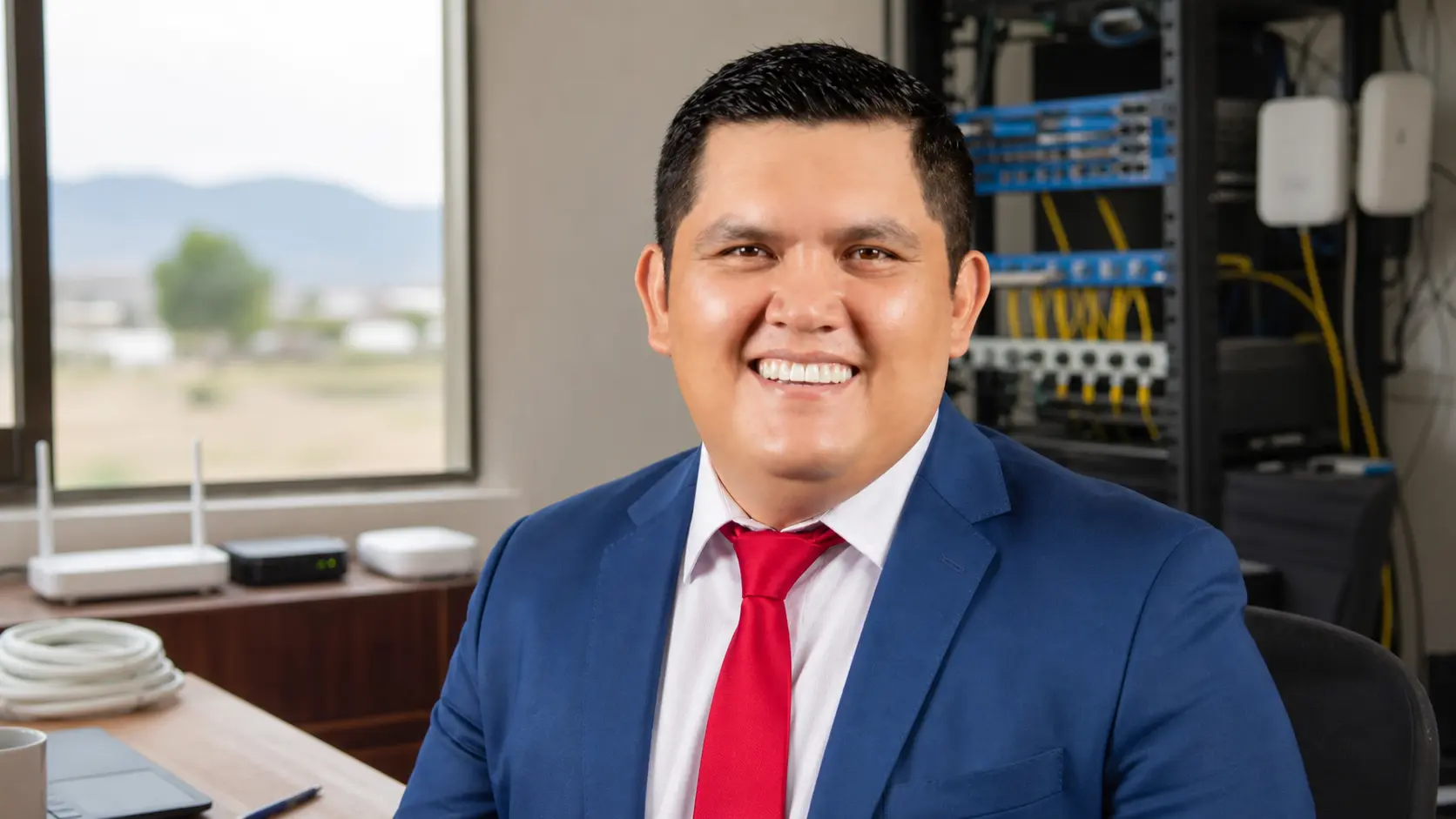
At first glance, the image question looks separate from the network and consumer-contract story. It is not. For a person profile, the featured image has to show the actual subject, preserve identity from public reference provenance, and place that person in a context relevant to the role. The Prensario asset provides a public portrait-reference point for Azahel Garcia in WISPMX and Conekta/Konecta context. It should be used as provenance for an AI editorial head-and-shoulders portrait, not republished as a raw image without rights review.
The portrait requirement is more than a visual rule. It reflects the same principle as the article: do not make a person more or less specific than the record allows. A generic tower photograph would show a sector. A back-view technician image would show a mood. But this commission is about a named person whose operating surfaces are publicly linked across registry, consumer, brand, and association records. The image should therefore be person-specific, while avoiding private locations, private contact details, or invented biographical scenery.
The right editorial portrait would place Garcia in a setting that suggests rural fixed-internet operations in Mexico: network equipment, fiber or wireless infrastructure, modest office context, or a neutral background referring to local connectivity work. It should not turn the subject into a heroic monument. It should not show fictional logos or claim exclusive rights to the Prensario image. The goal is to align identity and role, just as the article aligns name and operating surface.
That alignment matters because visual genericism can distort accountability. If the article is about a named operator but the image is only a rural tower, the reader receives an infrastructure story with the person blurred out. If the image is an ungrounded likeness, the reader receives a person story without evidentiary discipline. The Prensario reference helps solve that problem by allowing a grounded portrait approach while still respecting the difference between reference provenance and republication.
The Public-Sector Continuity In The Record
One of the most striking features of the Azahel Garcia trail is how many public or quasi-public systems touch it. LACNIC supplies the regional internet registry record for AS265578. PROFECO supplies the consumer-contract registration packet. IFT appears through authorization and tariff-reference context. Conekta supplies the operator-facing retail surface. WISPMX supplies the industry-association frame. Prensario supplies current public operator coverage and portrait context. None of those sources alone is enough for a broad biography. Together, they create public-sector continuity.
That continuity also changes how risk should be understood. A small operator can be hard to evaluate if each record is read in isolation. The registry record may look purely technical. The consumer-contract packet may look purely administrative. The brand site may look purely commercial. The association article may look like sector advocacy. But the same operating story runs across them: a named person is connected to a network resource, a fixed-internet customer contract, a local service brand, and a rural-ISP representation context. The public does not need private details to see that pattern.
It needs the non-sensitive parts of the record placed in order.
That continuity is especially valuable in Latin American connectivity markets, where the most consequential operators are not always the largest ones. A small ISP can be decisive for a cluster of localities, yet it may not appear in national business pages or investor databases. Network-resource evidence and consumer-registration evidence become substitutes for the corporate visibility that larger firms generate automatically. They show who is responsible, what service category is involved, and which public systems can be invoked when the relationship fails.
For consumers, continuity is practical. The name on a contract should not be disconnected from the name behind the network. The brand that sells service should not be impossible to relate to the regulatory record. The association voice that speaks for rural ISPs should not float free of the operator's actual service responsibilities. The Azahel Garcia record is valuable because it lets these surfaces be read together, while still preserving the limits of each.
For policymakers, the continuity points to a measurement problem. Rural connectivity cannot be understood only through national coverage maps and spectrum policy. It also has to be understood through the paperwork and resource records of local actors. Which small operators have network resources? Which have consumer-contract registrations? Which appear in tariff or authorization contexts? Which participate in training and representation networks? Which localities do they claim to serve? These questions do not produce a glossy narrative, but they produce a map of accountability.
A Micro-ISP Is Not A Miniature Carrier
It is tempting to describe a micro-ISP as a small version of a large carrier. That frame misses the point. A micro-ISP does not simply shrink the same corporate machine. It often combines roles that larger companies separate: technical planning, field operations, customer relationships, regulatory paperwork, vendor negotiation, and community presence. The person behind the service may be closer to every point of friction. That closeness can be a strength, because problems are local and relationships are direct. It can also be a risk, because resilience, documentation, and consumer recourse may depend on a small number of people.
Azahel Enrique Garcia Salazar's record shows this compressed operating surface. The same full legal name appears in network and consumer-protection contexts. Azahelgarcia appears as the commercial name in the PROFECO packet. Conekta appears as the public service brand. WISPMX and Prensario place Azahel Garcia in a small-ISP association and rural-connectivity conversation. The record does not show a large corporate apparatus. It shows a local operator whose accountability is distributed across several records.
That distribution has consequences. If one record is stale, another may still provide continuity. If a brand changes emphasis, the AS registration may still show network accountability. If industry coverage uses a shortened name, consumer and registry records can anchor the legal identity. If a customer sees only the local brand, PROFECO and IFT references can connect the service to a public framework. The system is not elegant, but it is legible when read patiently.
This is why the story should remain operational. There is no need to invent a grand personal mission. The public importance lies in the everyday machinery: registering a network resource, offering fixed internet, making a contract available, tying service to tariff and authorization context, and participating in a rural-ISP association. Those are the acts by which a smaller provider becomes visible to public scrutiny.
Rural Connectivity And The Economics Of Trust
Trust in rural connectivity is not built only by advertising speed. It is built by installation reliability, billing clarity, outage response, equipment responsibility, and the ability to understand who stands behind the service. In smaller markets, that trust can be intensely local. The customer may care less about national brand prestige than about whether the operator will answer, whether the service can be repaired, and whether the contract terms are understandable. Public records cannot create trust by themselves, but they can make trust auditable.
AS265578 contributes one layer of auditability. It says the network has a named resource holder in the regional internet registry. The PROFECO packet contributes another layer. It says the fixed-home-internet customer relationship has a registered contract structure. The IFT reference contributes a telecom layer. Conekta contributes the market-facing layer. WISPMX contributes a sector layer, where small and medium ISPs seek representation and training. Prensario contributes a public narrative layer, reporting rural-locality reach and association context.
Together, those layers help answer a basic question: when a rural internet customer buys service, what public surfaces can be used to identify responsibility? In many markets, that answer is surprisingly hard. A flyer may use one name, the bill another, the network registry another, and the trade press another. Here, the names are not perfectly identical across every surface, but they are connected well enough to make the operator visible.
The economics of trust also depends on restraint. A public profile should not expose private data just because it appears in a record. It should not treat private location details, contact channels, or tax identifiers as news when the accountability claim can be made without them. The relevant facts are the existence of the registration, the service category, the responsible name, the commercial surface, the authorization context, and the public operating role. Privacy is not the enemy of accountability. In this case, it is part of making the accountability frame legitimate.
Why This Profile Matters Beyond One Operator
The reason to write about Azahel Enrique Garcia Salazar is not that every reader needs to know one local Mexican ISP operator by name. It is that his record demonstrates a wider method for understanding regional connectivity. In markets where the most important access providers are sometimes small, documentary visibility becomes a public good. If the operator can be connected across network, consumer, telecom, brand, and association records, the public can see a piece of infrastructure that would otherwise remain below the threshold of national attention.
That method is transferable. Start with the network resource, but do not stop there. Move to consumer-protection registrations, but do not quote private fields. Look for tariff and authorization context, but do not pretend it proves service quality. Read the operator's public site, but treat self-description as positioning rather than independent proof. Use industry press for current role and portrait context, but bridge shortened names to stronger records before making identity claims. The result is not a biography. It is a disciplined operating profile.
For Mexico and Latin America, the method matters because connectivity policy often has to balance national scale with local delivery. Large carriers remain central. So do regulators, spectrum decisions, wholesale backhaul, universal-service strategies, and public investment. But the lived experience of connectivity in rural localities can depend on operators whose names appear more often in PDF packets and registry records than in boardroom coverage. If those operators are omitted from analysis, the public misses part of the access system.
Azahel Garcia's record is a reminder that micro-ISP accountability is not abstract. It has names, dates, identifiers, registration numbers, service categories, and obligations. AS265578, Azahelgarcia, Conekta, WISPMX, PROFECO, and IFT references are not random fragments. They are the public handles by which a smaller fixed-internet provider can be understood.
The Narrow Profile Is The Stronger One
The strongest version of this article is narrow by design. It does not ask Azahel Enrique Garcia Salazar to stand for every rural ISP in Mexico. It does not turn a service-registration packet into a life story. It does not use Prensario's current role context as a substitute for official identity records. It does not publish private registry or contract details. It does not claim to audit customer experience. It follows the public surfaces that exist and stops where they stop.
That restraint makes the profile more useful. The LACNIC record shows a named network operator behind AS265578. The PROFECO packet shows the same full legal name and Azahelgarcia in a fixed-internet consumer-contract registration. The Conekta surface gives the public operator context around Rioverde and Ciudad Fernandez. Prensario places Azahel Garcia in a 2025 Conekta and WISPMX rural-ISP conversation, with reported service to thousands of families and businesses across rural localities. WISPMX gives the association frame for small and medium ISPs. The public image asset gives portrait provenance for a person-specific editorial image.
Those facts are enough. They show how local internet-service accountability is assembled from records that were not designed to tell a story but, together, reveal one. A person who holds the network-registration surface, appears in the consumer-contract surface, connects to a brand selling fixed internet, and participates in the rural-ISP public conversation is part of the infrastructure story. Not because he is famous. Because he is accountable.
In the end, the subject is not only Azahel Garcia. It is the way a smaller market makes an internet operator visible. The paper trail is technical, legal, commercial, and public at once. It shows why rural broadband cannot be judged only by maps or slogans. It has to be read through the operators who carry the obligation into specific places, under specific names, with specific records that consumers and regulators can find. For AS265578 and the Azahelgarcia/Conekta surface, that name is Azahel Enrique Garcia Salazar.