
Summary
- The collaboration announced by Lattice Semiconductor and Arm places FPGA-based bridging and platform firmware at the boundary between an Arm AGI CPU host processor module and a data-centre secure control module. The opportunity is not a new compute benchmark, but a question of whether a defined management interface can make parts of server integration more modular while leaving validation, implementation and adoption decisions with OEMs and operators.
- OCP’s DC-SCM 2 LTPI specification defines a management and control communication path between HPM and SCM modules, including tunnelling of low-speed interfaces such as GPIO, SMBus, I2C and UART. It creates an interoperability option, but it does not by itself prove full server compatibility, security outcomes, customer deployment or economic returns.
Analysis
A server architecture decision begins with a boundary question: when an operator or OEM changes one part of a system, which responsibilities can move with that component and which remain attached to the surrounding platform? The answer determines whether a hardware change is a contained modification or a wider engineering project.
The collaboration announced by Lattice Semiconductor and Arm on 7 October 2026 is focused on that boundary. Lattice described a solution combining Arm AGI CPU server platforms, Lattice FPGAs and AMI firmware. The company said the FPGA works alongside the CPU and baseboard management controller, while AMI firmware provides platform boot and management capabilities. These descriptions establish how the companies present the architecture. They do not establish independent results on security, performance, deployment scale or commercial impact.
The market significance therefore depends less on the existence of a new server component and more on the role of a defined interface. A standard boundary can influence how suppliers and OEMs divide engineering work. It can create a common connection point without requiring every internal design decision to become identical.
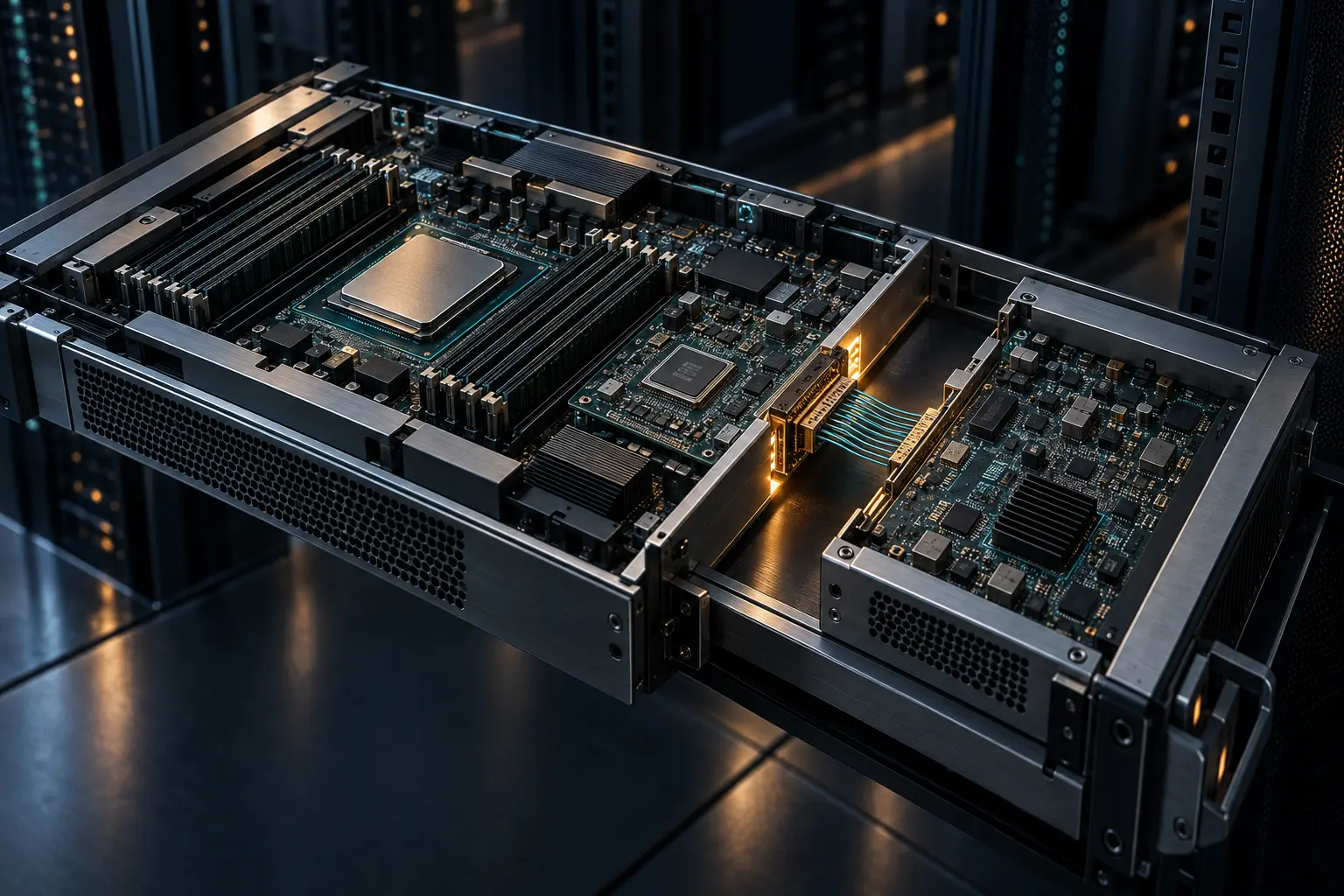
The Open Compute Project’s DC-SCM architecture is built around this distinction. OCP describes the DC-SCM project as separating common platform management and security hardware behind a connector and providing design specifications for interoperable DC-SCM and HPM modules. The objective is to create a framework where certain functions can be organized around a defined module boundary.
That boundary does not mean that all server functions become standardized.
The host processor module (HPM) remains an implementation area. The data-centre secure control module (DC-SCM) remains an implementation area. The OEM assembling the final system remains responsible for how those pieces are combined into a complete platform. The interface can define how modules communicate, but it does not decide how each module is built or how the final system is validated.
This distinction is central to understanding LTPI.
The Open Compute Project’s DC-SCM 2 LTPI specification defines a Low-Voltage Differential Signaling (LVDS) tunnelling protocol and interface between HPM and SCM modules. LTPI provides a method for carrying low-speed signals across that boundary. The specification covers GPIO and serial interfaces including SMBus, I2C and UART. It also includes an OEM channel that can carry proprietary interfaces.
The common boundary therefore standardizes a communication mechanism rather than an entire server design.
For OEMs, this can create a clearer separation between shared requirements and local choices. A platform designer can use the defined interface as a point of connection while continuing to make decisions about components, board design and firmware behaviour. The OEM channel reflects that some requirements may remain specific to a particular implementation.
This balance between standardization and flexibility is important. A completely fixed architecture could reduce supplier choice, while a completely undefined architecture could force each company to solve the same integration problem independently. LTPI occupies a narrower middle ground: a defined path for certain management communications while leaving broader platform decisions open.
The limits of that boundary are equally important.
LTPI is not a CPU interconnect. It is not a GPU fabric. It is not a workload acceleration interface. It does not describe how AI workloads execute, how much computing capacity a server provides or whether a system achieves a specific performance or energy outcome.
The existence of LTPI support therefore cannot be treated as proof of complete platform interchangeability. A module designed around the specification may still require substantial system-level work before it can replace another implementation.
That work begins with board validation. An OEM must determine how the physical design implements the HPM and SCM relationship, how surrounding components interact and whether the complete hardware configuration functions as intended. The standard defines communication expectations; it does not eliminate electrical, mechanical or platform-specific engineering decisions.
Firmware creates another boundary between specification and operation. Lattice identifies AMI firmware as providing platform boot and management capabilities in the announced solution. However, the presence of firmware does not demonstrate that different implementations can be exchanged without additional integration. Firmware behaviour, configuration choices and platform requirements remain part of the local validation process.
Security evaluation also remains separate from interface compatibility. The DC-SCM architecture concerns management and secure control functions, but an OCP-compatible interface does not itself establish a security audit, certification result or measured security improvement. A security conclusion would require evidence about the implemented design, security mechanisms, threat model and validation process.
The same applies to fleet adoption.
For an operator managing many systems, a modular boundary has value only if it changes operational decisions. An operator would need confidence that alternative modules can be integrated, supported and maintained without creating unexpected lifecycle costs. The available sources do not identify customer deployments, fleet results, measured savings or adoption levels for this collaboration.
The possible economic impact is therefore an inference.
If HPM/DC-SCM interfaces are implemented consistently and validated across products, OEMs may gain more flexibility in sourcing compute and control modules separately. A supplier could potentially participate in more platform designs because its component aligns with a recognized architecture. However, that possibility depends on adoption and validation, not only on the existence of a standard.
For Lattice, the architecture creates a position within the server control layer. OCP’s LTPI IP Core marketplace identifies Lattice as a solution provider and describes its core as compatible with OCP’s DC-SCM standards. This indicates participation in the standards-related control layer. It does not disclose licensing terms, pricing, shipments, design wins, customer-specific adoption or revenue contribution.
This difference between technical position and commercial position is important. A supplier can support a standard without the standard becoming widely adopted. A widely adopted standard can create opportunities for suppliers whose products reduce integration complexity. The current information does not show which outcome will occur.
The Arm relationship provides the compute-module context. Arm announced AGI CPU on 24 March 2026 as a server CPU product for AI infrastructure, including a reference-server design and partner ecosystem. Arm’s own performance and efficiency statements are vendor claims. They do not demonstrate that the Lattice control layer or LTPI changes compute performance.
The planned OCP Global Summit showcase also has a limited evidentiary meaning. Lattice announced a planned showcase of the joint platform at Booth A53 during OCP Global Summit 2026, and OCP confirms the event dates of 12–15 October in San Jose. The announcements confirm an intended showcase. They do not independently verify production deployment, customer adoption, sales activity or measured operational results.
The evidence required for a stronger market conclusion would be practical rather than architectural. A claim of economic value would require proof that organizations use the interface in real designs, that interoperability can be reproduced across implementations and that the resulting modularity changes engineering or procurement decisions.
An operator considering adoption would need several types of evidence: validated implementations, support processes, lifecycle experience and proof that the architecture changes the cost or flexibility of managing systems. An OEM would need confidence that sourcing alternatives do not introduce greater integration risk elsewhere.
The current record supports a narrower conclusion. The HPM/DC-SCM boundary creates a defined location where management responsibilities can be separated. LTPI provides a specified communication method across that boundary. Lattice’s participation gives the company a role in a standards-based control-layer opportunity.
The remaining question is whether the ecosystem converts that technical option into a repeatable operating model.
Sources
Member Briefing
Deeper Profile Context
Sign in with the right membership level to unlock the full briefing and source notes.
Only for Strategic Circle
Strategic Circle
Open to all readers. Unlock profile briefings after joining and signing in.
Join Strategic CircleOnly for Leadership Alliance
Leadership Alliance
For qualified IP-asset owners and management; sign in to unlock alliance briefings.
Join Leadership Alliance