Summary
- Arista's AI figure arrives as a floor, its Etherlink customer count arrives as a cumulative tally, and its largest-customer disclosure arrives as a range of one to two: three ways of stating direction, none of them a measured stock.
- Set against a quarterly revenue guide of about $3.3 billion, the full-year AI fabrics target of at least $3.5 billion is roughly a quarter of the annualized rate — a comparison, not a reconciliation to anything Arista reported.
If you are sizing a network budget for an AI cluster, the number you are most likely to be handed is not a measurement. It is a target with two words bolted to the front: at least.
Arista Networks announced third-quarter 2026 results on 3 November 2026, for the quarter ended 30 September. In that announcement the company describes itself as "an industry leader in data-driven, client-to-cloud networking for large AI, data center, campus, and routing environments." Read that sentence twice. AI is one of four environments in the frame, listed beside data centre, campus and routing. It is a positioning statement, not a reported segment, and the announcement text that reached this desk carried no AI revenue line at all.
The quantities live elsewhere. A 29 October 2026 preview published by 24/7 Wall St. recorded management's guidance of about $3.3 billion in third-quarter revenue at roughly 63 percent gross margin and earnings per share of $1.06 to $1.08; a target of at least $3.5 billion in AI fabrics revenue for the year; more than 100 cumulative Etherlink customers; one, possibly two, customers at 10 percent or more of revenue, anchored by Microsoft and Meta Platforms; and 1.6 terabit-per-second switches entering trials in the second half of 2026 with production in 2027. Every figure in this article comes from that publisher on that date unless it is the announcement sentence quoted above.
A fabric is a boundary you draw
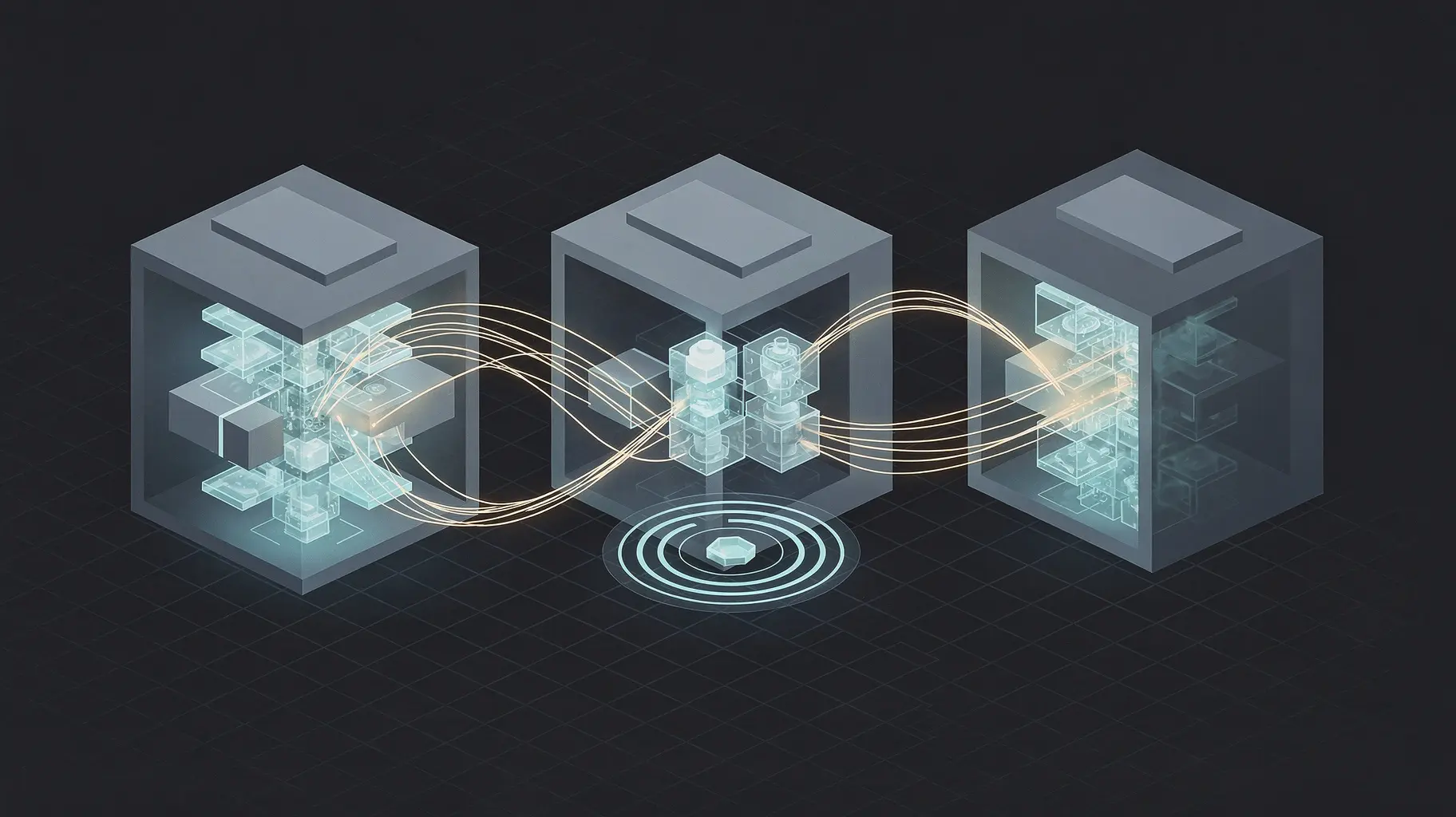
An AI fabric, in the sense switch vendors use the term, is the network layer that carries traffic between accelerators inside a training or inference cluster — the cabling and silicon that decides how fast one rack can talk to the next. Calling revenue "AI fabrics revenue" therefore requires someone to decide which orders count. A campus refresh that happens to sit next to a cluster, a cloud order that mixes conventional leaf-spine traffic with accelerated compute, a routing deployment in the same account: each of those is a judgement call, made inside the company, disclosed at the company's discretion.
That is not a scandal. It is a definition, and definitions are the first thing a buyer should ask for. The practical question is not whether Arista's AI number is honest. It is whether the number can be checked by anyone outside the building, and the answer depends on whether the company ever states the boundary in operational terms: which products, which customers, which geography, and whether the figure is revenue recognised in the period or orders booked for later.
The tally that cannot fall
"More than 100 cumulative Etherlink customers" is a strong-sounding sentence doing weak work. Cumulative means the count never decreases. A customer who bought once in 2024 and never returned stays in the total forever. A customer who leaves for a competitor stays in the total forever. The metric can only rise, so it will always look like progress, and it tells you nothing about how many of those hundred-plus accounts bought in the most recent quarter, how much they bought, or whether they are still buying.
A quarterly active-customer count would be falsifiable: it can go down, and a reader would notice. A cumulative count is a monument. Monuments are worth visiting and useless for navigation.
The same logic applies to the target. A figure introduced as "at least" sets a floor that management expects to clear, which is a reasonable thing for a company to say and a poor thing for a buyer to lean on, because clearing a floor generates no information about the size of the surplus or the speed at which it is growing. When the floor is roughly a quarter of your annualized run rate, the interesting number is not the floor. It is everything above it.
The arithmetic, labelled
Here is the comparison, stated as plainly as it can be. Four times the roughly $3.3 billion quarterly guide is about $13.2 billion on an annualized basis. The full-year AI fabrics target of at least $3.5 billion is roughly 26 to 27 percent of that rate.
That is an annualized comparison of a single-quarter guide against a full-year target. It is not a reconciliation to revenue Arista reported, because no reported full-year figure is being substituted for the guide, and nobody should read the ratio as a precise share of the year's actual turnover. What the comparison does establish is scale: the AI category is a substantial slice of the business and a minority of it, which is exactly the profile that makes a company's own definition worth scrutinising. A category that were 3 percent of revenue would be a curiosity.
A category at roughly a quarter is a strategic claim, and strategic claims get priced.
Two customers hold the floor
One, possibly two, customers at 10 percent or more of revenue, named as Microsoft and Meta Platforms. That is the concentration disclosure, and it is the most consequentially honest number in the set. AI fabric demand at this scale is not a broad market yet; it is a handful of hyperscale capital budgets, and Arista's growth in the category is largely a function of two companies' decisions about how many accelerators to buy and whose switches to put in front of them.
For a buyer, this cuts two ways. It means the vendor has reference deployments at genuine scale, which is worth something when your own cluster is on fire at two in the morning. It also means your order is small relative to the accounts that set the roadmap, that allocation priority in a tight supply quarter belongs to somebody else, and that if either anchor customer slows its build, the product line's economics change without any announcement.
And the generational clock is already visible. The 1.6T switches are described as entering trials in the second half of 2026, with production in 2027. Whatever an AI buyer commits to this quarter is the prior generation of that line, purchased while the next one is still being qualified.
What we could not read
One boundary matters and it belongs here rather than in a closing paragraph. Arista's own release or shareholder-letter text stating the AI fabrics figure, and stating how the company defines it, was not obtained as readable text on 12 November 2026. The company's press-release page confirmed the 3 November announcement and supplied the self-description quoted above; the quantities came from the dated secondary publication named at each use. That is a limit on this desk's retrieval, not a finding that Arista declines to explain the figure.
If the company does publish a definition and a reported AI revenue line, the test above still applies, and it gets easier to run: compare the definition to the products actually shipped, and compare the reported line to the floor.
What to demand next quarter
Ask for four things, in this order. The AI figure as a dollar amount with a stated period and a stated definition. An active customer count rather than a cumulative one. The concentration list with the actual percentages rather than a one-to-two range. And a sentence saying whether the number is recognised revenue or orders booked.
None of that is an unreasonable request to make of a company that has just put a strategic number in front of the market. It is the ordinary cost of being believed. Arista can pay it in a paragraph, and until it does, the safest reading of its AI story is the one its own wording supports: a large, real, vendor-defined slice of the business, measured by a tally that cannot fall and held up by two customers who can change their minds.
Arista Networks is tracked in the BTW directory, where the entity carries two supporting public references and, before this briefing, no article.
Member Briefing
Deeper Trend Context
Sign in with the right membership level to unlock the full briefing and source notes.
Strategic Circle
A daily briefing in your language, built from changes we have verified.
Join for USD 20/monthCancel anytime.
Public reporting stays free. Member research, the daily briefing and the forum need a membership.