Summary
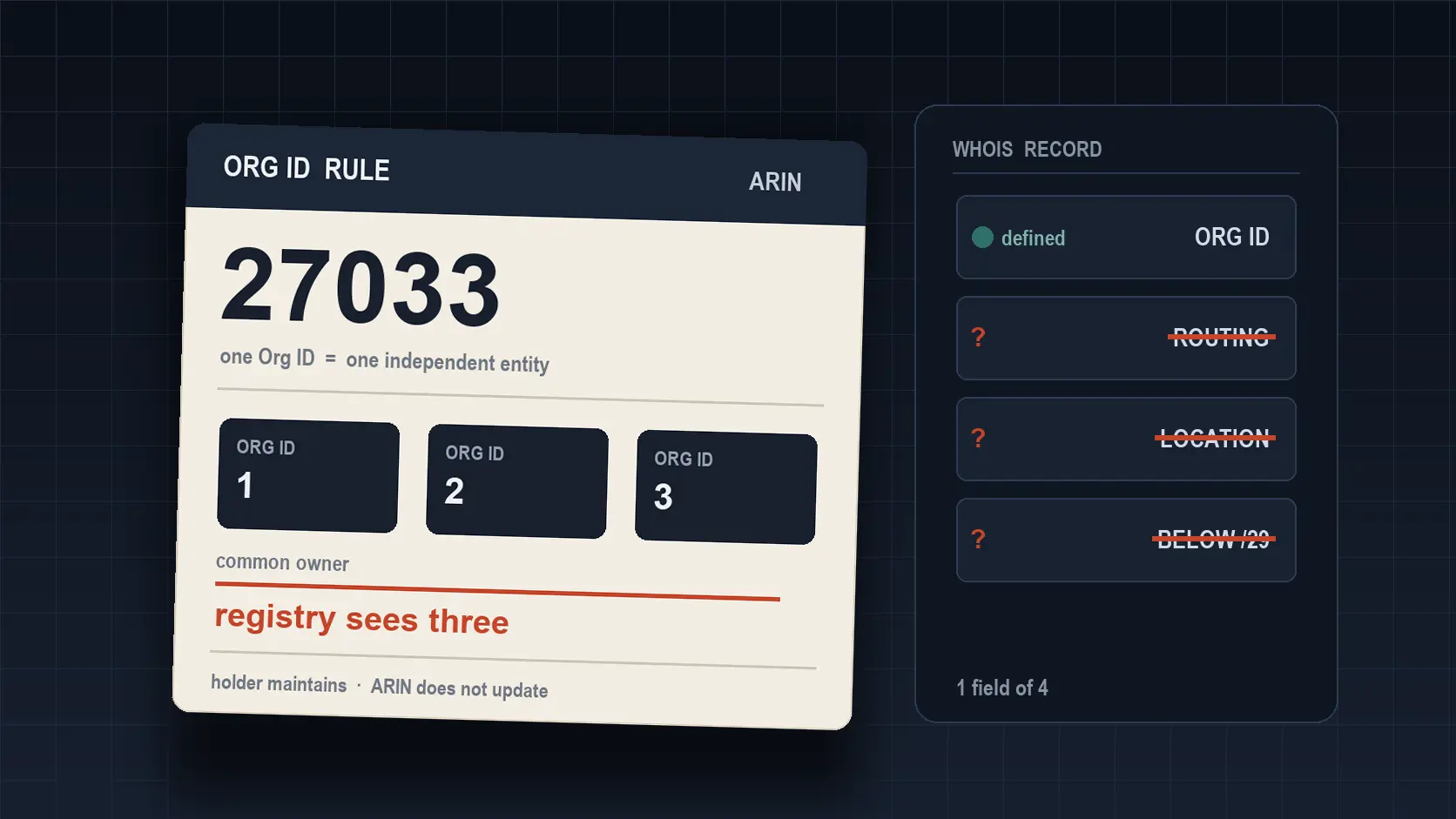
- ARIN's Registry Data Description defines the record the market trades on: Org IDs are treated as independent entities whatever the corporate relationship, all resources attach at Org ID level, and ARIN generally does not update customer data but relies on customers to maintain it.
- The same document lists what public directory data does not contain — routing information and the network's accurate geographic location among it — and restricts use of that data so it may not be republished, resold or made publicly available. Accuracy is a contractual duty on the holder under the Registration Services Agreement.
The record proves an authorized holder. Nothing more.
ARIN states the purpose in one sentence: "The main purpose of Whois is to record authorized users or assignees of an Internet resource. ARIN cannot guarantee that the address associated with an Internet resource record is the actual physical location of the network." The list of what the directory does not hold includes routing information, accurate geographic location of the network, customer reassignments smaller than a /29, and some privatized residential customers.
Read that as a diligence checklist. A prefix in Whois tells a buyer who is authorized to hold it. It does not tell the buyer where the equipment is, what is announced from it, who the downstream users are below the /29 cut, or whether the organization record has been touched since it was created. For an asset whose value is the right to announce, the public record covers the right and not the announcement.
Org IDs are legally blind on purpose
The sharpest line in the document is about corporate structure. "An organization, or a functional subset of an organization, e.g. a company may either be represented by a single Organization Identifier (Org ID) or multiple Org IDs. Org IDs are treated as independent entities, regardless of whether they are legally or functionally related to other Org IDs. All Internet number resources are associated at the Org ID level."
That is a design decision with a market consequence. Concentration is formally invisible: a group that holds its address space across several Org IDs appears in the registry as several unrelated holders, and two Org IDs under common ownership owe nothing to each other in registry terms. The same rule cuts the other way. A seller presenting ten Org IDs is presenting ten independent counterparties, and the registry will not certify that they answer to one board. Anyone counting holdings, whether to size a deal or to test whether a market is competitive, is counting entities the registry defined as unrelated.
Accuracy is the holder's job
The Registration Services Agreement puts the duty on the customer. Section 3(b) makes the holder "responsible for the timely and accurate maintenance of directory services data (Whois) with respect to the Included Number Resources". The data description adds that "ARIN generally does not update customer data but relies on customers to self-manage their data."
Policy then removes information by permission. NRPM 3.3 lets an organization privatize points of contact as long as one remains listed. NRPM 4.2.3.7.3.2 lets a provider substitute its own name for a downstream customer's — the document's example is "Private Customer - XYZ Network" — and use "Private Residence" for the address. Reassignment registration is required from a /29 upward, which leaves everything below eight addresses outside the public picture.
The fraud desk is the proof of the gap
ARIN runs a fraud reporting channel for suspected Internet number resource abuse, including "the submission of false documentation and information" to obtain resources, to abuse policy, to gain approval to transfer resources, to make unauthorized Whois changes, or to hijack resources. Outcomes include reclaiming resources issued or transferred on fraudulent data, reclaiming resources registered to a defunct organization with no eligible successor, and reverting unauthorized changes.
A registry that defines its own record as self-maintained, entity-blind on corporate structure, silent on routing, and correctable only through a report has told the market exactly what the record is worth as evidence. The fraud process is not an admission of failure; it is the mechanism that covers the part the record cannot. Buyers who treat Whois as a title chain are relying on a document that never claimed to be one.
Sources
Member Briefing
Read the full trend briefing
Members read the full briefing with the source notes behind every finding.
Strategic Circle
A daily briefing in your language, built from changes we have verified.
Join for USD 20/monthCancel anytime.
Members also get the full research library, a daily briefing on the networks they follow and the private forum.