Summary
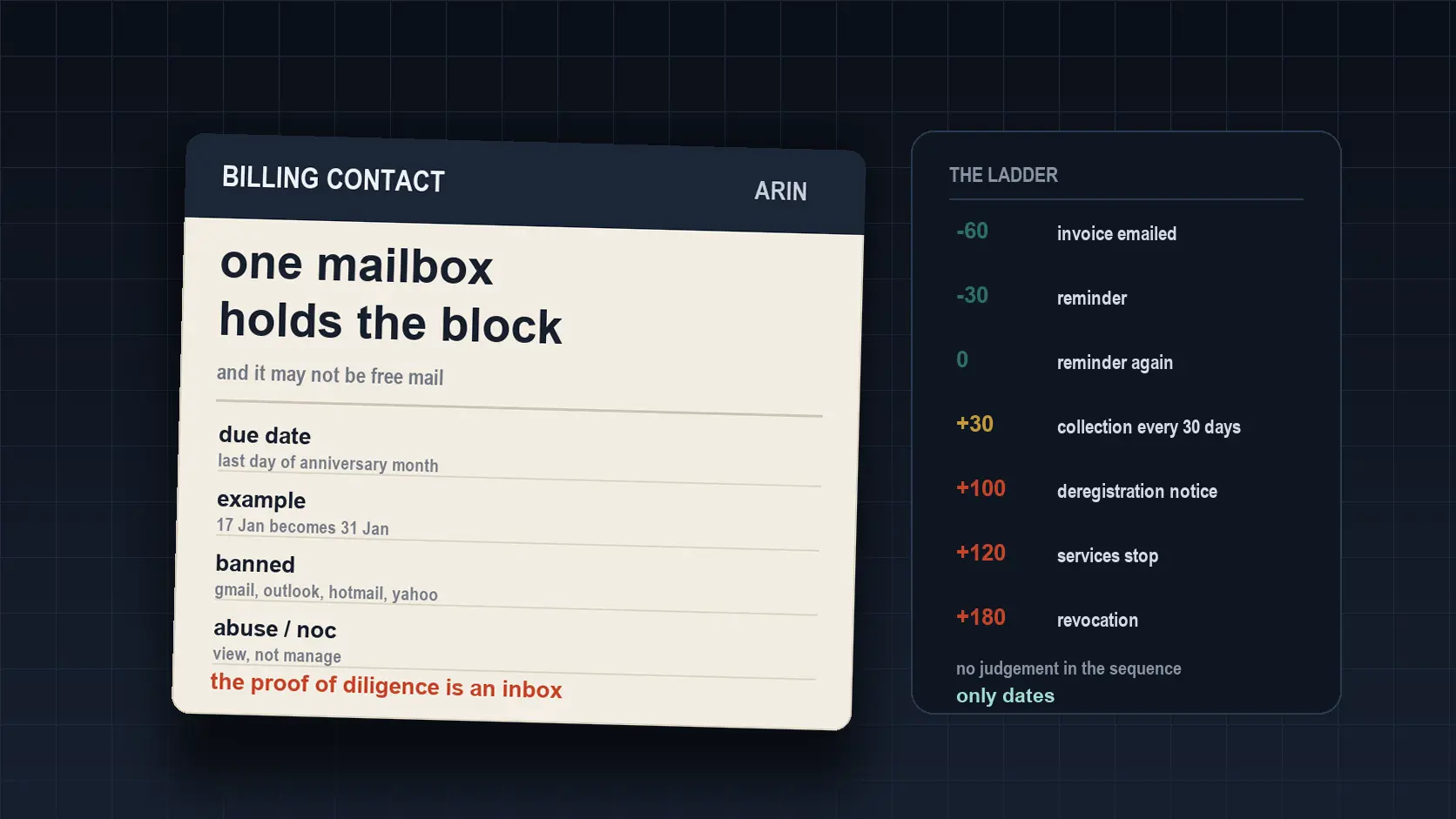
- ARIN's billing page states that an annual fee is due for registry services on all resources covered by an RSA or LRSA, "typically due each year on the last day of the anniversary month", with invoices emailed to the designated Billing Contact 60 days before the due date.
- Reminders go out 30 days before and again on the due date; a Collection Notice follows every 30 days once an invoice is 30 days past due; a Pending Deregistration Notice specifying the revocation date is sent at 100 days past due. Billing contact information "cannot include generic email accounts" from Gmail, Outlook.com, Hotmail or Yahoo Mail, and Abuse, NOC and Routing contacts can view but not manage billing information.
The anniversary month quietly adds days
The worked example is worth reading twice. Resources issued on 17 January 2020 produce an annual due date of 31 January. The fee is annual, but the clock starts from the end of the month in which the resources arrived, not from the date they arrived.
That is a small thing with a long tail. Every organisation that received space mid-month has a due date two weeks later in the year than its own anniversary, and every finance team that plans on the issuance date is planning against the wrong day. The registry gets the second half of a month it never carried.
A five-step ladder with dates, not warnings
The sequence is published and mechanical. Invoice at minus 60 days. Reminder at minus 30 and again on the due date, sent to Admin, Tech and Billing contacts. At 30 days past due, a collection notice every 30 days to all contacts until the account is current or services end, plus email, ordinary and certified mail, and collection phone calls. At 100 days past due, a Pending Deregistration Notice naming the date revocation will occur.
Nothing in the ladder depends on a judgement. It is a schedule, and a schedule is the most reliable thing a registry produces.
The mailbox rule is a robustness decision made by someone else
Here is the part that matters in practice. The billing contact must be a person or group with whom ARIN works on invoice matters, and generic accounts from Gmail, Outlook.com, Hotmail and Yahoo Mail are not allowed. Abuse, NOC and Routing points of contact may view billing information but not manage it.
So the registry has decided that paying attention requires a corporate identity, and has removed the free-mailbox fallback that most small organisations reach for when a staff member leaves. When the billing contact departs and the mailbox dies, the ladder does not pause. The first indication that anything is wrong is a collection notice, unless the organisation has already missed several.
Authorisation is by link, to an address of record
Changing billing authority is not a self-service action. An account requests billing authorisation by entering the Org ID, and a notification with an authorisation URL goes to the email address of the billing contact on file with ARIN, which is then confirmed.
That is a good control and a single point of failure in the same sentence. If the address on file is stale, the request goes to a mailbox nobody reads, and the organisation is locked out of the panel that would let it fix the problem — while the invoice ages according to a calendar nobody stopped.
What is not published
ARIN does not publish how many resources are revoked each year for non-payment, how many of those were unreachable billing contacts rather than unwilling payers, or how often an authorisation request is sent to an address that turns out to be dead. Those three numbers would settle whether this is a revenue machine or a mailbox-maintenance problem, and the page that runs the ladder does not report them.
Sources
Member Briefing
Read the full trend briefing
Members read the full briefing with the source notes behind every finding.
Strategic Circle
A daily briefing in your language, built from changes we have verified.
Join for USD 20/monthCancel anytime.
Members also get the full research library, a daily briefing on the networks they follow and the private forum.