Summary
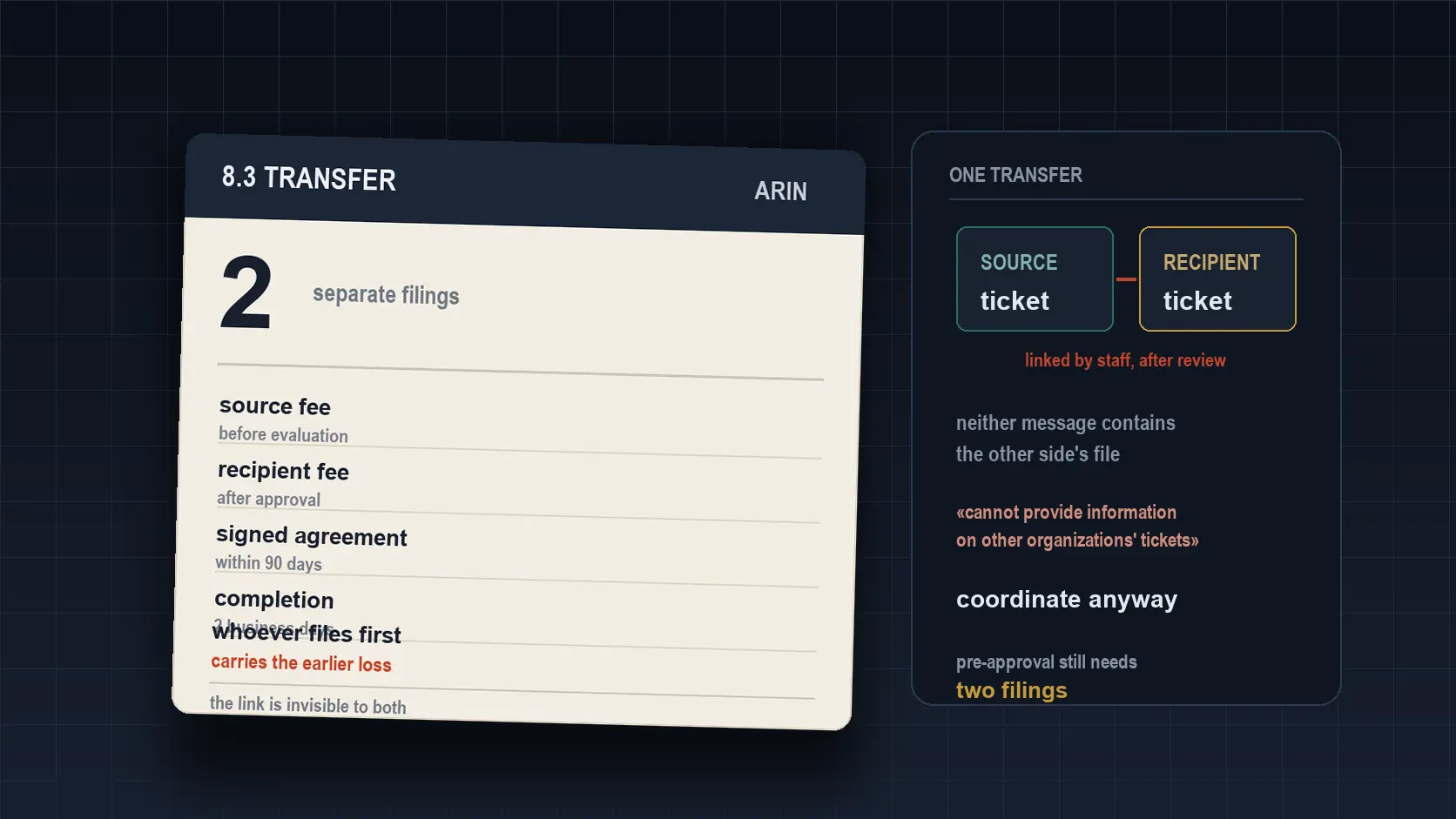
- ARIN's 8.3 specified-recipient procedure requires both the source and the recipient to submit transfer requests separately, and ARIN staff link the ticketed requests once they have been reviewed.
- ARIN tells the parties to coordinate with each other before approval because it "cannot provide information on ticketed requests from other organizations", and states that regardless of pre-approval both organisations must still submit a request.
The registry is the only party that sees both sides
Every market needs a point where the two halves of a trade meet. In ARIN's 8.3 process that point is a member of staff with a linking function. The buyer files a ticket, the seller files a ticket, and neither ticket contains the other's content in a form the counterparty may read. ARIN joins them and then decides.
The arrangement is unusual enough to be worth stating slowly. The two organisations are in a commercial negotiation, they are expected to coordinate, and the registry formally refuses to be the channel through which they do it. The counterparty's progress on its own filing is a fact each side must obtain from the other side, not from the registry that will approve both.
Coordination is required and unassisted
The page is explicit: participants should "coordinate your request with the other party prior to ARIN approval". Nothing in the process supplies the coordination. There is no shared case view, no status exchange, and no way for a buyer to discover from ARIN that the seller has not filed at all.
That produces a specific failure mode for anyone who has not done this before: a buyer can complete its side perfectly, pay its fee, receive an approval, and still be waiting on a ticket it cannot see. Whether the transfer happens depends on an action taken in a queue the buyer has no visibility into, and the buyer's only instrument is the seller's willingness to report it.
Pre-approval does not remove the second ticket
One sentence closes a tempting assumption. Even where pre-approval exists, "both the source and recipient organizations must submit an 8.3 transfer request". A pre-approval is not a substitute for a filing; it removes the need to argue eligibility again, not the need to appear.
Read together with the 90-day signature window and the non-refundable source fee, the shape of an 8.3 deal becomes clear: two independent filings, two fee events, one clerk's link, one signature deadline, and a completion that arrives once the paperwork is clean. The registry has designed a market where the transaction is real only when both sides have done their own administration.
What the arrangement protects and what it costs
The opacity is not accidental. "ARIN cannot provide information on ticketed requests from other organizations" is a confidentiality rule that keeps one party's filing from becoming intelligence for another, and it stops the registry becoming a de facto escrow agent for negotiations it does not supervise.
The cost is that the market's verification burden sits in the private contract. Whoever writes the transfer agreement has to invent the reporting duties the registry declines to supply: when each side filed, whether the filing was accepted, what was asked for, and what happens if one side withdraws. ARIN will not tell you, and it will still approve the other half.
What is not published
ARIN publishes no count of 8.3 transfers where one side filed and the other did not, no typical interval between the two filings, and no rate at which linked requests fail to complete. Those three numbers would say whether the two-ticket design is a confidentiality device or a trap for the inexperienced, and the page that imposes it does not report them.
Sources
Member Briefing
Read the full trend briefing
Members read the full briefing with the source notes behind every finding.
Strategic Circle
A daily briefing in your language, built from changes we have verified.
Join for USD 20/monthCancel anytime.
Members also get the full research library, a daily briefing on the networks they follow and the private forum.