Summary
- Since Despacho Presidencial n.º 105/19 of 2 July 2019, international and regional interconnection points have been the only passage for Angola's international connections, covering data, voice and Internet traffic, with operator interconnection mandatory on transparent and non-discriminatory terms.
- The instrument that would make that passage operational is a concession contract the regulator negotiates and signs. No executed gateway concession, title number, execution date or validity period appeared in the documents I read on 12 and 13 November 2026.
Angola's international connectivity has a legal shape that most markets do not. Lei n.º 23/11, the electronic communications statute of 20 June 2011, gives the regulator INACOM the authority to attribute the titles needed to offer networks and services and to ensure interconnection, opens network and service provision to private operators, and makes interconnection between public electronic communications networks mandatory (Lei n.º 23/11). Read that quickly and it looks like liberalisation in the ordinary 2011 style. Read it next to what came eight years later and it does not.
On 2 July 2019 the government approved the creation of international and regional interconnection points as the único ponto de passagem — the only passage — for Angola's connections to other countries. The instrument covers international and regional data, voice and Internet traffic. It requires electronic communications operators to interconnect with the gateway on transparent and non-discriminatory terms. And it places management of the gateway infrastructure inside the public-private partnership framework (Despacho Presidencial n.º 105/19). The PDF on INACOM's own servers carries no readable text layer; I read its pages as screenshots, which is why I quote the phrase rather than reconstruct the article numbering.
Two details about that instrument matter more than its ambition. The first is bureaucratic: INACOM's live legislation index lists the same document as Decreto Presidencial n.º 105/19, while the official gazette copy identifies it as Despacho Presidencial n.º 105/19 (INACOM legislation index). A buyer chasing the instrument in a portal search will find it or not find it depending on which word the portal indexed. That is a filing problem, not a scandal, and it is exactly the kind of filing problem that makes an authorisation hard to verify.
The second is structural. A designated passage is infrastructure. What makes it possible to operate, and what makes it possible to sell capacity across it, is a title. The current General Regulation of Electronic Communications, republished by Decreto Presidencial n.º 271/25 of 29 December 2025, requires a title for public networks and publicly accessible services and allows the concession route where essential infrastructure or services are involved. The final award is approved by the Titular do Poder Executivo; INACOM conducts the process and negotiates and signs the contract afterwards. The regulation then lists what that contract has to state: the concessionaire and the grantor, the object and scope, the geographic area, the applicable rules, service and quality conditions, rights and obligations, fees, supervision, validity, termination and dispute resolution. Concession validity is capped at 15 years subject to renewal. Ordinary multiservice licences are issued by INACOM on application, identify the operator, services, geographic scope, validity, rights and obligations, run for an initial ten years renewable for equal periods, and require a licence change if the operator adds a service type (Decreto Presidencial n.º 271/25).
The regulation is unusually specific about the paperwork. That is the point. If a gateway concession exists, it has a number, a date, a named concessionaire, a scope and an expiry. Which brings in the 2020 executive decree that delegates to INACOM the competence to sign the specific concession contract for management and maintenance of the gateway (Decreto Executivo n.º 260/20). A delegation to sign is not the signed instrument. It tells you the state intended to execute one; it does not tell you the name on it.
The one gateway instruction I could read in full is narrower than the framework above and more revealing about enforcement. Instrutivo n.º 1/23 of 9 January 2023 is expressly about international voice. It obliges the gateway manager to publish a reference interconnection offer with prices and conditions on transparent, cost-oriented and non-discriminatory terms, to submit domestic interconnection agreements to INACOM for homologation and agreements with foreign operators for supervision, and it treats the supply of transit services to entities not licensed to resell capacity and electronic communications services as unlawful (Instrutivo n.º 1/23). Note the scope. The 2019 instrument reaches data, voice and Internet; the detailed rule-making I found reaches voice. For the data and Internet capacity buyer there is no equivalent published schedule of gateway conditions in the set I inspected, and I will not turn that gap into a claim that such conditions do not exist.
Someone is inside the passage. A company called Gateway Internacional Angola, S.A. describes itself as controlling and managing Angola's international communications traffic, describes its origin as a public-private partnership between MTTICS/INFOSI and MGI Communications, and dates its inauguration to 24 March 2021 (GIA). Its partners section displays the logos of Angola Telecom and Angola Cables (GIA partners graphic). Logos are relationships, not instruments. They do not say whether either company is a customer, a capacity supplier, a shareholder or the concession-holder, and the graphic is undated. No concession number, licence number, issuance date or validity period appears on the GIA material I read.
So what does the incumbent itself publish? Angola Telecom is in the BTW directory as an AFRINIC member in Angola and little else (Angola Telecom directory entry). Its 2021 report is more forthcoming: retail, enterprise and wholesale operations including SAT-3/WASC capacity, international leased circuits, IP transit and backhaul; 100% state ownership; a 51% holding in Angola Cables; and a 15-year electronic communications concession with the state represented by INACOM. The report does not describe a designated gateway role. I read it through a mirror hosted on a third-party document site, not an authenticated original, and its reporting period ends on 31 December 2021 — so those ownership figures are a dated statement, not a current corporate register (Relatório e Contas 2021).
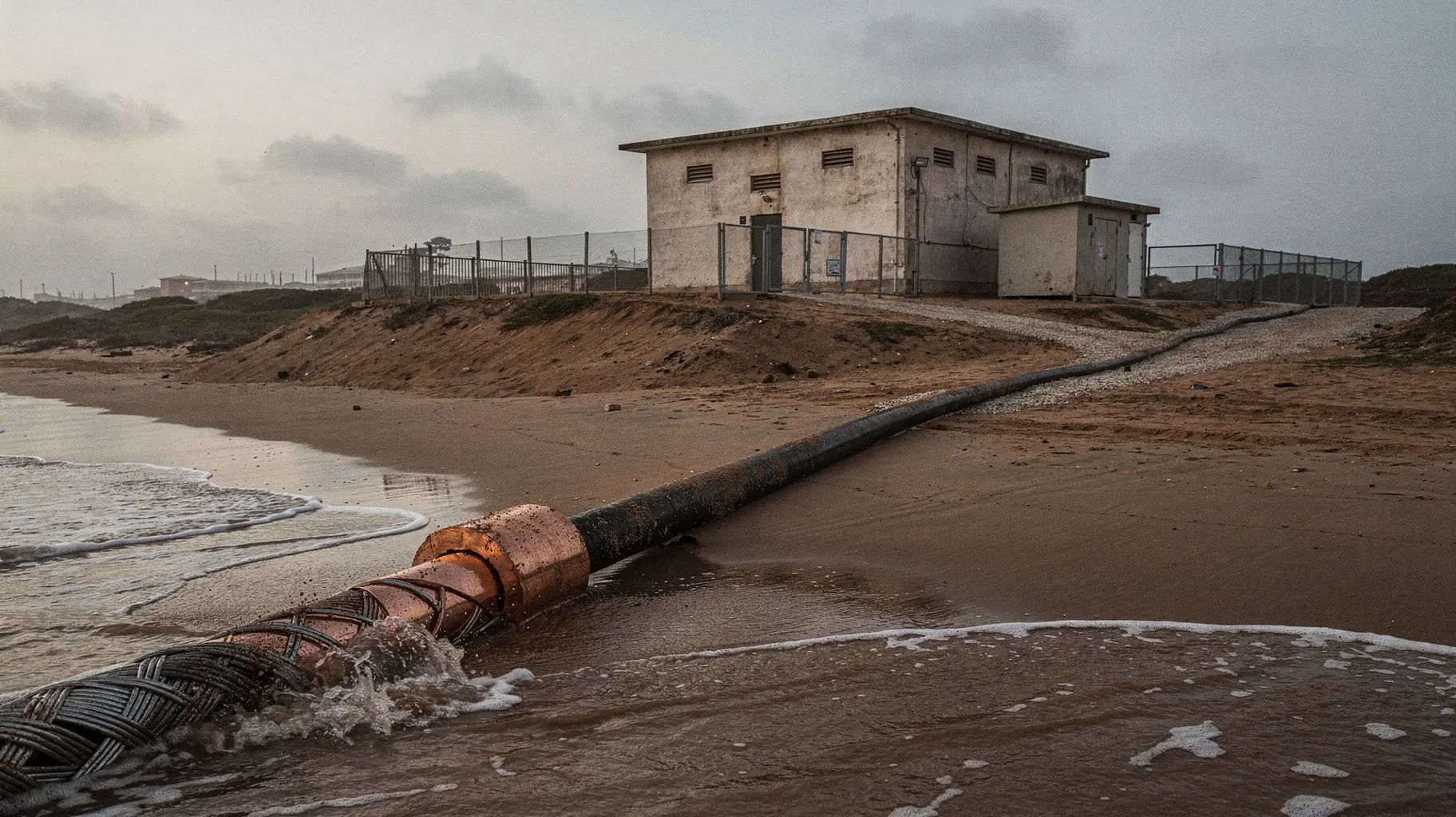
Angola Cables is a different kind of object again, and its own announcements are precise about which one. In October 2018 the company and NEC announced that SACS was complete and ready for commercial service, that SACS is 100% owned and operated by Angola Cables, that Sangano is the Angolan landing station with onward connectivity to AngoNAP, and that the Brazilian landing sits in a Fortaleza data centre (SACS ready for service). Its Global IP Network routing policy, last updated 26 July 2024, describes a wholesale carrier marketing international data-circuit and voice capacity over WACS, MONET, SACS and partner networks through ASN 37468, and says nothing about a national gateway concession (Angola Cables routing policy). A 2013 partner release had already assigned Angola Cables the management and development of WACS in Angola and international transmission services for operators, and its forecast that SACS would be running by the end of 2014 was overtaken by the 2018 launch (Epsilon release).
Here is the discipline the record demands. Cable ownership, landing station operation, wholesale capacity sale, internet exchange management and management of the designated gateway are five different objects, and the documents I read support different ones for different companies. SACS ownership belongs to Angola Cables. The Sangano landing belongs to the SACS story. The gateway belongs to an instrument none of these documents displays. Every Angolan commercial deck that runs those five together is asking a buyer to accept an inference as a title.
What the buyer can actually check is narrower and more useful. Ask for the title under which capacity is sold: a multiservice licence identifying the operator, services, geographic scope and validity, or a concession contract identifying grantor, concessionaire, scope, validity, fees and termination. Ask which legal person signs. Ask what the contract says happens to the service if the underlying title lapses, is renewed or is replaced. Ask for the concession number on the gateway side, and if the answer is a partner page, treat it as a partner page.
Three limits bound what I can assert, and each belongs next to the claim it touches. The official 2025 RGCE file was too large for the retrieval route I had, so its provisions come from an accessible reproduction while INACOM's index confirms the instrument's publication and listing. The Diário da República naming conflict on the 2019 instrument is unresolved by me. And neither angolatelecom.ao nor angocables.com would load on 13 November 2026, so nothing in this briefing rests on what those homepages do or do not display.
Angola does not have a cable problem. It has a signature problem. The single passage is real, it is legally enforceable, and its operator has an obligation to publish interconnection terms in at least the voice layer. What the record does not give a buyer is the name on the concession. Until that document is published, the honest answer to "who is Angola's international gateway" is: the state says one exists, a company says it runs it, and nobody has shown you the paper.
Member Briefing
Read the full trend briefing
Members read the full briefing with the source notes behind every finding.
Strategic Circle
A daily briefing in your language, built from changes we have verified.
Join for USD 20/monthCancel anytime.
Members also get the full research library, a daily briefing on the networks they follow and the private forum.