
Summary
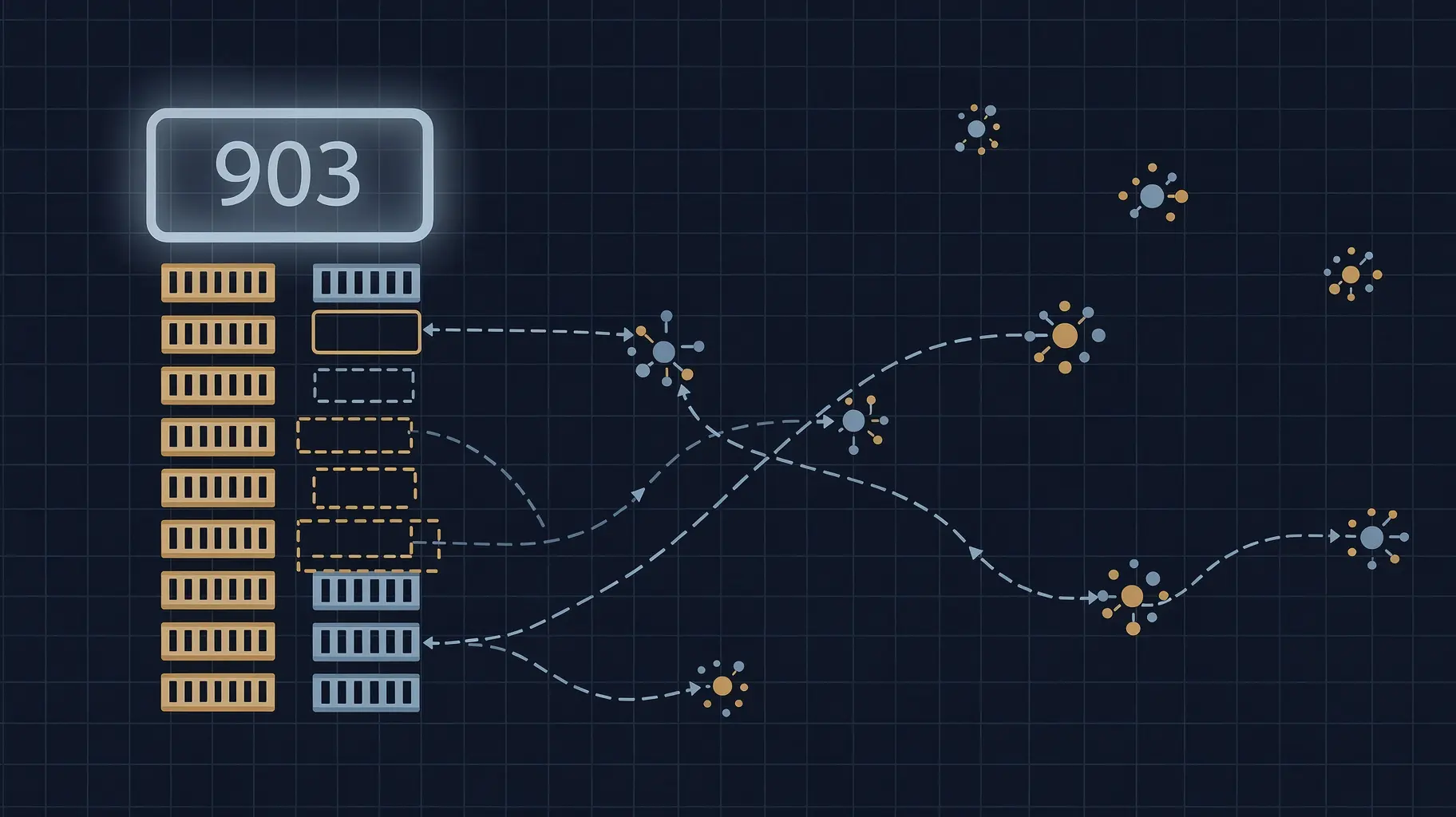
- The Amsterdam Internet Exchange front page, as retained on 2026-10-18, displayed "903 Connected networks" alongside "ASNS 903" and "Connect from 3000+ data centres worldwide"; the retained excerpt contains no definition of the unit, no measurement date and no port definition.
- The public record uses membership and ports interchangeably without a bridge: a party release calls the organisation one with "a member base of nearly a thousand" and names HGC as a regional partner, while another release ties the word member to a 100 Gigabit Ethernet port. Neither document says whether a network counted as a member must hold its port at a location the exchange itself operates.
The number and the missing unit
A count is a unit plus a number. On the retained text, only the number survives.
The exchange's own front page carries three fragments in sequence: "903 Connected networks", then "ASNS 903", then "Connect from 3000+ data centres worldwide" (AMS-IX front page). The ellipses belong to the retained excerpt — they mark where the retrieval preserved separated fragments rather than a continuous sentence — and the surrounding prose, any footnote, any date stamp and any method note were not retained. That matters for reading the excerpt honestly: nothing here shows the exchange refusing to define its terms. It shows that no definition was captured.
Two of the three fragments are not even the same kind of measure. A count of networks and a count of "3000+ data centres worldwide" are different inventories, and the retained text supplies no overlap, no ratio and no statement that one contains the other. Any arithmetic combining them would be invention. The same applies to "ASNS 903": a token placed beside a number is not a published statement that the number equals a count of autonomous systems, even where that reading is plausible.
One vocabulary, two instruments
A release announcing a connectivity arrangement between Taipei Internet Exchange and AMS-IX Hong Kong describes the Amsterdam organisation as "one of the largest internet exchanges globally, boasting a member base of nearly a thousand", and names HGC as "a partner of AMS-IX in the region" (release text). The same release lists other AMS-IX exchanges in Asia — Singapore, Bangkok and Manila — and globally in Amsterdam, the Bay Area and Chicago.
903 and "nearly a thousand" are consistent to the precision either document offers, and they should not be treated as two independent measurements. Both originate with parties who have an interest in the figure, and neither carries a definition of the unit.
The word itself is used for something more concrete elsewhere. A release describing a port upgrade states that "Atrato IP Networks has become the first AMS-IX (Amsterdam Internet Exchange) member with a 100 Gigabit Ethernet (GbE) port connection" (port reference). Here membership is a port of a stated speed. A port, however, is a physical thing at a physical site, and the site's operator, the cross-connect and the power are separate commercial arrangements. A single headline number that spans a brand operating in several countries cannot simultaneously be a count of ports at one site in Amsterdam and a count of everything carrying the name.
Whose name sits on the other side of the port
The retained record does establish that the brand covers more than one place. Trade press reports that "AWASR, Alliance Networks, and the Amsterdam Internet Exchange (AMS-IX) have partnered up to launch a new Internet exchange in Oman - Oman-IX" (launch report). That sentence is one line long and deliberately limited: it does not say which of the three parties operates the fabric, who owns the switching, whether a network connecting there appears in the Amsterdam figure, or on whose paper a member's contract sits.
This is where a convergence claim would be tempting and wrong. The retained material does not state that these named exchanges share one fabric, one switch estate, one power feed or one maintenance arrangement; neither does it state that they are wholly separate. A common brand across Amsterdam, Singapore, Bangkok, Manila, the Bay Area, Chicago and a partner-launched platform in Oman establishes that the name is shared. It establishes nothing about the physical path between them.
For a network engineer the distinction is not academic. What is bought at an exchange is a port; what provides redundancy is a second port on a path that fails independently; what a brand provides is a promise that the same operational practice and the same counterparty relationships apply. A count that mixes those three things is a marketing figure, not an engineering specification.
The two pages that would have answered it
Two first-party pages whose addresses suggest they hold precisely this inventory — a partners page and an exchanges page — returned no retrievable text on 18 October 2026 (partners, exchange list).
That is a dated boundary and must be reported as one. A failed retrieval is not a finding that the page is empty, still less that the company withholds the list. It simply means that on this date an outside reader could not obtain the document that would convert a brand claim into a facility inventory, and this article therefore cannot say how many AMS-IX-branded exchanges exist, which of them are operated by the exchange itself, or how the 903 is distributed among them.
What the BTW record actually holds
The directory entry for the exchange is an import of one APNIC member-directory row, read verbatim for this article (BTW directory record). It records region AP, a known role of "a very small member in AP", two evidence entries — the APNIC member list and the ams-ix.net website link — no relationships, no contacts, no service classification and a confidence score of 0.82. Its published data-gap list states that legal registration, the public website and leadership contacts remain unverified, that ASN and IP resources have not been mapped, and that the entity should not be classified as an ISP, transit, cloud, registry or managed-network provider without a source that says so.
The record does not describe exchange operations at all, and it should not be read as doing so. Nor is "a very small member in AP" a verdict on a fabric: it is a tier in an RIR membership list, which is a different measurement from a connected-network count. The two look contradictory only if one assumes they describe the same object. They do not, and the honest reading is that the word "member" is doing different work in an RIR directory, in a press release and on a front page — which is exactly the ambiguity at the centre of the headline figure.
What would settle it
The question is falsifiable in both directions, and the documents that would settle it are ordinary ones.
A published definition stating that a connected network means a port on a switch the exchange operates would support the headline reading. A facility list showing every branded exchange on exchange-owned switching, with no third-party transport between them, would support it further. An incident or partition record in which the counted networks failed together with the Amsterdam fabric would support it behaviourally.
Conversely, a statement that the count includes ports delivered at partner sites, or a member agreement whose counterparty is a partner rather than the Amsterdam entity, would confirm that the figure measures commercial reach rather than one attachment surface. A price list that distinguishes direct from remote or partner-delivered ports would do the same.
None of these was obtained. The article can therefore establish only that in the material read on 18 October 2026 no definition was published; it cannot establish that none exists.
What the figure is still good for
As an order of magnitude, 903 says the exchange is large, and the "nearly a thousand" phrasing in a party release is consistent with it. As a comparator it is weaker: a number with an unpublished and possibly changing unit cannot be safely compared with last year's version of itself, let alone with a rival exchange whose unit is undefined in a different way. Two undefined units do not become defined by being placed side by side.
For the audience that actually commits capital and circuit inventory, the count is a pointer rather than a specification. The questions that decide whether a peering presence is resilient are narrower and answerable: at which facility does the port sit, who is the counterparty on the contract, who supplies the cross-connect and the power, which second path fails independently of the first, and what is the maintenance and restoration practice on each. A headline number answers none of them, and treating it as though it did is how continuity risk gets priced off a marketing figure.
Member Briefing
Deeper Profile Context
Sign in with the right membership level to unlock the full briefing and source notes.
Only for Strategic Circle
Strategic Circle
Open to all readers. Unlock profile briefings after joining and signing in.
Join Strategic CircleOnly for Leadership Alliance
Leadership Alliance
For qualified IP-asset owners and management; sign in to unlock alliance briefings.
Join Leadership Alliance