Summary
- Amphenol's third-quarter free cash flow was $1.623bn, close to the roughly $1.6bn combined price of four completed or agreed acquisitions. The company plans to use both cash and debt.
- The purchases reach automotive lighting, specialist circuit boards, European fibre connections and sensors. Turning today's component demand into tomorrow's cash sources will test capital allocation alongside manufacturing investment and shareholder payouts.
Amphenol produced $1.623bn of free cash flow in three months. It also unveiled a four-deal shopping bag costing about $1.6bn. A financier could scarcely ask for a neater pair of numbers. The cash account, inconveniently, has several other customers.
In the quarter ended September 30, the connector maker returned roughly $553m to shareholders and repaid $937.9m of debt principal. Cash and equivalents fell by $556.3m. Amphenol's October 28 original results release says the acquisitions will be financed with cash on hand and debt. That makes the near match useful as a measure of buying power, while the actual funding has to accommodate all the other claims on the till.
The commercial question is what this buying power purchases. An electronics boom can leave a supplier with a larger factory bill, a richer shareholder base, or ownership of additional businesses. Amphenol is pursuing all three.
Four purchases, several places to earn
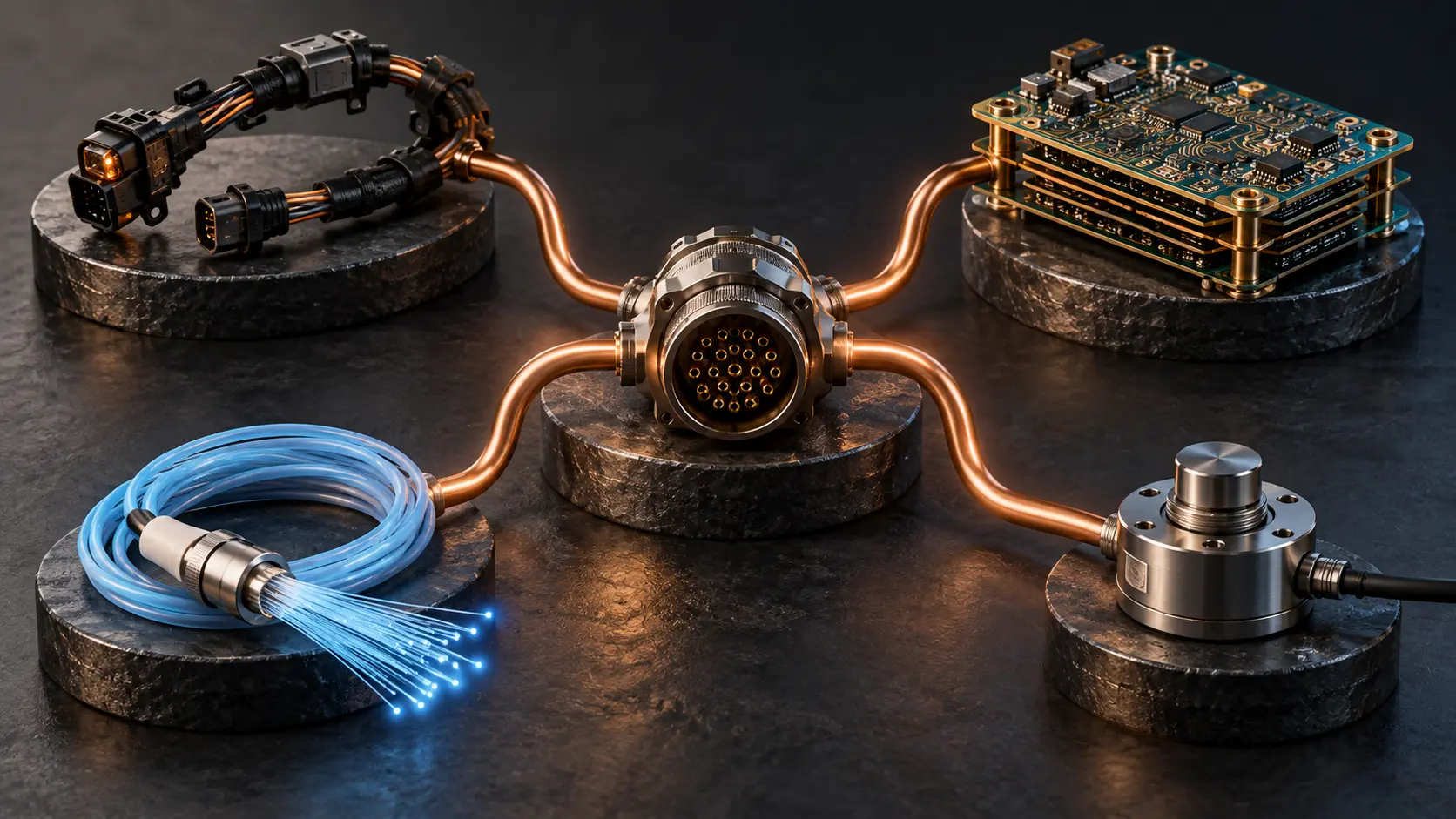
Empire Electronics joined at the beginning of September. The Michigan business makes complex automotive interconnect assemblies, particularly lighting-related products, and is expected to generate about $320m in full-year 2026 sales.
Three more agreements extend the reach. AdvancedPCB makes high-technology circuit boards for defence and industrial customers; its expected annual sales are about $270m. Dexgreen Limited supplies fibre connectivity, primarily for European fibre-to-the-home applications, with expected sales of about $90m. The proposed Humanetics Sensors purchase covers the sensor business of Humanetics: precision force sensing, specialist fibre sensing and micro-machining for commercial aerospace, defence and industry, with expected sales of about $70m.
AdvancedPCB and Humanetics Sensors are expected to close in the fourth quarter of 2026; Dexgreen in the first quarter of 2027, subject to approvals and other closing conditions. Empire is already inside. The four targets' full-year sales expectations sum to roughly $750m, a description of their size. Amphenol's current 2026 guidance excludes the three pending purchases.
For a company enjoying exceptional organic growth in IT datacom, as management describes it, this is an interesting shopping list. Car lighting and force sensors do not all march into the server room. The purchases add different customer uses for components, giving future cash generation more places to develop. Any reduction in exposure to a particular cycle will depend on how those businesses actually perform.
Free cash has already paid one bill
Amphenol calculates free cash flow by taking operating cash of $2,078.5m, subtracting $457.2m in capital expenditure and adding $1.4m from disposals of property, plant and equipment. The result, $1,622.7m, is its non-GAAP liquidity measure. The factories have received their investment allowance before that figure appears.
Acquisitions, distributions and debt principal still come afterwards. The cash-flow statement records $371.8m of quarterly acquisition spending, net of cash acquired, across the quarter. It does not allocate that whole number to Empire. Repurchases consumed $244.7m and dividends $308m; the debt repayments added another substantial call.
The distinction matters for businesses supplying data-centre construction. A surge in orders acquires economic force when the supplier can finance more production and buy useful capabilities without permanently stretching its finances. Amphenol's capital spending rose from $257.2m a year earlier to $457.2m. Keeping the manufacturing engine supplied takes money even during a cash-rich quarter.
The engine is bigger than an AI label
Group sales reached $10,229.7m, up 65% as reported and 37% organically. Orders were $12.2bn, producing a book-to-bill ratio of 1.19. Communications Solutions generated sales of $6,583m, organic growth of 51% and a segment operating margin of 33.1%. That segment is broader than IT datacom or AI; the free cash-flow figure belongs to the whole group.
The balance sheet also belongs to the whole group. At September 30, cash, equivalents and short-term investments totalled $5,301.4m. Long-term debt excluding its current portion was $17,170.1m, with another $700.7m due in the current portion. Quarterly interest expense was $212.3m against $80.7m a year earlier. Those are group financing costs, rather than a bill assigned to the four new purchases.
The attraction of ownership is the ability to redeploy what a productive business earns. The discipline comes from the price of that redeployment. Debt, manufacturing investment and cash returned to owners all set demands against the next acquisition pitch.
Let the previous purchase earn its argument
Amphenol's earlier CommScope business acquisition, completed in the first quarter, offers a live operating test. Management now expects 2026 sales of $5.1bn and adjusted earnings-per-share accretion of $0.18 from that business, above previous expectations of $4.6bn and $0.15. Those forecasts are already included in group guidance. The acquired operations have moved from a deal announcement into a business whose performance can be followed.
The new basket lacks individual purchase prices, earnings and expected returns; later purchase accounting and acquired-business results would allow each price to be judged.
Shareholders have also been invited to expect more. The board increased the quarterly dividend by 20% and approved a new three-year, $4bn repurchase plan effective January 1, 2027. The future cash queue is forming beside the acquisition queue.
Amphenol has the means to make component demand compound into a wider business. Its next achievement must be to make the wider business produce more usable cash. Buying four names is the opening transaction. The returns have to come off the production line.
Member Briefing
Deeper Profile Context
Sign in with the right membership level to unlock the full briefing and source notes.
Only for Strategic Circle
Strategic Circle
Open to all readers. Unlock profile briefings after joining and signing in.
Join Strategic CircleOnly for Leadership Alliance
Leadership Alliance
For qualified IP-asset owners and management; sign in to unlock alliance briefings.
Join Leadership Alliance