
Summary
- The Australian Business Register identifies ALPHAWEST SERVICES PTY LTD as an active Australian private company. Singtel's historical financial statements listed it as a wholly held Australian subsidiary whose principal activity was information technology services, while a current Australian government reporting register still includes it within the Singtel Optus reporting group. These records support legal continuity. They do not prove that Alphawest remains a distinct customer-facing brand or operates every service once sold under its name.
- Australian Securities Exchange material from 1999 described a business spanning network hardware, installation, support, consulting, design, delivery, maintenance, and helpdesk work. The record is useful because it shows that Alphawest's proposition was not merely the resale of equipment. It combined design and delivery with the recurring labour needed to keep systems usable. Historical descriptions must still be kept in their period; they are not a current product catalogue.
- The Australian Competition and Consumer Commission described Optus's 2005 acquisition in markets for network consulting and integration and network outsourcing. Singtel reported an A$26 million purchase price and framed the deal as an expansion of end-to-end information and communications technology capability for corporate and government customers. That explains the strategic logic. It does not establish the quality, availability, or economics of any deployment.
- A later Optus Wireless IP VPN administration guide exposed a practical control boundary: a virtual routing and forwarding environment could be managed by the customer, Optus, or Alphawest, with different administrator permissions. This is unusually useful public evidence because it shows that a managed service is partly a decision about who may change what. It does not reveal the underlying topology, current platform, actual customer configuration, or incident history.
- Singtel's 2012 reporting described the Optus and Alphawest "Your IT as a Service" offer as a catalogue combining servers, storage, networking, and security. A catalogue can reduce procurement friction and make components easier to request. Reliability still depends on identity, dependency mapping, capacity, configuration, monitoring, rollback, supplier coordination, and recovery. A capability statement cannot substitute for repeated production measurements.
- APNIC RDAP records list AS38295, named ALPHAWEST-AP, and AS140676, named ALPHAWEST-SERVICES-AS-AP, with Alphawest Services Pty Ltd as registrant. Both records were active when reviewed and exposed Optus-domain operational or abuse contacts. These are authoritative registry records. They do not prove that either autonomous system is currently announcing routes, carrying traffic, serving customers, or operating independently from the parent group.
- The two ASN records illustrate a wider identity problem after acquisition. A legal entity, an inherited brand, number resources, operational contacts, product documentation, and a parent company's support structure can remain valid on different timelines. Continuity depends on keeping those layers deliberately linked. A registry can record identity, but it cannot make a mailbox responsive, approve a route change, restore a service, or resolve an internal ownership dispute.
- The main costs are supervisory rather than cosmetic. Someone must maintain the inventory, validate authority, review access, coordinate changes, interpret monitoring, patch components, preserve rollback, test recovery, reconcile provider and customer responsibilities, and take ownership when a fault crosses organisational boundaries. Outsourcing can transfer execution. It cannot remove the customer's duty to define a service, approve risk, retain evidence, and verify outcomes.
- Important failure modes include stale registry identity, contact drift, brand and legal-entity divergence, unclear change ownership, over-broad administrator access, catalogue dependency surprises, consolidated reporting that hides service-level economics, incompatible lifecycle schedules, alert handoff failure, and escalation ambiguity. None is asserted to have occurred at Alphawest. They are the foreseeable failure paths exposed by the public control surfaces.
- Capability, product reliability, and customer results remain separate. Public records support claims about historical services, acquisition rationale, administrative roles, catalogue scope, legal continuity, and ASN registration. The sources reviewed do not provide a verified dataset for uptime, latency, incident frequency, change failure, repair time, recovery time, customer savings, staffing reduction, or business outcomes.
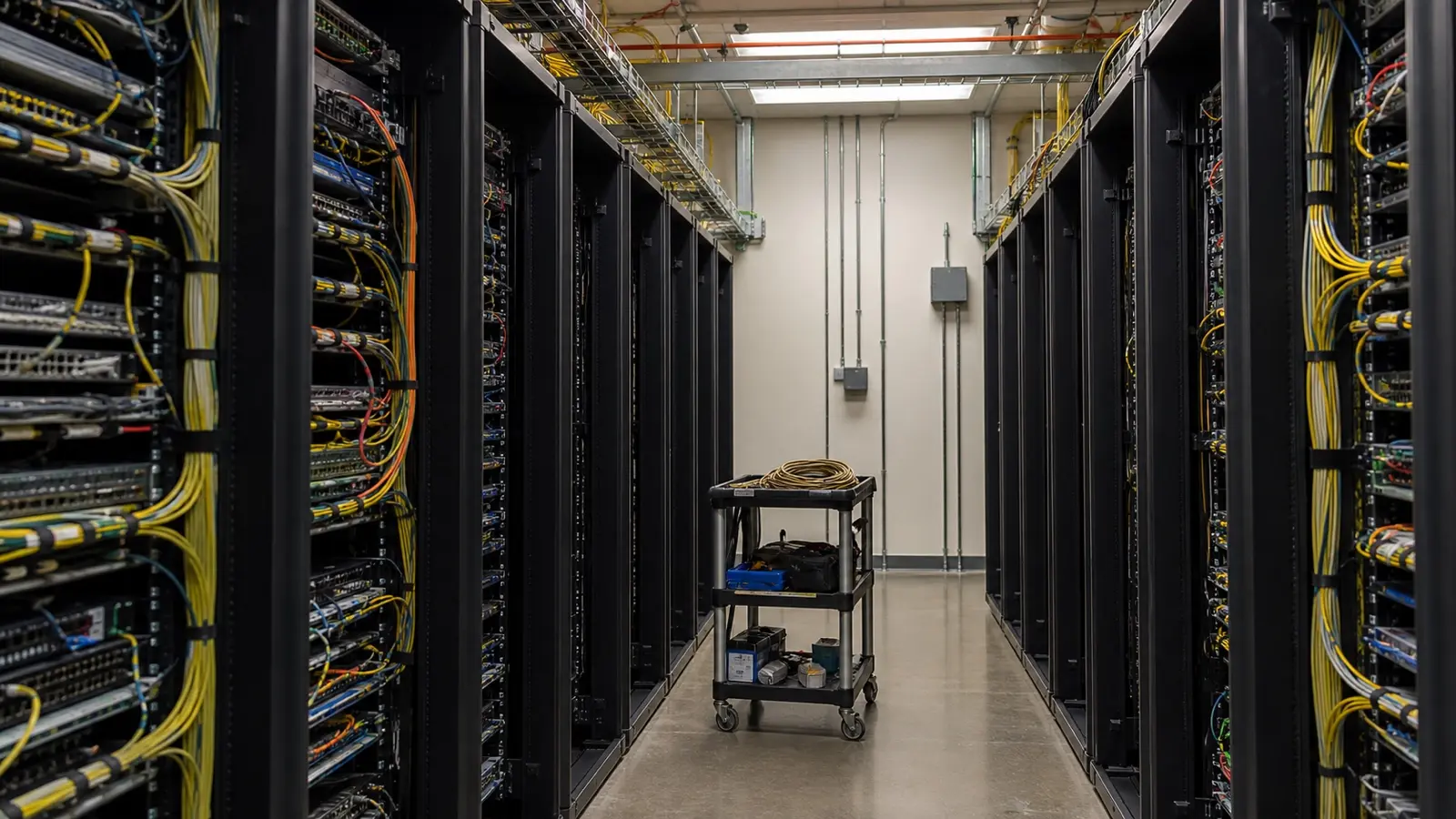
- The featured image is a generated editorial photograph of a generic network equipment room. It does not depict Alphawest Services, Optus, their facilities, architecture, employees, systems, customers, reliability, or production results.
Alphawest's public record is most revealing when treated as a map of operational responsibilities rather than a corporate profile. The company was described as a specialist in network design, integration, support, and outsourcing before Optus acquired it. Later group material placed Alphawest inside broader managed connectivity and private-cloud offers. APNIC still preserves two network identities associated with the legal entity. The result is not evidence of a hidden standalone network. It is evidence that corporate consolidation does not erase the need for precise records and explicit control.
That distinction matters because enterprise technology failures often occur between product categories. A carrier link can be available while a customer's routing policy is wrong. A virtual routing environment can be configured correctly while an application dependency is unavailable. A server can be healthy while identity or DNS fails. A catalogue can supply the expected components while ownership of a cross-component exception remains unclear. The visible offer may be integrated, but the work required to operate it stays distributed across people, permissions, systems, suppliers, and evidence.
The responsible conclusion is bounded. Alphawest Services Pty Ltd is a continuing legal entity within the Singtel Optus group record. Historical sources establish a substantial network-integration and outsourcing proposition. First-party material shows managed-service control choices and a later infrastructure catalogue. APNIC establishes two registered ASN identities. None of this certifies current route use, product reliability, or customer outcomes. It does show where operators should ask for evidence.
A Specialist Integrator Inside a Carrier
The Australian Business Register provides the present legal anchor. It identifies ALPHAWEST SERVICES PTY LTD, ABN 49 009 196 347, as an active Australian private company. That is stronger identity evidence than a surviving product page, a search result, or an inherited email address. It establishes that the company entity continues to exist in the registry. It does not establish its current staffing, revenue, product activity, infrastructure, or degree of operational independence.
Historical corporate records explain how that entity reached its current position. An Australian Securities Exchange announcement from 1999 described Alphawest in terms that combined network hardware with installation, support, consulting, design, delivery, maintenance, and helpdesk activities. The combination matters. Hardware and initial installation are discrete transactions. Maintenance, support, and helpdesk work are recurring operational obligations. Consulting and design define an intended system. Delivery turns that intent into configuration and dependencies.
The business proposition therefore already contained the tension that follows managed technology: implementation is visible, while lifecycle work determines whether the system remains dependable.
The 2005 acquisition moved that proposition into Optus. The ACCC framed the relevant markets as network consulting and integration and network outsourcing. Singtel's annual reporting said Optus acquired Alphawest for A$26 million and intended to strengthen end-to-end information and communications technology capability for corporate and government customers. The strategic logic was straightforward. A carrier already supplying connectivity could add design, integration, equipment, managed operations, and application or infrastructure services around that connectivity.
"End to end" is commercially attractive because customers experience a service as one chain. It is operationally difficult because the chain crosses layers that fail differently. Physical access, carrier transport, routing, virtual network configuration, firewalls, identity, servers, storage, operating systems, applications, monitoring, and support may have different owners and change schedules. A wider supplier can coordinate more of those layers, but it also needs a stronger internal model of dependencies and authority.
Acquisition does not automatically produce that model. Corporate ownership can unify contracts, management, or sales while technical systems remain heterogeneous. The acquired company may retain tools, processes, credentials, customer configurations, number resources, and specialist knowledge. The parent may impose new support channels, security controls, finance systems, procurement rules, and platform standards. Integration work must decide what to consolidate, what to preserve, and how to maintain service while those decisions are implemented.
The public record does not reveal how Optus and Alphawest performed that integration. It would be speculative to describe an internal architecture, staffing model, migration programme, service desk, or network design. What can be said is that the acquisition joined a specialist integration and outsourcing business to a carrier, and later public material presented combined managed-service and infrastructure capabilities. That sequence creates a clear set of control questions even when the private answers are unavailable.
Legal identity is one of those controls. A customer may remember Alphawest as a brand while invoices, contracts, support channels, and product names move toward Optus. A registry may continue to show Alphawest Services Pty Ltd. APNIC may retain the Alphawest name on ASN records while operational contacts use an Optus domain. None of these states is inherently inconsistent. The risk appears when the relationship between them is undocumented or no longer understood by the people who must act.
An operationally mature organisation needs a current map from each public or contractual identity to the responsible team, approved contact, credential owner, service boundary, and escalation path. That map should survive personnel change and corporate reorganisation. It should distinguish the entity that owns a resource, the team that operates it, the supplier that supports it, and the person authorised to approve a change. A name in a ledger is valuable only when it leads to practical control.
Reconstructing the Historical Service Proposition
The 1999 ASX material is useful because it lists work categories rather than relying on a generic technology label. Network hardware suggests procurement and integration with physical or virtual infrastructure. Installation implies site access, compatibility checks, configuration, and acceptance. Support and helpdesk functions imply incident intake and triage. Consulting and design imply requirements, architecture, and trade-off decisions. Delivery implies project coordination and handover. Maintenance implies patching, replacement, lifecycle management, and recurring verification.
Each category replaces or relocates human work differently. A customer buying hardware may avoid procurement and compatibility work. A customer buying design may transfer some architecture analysis. A customer buying installation may transfer configuration execution. A managed or outsourced service may transfer monitoring, maintenance, and first response. Yet the customer still needs to specify critical services, acceptable risk, access constraints, change windows, escalation priorities, and evidence requirements.
This is why outsourcing does not make supervision disappear. It changes the form of supervision. Instead of employing every specialist directly, the customer must manage service definitions, responsibility boundaries, approvals, reporting, exceptions, and supplier performance. The supplier in turn must supervise its people, tools, subcontractors, platform dependencies, and access. If the handoff is vague, work is not removed; it is made harder to see.
The ACCC's market description adds another distinction. Network consulting and integration are not the same as network outsourcing. Consulting and integration can be project-based: understand requirements, design a solution, connect components, test, and hand over. Outsourcing is continuous: operate, monitor, maintain, respond, report, and improve over time. A project can close after acceptance. An operational service requires a durable owner and a method for handling conditions that were not in the original design.
The transition from project to service is a common failure point. Documentation may describe the intended architecture without capturing every implementation deviation. Credentials may remain with project staff. Monitoring may cover components but not user transactions. A support team may inherit the system without the design rationale. Suppliers may disagree about whether a fault belongs to the network, platform, application, or customer configuration. Acceptance tests may pass under normal conditions without demonstrating recovery.
A defensible handover would preserve at least six forms of evidence. First, an inventory of components, versions, interfaces, addresses, identities, and dependencies. Second, an authority map for routine and emergency changes. Third, a baseline of expected operating state. Fourth, monitoring that reaches a meaningful service condition. Fifth, recovery and rollback procedures with tested prerequisites. Sixth, open exceptions with owners and expiry or review dates.
The public sources do not show Alphawest's handover methods or operational results. They do show that the business proposition crossed precisely these boundaries. Network consulting, integration, outsourcing, support, maintenance, and helpdesk work form one chain only when evidence and authority connect them. Without that connection, a broad offer can increase the number of teams involved without improving the speed or quality of repair.
Historical customer or staff figures in issuer announcements should be treated with the same care. They describe the business at a particular time and come from company disclosures. They can establish that the operation had commercial scale. They do not prove present scale, customer satisfaction, service reliability, or the outcome of a specific deployment. Group-level customer names in later Singtel reporting are also context, not independently verified Alphawest results.
The most useful lesson is therefore structural. Alphawest was sold as a combination of expertise and recurring operational work. Optus bought that capability to broaden its enterprise offer. The reliability of the combined service would depend less on the breadth of the catalogue than on whether design intent, running configuration, service ownership, and exception handling stayed aligned.
What the Acquisition Changed, and What It Could Not Remove
Carrier ownership can change the delivery model in several practical ways. Connectivity and managed infrastructure may be contracted through a larger group. Network and information-technology teams may share account planning. A customer may have fewer commercial interfaces. The supplier may be able to coordinate a carrier network with integration and managed-service work under one programme.
Those are capabilities, not outcomes. A single contract does not guarantee a single operating model. A shared account team does not guarantee that engineers have the same telemetry or authority. Owning more layers does not make their failure modes identical. The enterprise still needs to know which layer failed, who can change it, and how a repair will be verified.
The Singtel quarterly management discussion reported that Alphawest results were consolidated from November 2005 and contributed A$31 million to Optus operating revenue in the reviewed quarter, with a modest contribution to earnings before interest, tax, depreciation, and amortisation. This is financial context. It confirms that the acquired business became part of group reporting and had measurable commercial activity. It does not isolate service quality, support efficiency, or customer production performance.
Consolidated reporting can make operational economics harder to see from outside. Revenue may sit in a group segment while costs are spread across network, support, platform, sales, and corporate functions. A broad managed offer can share infrastructure and staff. That may improve utilisation. It can also make it difficult to determine the cost of exceptions for one service or customer.
Inside an operating organisation, useful cost accounting would separate routine execution from exception work. Routine work includes standard provisioning, approved changes, patching, monitoring review, backup checks, and planned maintenance. Exception work includes failed changes, unusual routing, access recovery, incompatible versions, data corruption, ambiguous ownership, supplier escalation, and incidents that cross service boundaries. The exception share often determines whether a supposedly automated or integrated service actually reduces human effort.
Carrier ownership cannot remove the need for customer knowledge. The supplier may operate a virtual network, firewall, server, or storage platform, but it may not know which application transaction matters most, which business deadline changes priority, or which data loss is unacceptable. The customer must keep enough architecture and service knowledge to approve risk and interpret impact. Transferring all knowledge to a supplier creates lock-in and weakens incident decision-making.
Nor can acquisition remove lifecycle asymmetry. Carrier transport may change on one schedule. Network devices, hypervisors, operating systems, storage firmware, security controls, and applications may change on others. A patch that is routine in one layer can break compatibility in another. A replacement product can alter administrator roles or telemetry. Integration ownership means coordinating these schedules rather than assuming the parent company has one universal lifecycle.
The acquisition can nevertheless reduce some coordination cost if the combined operator maintains a real cross-layer control model. That model would define services, dependencies, owners, access, monitoring, change authority, rollback, and escalation. It would show where customer responsibility begins and ends. It would also preserve a route for independent verification instead of asking customers to treat integrated branding as evidence.
Public evidence cannot score the success of that model at Alphawest or Optus. It supports a narrower proposition: the acquisition joined complementary capabilities, and the resulting value would depend on operational integration that financial consolidation alone cannot demonstrate.
The Managed VPN Guide as a Control-Boundary Document
The Optus Wireless IP VPN administration guide is the most concrete public source in the set because it describes administrator roles. It indicates that a virtual routing and forwarding environment could be managed by the customer, Optus, or Alphawest. Different management choices imply different permissions and different expectations about who performs changes.
A virtual routing and forwarding instance separates routing tables and forwarding contexts. In an enterprise service, it can help isolate customer networks or traffic domains. The existence of a VRF does not by itself establish security, availability, or application separation. Those outcomes depend on configuration, route import and export, access controls, device state, surrounding firewalls, addressing, and operational practice.
The management choice is therefore critical. If the customer manages the environment, the customer needs competent administrators, protected credentials, accurate documentation, monitoring, and a change process. The carrier or integrator still needs to define the platform boundary and support interaction. If Optus or Alphawest manages it, the supplier needs approved authority, controlled access, service context, and a way to coordinate customer-impacting changes. The customer still needs assurance and an escalation path.
Neither model is universally better. Customer control can provide immediacy and local context, but it can also create configuration drift or unclear support responsibility. Supplier control can centralise expertise and standardise changes, but it can add approval latency, dependence on support queues, and reduced visibility. Shared control can combine strengths only if permissions and decision rights are explicit. Otherwise it creates overlapping access and ambiguous ownership.
Administrator roles should follow least privilege. A role should permit the actions required for its responsibility and no more. Emergency access should be time-bounded, attributable, and recoverable. Service accounts should not become permanent substitutes for named authority. Credentials should have owners, rotation rules, revocation procedures, and a tested recovery path. Logs should connect a change to an approved request and a responsible party.
The harder problem is not normal administration but exception handling. A route change may be syntactically valid yet disrupt an application. A customer request may conflict with a platform guardrail. A support engineer may need information held by another team. A change may require both carrier and customer action within a narrow window. A degraded service may need emergency authority that the routine process does not provide.
For those cases, the operating contract should identify who can diagnose, who can approve, who can execute, who can communicate, and who determines closure. It should specify what evidence each party can see. It should distinguish a network symptom from a service impact. It should also define what happens when the initial owner believes the problem belongs elsewhere.
Monitoring should reflect the management boundary. A supplier managing a VRF can monitor configuration and device state, but the customer may be the only party able to test a critical business transaction. A customer can observe application failure without seeing carrier telemetry. Effective supervision correlates both views. A green router is not proof that the customer service works. A failed application test is not proof that the carrier network caused the failure.
Change control should include a baseline, intended delta, dependency assessment, approval, implementation plan, observation period, rollback threshold, and post-change verification. Automation can enforce parts of this sequence. It can validate syntax, compare configuration, schedule work, or collect telemetry. Someone must still define the intended state, interpret exceptions, and decide whether rollback is safer than continued diagnosis.
The guide does not establish how frequently customers selected each management option, how well changes were executed, or how incidents were resolved. It does not reveal current product design. It does establish that Alphawest appeared in an operational administration boundary inside an Optus service. That is enough to support a rigorous analysis of supervision and authority without inventing a private network.
A Catalogue Is Not a Reliability Result
Singtel's 2012 annual reporting described the Optus and Alphawest "Your IT as a Service" private-cloud offer. The description brought servers, storage, networking, and security into a central service catalogue. A catalogue can make infrastructure easier to request by presenting standard components and commercial choices through a defined interface.
Standardisation can remove some work. Buyers may avoid designing every order from scratch. Approved configurations can reduce incompatible combinations. Provisioning can reuse templates. Pricing and service descriptions can be easier to compare. A shared catalogue can also help a supplier govern which versions and support boundaries it offers.
Yet the catalogue is the beginning of a production system, not the end. A requested server needs an identity, network placement, storage, access policy, patch ownership, monitoring, backup, recovery, capacity, and retirement plan. A network choice needs addressing, routing, security policy, DNS, and dependency context. Storage needs performance, durability, access, backup, restore, and data-lifecycle decisions. Security controls need tuning, exception handling, evidence, and response ownership.
The components also interact. A server can be provisioned before the necessary network path exists. A firewall rule can be correct for one address and stale after a change. Storage can be available while credentials fail. Monitoring can report resource health while the application transaction is broken. A security control can block a legitimate dependency. Catalogue automation reduces value when the customer must repeatedly escalate cross-component mismatches.
Reliability therefore needs measurements at several layers. Provisioning reliability asks how often a complete request reaches the intended state without repair. Change reliability asks how often modifications succeed and how quickly failures are reversed. Service reliability asks whether the defined user path meets availability and performance conditions. Recovery reliability asks whether data and service can be restored within an accepted period. Support reliability asks whether exceptions reach a party able to act.
The reviewed material does not provide those measurements. A company statement about deployment speed or integrated capability should be labelled as a product claim. It should not be converted into an observed median, an uptime figure, a staffing reduction, or a customer outcome. No controlled test of the service was performed for this analysis.
The catalogue also creates lifecycle obligations. Templates and supported combinations must be updated. Old components need retirement paths. Customers need notice and migration options. Dependencies must be tested across versions. Exceptions can accumulate when a customer cannot move on the standard schedule. Each exception increases maintenance and support complexity.
Lock-in is not limited to contract duration. It can come from provider-specific templates, operating knowledge, identity integration, network design, monitoring, access, data placement, or support procedures. A customer can reduce that risk by preserving its own service model, data export and recovery evidence, configuration records, dependency map, and exit tests. The goal is not to avoid managed services. It is to retain enough independent control to make a change safely.
The private-cloud catalogue illustrates the same central distinction as the managed VPN guide. Product capability can be broad and useful. Product reliability requires repeated evidence. Customer production results require customer-specific evidence. Combining categories in a sales offer does not combine the proof needed for each layer.
AS38295 and AS140676 as Registry Identities
APNIC RDAP records list two autonomous-system resources associated with Alphawest Services Pty Ltd. AS38295 appears under the name ALPHAWEST-AP. AS140676 appears under ALPHAWEST-SERVICES-AS-AP. Both records were active when reviewed. The records include operational or abuse contact paths using an Optus domain.
An autonomous-system registration provides a unique number, an accountable registrant, status, dates, and contact relationships. It is a public control surface for coordination. It can help another operator identify the organisation associated with a resource, find an expected contact role, and compare observed routing with intended identity.
The registry is a ledger and recordkeeper, not a router operator. APNIC can maintain the resource record and authorised update process. It cannot announce a route, fix filtering, restore a circuit, respond to an abuse report, or resolve a customer incident. Those actions remain with the resource holder and its operational counterparties.
The records do not prove route activity. An active status means the registry object is active in the database; it is not a statement that the autonomous system is visible in BGP at a given moment. Establishing route activity would require time-bounded observations from routing collectors or other appropriate sources. No route-observation source was used here, so no claim is made about announcements, prefixes, peers, capacity, or traffic.
This limit is important because ASN names can look like live product evidence. They are not. ALPHAWEST-AP and ALPHAWEST-SERVICES-AS-AP identify registered resources. They do not show which service uses them, whether they are operated separately, whether one replaced the other, or whether the parent company manages both through a shared team.
The Optus-domain contacts provide a narrower clue. They are consistent with group operational control or integration after acquisition. They do not establish the internal team, support process, response time, or contract. A contact field can be current while the mailbox is unmonitored. It can also be operationally effective without exposing the full ownership model.
Maintaining registry identity creates recurring work. The legal entity and contact roles must remain accurate. Credentials for authorised changes must be protected and recoverable. Staff departures and reorganisations must trigger review. Abuse and operational contacts need coverage. Resource intent should be documented so that an external observation can be compared with an approved baseline.
Transfer recording is another control even when no transfer is known. Acquisitions can change who owns a company while the resource holder remains the same legal entity. Internal responsibility may move between teams. The organisation needs evidence of authority and a documented relationship between legal ownership, registry account access, technical operation, and incident response.
Security metadata also has a lifecycle. Route-origin authorisations, routing-policy records, contact data, and related controls may need review as the network changes. The source set does not establish what security metadata Alphawest or Optus maintains for these ASNs. The responsible question is whether intended state, registry state, and observed running state can be reconciled by accountable operators.
The two records are therefore valuable not because they prove a network's performance, but because they make accountability testable. A reviewer can ask which services depend on each ASN, who owns changes, what prefixes are intended, how contacts are tested, what security metadata is expected, and what evidence closes an exception. Without those answers, the registration remains accurate in form but incomplete as an operational control.
The Costs That Move Rather Than Disappear
Managed services are often evaluated by the visible labour they replace. A customer may need fewer people to install equipment, monitor devices, apply routine changes, or answer first-line alerts. That can be a real benefit. It is incomplete accounting if the new supervision, integration, maintenance, and exception costs are ignored.
Supervision cost begins with service definition. The customer must decide which user outcome matters, what availability or recovery condition is acceptable, which changes require approval, and what evidence should be retained. The supplier must translate that definition into platform controls and operational work. Both parties need reporting that distinguishes routine activity from unresolved risk.
Supervision also includes access review. Administrator roles, service accounts, emergency credentials, and support access must remain appropriate. A managed environment can involve customer, carrier, integrator, platform, and subcontractor identities. Every additional path can improve support or increase risk depending on how it is governed.
Integration cost appears wherever components or organisations meet. Network configuration must match addressing, firewall, DNS, identity, server, storage, and application requirements. Monitoring must join infrastructure signals to user-path tests. Commercial service definitions must correspond to technical responsibility. An incident ticket must carry enough context to cross teams without restarting diagnosis.
Integration work is continuous because dependencies change. An application adds an endpoint. A security policy changes. A certificate expires. An address is renumbered. A component reaches end of support. A business acquisition introduces another identity domain. A standard catalogue item can reduce initial variation while these later changes reintroduce complexity.
Maintenance cost covers versions, patches, hardware replacement, capacity, certificates, backups, recovery, documentation, monitoring rules, and automation. Standardisation can lower unit cost. It can also create large coordinated changes. Delaying a change preserves short-term stability while increasing lifecycle risk. Moving too quickly can break a dependency. The operating model needs an explicit method for exceptions.
Maintenance includes the management system itself. Provisioning templates, configuration tools, monitoring, ticket integrations, and access systems must be tested and updated. Automation is software with dependencies and failure modes. It can repeat an error faster than a person. It can also reduce routine error when intent and guardrails are well defined.
Exception-handling cost is the least visible and often the most important. A routine request follows the standard path. An exception may involve a legacy application, unusual route, unsupported version, conflicting security requirement, failed change, ambiguous owner, or urgent business deadline. It consumes senior attention, cross-team coordination, and judgement.
Exception work needs a budget and an owner. Treating every exception as a one-off hides recurring patterns. A useful review asks how many requests required manual repair, how long they waited for authority, how often the same dependency caused trouble, and whether a standard should change. The public sources do not provide such metrics for Alphawest, so no numbers are inferred.
Verification cost remains with both customer and supplier. A supplier can report component health. The customer must verify the business service. An external registry can report identity. The operator must verify contact and running state. A change can be marked complete in a ticket while the user path remains broken. Closure should require the evidence appropriate to the service, not only the completion of an assigned task.
Exit and portability cost should be counted before it is needed. A customer must know how to retrieve data, configuration, access records, dependency information, and operational history. It needs a plan for replacing provider-specific controls. The supplier needs a controlled way to revoke access and transfer responsibility. Without that preparation, a service can be technically functional yet commercially difficult to change.
The total cost of managed infrastructure is therefore not simply supplier fees plus reduced payroll. It includes retained customer supervision, cross-layer integration, lifecycle maintenance, exception handling, verification, and exit readiness. A broad provider may lower some categories and raise others. The only defensible evaluation uses measured work and service outcomes over time.
Failure Modes Exposed by the Public Record
The following failure modes are analytical scenarios, not claims that Alphawest or Optus experienced them. Each is tied to a visible control surface and identifies the evidence needed to close the question.
Stale legal or registry identity. A company name, address, role, or contact can remain formally present while practical responsibility has moved. Evidence should connect the active legal entity, registry account authority, current operator, and tested contact path. Closure requires confirmation by an authorised owner, not merely an unchanged record.
Brand and entity divergence. Customers may know a historical brand while contracts, support, and operations move to a parent. A ticket or escalation can be delayed if the receiving team cannot map the old identity to the current service. Evidence should preserve aliases, contract lineage, service ownership, and current escalation routes.
Contact drift. An abuse or operational mailbox can outlive the team that monitored it. A technically correct message then fails as an operational control. Evidence should include periodic contact tests, coverage expectations, alternate paths, and a process for updating the registry after organisational change.
Unclear administrator ownership. Customer, Optus, and Alphawest management options can create ambiguity if a service changes hands or uses shared permissions. Evidence should identify the current role model, approved users, emergency access, and actions attributable to each party.
Over-broad access. A role created for convenience can allow changes beyond its intended scope. Evidence should compare granted permissions with responsibility, review dormant access, protect credentials, and verify that revocation works. Logs should be useful for investigation without exposing unnecessary sensitive data.
Configuration drift. A managed environment can diverge from the documented or approved baseline through emergency changes, manual repair, automation defects, or incomplete handover. Evidence should compare running and intended state, record approved exceptions, and test rollback.
Change collision. The carrier, integrator, customer, or another supplier can make individually reasonable changes that interact badly. Evidence should show a shared change calendar, dependency review, communication, observation window, and authority to stop or reverse work.
Catalogue dependency surprise. A requested server, network, storage, or security component can depend on another service not included in the visible request. Evidence should show a dependency graph and an end-to-end acceptance test. Component completion is not sufficient closure.
Misleading health checks. Device or process monitoring can remain green while a critical transaction fails. Evidence should correlate infrastructure state with external user-path tests and identify which dependency each test exercises.
Routing identity confusion. An active ASN record can be mistaken for a current route or service map. Evidence should separate registry status, intended routing policy, time-bounded external observation, and customer service dependency. Without route observations, no route claim should be made.
Security-metadata drift. Registry and route-policy metadata can fall out of alignment with intended operation. Evidence should include the approved resource inventory, authorised origin policy, relevant security records, change history, and owner. A metadata anomaly requires investigation; it is not automatically an outage or attack.
Lifecycle incompatibility. Network, platform, operating-system, storage, security, and application components can require changes on different schedules. Evidence should show compatibility, support status, exception expiry, test results, and rollback. A standard patch policy cannot replace dependency analysis.
Automation amplification. A provisioning or configuration system can apply a wrong assumption consistently across many components. Evidence should preserve input intent, validation, scope, approval, output diff, and recovery. Automation success should be measured by correct end state, not task execution.
Consolidated-reporting blindness. Group financial results can obscure the cost and performance of an individual managed service. Evidence should separate routine delivery, exception work, shared platform cost, and customer-impacting outcomes where the organisation needs to make operational decisions.
Support handoff failure. Network, platform, security, application, and customer teams can each see a partial symptom without one owner joining the evidence. A ticket may move while the service remains broken. Evidence should record the lead owner, hypotheses, tested conditions, decisions, and closure test.
Escalation ambiguity. A routine queue may not provide the authority required during a critical event. Evidence should identify time-based and impact-based escalation, alternate authority, supplier contacts, and communication responsibilities. The path should be tested before an emergency.
Recovery that restores components but not service. A configuration, server, or data set can be restored while identity, DNS, certificates, network policy, or dependencies remain wrong. Evidence should include a user-path validation and business acceptance condition.
Portability failure. A customer may possess data but lack the configuration, identity mapping, operational knowledge, or network changes needed to use it elsewhere. Evidence should include export, restore, dependency, access-revocation, and cutover tests.
The catalogue shows why integrated services require more than one reliability metric. Each failure path has a different owner, evidence source, and recovery action. A single availability percentage cannot show whether the problem was prevented, detected, repaired, or simply hidden outside the measured boundary.
Capability, Product Reliability, and Customer Production Results
The public record supports several capability conclusions. Alphawest historically offered network design, integration, support, maintenance, helpdesk, and outsourcing work. Optus acquired it to broaden enterprise information and communications technology capability. An administration guide placed Alphawest inside a managed VPN control boundary. Singtel later described a catalogue spanning servers, storage, networking, and security. APNIC associates two ASN records with the legal entity.
Product reliability is a different evidence class. It would require repeated measurements of provisioning correctness, change success, availability, latency, packet loss, incident frequency, restoration, escalation, and recovery, each with a defined service scope and time period. The reviewed sources do not provide a dataset sufficient to score those conditions.
Customer production results are narrower still. A customer outcome depends on its applications, data, configuration, access, users, business process, operating team, and other suppliers. A group-level customer name or contract announcement is not a measured outcome. No named deployment was independently verified for this analysis.
Model capability is not central to the source record. No public evidence establishes that a particular machine-learning model operated these services, made changes, or produced customer outcomes. Automation may be used in provisioning, monitoring, or configuration, but the sources do not identify a system or benchmark. It would be improper to convert a general expectation about modern operations into a claim about Alphawest.
If automation is present, its reliability must still be separated from its nominal capability. A tool may be able to generate a configuration, classify an alert, or schedule a change. Product reliability asks how often it reaches the correct operating state under ordinary and exceptional conditions. Customer outcome asks whether the business service remained within its defined condition. Supervision, integration, maintenance, and exceptions remain part of the cost.
The absence of reliability evidence is not a negative verdict. It is a limit on what can responsibly be said. A broad capability may be real and valuable without public measurements. The correct response is to label the evidence class, identify the missing observation, and avoid turning a product description into a performance claim.
What the Public Evidence Does Not Establish
The sources do not reveal Alphawest or Optus's private network topology, route announcements, prefixes, peers, circuits, capacity, device inventory, configuration, firewall policy, identity architecture, cloud implementation, storage design, monitoring stack, automation, staffing, support queues, subcontractors, service levels, incident record, recovery performance, or customer environment.
They do not establish that AS38295 or AS140676 currently announces a route, carries traffic, serves a product, or operates independently. They do not establish how the two records relate to each other in running systems. Active registry status must not be presented as route activity.
They do not establish present Alphawest product branding, revenue, staffing, service volume, or operational independence. Historical issuer and annual-report statements remain historical. The current government reporting-group inclusion establishes group and entity continuity, not a current standalone market offer.
They do not establish uptime, latency, change success, repair time, recovery time, cost savings, customer satisfaction, security effectiveness, or staffing reduction. No private test, benchmark, customer interview, employee interview, production experiment, or facility inspection was conducted for this analysis.
These limits are part of the result. They prevent a precise public identity and capability record from becoming an unsupported claim about reliability or outcomes.
A Reality-Layer Verification Checklist
- Legal identity: Confirm the active entity, parent relationship, contract name, service aliases, and authority for each public record.
- Number resources: Map AS38295 and AS140676 to intended use, accountable operator, authorised changes, and current contact roles without assuming route activity.
- Observed routing: If route behaviour matters, gather timestamped collector evidence and compare it with intended policy; do not infer it from RDAP status.
- Administrative boundary: Record whether the customer, Optus, Alphawest, or another party manages each network control and what permissions follow.
- Service dependency: Connect network, DNS, identity, firewall, compute, storage, security, monitoring, and application dependencies to a defined user path.
- Change authority: Identify who approves, executes, observes, rolls back, and closes routine and emergency changes.
- Access lifecycle: Review named and service accounts, least privilege, emergency access, credential recovery, logging, and revocation.
- Monitoring truth: Correlate infrastructure telemetry with external user-path tests and preserve observer boundaries.
- Lifecycle control: Track versions, support dates, patch exceptions, compatibility, capacity, certificates, and rollback readiness.
- Exception ownership: Give cross-layer faults one lead owner, an escalation clock, evidence access, and a closure test.
- Recovery: Test configuration, data, identity, network, DNS, certificate, dependency, capacity, and business validation together.
- Portability: Preserve data export, configuration, dependency knowledge, access-revocation, and cutover evidence before an exit is urgent.
- Claim discipline: Keep capability, product reliability, and customer results in separate records and approval standards.
The checklist does not score Alphawest. It turns visible identities and control boundaries into questions that operators can answer with current evidence. The governing principle is coherence: registry identity, legal authority, intended service, running configuration, and accountable decisions must agree closely enough that an exception can be detected, assigned, repaired, and verified.
Public Sources
- Australian Business Register, ALPHAWEST SERVICES PTY LTD: https://abr.business.gov.au/ABN/View?abn=49009196347
- Australian Competition and Consumer Commission, Optus Networks proposed acquisition of Alphawest: https://www.accc.gov.au/public-registers/mergers-and-acquisitions-registers/public-informal-merger-reviews-register-2002-25/optus-networks-pty-limited-proposed-acquisition-of-all-of-the-shares-in-alphawest
- Australian Securities Exchange, 1999 Alphawest announcement: https://www.asx.com.au/asx/v2/statistics/displayAnnouncement.do?announcementId=319461&display=text&documentDate=1999-12-29&documentNumber=199168&issuerId=1195
- Australian Securities Exchange, 2005 Alphawest announcement index: https://www.asx.com.au/asx/v2/statistics/announcements.do?by=issuerId&issuerId=5354&timeframe=Y&year=2005
- Singtel, financial year 2006 annual report: https://www.singtel.com/content/dam/singtel/investorRelations/annualReports/2006/attachment_hub_7FBEBD76-6457-4CC0-A4CF-F7B5BC8D4672_OFR.pdf
- Singtel, December 2006 management discussion and analysis: https://www.singtel.com/content/dam/singtel/investorRelations/financialResults/2006/december/MDA_2.pdf
- Singtel, 2007 financial statements: https://www.singtel.com/content/dam/singtel/investorRelations/annualReports/2007/attachment_hub_F3AD4A4D-9476-416E-AA9F-74A87EF40514_Financial%20Statements.pdf
- Singtel, 2012 Group ICT report: https://cdn.aws.singtel.com/annualreport/2012/group-ict.html
- Optus Wireless IP VPN CMI administrator guide: https://wirelessip.optus.com.au/Optus_Wireless_IP_VPN_-_CMI_Administrator_Guide.pdf
- Australian Modern Slavery Register, Singtel Optus group statement: https://modernslaveryregister.gov.au/statements/19327/
- APNIC RDAP record for AS38295: https://rdap.apnic.net/autnum/38295
- APNIC RDAP record for AS140676: https://rdap.apnic.net/autnum/140676
- Singtel, results for the year ended 31 March 2006: https://www.singtel.com/about-us/media-centre/news-releases/singtel-groups-results-fourth-quarter-and-year-ended-31-march-2006
Member Briefing
Deeper Profile Context
Sign in with the right membership level to unlock the full briefing and source notes.
Only for Strategic Circle
Strategic Circle
Open to all readers. Unlock profile briefings after joining and signing in.
Join Strategic CircleOnly for Leadership Alliance
Leadership Alliance
For qualified IP-asset owners and management; sign in to unlock alliance briefings.
Join Leadership Alliance