
Summary
- IPv4 option 7 reserved a finite sequence of four-octet slots in which cooperating forwarding systems could record addresses without choosing the packet’s route.
- Router requirements once made processing the normal behaviour, but the record’s limited capacity, lack of authentication and topology disclosure later supported a drop-by-default policy.
Four bytes at a time
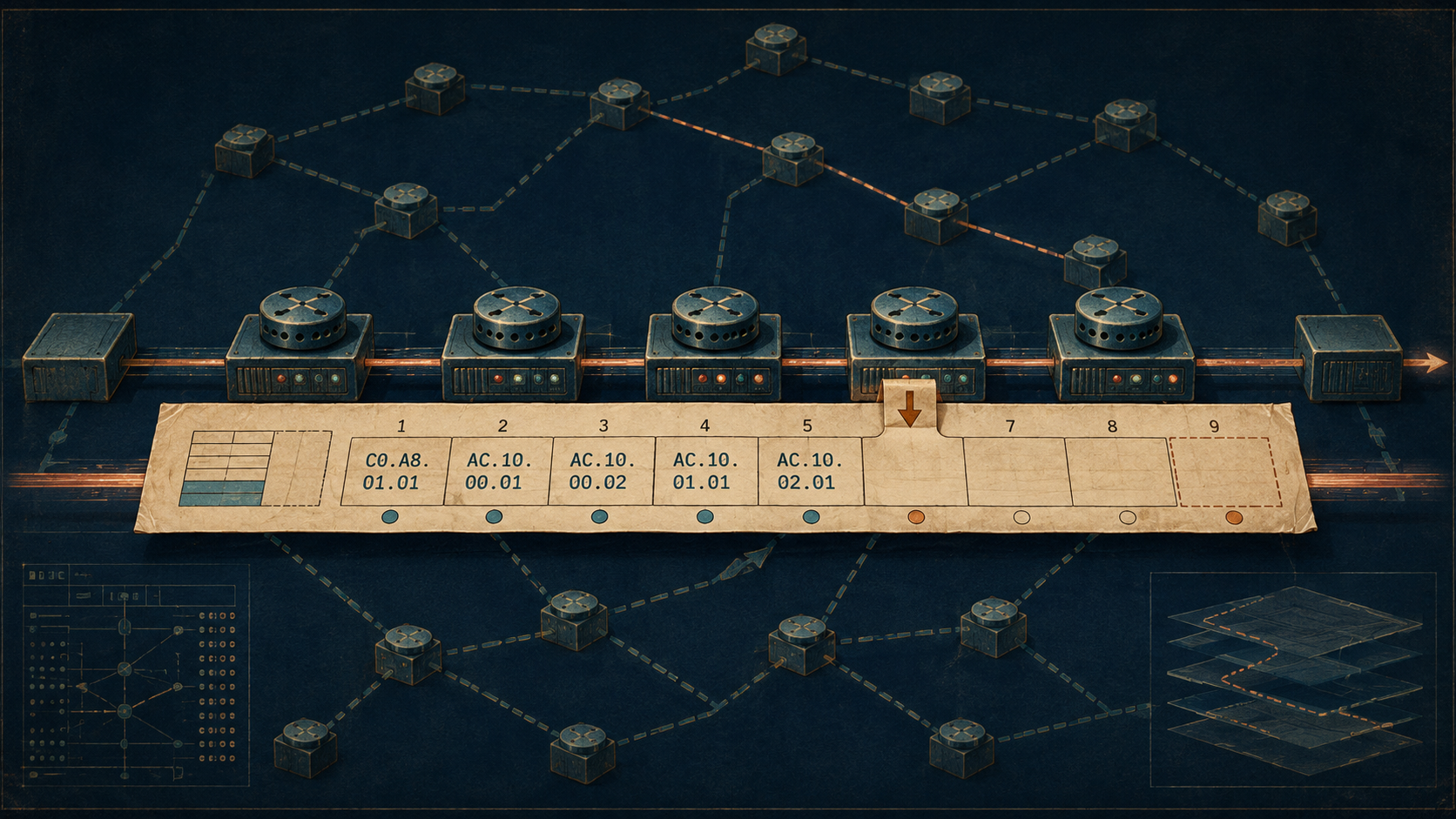
Record Route began with a modest instruction. Its option type was 7, followed by a length, a pointer and a route-data area. The sender allocated the whole area before transmission and filled it with zeroes. The pointer, whose smallest legal value was 4, identified the next place where a 32-bit Internet address could fit.
When an Internet module forwarded the datagram, it looked for the option, wrote its address into the indicated slot and advanced the pointer by four. RFC 1812 later made the address choice more precise for routers: use the address of the logical outgoing interface, or a stable router ID when that interface was unnumbered. What entered the record was therefore an address meaningful in the environment toward which the packet was being sent, not a universal name for a physical box.
The option could not grow. If the pointer had passed the declared length, the record was full and forwarding continued without another entry. If one to three octets remained—space that looked available but could not hold an address—RFC 791 treated the original datagram as erroneous and discarded it, with an ICMP Parameter Problem permitted. Record Route was not copied to later fragments and could appear only once.
The familiar maximum of nine addresses follows from the same constraints. An IPv4 header may be at most 60 octets; its ordinary fixed part takes 20. With 40 option octets available, type, length and pointer leave 37, enough for nine complete addresses. That is an upper bound when Record Route has essentially the option space to itself, not a promise that nine useful hops will answer.
A record without authority over the route
The name invites confusion with Loose and Strict Source and Record Route. Those options carried addresses supplied by the sender and used them in forwarding. Type 7 did not. It asked systems on whatever path ordinary routing selected to append observations. A participant could say, in effect, “this is the outgoing identity I used,” but the option did not tell it where to send the packet next.
Nor did an entry authenticate itself. The format contained no signature, stable device identity or proof that every intervening router participated. A blank slot might mean the path was shorter than the reserved area. It might instead reflect filtering, pass-through policy, absent host support, fragmentation or a route different from the one expected. Even a populated list was a finite view of cooperating interfaces rather than a complete, independently verifiable topology.
Host requirements reflected that qualified utility. RFC 1122 made originating and processing Record Route optional. For an ICMP Echo exchange, however, a received option should be updated and returned without truncation, so the resulting list could describe the round trip. That was useful diagnostic behaviour, but it still depended on every relevant boundary allowing the option through.
Two defaults, nineteen years apart
RFC 1812 in 1995 required routers to support Record Route in forwarded packets. An implementation could offer a switch that passed the option unchanged, but the switch had to default to processing it. The document acknowledged the topology-disclosure concern yet placed diagnostic cooperation on the default path.
RFC 7126 in 2014 recommended the opposite operational starting point. Record Route could help map network topology, although its small capacity limited that use. Option-dependent ping diagnostics would break when it was blocked, but widespread dropping had already made such techniques virtually impossible across arbitrary paths. Routers, firewalls and security gateways were advised to expose an option-specific choice among dropping, ignoring and fully processing type 7—and to make the documented default “drop.”
Sources
Member Briefing
Deeper Profile Context
Sign in with the right membership level to unlock the full briefing and source notes.
Only for Strategic Circle
Strategic Circle
Open to all readers. Unlock profile briefings after joining and signing in.
Join Strategic CircleOnly for Leadership Alliance
Leadership Alliance
For qualified IP-asset owners and management; sign in to unlock alliance briefings.
Join Leadership Alliance