
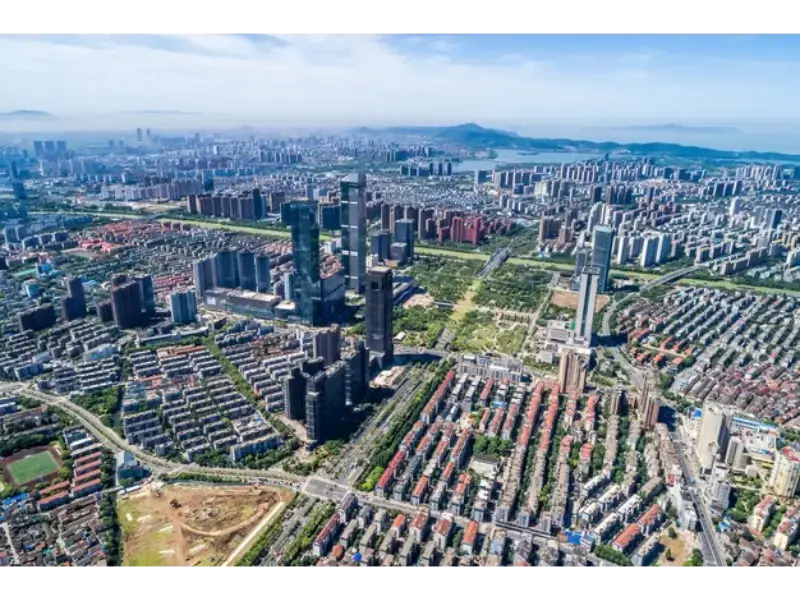
- A blog post from Asia’s Regional Internet Registry highlights Xiong’an as a blueprint for the ideal future digital city, establishing IPv6 as a ground-up priority.
- The city forms part of the development hub for the Beijing-Tianjin-Hebei economic triangle.
- The local government has adopted a series of measures to future-proof the city’s businesses and citizens, such as the use of IPsec, blockchain technology, and IPv6 address block application services.
The exclusive use of IPv6 and the transition system
Also read: Professor Li Xing: The challenges of IPv4 and IPv6 in China
A recent blog post from the Regional Internet Registry for the APAC region has picked out a Chinese city as being a great blueprint for tech-forward communities. The report from the APNIC blog called Xiong’an, a city only established in April 2017 and located about 100 kilometres southwest of Beijing, “the IPv6 city” and described how it was aiming to create a model for future digital cities, a large part of which was building in IPv6-only.
With the application of IPv6-only, the area covers a density of over 1M Internet of Things (IoT) terminals per square kilometre. However, the risk of network silos cannot be neglected. Xiong’an has deployed a city-level IPv4 – IPv6 transition system. The system enables the optical and 5G networks are IPv6-only, employing SRv6 technology for network slicing and serving various virtual private networks (VPN) without the need for overlay networks. The IPv4 to IPv6 transition system simplifies system complexity at scale by reducing protocol compatibility issues.

City computer center
Xiong’an has built a ‘city computing center’ to provide various service capabilities for enterprises and institutions. Such as cloud computing, edge computing, supercomputing. The successful running of the IPv4 to IPv6 transition system also benefits from the city computer center. Another highlight of the Computer center is that its PUE(power usage effectiveness) is under 1.1, which means the center has met the goal of green development.
Cybersecurity and management
The city now is faced with the challenge of high density of IoT terminals and massive new-era network users. Therefore, to ensure a safe and well-regulate cyber space, the security system uses IPsec and blockchain technology to prevent data from being intercepted and tampered. APNIC provides IPv6 address block application services for the government, all enterprises, and all residents. DHCPv6 also provides centralized IPv6 address dynamic allocation services for IoT terminals, reducing the workload of manual configuration.
Future development of Xiong’an
Xiong’an’s role as an IPv6-only city will be a functioning prototype that provides real-world lived experience lessons on mass deployment mechanisms, infrastructure and the IPv4 to IPv6 transition systems at scale, as well as IPv6 convergence applications. Right now, Xiong’an is finding a way to IPv6 supported by national requirements and internal demand alongside creating the right development conditions and technical support.