
Summary
- vHive announced on 23 September that it is extending WorldTwin AI into data centres, using camera capture to map floors, racks and individual equipment and to compare physical state with facility records.
- The offer joins at least four kinds of evidence: a visual observation, a plan or asset record, a live power or thermal sensor value, and an operator or tenant's commercial record. Putting them in one view does not make them contemporaneous or equally authoritative.
- Before a twin drives onboarding, billing, maintenance or capacity sales, buyers need separate timestamps, lineage, confidence, exception handling and a named party that can accept or correct a discrepancy.
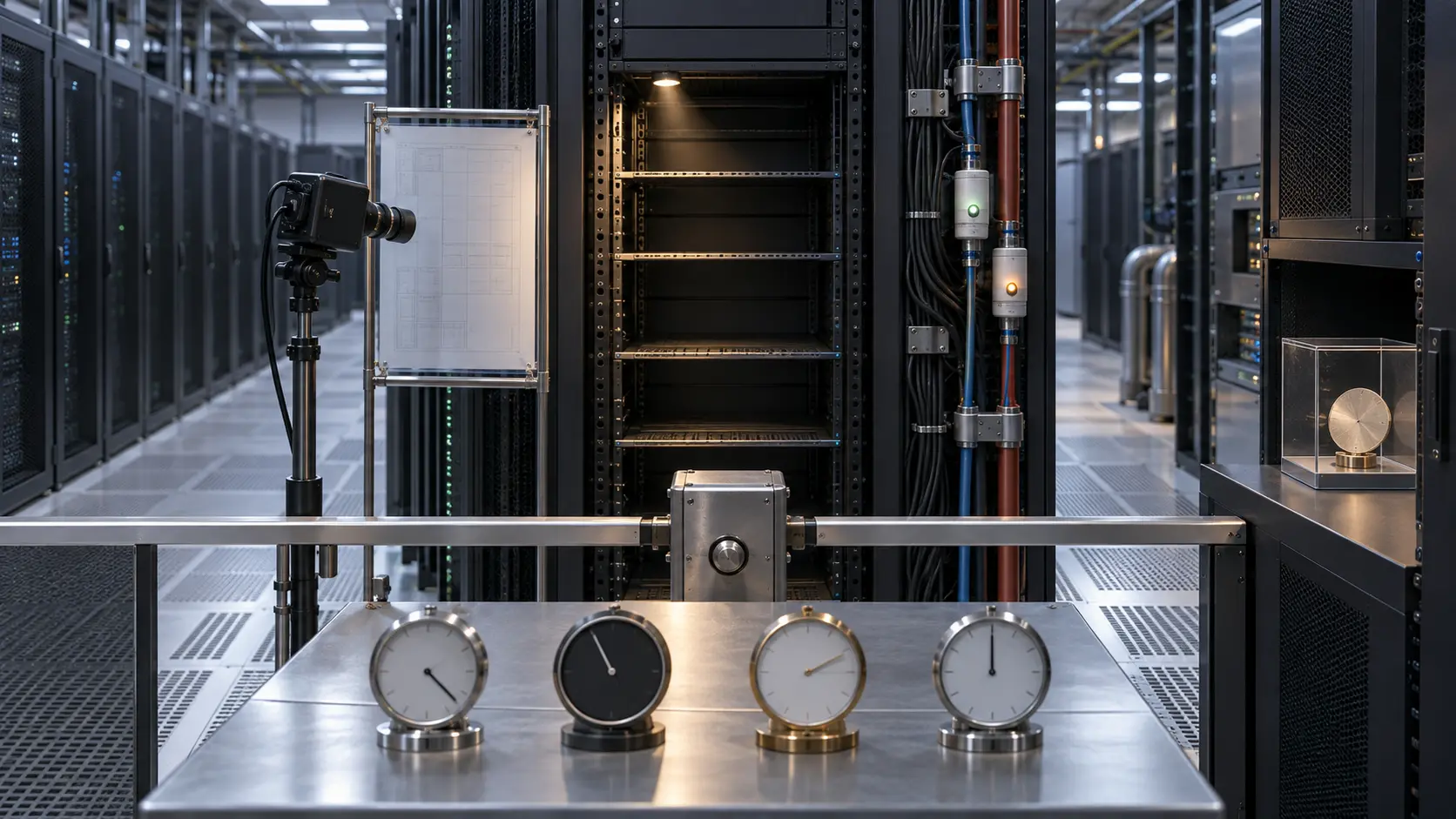
An empty slot in a server rack is an observation, not yet a product. It may lack a power circuit, a cooling envelope, a network path or permission to sell. It may be reserved for a tenant whose contract is more durable than the equipment currently visible. A photograph can make the vacancy obvious while leaving the commercial answer entirely open.
That is the useful market question raised by vHive's expansion into data centres. The company announced on 23 September that its WorldTwin AI engine will create a three-dimensional view from facility images, catalogue equipment, show rack density, identify floor and rack space, track changes and compare the build with planning records. Operators and colocation tenants are meant to work from views of their physical assets without always entering the facility.
vHive describes the result as a single source of truth. The ambition is understandable. Data-centre information is distributed across drawings, asset registers, DCIM tools, work orders, sensor systems, spreadsheets and customer contracts. A structured visual record could expose the gap between what a system says and what is actually installed.
But exposing a difference is not the same as resolving it. A useful twin needs a clock for every observation and a referee for every contested change.
Four records can occupy one screen without becoming one fact
The visual model says what a camera saw at a particular visit. A plan says what a project intended to install. An asset system says what somebody entered, imported or previously accepted. A power or thermal sensor says what it measured at another instant. A tenant record says what the customer may use, pays for or remains obliged to remove.
These records can disagree without any one of them being fraudulent or useless. A newly installed device may be visible before its work order closes. A removed server may remain on an asset register. A planned rack may be valid for a future phase but absent from the room. A sensor overlay may be current to the second while the geometry underneath it comes from last week's capture.
vHive says the data-centre product will reconcile disparate physical records with the actual state of a facility. Its general platform materials describe exchanging inventory with asset-management systems, comparing provisioned equipment with detected assets and monitoring changes between surveys. The launch also says real-time power and thermal readings can be overlaid on the spatial view.
The word “real-time” therefore needs a precise object. The sensor sample can be live without the equipment inventory being live. A reliable view should expose at least the capture time, model-processing time, sensor time, manual-correction time and formal acceptance time. A single “last updated” label would conceal the very mismatch the product is meant to repair.
Free U-space is not the same thing as saleable capacity
The announcement links visible space to faster customer onboarding and time to revenue. That is plausible, but physical occupancy is only one coordinate of capacity. Uptime Institute's management and operations criteria place space, power and cooling inside one capacity-management discipline. They also call for accurate as-built drawings, documented operating conditions and reserve policies.
A data-centre operator may therefore find empty rack units that cannot support the next workload. The relevant power path may be committed, the cooling zone may be at its operating limit, network ports may be unavailable, or reserve capacity may be held for switching and resilience. Floor loading, cable routes, maintenance state and a customer's existing rights can narrow the option further.
WorldTwin AI could make this constraint easier to inspect if spatial observations remain linked to those other limits. It would be misleading to convert a computer-vision result directly into a sales promise. The commercially useful object is not “vacant U”; it is capacity that a named operator has verified as deliverable under an identified set of constraints.
A tenant view creates rights as well as convenience
vHive says colocation tenants can receive interactive views of their dedicated assets. Remote visibility may reduce site visits and shorten discussions about what is installed. It also creates a new evidence boundary in a shared building.
The operator needs to decide what a tenant may see around its racks, whether neighbouring equipment is redacted, who can annotate a suspected mismatch and whose acceptance changes the operating record. If an image shows equipment that the billing system does not, the answer may affect an invoice. If the contract lists equipment that the model does not detect, the answer may affect access, removal or a dispute at exit.
A model can present the evidence. It cannot derive ownership or contractual entitlement from appearance alone. The correction procedure needs to retain the original observation, the competing record, the person who decided, the time of the decision and the reason. Otherwise “one truth” can become one editable field with no durable account of how it changed.
The launch establishes a category, not yet a track record
vHive says it has digitised more than 120,000 critical-infrastructure assets around the world. The figure spans industries; it is not a disclosed count of data-centre deployments. The release names no data-centre customer and publishes no price, accuracy rate, confidence threshold, capture cadence, processing latency, service level or production acceptance result.
It also does not publish a hierarchy among the visual model, DCIM, asset-management records, drawings, sensors and commercial systems. Tenant permission boundaries, exception queues, API rights, export formats, evidence retention and assistance at contract exit remain unspecified in the public material.
Those omissions are not proof of weak engineering. They define the questions that a first customer must settle before the model becomes an operational authority. vHive's existing telecom materials show experience comparing detected and provisioned equipment, tracking changes and supporting site acceptance. Moving the method into a data centre changes the stakes: the same room contains continuous operations, shared tenants and capacity that can be sold more than once only on paper.
The offer is therefore more interesting than another three-dimensional facility map. It is a bid to sit between physical observation and the systems that allocate money and work. If each input keeps its clock and lineage, and if correction authority is explicit, the twin can reduce the cost of disagreement. If those controls stay implicit, a polished common view may only make an uncertain record easier to trust.
Sources
Member Briefing
Deeper Profile Context
Sign in with the right membership level to unlock the full briefing and source notes.
Only for Strategic Circle
Strategic Circle
Open to all readers. Unlock profile briefings after joining and signing in.
Join Strategic CircleOnly for Leadership Alliance
Leadership Alliance
For qualified IP-asset owners and management; sign in to unlock alliance briefings.
Join Leadership Alliance