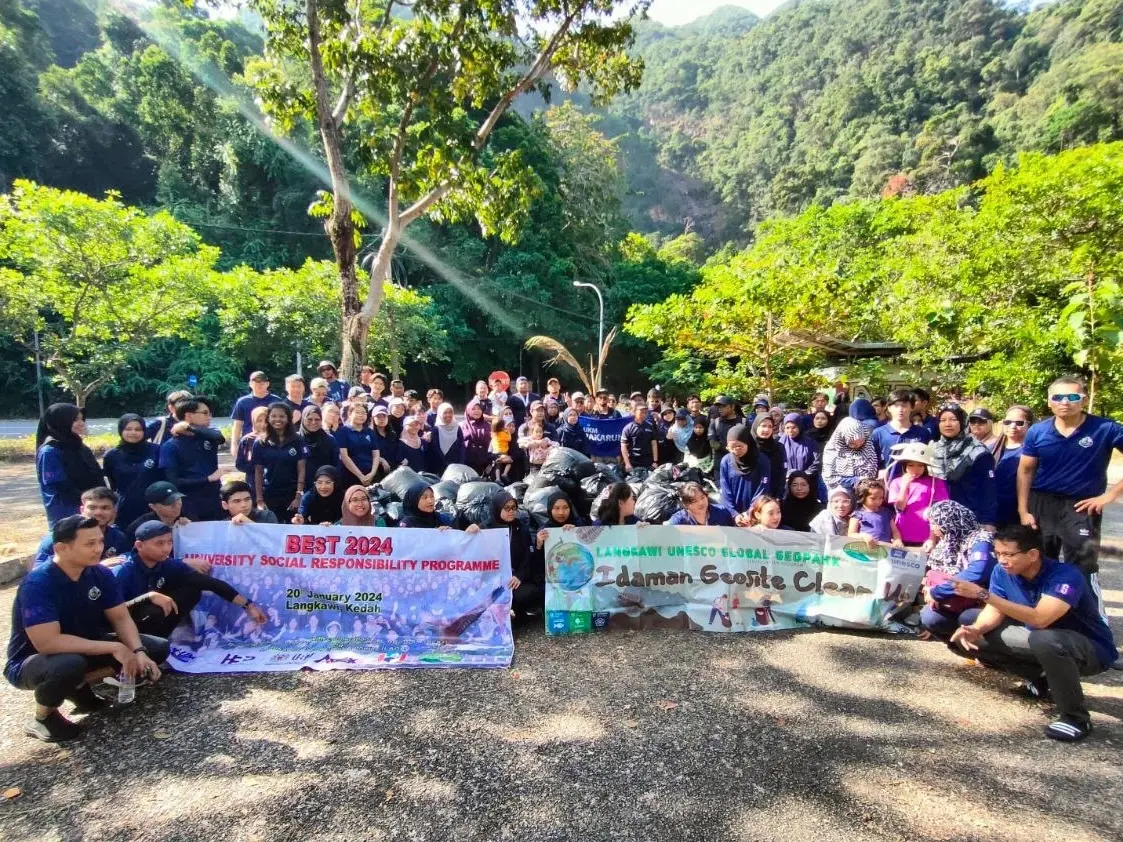
- USM's School of Housing, Building, and Planning (HBP) and the Langkawi Development Authority (LADA) launched the Idaman Geosite Clean Up (IGSC), sending 46 students into the Langkawi UNESCO Global Geopark.
- The University Social Responsibilities (USR) programme swaps lecture-hall theory for hands-on conservation — and a working lesson in teamwork and leadership.
- Dr. Ariza Sharikin Abu Bakar makes the case for experiential learning: education that leaves the classroom and walks the terrain.
A UNESCO Global Geopark does not stay a geopark by decree. It stays one because somebody shows up with gloves, bags, and a stubborn refusal to let the brochure outrun the ground. This month that somebody was 46 students from Universiti Sains Malaysia (USM), sent into the field by the School of Housing, Building, and Planning (HBP) and the Langkawi Development Authority (LADA) — and the classroom, for once, stayed behind.
From slogan to soil: turning university responsibility into fieldwork
Every university now claims a social-responsibility mandate; far fewer can point to a place where the mandate got its hands dirty. USM's answer is the University Social Responsibilities (USR) programme, which asks students to love, safeguard, and preserve the natural beauty around them — not as a poster campaign, but as an assignment with a deadline and a rubbish bag.
The framing matters. A geopark is an institutional asset with a real maintenance bill: its UNESCO status rests on the terrain actually being looked after, not merely labelled. Hand that upkeep to the people who will inherit it, and the lesson stops being abstract.
Also read: Victoria University of Wellington pilot: Early autism detection
Idaman Geosite Clean Up: 46 students, one geopark, zero spectators
The flagship activity of the USR programme, the Idaman Geosite Clean Up (IGSC), drew 46 students from the third- and fourth-year batches. Guided by Dr. Ariza Sharikin Abu Bakar — an HBP lecturer and the programme chairman — they set to work cleansing the Langkawi UNESCO Global Geopark area.
There is a particular honesty to a clean-up: the work is visible, the result is immediate, and no one can delegate the bending. For a generation raised on group projects and slide decks, an afternoon spent restoring a geosite is a different kind of credential.
Why experiential learning beats the whiteboard
Dr. Ariza Sharikin made the case plainly: experiential learning gives students a meaningful education beyond the confines of the traditional classroom. She framed IGSC as a workout for physical and mental resilience — and as a way to reinforce the core values that student development is supposed to be about.
It is a quiet rebuke to the lecture theatre. Resilience is not taught on a slide; it is earned on a slope, in the heat, with a bag that gets heavier before it gets lighter.
Also read: Microsoft signs deal with Swedish partner to capture carbon
The dean's verdict — and why the LADA partnership carries the weight
USM HBP Dean Associate Professor Ts. Dr. Mohd Rodzi Ismail commended the initiative, crediting it with building the skills employers keep claiming to want: teamwork and leadership, tested in the field rather than asserted on a résumé.
None of it works without LADA. The authority's backing turned a well-meaning campus gesture into a genuine collaboration on the ground, and USM has been explicit in its gratitude for the support. Institutions are fond of the word 'partnership'; this one had a work site.
What comes next
USM says it is eager to run more programmes like IGSC, aiming at intergenerational cooperation and a durable contribution to society. The test will be whether the clean-up becomes a habit rather than a headline — whether next year's batch inherits a geosite that is still worth the trip.
The classroom teaches students to describe the world. LADA and USM handed them a bag and asked them to improve a corner of it — and that, more than any slogan, is what responsibility looks like when it leaves the syllabus and meets the ground.