
Summary
- The BTW directory and LACNIC's Registration Data Access Protocol, or RDAP, associate UFINET PARAGUAY S.A. with AS264853. That is useful identity and contact information, not a drawing of fibre routes.
- PeeringDB and IXpy place the same company name and ASN in a declared interconnection context. Their entries do not measure a live session, a customer path, traffic volume or spare capacity.
- Ufinet's Paraguay page presents internet, capacity, dark fibre, FTTH, towering and data-centre links as service categories and identifies an office in Asuncion. Those company descriptions do not establish a Paraguay-specific route length, asset list or performance result.
- A buyer can use the public records to confirm whom a routing identity is associated with and where interconnection is declared. The buyer still needs service-specific evidence for physical separation, usable capacity, power, operating responsibility and recovery.
- The practical decision is not whether the records are valuable. It is whether each claim is matched to evidence capable of proving it.
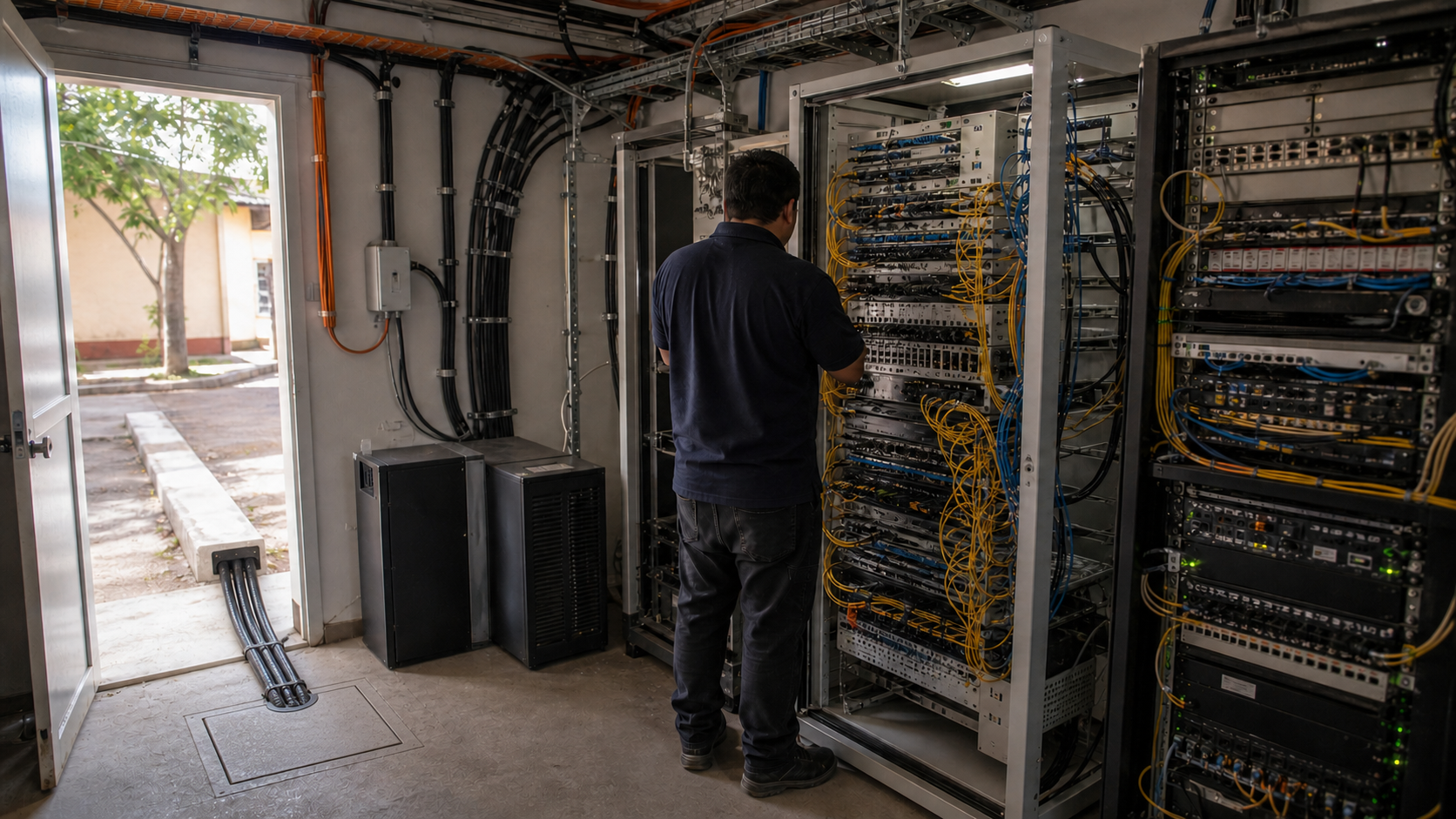
Image note: The featured image is a realistic editorial illustration of a fictional, generic telecom room. It is not a photograph of a Ufinet or IXpy facility, and it does not claim that either organisation controls any depicted room, rack, cable, route, power system or other equipment.
A Monday-morning connectivity decision
Imagine a Paraguayan business preparing to move a payment system, call centre or branch application onto a new connection. The team has a commercial description, several public internet records and a simple instruction from management: make sure the service can be identified, supported and restored when something goes wrong. This is a hypothetical decision, not a description of a named Ufinet customer or contract.
The first search produces an encouraging result. The exact BTW directory page associates UFINET PARAGUAY S.A. with AS264853. LACNIC's RDAP record also names UFINET PARAGUAY S.A. as the registrant of that active autonomous-system record. A participant-maintained PeeringDB profile names Ufinet Paraguay as AS264853 and declares an operational public interconnection at IXpy. IXpy's own member table lists Ufinet, the legal entity UFINET PARAGUAY S.A. and AS264853.
Those matches solve an important part of the assignment. They give the team a stable network identity and reduce the risk of attaching the wrong company to the wrong ASN. That precision matters because similarly named directory entries exist. The relevant public entity is the one that carries the AS264853 association, not another entry selected because its name looks familiar.
The search does not solve the whole assignment. It does not show the building entrance used by the proposed circuit. It does not show whether a second connection would share a conduit, room, power feed or transport segment. It does not state how much capacity would remain after a fault. It does not show which destinations would use IXpy, whether a particular routing session is active at the time of purchase or how quickly service would return after a failure.
This is the point at which a procurement decision can go wrong. A team may treat the stack of public pages as if the number of documents were evidence of physical depth. Four matching entries can feel stronger than one. Yet they may all describe the same logical identity from different administrative perspectives. Agreement about a name and number does not create four fibre routes, four power supplies or four recovery options.
The better method is to divide the assignment into three decisions. First, can the team identify the routing domain and the organisation associated with it? Second, can it describe the declared interconnection context without pretending that a directory is a live monitor? Third, what additional evidence would be required before the team relies on a physical service during a fault? The public records answer much of the first decision, part of the second and almost none of the third.
That division is not scepticism for its own sake. Identity records and interconnection directories perform real infrastructure functions. Accurate names, unique numbers and current contacts make coordination possible. The mistake is to make them carry claims about physical reach, capacity or resilience that belong to other evidence.
The evidence board: five records, five bounded answers
A useful way to read the material is as an evidence board rather than a story of increasing certainty. Each row below has a specific job. No row becomes stronger merely because another row sits beside it.
| Public record | What it supports | What it does not settle |
|---|---|---|
| BTW directory | The exact public entity UFINET PARAGUAY S.A. is associated with AS264853 | Physical topology, customer routes, capacity or resilience |
| LACNIC RDAP | AS264853 is active, UFINET PARAGUAY S.A. is the registrant, the registration event is dated 6 January 2017, and administrative, technical and abuse roles are present | Live announcements, fibre, facilities, traffic, failover or restoration |
| PeeringDB | Ufinet Paraguay is presented as AS264853, with a declared operational public interconnection at IXpy using IPv4 and IPv6 addresses and an open general peering policy | A continuously observed session, customer use, volume, spare capacity or physical diversity |
| IXpy | IXpy describes itself as Paraguay's internet exchange point operated by NIC Paraguay; its table lists Ufinet, UFINET PARAGUAY S.A. and AS264853; its technical rules require an ASN and BGP4 | A particular route, traffic amount, fibre ownership or failure-state performance |
| Ufinet Paraguay page | Ufinet identifies an office in Asuncion and presents internet, capacity, dark fibre, FTTH, towering and data-centre links as service categories | Paraguay-specific route length, asset inventory, availability at an address, control or measured performance |
The first two rows answer an identity question. The BTW page binds the exact public entity used here, while RDAP supplies the authoritative registration record for the autonomous system. RDAP is a standard way to retrieve registration information about internet number resources. For a non-specialist, it can be understood as a carefully maintained ledger: it records who is associated with a resource, relevant events and published contact roles.
That ledger function has direct operational value. When two networks need to investigate a routing or abuse incident, a unique number and a relevant contact reduce ambiguity. When a researcher encounters similarly named companies, the exact ASN association helps prevent mistaken identity. When the recorded organisation or contact is stale, coordination can take longer. Accuracy is therefore part of continuity even though it is not the same as continuity.
The next two rows answer a declared-interconnection question. PeeringDB is a directory in which networks and exchanges publish interconnection information. IXpy supplies exchange-side context through its own site and member table. The company name and ASN appear in both places, which gives readers a consistent statement about the declared relationship.
The fifth row answers a commercial-description question. Ufinet's page describes how the company presents its Paraguay presence and service categories. It is appropriate to say that Ufinet presents those categories. It is not appropriate to convert a global headline or navigation label into a local route length, asset count or engineering result.
The grammar used around each row matters. LACNIC records. PeeringDB declares. IXpy lists. Ufinet presents. Those verbs preserve the nature of the evidence. Words such as measured, guaranteed, physically separate and tested require material that is not contained in these five pages.
Time also belongs on the evidence board. The autonomous-system registration event is dated 2017, while the pages were retrieved during current research in 2026. A registration event and a retrieval date describe different moments. Interconnection arrangements, routing and service designs can change, so a decision about present operation needs evidence dated for that decision.
Decision one: identify the routing domain without turning it into an asset list
An Autonomous System Number, usually shortened to ASN, is a unique public identifier for a network that presents routing policy to other networks. The internet consists of many separately managed networks. They need stable numbers so they can distinguish one routing domain from another while exchanging reachability information.
AS264853 is the number in this case. LACNIC's RDAP service records the active autonomous-system entry to UFINET PARAGUAY S.A. The number gives other networks and researchers a precise identity to use in routing data and coordination. It is far more useful than relying on a brand name alone.
The word autonomous can mislead a reader who encounters it for the first time. It does not mean that the organisation is self-sufficient or owns every component used by its services. A routing domain can depend on leased circuits, shared buildings, commercial electricity, equipment vendors, exchange infrastructure and connectivity from other networks. Autonomy here concerns routing administration and policy, not freedom from physical or commercial dependencies.
The ASN also contains no hidden inventory. Its digits do not encode fibre routes, router rooms, building entrances, electric feeds, equipment models or staffing arrangements. They do not show which internet-address blocks are visible at a particular moment. They do not say how a named customer's traffic reaches a destination.
A vehicle registration offers a useful, if imperfect, comparison. It can identify a vehicle accurately without showing the road it is using, its fuel level or a blocked bridge ahead. AS264853 can identify a routing domain accurately without showing the physical medium, remaining capacity or conditions along a current path.
This boundary makes the registry more useful, not less. A ledger should be judged by whether it maintains unique and accurate identity, events and contactability. It should not be judged as a failed cable plan. The LACNIC entry is strong evidence that UFINET PARAGUAY S.A. is the recorded registrant of AS264853. It is not evidence that the company controls every physical element associated with traffic from that ASN.
The running network is a separate reality. A registry status does not command a router to announce a destination or another router to accept it. It does not establish that an interface is passing traffic. Those behaviours arise from active configurations, technical relationships and current conditions.
BGP, the Border Gateway Protocol, is the mechanism networks use to tell neighbouring networks which internet destinations they can reach. An announcement carries a path expressed through autonomous-system numbers, and each receiving network applies its own technical and commercial rules when selecting a path.
One way to picture BGP is to imagine transport companies exchanging lists of destinations they can serve. A company may learn several possible sequences for reaching a city and then choose among them according to its rules. If a relationship or condition changes, the preferred sequence may change. The real protocol is more complicated, but the comparison shows why identity alone does not determine the path.
Visibility also depends on viewpoint. A route can appear differently from different networks because their policies and relationships differ. Seeing a route does not prove that every customer service works; local access, internal transport, congestion, name resolution or an application can still fail. Not seeing a route from one place does not, by itself, identify a physical cause.
Route-origin security is another distinct question. RPKI, the Resource Public Key Infrastructure, allows holders of internet-address resources to publish cryptographically verifiable statements about which ASN may originate a prefix. No current RPKI or Route Origin Authorisation conclusion for AS264853 is made here because such a finding is not established by the five bounded public records.
The first decision can therefore be recorded confidently and narrowly: the exact public entity and the LACNIC record associate UFINET PARAGUAY S.A. with AS264853. That answer enables coordination. It leaves live routing, physical control and service performance for other tests.
Decision two: describe IXpy participation as a declaration, not a traffic trace
An internet exchange point, commonly shortened to IX, is a shared interconnection environment where participating networks can exchange traffic. Direct interconnection may offer a way for two networks to reach one another without sending that traffic through a longer commercial path. Whether it does so for a particular destination or customer depends on active sessions, policy and conditions at the time.
PeeringDB identifies Ufinet Paraguay as AS264853 and declares an operational public interconnection at IXpy with IPv4 and IPv6 addresses. IPv4 and IPv6 are two systems used to number internet interfaces. The profile also describes an open general peering policy, indicating that the network presents itself as broadly willing to consider direct interconnection under its stated practice.
IXpy supplies a matching exchange-side statement. It describes itself as Paraguay's internet exchange point operated by NIC Paraguay. Its public member table lists Ufinet, UFINET PARAGUAY S.A. and AS264853. The exchange's technical rules require participants to operate an ASN and use BGP4 for interconnection.
For the hypothetical buyer, this is useful context. It identifies a declared place where interconnection is presented and tells a technical team which ASN is involved. For another network, it may identify a possible peer. For an investigator, it adds a second public setting in which the exact company name and number appear together.
It does not answer whether the buyer's traffic uses IXpy. A customer path can change with destination, service design, routing policy and current conditions. Even a trace taken at one time would describe a logical observation, not every fibre underneath it. The member row alone is further removed: it is a declaration, not an end-to-end path measurement.
The word operational in a directory field deserves particular care. It reports the status presented in that directory. It is not the same as an independent observation that a session remained available continuously or was available at the instant the page was opened. The IXpy table likewise establishes listed participation context, not a minute-by-minute performance result.
The records also make no traffic-volume claim. They do not say how much data is exchanged, how much of a listed connection is occupied or how much capacity would remain during a fault. They do not reveal the terms of a bilateral arrangement or whether every technically possible exchange is accepted by routing policy.
Physical dependencies remain hidden. A logical interconnection can rely on local fibre, transport services, building systems, exchange equipment, power and remote operations. Two rows or connections that appear separate can share a conduit, room, power system or control platform. Conversely, an organisation may maintain safeguards that are not published in an exchange directory.
The second decision should therefore use two clauses. The evidence supports saying that PeeringDB declares an operational public interconnection for AS264853 at IXpy and that IXpy lists the company and ASN in its member table. The evidence does not establish a named customer path, live session, traffic level, spare capacity or physical route.
Decision three: test the service claim against the physical chain
The company page changes the type of question. Ufinet identifies an office in Asuncion and presents internet, capacity, dark fibre, fibre to the home, towering and data-centre links as service categories in Paraguay. Fibre to the home, often shortened to FTTH, describes an access design in which fibre reaches residential premises. Dark fibre generally refers to fibre made available without the active transmission equipment that lights it.
These descriptions help a prospective customer understand what the company says it offers. They do not specify which category is available at a particular address or under a particular contract. They do not state a Paraguay-only fibre length, list physical routes or identify every facility. They do not show which elements are directly controlled, leased or shared.
That distinction is central to the title. A genuine fibre map would answer questions that AS264853 cannot. It would distinguish routes rather than draw one broad line. It would show where paths enter buildings, where they share conduits, which locations connect them and where responsibility changes. It would state whether the drawing represents planned, installed or currently usable infrastructure and would carry a date.
Even a map is not enough for resilience. Two lines can look separate while crossing the same bridge, utility corridor, room, splice enclosure or power system. Engineers describe this as shared risk: one event can affect components that were counted as independent. A useful diversity assessment must uncover common physical and operational dependencies, not simply count labels or colours.
A service can also combine elements under different forms of control. Legal possession is not the only operational question. The customer needs to know who can monitor each segment, who can authorise work, which restoration obligation applies and how the responsible organisation can respond. The public pages do not establish those service-specific details.
The physical chain begins at the customer's service boundary. It may pass through customer equipment, building cabling, an access connection, optical systems, routers, aggregation, interconnection and external networks. The exact chain for any Ufinet Paraguay service is not established here. These are categories that a proper service assessment would examine, not claims about a Ufinet site.
Power is an independent dependency. Network equipment cannot operate without electricity. Batteries, generators, multiple feeds and procedures may form part of continuity planning, but an ASN or exchange listing does not show whether such arrangements exist, which systems they protect, how long they last or whether they have been tested.
Cooling and environment form another dependency. A room can retain electricity and still become unusable if cooling fails. Fire protection, water ingress, physical security and access to replacement parts may also affect restoration. The featured illustration represents these generic categories only. It is fictional and should not be read as a Ufinet or IXpy facility.
People and procedures complete the chain. Monitoring must produce useful alarms. Someone must interpret them, decide whether traffic can be moved, contact another organisation when a shared service is involved and reach an affected site when physical work is required. Accurate contact roles in RDAP help coordination, but they do not prove the quality or speed of the operational response.
Capacity must be tested separately from connectivity. A link can exist and still be too small for demand after another link fails. Physical line rate is not the same as contracted capacity. Contracted capacity is not the same as what remains available at a busy moment. Available capacity on one interface does not prove that the rest of an end-to-end path can carry the same load.
This is why a directory speed field, if displayed, should not be converted into an independently verified service result. It would not reveal current use, traffic shaping or the demand that might move there during a fault. The public evidence used here supports no speed, volume or reserve-capacity claim.
The third decision is therefore conditional. The company page can support an attributed statement about service categories. Reliance on a particular service requires contract-specific evidence about boundaries, physical dependencies, capacity, control and failure behaviour. No inference about those matters should be drawn from the ASN itself.
Three continuity questions that turn labels into evidence
The hypothetical procurement team can now replace a broad request for “resilience” with three testable questions. Each question asks for a defined outcome rather than another label.
1. What useful service remains after one named failure?
The team should name the service that matters and the condition to be tested. Internet access, a private link, dark fibre and managed capacity do not have identical boundaries. A payment system, voice service and high-volume enterprise connection can also require different minimum performance.
The question is not merely whether a second connection exists. It is whether enough end-to-end capacity, reachability and operating support remain when a relevant component is unavailable. A useful answer specifies the failed component, minimum service level, duration and limitations.
A dated controlled test is stronger than a timeless assertion that redundancy exists. Traffic measurements can show whether an alternate path carried the intended load. Routing observations can show how reachability changed. Equipment logs can show alarms and switching events. A contract can define minimum performance for a stated failure condition.
No such current test, reserve-capacity result, restoration-time distribution or route-diversity proof for Ufinet Paraguay is established by the public records here. That absence does not prove weakness. It means the answer must come from evidence tied to the purchased service.
2. Which apparently separate elements share one dependency?
Two logical connections may use different ports but share a building entrance. Two fibres may depend on one power system. Separate devices may rely on one remote control platform. Paths presented by different names may converge on the same transport segment or facility.
The team does not necessarily need sensitive route coordinates. It can request bounded assurance about separate entrances, shared conduits, common facilities, power dependencies and restoration control. The response should distinguish what has been verified from what has been assumed.
This question also applies to interconnection. A listed IX connection can be one useful option without proving that a customer's normal and alternate paths are independent. The path to an exchange, the exchange environment and routes beyond it can each introduce dependencies not visible in a member table.
The reverse possibility must remain open. Public pages may omit safeguards for security or commercial reasons. Silence is not proof that diversity exists, and it is not proof that diversity is absent. The responsible result is “not established by these public records” until suitable evidence is available.
3. Who detects, decides and acts at each service boundary?
Continuity is partly a coordination problem. A fault may cross the customer's equipment, building systems, an access circuit, transport, routing or an external destination. If each organisation assumes another is responsible, a technically recoverable problem can last longer.
The team should identify where responsibility begins and ends. It should know which conditions trigger an alert, who can change routing policy, who can authorise physical work and how another organisation is contacted when a shared component is involved. Restoration obligations should match the boundaries in the service design.
The RDAP administrative, technical and abuse roles help establish public contactability for AS264853. They are useful infrastructure. They cannot replace the service-specific escalation list, current operations contacts or evidence that staff can execute the intended response.
Incident language should preserve the sequence of action. Detection is when the problem becomes known. Diagnosis identifies what is happening. Mitigation reduces impact. Restoration returns the intended service. Repair removes the underlying fault. A notice that collapses those moments into one word makes performance difficult to assess.
Together, the three questions convert a vague claim into observable conditions. They also show why AS264853 is necessary but insufficient. The number helps identify the routing domain involved; it cannot answer what survived, which dependencies were shared or who acted.
A claim-to-evidence worksheet
Before approving a decision, the team can place each proposed sentence beside the least evidence needed to support it. The exercise prevents a true statement at one layer from becoming an unsupported statement at another.
| Proposed statement | Evidence that can support it | Status from the public material here |
|---|---|---|
| UFINET PARAGUAY S.A. is associated with AS264853 | Exact directory identity and LACNIC RDAP | Supported |
| AS264853 is listed in an IXpy interconnection context | PeeringDB declaration and IXpy member table | Supported as a declaration |
| A named customer's traffic uses IXpy | Dated service-specific route observations or direct operational evidence | Not established |
| Two customer paths are physically diverse | Current route and facility evidence that addresses shared risks | Not established |
| Enough capacity remains after a failure | A dated end-to-end test under the defined failure condition | Not established |
| Recovery meets a stated objective | Repeated test results or incident outcomes measured against that objective | Not established |
| Ufinet presents named service categories in Paraguay | Attributed company page | Supported as company description |
| A category is available at a particular address with a particular design | Service-specific commercial and engineering evidence | Not established |
The worksheet shows that unsupported does not mean false. It means the five public pages cannot decide the statement. Ufinet Paraguay may hold private design, testing or operating material that is not public. It may also have dependencies that require attention. The available evidence does not justify selecting either possibility.
The worksheet also keeps praise and criticism symmetrical. It prevents an accurate ASN record from being promoted into a resilience guarantee. It prevents the absence of a public topology diagram from being treated as proof that no safeguards exist. Accountability rests on claims that can be tested.
For live routing, the needed material would normally include dated observations from suitable viewpoints. The analyst would identify which destinations were visible and at what time. A single viewpoint cannot establish universal behaviour because policies differ. This briefing includes no such current measurement and therefore makes no live announcement, stability, convergence or path-preference conclusion.
For a customer route, an end-to-end trace or direct evidence tied to the service would be needed. Even then, a trace usually shows a logical path visible at one moment rather than every underlying fibre. Repeated observations and service documentation can add confidence without turning the result into a complete physical map.
For physical diversity, the material must address shared risks: entrances, conduits, facilities, power and the organisations controlling restoration. Separate product names, circuit identifiers or coloured lines do not by themselves demonstrate independence.
For capacity, the metric and condition must be explicit. A port label is not spare end-to-end capacity. A meaningful result says what load was carried, which component was unavailable, for how long and with what limitations.
For resilience, the strongest case combines design evidence, operating evidence and history. Documented dependencies show what was intended. Controlled tests show behaviour under chosen conditions. Monitoring and incident outcomes show what happened in practice. No single directory entry can replace that combination.
Run the decision twice: an ordinary day and a failure day
A service decision often looks sound in normal conditions because the basic connection works. Running the decision twice exposes what the public records cannot show.
On the ordinary day, the hypothetical team confirms the exact entity and ASN. It records that PeeringDB declares an operational public interconnection at IXpy and that IXpy lists the same company and number. It attributes Ufinet's service categories to the company page. It checks the purchased service boundary and records current measurements supplied for that service.
The ordinary-day decision must not assume that every destination follows one path. BGP choices can vary by destination, policy, time and observation point. It must not assume that an IXpy listing means every customer flow crosses the exchange. It must not assume that visible reachability proves local access, name resolution or applications are healthy.
On the failure day, the team begins with the observed symptom, not the ASN. It records the time, locations and services affected. A problem limited to one application is different from a problem affecting one customer site, an access area or broader reachability. The first observation should not become a conclusion about all of AS264853.
The team then separates layers. If RDAP still returns the correct record, the identity ledger remains available; that says nothing about traffic movement. If PeeringDB and IXpy still show the member entry, the declaration remains visible; it does not show whether a current BGP session is established.
Dated route observations can narrow the possibilities. A change seen from several suitable viewpoints may point to a routing event, while unchanged expected visibility may direct attention toward local access, internal transport, congestion, name resolution or an application. Neither result identifies a physical cause without further evidence.
Operational data can connect the logical and physical layers. Interface state, optical readings, power events, environmental alarms and maintenance records can show where conditions changed. These details are normally held by the organisations operating the systems and cannot be reconstructed from the ASN digits.
The team records detection, diagnosis, mitigation, restoration and repair separately. It notes whether an alternate path carried the required load, whether a shared dependency affected multiple paths, whether contacts were accurate and whether observed routing matched the intended policy.
After service returns, the two decisions are compared. If the stated design and observed result differ, the discrepancy becomes a concrete improvement item. If the alternate arrangement works under the named condition, the dated result supports a bounded continuity claim. Either outcome is more informative than pointing again to the continuing existence of a directory row.
This twice-run method matters to several audiences without requiring a separate list of generic impacts. Procurement gains a testable purchase condition. Technical staff gain a map of responsibilities. Other networks gain precise identity and contact information. Ordinary users receive clearer explanations. Journalists and researchers gain verbs that distinguish registration, declaration, observation and testing.
UFINET PARAGUAY S.A. benefits from the same precision. Unsupported praise can create expectations the public material cannot support. Unsupported criticism can imply that undisclosed safeguards do not exist. A dated, service-specific account is fairer than either assumption.
The one-page decision checklist
The final meeting does not need a complete public blueprint. It needs a compact set of answers with evidence dates and clear boundaries.
Identity
- Use the exact directory entity associated with AS264853, not a similarly named entry.
- Record that LACNIC lists AS264853 as active, names UFINET PARAGUAY S.A. as registrant, dates the registration event to 6 January 2017 and provides administrative, technical and abuse roles.
- Treat the registry as an identity and coordination ledger, not a physical authority over routes or assets.
Declared interconnection
- Record PeeringDB's Ufinet Paraguay and AS264853 entry as a participant-maintained declaration.
- Record IXpy's description of the exchange, its Ufinet member row and its ASN and BGP4 requirements.
- Do not convert either page into a live-session, customer-path, traffic-volume, capacity or diversity claim.
Purchased service
- Name the exact product and the service boundary.
- Ask how alternate paths differ at building entrances, conduits, facilities, power and restoration control.
- Define the minimum useful capacity and reachability required after a named failure.
- Require dated evidence of switching, routing behaviour and operating response appropriate to the service.
- Clarify what the IXpy declaration means, if anything, for the purchased path.
Continuing evidence
- Refresh identity and contact information when it changes, but do not describe a registry update as a physical network change without supporting evidence.
- Refresh PeeringDB and IXpy declarations when they change, then use current observations to determine practical effects.
- Keep route measurements tied to time and viewpoint.
- Keep physical-diversity assurances tied to shared risks.
- Keep capacity results tied to a metric and failure condition.
- Keep incident accounts divided into detection, diagnosis, mitigation, restoration and repair.
The checklist deliberately avoids a yes-or-no resilience label. Resilience is demonstrated behaviour: the ability to continue, adapt or recover when something fails. Redundancy is only an input. Alternatives must be independent enough, large enough, correctly configured and tested if they are to support a result.
The checklist also avoids demanding that sensitive infrastructure details be posted publicly. A customer can receive bounded assurance about shared risks and test outcomes without publishing route coordinates or a complete equipment inventory. Precision and operational security are compatible when the claim is carefully framed.
The decision memo the evidence can support
The hypothetical team can now write a short decision without overstating the public record.
UFINET PARAGUAY S.A. is associated with AS264853 in the exact BTW directory entry, and LACNIC records the company as registrant of the active autonomous-system record. Those records provide a unique routing identity and public contact roles. They help networks and researchers coordinate and avoid confusing similarly named entities.
PeeringDB declares an operational public interconnection for Ufinet Paraguay at IXpy using IPv4 and IPv6 addresses and describes an open general peering policy. IXpy describes itself as Paraguay's internet exchange point operated by NIC Paraguay, lists Ufinet, UFINET PARAGUAY S.A. and AS264853, and requires participants to operate an ASN and use BGP4. These statements establish declared interconnection context, not a measured customer path or continuous availability result.
Ufinet's Paraguay page presents internet, capacity, dark fibre, FTTH, towering and data-centre links as service categories and identifies an office in Asuncion. Those are attributed company descriptions. They do not establish a Paraguay-specific fibre length, route map, asset inventory, capacity result, physical diversity or recovery performance.
The purchasing decision should therefore separate identity from continuity. AS264853 answers which routing domain is involved. It does not answer which fibre a service uses, whether alternate paths share one dependency, how much capacity remains after a fault or how quickly the intended service returns.
Current running evidence remains decisive for those questions. Routers must exchange and accept reachability. Fibre and equipment must carry signals. Power and cooling must sustain the systems. People and participating organisations must detect faults and act. The alternate arrangement must carry the useful service under the condition that matters.
Nothing in this conclusion is an endorsement or accusation. The public records are valuable within their proper roles. The company may hold relevant private evidence, and the absence of that material from public pages does not decide the quality of the system. The buyer's next step is to obtain evidence matched to the service and failure condition, not to ask the ASN to act as a fibre map.
That is the central reality behind AS264853. An accurate ledger and a functioning network support one another, but they remain different layers. Keeping those layers separate produces a clearer purchase, a more useful incident account and a fairer description of Ufinet Paraguay's public network identity.