
Summary
- UCIe establishes common rules for the physical layer, the adapter, the protocols and link management between chips; function, packaging and vendor responsibility fall outside its remit
- Versions 1.0 to 3.0 extended the standard with cheaper packaging options, automotive monitoring, 3D support, management and operation at 64 GT/s
- Its commercial value will be seen in reproducible conformance profiles, multi-vendor packages with genuine support and clear liability when a shared system fails
The 64 GT/s version turned the speed race into a systems question
On 5 August 2025, a standardisation consortium that had been in the public eye for just over three years published its third major specification. Universal Chiplet Interconnect Express, abbreviated UCIe, added 48 and 64 gigatransfers per second for its standard and advanced packaging channel classes. It also broadened the scope of the low-speed sideband channel, extended continuous raw streaming and added more management controls. The headline was speed. The bigger story was the attempt to make a package made up of independently designed chips behave like a governable system.
The difference matters because a faster link is only part of a chiplet-based product. The buyer still needs to know what each chip does, how much power it consumes, how it is cooled, what software discovers it, how its firmware is updated, what happens when a component fails and which vendor bears the warranty. UCIe brings common rules for moving information between chips and for part of the management around that movement. It does not by itself turn a collection of unrelated silicon into a finished processor.
The consortium talks about an “open chiplet ecosystem”. The phrase is useful as an ambition, but it can be confused with the description of an existing market. The public record examined for this profile contained no independent, comprehensive census of multi-vendor UCIe packages in production, no universal list of certified products and no catalogue from which an integrator could select interchangeable chips. It did contain specifications, member activity, implementation training and demonstrations. These are necessary steps. They are not equivalent to repeatable procurement and consolidated production.
The central question is therefore narrower than asking whether chiplets will matter. They already matter as a way of dividing complex systems. The question is how much modularity a shared link can create when the package around it remains a highly integrated engineering entity. UCIe may become the common language of the chip boundary while leaving most physical and commercial dimensions of the system proprietary. That is why the interface is best assessed as a chain of handoffs, not as a single interchangeability promise.
The word interchangeability compresses several tests into one. The first is electrical: can transmitters, receivers and the package channel establish a link under the same physical profile? The second is protocol-based: do both ends understand the same PCIe, CXL or raw mapping? The third is operational: can the package discover, test, monitor and update the dies through compatible management functions? The fourth is functional and software-based: does the chiplet expose behaviour that firmware, drivers and applications know how to use?
The fifth is commercial: can the buyer obtain the part with enough test evidence, volume, support and warranty to include it in a product?
UCIe directly addresses the first two tests and, increasingly, the third. It can make electrical negotiation, protocol transport and management handoffs less dependent on a private bilateral design. The fourth layer lies partly in PCIe, CXL and product-specific software. The fifth belongs to vendors, foundries, packaging companies and buyers.
Confusing the layers produces two opposing errors. One dismisses the standard because it does not create a finished market, ignoring the value of removing a recurring physical and protocol barrier. The other declares the market complete because two dies establish a conformant link, ignoring all the decisions needed to turn it into a supported system.
A professional assessment must say which promise has been demonstrated. A physical interface demonstration proves less than a protocol pairing. That pairing proves less than a package that can be managed across its life. And a manageable package proves less than a component that can be replaced without rewriting software or contracts. The hierarchy does not criticise UCIe; it clarifies what the consortium controls and what it leaves to the market.
This five-layer reading explains why progress can be real without looking like a plug-and-play purchase. A new specification can strengthen the first three promises while the fourth and fifth mature slowly. The chiplet market will not arrive with a single announcement. It will be built through a sequence of narrower handoffs that become repeatable enough to earn trust.
Chiplets move complexity from silicon to packaging
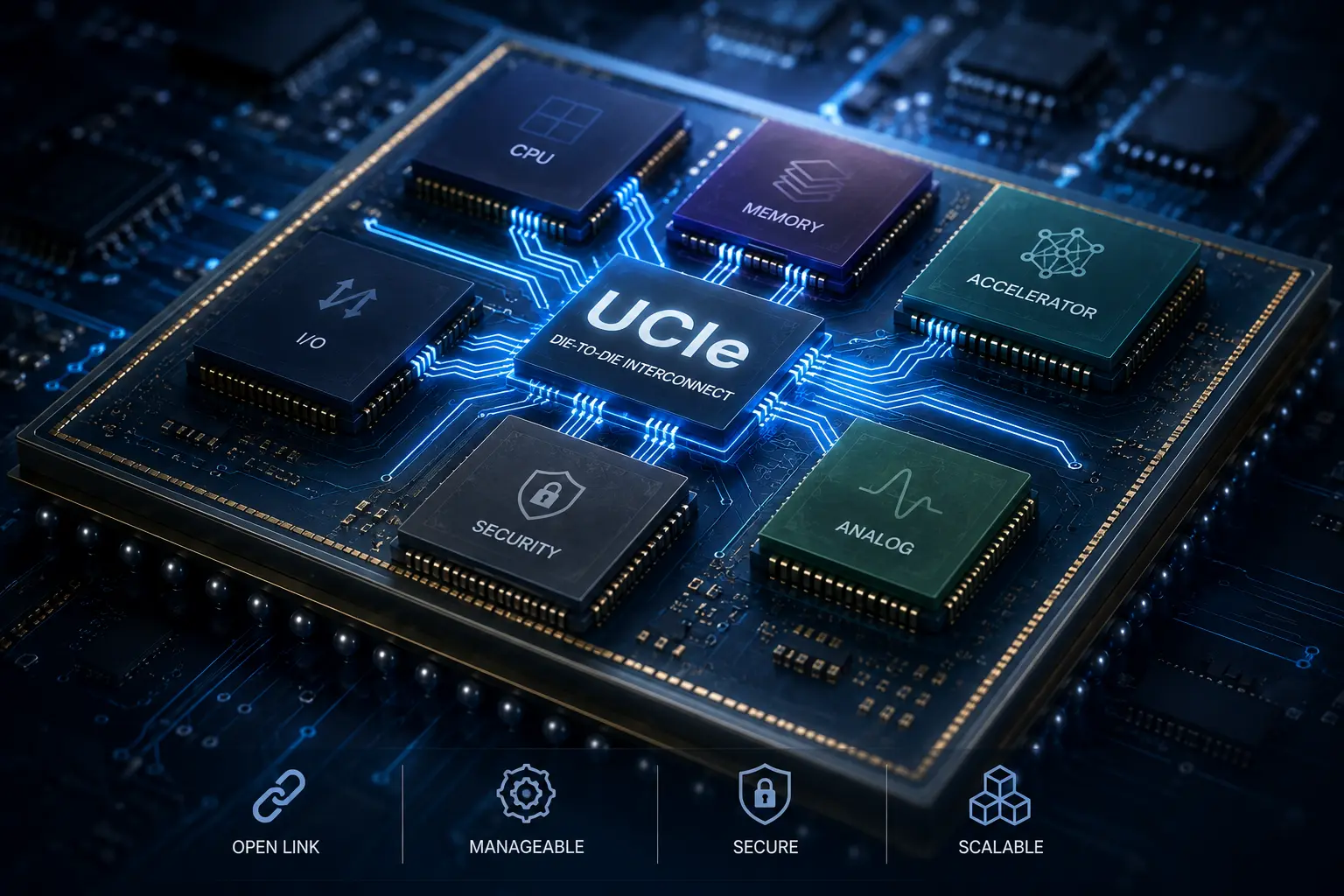
A monolithic chip places a system's functions on one large piece of silicon. That arrangement can simplify internal communication, but it forces a single manufacturing plan. As design complexity at advanced nodes increases, along with mask costs and yield pressure, integrating every block into one large chip becomes expensive and difficult. Chiplets offer another path: compute, memory, input/output, analogue, security and accelerators can be separated, manufactured in processes suited to each function, and reunited in a system-in-package.
Partitioning does not eliminate complexity. It moves part of the chip problem into the package. Every boundary needs signalling, clocking, error management, power, thermal planning, test coverage and software-visible behaviour. A large monolithic die can lose yield as its area grows; a multichip package can lose value because one component is defective, marginal or poorly assembled. The designer gains the option of combining process nodes and reusing blocks, and accepts a new set of packaging dependencies.
That is why the word “modular” needs precision. A circuit board is modular partly because its components have physical forms, electrical conventions, identifiable functions and mature commercial terms. Vendors publish datasheets. Distributors stock parts. Integrators understand connectors and fault boundaries. A chiplet inside an advanced package lives in a far tighter environment with far less margin. Its neighbour may share power, heat, management and high-speed lanes that cannot be inspected or replaced after assembly the way a board component can.
UCIe addresses one of the most difficult recurring boundaries: the short, dense link between chips. Standardising it can reduce interface reinvention and give tools, intellectual-property vendors and integrators a common target. It does not remove every other problem. The value of the standard is in reducing a specific class of bilateral engineering, not in turning the package into a loose collection of independent parts.
Before a common interface, a company could split a system across several dies and remain vertically integrated. The link could be designed around its own electrical assumptions, protocol, packaging process and test flow. That freedom allows latency, power and area to be optimised for one product. It also makes it hard for another vendor to contribute a die without learning and implementing a private contract.
The proprietary-link trap is economic as well as technical. A company can call a design modular without the useful module being available outside the company. Reuse can cross internal product generations while the market sees a closed package. The architecture is modular inside a corporate boundary and indivisible outside it.
UCIe's founders attempted to create a shared boundary without dictating the whole system. The consortium defines the behaviour of the physical layer, an adapter and protocol mappings. Vendors still choose what the chiplet does, how the package is manufactured and which functions are exposed. The common layer must be thin enough to serve different products and detailed enough that independent implementations conform to the same specification.
The balance is difficult. A standard that is too vague leaves every pairing as a bespoke project. One that is too detailed can freeze decisions, favour early implementers or reduce differentiation. UCIe's rapid expansion into management, DFx and 3D shows that the original boundary was not enough for a fully operational package. The consortium has had to standardise more handoffs as the market discovered where private assumptions still blocked reuse.
Rival companies created a non-profit around a deliberately narrow boundary
UCIe launched publicly on 2 March 2022 with version 1.0. Universal Chiplet Interconnect Express, Inc. was incorporated in Delaware as a non-profit on 2 August and opened a formal membership structure. The founding group brought together processor, cloud, foundry, assembly and test, memory and acceleration companies. Current documentation cites AMD, ASE, Alibaba Cloud, Arm, Google Cloud, Intel, Meta, Microsoft, NVIDIA, Qualcomm, Samsung and TSMC.
That breadth is the main institutional asset. An inter-chip link cannot become useful through the actions of one processor designer. Foundries need channels and package rules they can manufacture. Assembly and test companies need flows they can qualify. Electronic design automation and interface IP vendors must turn the specification into controllers, physical layers and verification products. Cloud and systems companies must put the packages to work in real workloads.
The same list contains competing incentives. A hyperscaler may want reusable blocks while keeping a private architecture. A foundry may support a common electrical link while keeping its kits, capacity and know-how proprietary. A processor maker may benefit from more suppliers while continuing to use better internal links for certain uses. The consortium creates a room where these interests agree on a boundary; it does not make them identical.
That is why membership is also not proof of deployment. A promoter logo indicates participation in governance and technical work. A contributor may supply tools or IP. An adopter may be evaluating. No single status demonstrates that an identified production package contains UCIe chiplets from independent vendors, or that the parts are commercially replaceable. That institutional boundary is only valuable if the technical stack remains usable across different packaging types.
The current UCIe board shows Debendra Das Sharma of Intel as chair, Cheolmin Park of Samsung as consortium chair, Dong Wei of Arm as secretary, and Lihong Cao of ASE Group as treasurer. Other directors represent Google Cloud, Qualcomm, Alibaba Cloud, Meta, TSMC, AMD and NVIDIA. These are institutional roles exercised through the members. They do not grant personal ownership of the specification or sole authorship.
The non-profit form gives the programme a legal home for membership, intellectual property and technical work. The promoter, contributor and adopter levels offer different ways to participate. Public evaluation copies make the architecture visible. However, the terms distinguish access for study from the wider rights tied to implementation and membership. The agreement grants a limited licence for internal evaluation and does not present the specification as a royalty-free public-domain design.
The distinction matters for small suppliers. A public document lowers the cost of learning the interface. It does not remove legal uncertainty, verification tools or the engineering needed for a high-speed package. A startup can read the same specification as a promoter without its patent portfolio, packaging relationships or validation budget.
UCIe is funded through membership, but the available material does not include audited revenue, reserves, staff or per-generation spending. That absence limits any claim about its financial scale. It does not reduce the economic stakes of the standard.
The expensive work happens in member and supplier organisations. Companies design controllers and dies. Physical-layer vendors create reusable IP. Automation companies add modelling and verification. Foundries and assemblers develop processes. Systems makers pay for integration, qualification and software. A common link can reduce duplicated engineering, but the saving appears in product economics, not as consortium income.
Membership also distributes rights and risk. Promoters and contributors participate under consortium agreements. Public access allows the specification to be studied, while implementation rights and intellectual-property protections depend on the applicable agreements. The result is an open technical reference surrounded by a structured membership economy.
This matters for sustainability. The consortium does not need a manufacturer's revenue to be influential. It needs continued support to maintain specifications, resolve interpretations, develop conformance and coordinate the next generation. The risk is not a classic product failure; it is that those who pay for implementation prefer a proprietary path, or that qualification costs grow faster than the value of broad interoperability.
The specification reuses mature protocols and leaves packaging to the manufacturer
The first specification did not try to invent every high-level transaction. It defined a physical layer between dies and an adapter capable of carrying established families, including PCI Express and Compute Express Link, as well as raw traffic. That decision connected a new physical boundary to software and device models that developers already understood.
PCIe contributes familiar host, device and input/output semantics. CXL adds coherent and cache memory semantics in compatible systems. UCIe does not replace either organisation or specification. It allows their packets and meanings to cross dies within a package. A chiplet can appear in an existing enumeration and software environment without demanding a completely new host model simply because the function has moved off the main die.
The benefit is continuity, not automatic compatibility. The package still needs firmware, enumeration, memory policies, error management and software that understands the protocol. Two links can be electrically compatible and carry distinct PCIe, CXL or raw messages. An operating system that knows one device class may know nothing about another chiplet's function.
Reusing mature semantics also places UCIe in a chain of dependencies. Changes in PCIe or CXL can influence future mappings. The designer must qualify both the link and the upper protocol. Transport conformance does not fix a coherence bug or a missing driver. The standard makes an existing software contract portable across a new boundary; it does not make it trivial.
UCIe's architecture is layered. The physical layer manages the short channel. A Die-to-Die adapter manages the link and mediates with upper traffic. Above these sit the mappings that give software-visible meaning. That separation allows the same architecture to carry several traffic types without tying a protocol to one packaging technology.
The adapter is not a passive wrapper. The dossier describes it as managing link setup, errors, retries and adaptation. A boundary between dies cannot behave like an unreliable cable that is invisible to software. The package must establish the link, communicate capabilities and contain failures before an upper layer can rely on it.
The layers also create points of divergence. A physical interface may support one speed or class. An adapter may implement different optional functions. An engine may support PCIe and not CXL. A vendor may expose only what is needed. “UCIe” identifies a family, not a uniform function.
For buyers and integrators, the useful question is not whether a device supports UCIe. It is which generation, class, speed, width, mapping, management functions and test conditions it implements. A standard becomes infrastructure when those data are declared, tested and compared. Until then, the generic claim says less than it appears to.
Version alignment creates its own integration burden. A systems company may qualify a controller for one UCIe generation and one package class, while a new chiplet arrives with later options. Capability discovery and negotiation identify the common set, but they do not create a function that is absent on one end. Product teams need a supported intersection: declared and stable speeds, protocols, management functions and fallback behaviour across firmware and silicon revisions. Discovering a mismatch after committing the dies to a package is far more expensive than finding it on a board connector.
Software portability follows the same pattern. PCIe and CXL mappings can preserve familiar device models, while raw mode or vendor-specific management data reintroduce bespoke work. A package can enumerate correctly and still need new drivers, firmware, topology descriptions or failure policies. The practical test is whether the same software contract survives a vendor replacement and the next product revision. UCIe provides the transport and the capability framework; the functional name and lifecycle policy must come from other standards or explicit agreements.
The consortium defines two broad classes. UCIe-S targets standard packaging, including lower-cost and lower-density options. UCIe-A targets advanced packaging with finer bump pitch and higher bandwidth density. The distinction allows one family to serve products that do not justify the same interposer, bridge or bond.
This is an important commercial decision. A standard limited to the most expensive packages would have great potential but little market. One designed only for ordinary organic substrates might not deliver the density of advanced compute. The two classes acknowledge that interoperability must operate under different costs and physical limits.
They do not remove those limits. Standard and advanced packages have different channel budgets, bump maps and tolerances. A design qualified for UCIe-A does not simply move to UCIe-S. The manufacturer still chooses the interposer, bridge, organic substrate, hybrid bonding or other construction. Foundry and assembly rules remain decisive.
The result is a limited but useful choice. UCIe offers a common vocabulary for two environments and allows implementation-specific behaviour. It does not promise that a chiplet from one will be economical, mechanically compatible or electrically qualified in the other. The package class is part of the product's identity.
UCIe 3.0 raised the maximum per-lane speed from 32 to 48 and 64 GT/s for UCIe-S and UCIe-A. A higher transfer rate can increase bandwidth without a proportionate increase in edge connections. That is attractive for AI and high-performance computing, where compute, memory and accelerators exchange large volumes inside a limited perimeter.
A specification speed is not a product measurement. Useful bandwidth depends on lanes, coding, overhead, channel quality, controller and traffic. Energy per bit depends on implementation and conditions. Throughput depends on manufacturing and testing the channel repeatably. “64 GT/s” in a document proves that the mode is defined, not that every package can use it economically.
The fast mode also intensifies verification. Signal integrity, timing margin, routing and thermal behaviour are harder at higher density. A demonstration can work and then encounter different ageing, voltage or temperature conditions. Training and demos show progress, not a universal reliability history.
Value and limit meet here. A common 64 GT/s target concentrates investment and makes problems comparable. The target must still survive the physical reality of each package.
Management became as important as bandwidth
Fast channels carry the load, but a multichip package also needs a slow path for control and management. UCIe includes a separate sideband mechanism. Version 3.0 expanded its defined reach to 100 millimetres under the corresponding conditions, allowing more placement flexibility.
The channel matters because a component may need to be discovered, queried or placed into a safe state before the data link is ready. Management should not depend entirely on the path it is trying to diagnose. Low-latency signalling and emergency controls matter when several chiplets share resources and one behaves unexpectedly.
Greater reach does not mean the main 64 GT/s channel uses the same geometry. They have different objectives and electrical requirements. A package can extend management while keeping data links short.
In system terms, the channel shows that integration does not end at data transport. The package needs an operational plane. The standard can provide its common path, but each vendor defines much of the state, policy and remediation behind the messages. A common nerve does not guarantee the same diagnosis from every organ.
Published on 8 August 2023, UCIe 1.1 added automotive health monitoring and lower-cost options. The evolution was backward compatible within the family and extended the target beyond high-performance packages.
Automotive systems weigh monitoring, reliability and long service life differently. Including health information recognised that the link can sit in systems where latent failure and diagnosis matter as much as speed. The lower-cost options addressed the opposite pressure: interoperability has little reach if it always requires premium packaging.
A feature in the specification does not prove sector adoption. Platforms, qualification cycles and liability remain outside the consortium's control. The importance of 1.1 is in its direction: UCIe was already learning that a common link needed flexibility and lifecycle signals to serve more than one segment.
The pattern continued with 2.0 and 3.0. Each generation standardised another part of the burden that had been left to private agreements. The standard grew because the hardest problems were around the original link as much as inside it. By the second major revision, the challenge had shifted from merely establishing the link to operating the package throughout its life.
UCIe 2.0, published on 6 August 2024, added a management architecture and support for 3D. The work covered discovery, test, telemetry, firmware, debug and lifecycle across multiple dies. It included a Management Transport Protocol and a design-for-test, debug and telemetry architecture, summarised as DFx.
This was a major change in the definition of interoperability. A package can move data correctly and still be impossible to operate. Manufacturing needs to test before and after assembly. Firmware needs to identify versions and coordinate updates. Operations needs telemetry and isolation. The designer needs to know whether a faulty component can be contained without taking down the whole package.
The common architecture provides a shared transport and model. It does not define every entity, update policy or procedure. One vendor may expose extensive telemetry and another a minimal state. One manufacturer may allow coordinated updates or lock images. The standard makes cross-vendor messages possible without removing their policy boundaries.
The practical test is liability. If telemetry points to a marginal link, does the chip vendor, the assembler or the manufacturer diagnose it? If an update changes behaviour, who re-certifies the package? UCIe 2.0 created a common place to ask the question. It did not resolve it by contract.
Design for test, debug, telemetry and other lifecycle functions is often treated as a factory matter. In a multichip system it is part of the product architecture. The package may contain dies made in different processes, supplied by different companies and tested with different internal methods. Once assembled, the system must determine whether a failure belongs to a die, the link, the package channel, shared power or the coordinating software.
UCIe's DFx architecture attempts to provide a common fabric. A management path can carry state and diagnosis. Test and debug functions can rely on a shared model of the package rather than a proprietary connection for every pair. This can reduce bespoke handoffs and help preserve evidence during manufacturing and operation.
The standard cannot create observability that a chiplet does not implement. Nor does it guarantee that the signal indicated identifies the root cause. A die may report an error caused by power noise elsewhere. A link may retrain around a marginal condition without revealing how close it is to failure. An assembler may see a yield issue that the vendor's laboratory cannot reproduce. A common transport helps move evidence; it does not make it complete.
DFx also changes the commercial boundary. Test coverage, telemetry access and firmware control rights can become purchasing requirements. A conformant but opaque die may be less useful than a proprietary one with better lifecycle support. The common architecture opens a management route. The quality of that management remains a product decision.
3D integration expands the design space and the failure surface
The same UCIe 2.0 added support for 3D packaging, including vertically stacked dies and very short, dense connections. Stacking can bring compute and memory closer, increase bandwidth density and reduce footprint. It can also couple heat, mechanical stress and manufacturing yield more tightly than a 2D or 2.5D design.
A standard interface helps define what crosses the vertical boundary. It does not define the bonding process, the thermal stack, the power grid or the sequence for declaring dies good before assembly. Those decisions remain with foundries, test and assembly companies, designers and systems makers.
Repair matters especially. Board modularity suggests that a defective part can be replaced. A densely bonded multichip package may not allow practical replacement of an internal die. Management can identify the component, but the commercial remedy may still be to replace the whole package. Better diagnosis reduces investigation without changing physical repairability.
The standard supports 3D integration without making it easy. It keeps the communication and management boundary recognisable when the geometry changes. The surrounding manufacturing problem becomes more demanding, not less.
PCIe and CXL offer an established software path, but not every chiplet behaves like a conventional device or a coherent memory component. Specialised signal processing, networking and accelerators may need streaming or specific traffic. UCIe's raw mode carries that traffic without imposing PCIe or CXL semantics. UCIe 3.0 expanded the streaming mappings, including uses associated with analogue-to-digital and digital-to-analogue conversion.
Raw mode increases the systems that can use the physical layer. It also shows the difference between electrical and functional interoperability. Two vendors can meet the channel standard and define different framing, flow control or meaning. The link connects; the functions still require a separate agreement.
That is not necessarily a failure. A common physical substrate can reduce duplication even when the application protocol is specialised. The risk arises when “supports UCIe” implies a portability that raw mode does not offer. The buyer needs to know whether the mapping is a shared profile, a bilateral contract or a proprietary protocol.
Raw mode can broaden the ecosystem while also preserving private functional islands. The direction depends on common profiles emerging and on enough information being available for independent integration.
The industry is full of acronyms presented as competitors. UCIe, PCIe and CXL occupy different layers. PCI-SIG defines PCI Express and its device model. The CXL Consortium defines coherent memory semantics and related protocols. UCIe defines a short inter-chip channel and the mappings that carry those protocols inside the package.
This division helped UCIe move quickly. It did not need to persuade operating systems and device makers to adopt a new meaning for every transaction. It could carry semantics that already had software, validation and organisations behind them.
It also means an implementation inherits changes and complexity from the upper protocol. A CXL package still needs a coherent design. A PCIe chiplet still needs enumeration, drivers and error management. An upper-layer failure does not become a UCIe failure just because it crosses a die boundary.
The relationship is best understood as a stack of responsibilities. UCIe answers how bits and packets cross the package. PCIe or CXL answers what they mean. Firmware and operating systems decide how the whole is presented and used. No single layer can claim the result on its own.
A high-speed channel must establish that its endpoints communicate under the real conditions of the package. The dossier describes capability negotiation, training, in-run recalibration and throttling controls. UCIe 3.0 added transmitter recalibration and power improvements to cope with process, voltage, temperature and operating variation.
Adaptation is necessary because the package changes. Temperature follows load. Power varies. Components age. The link needs to recover margin or reduce activity rather than assume that the factory state will be permanent.
Training success remains a limited result. It proves that the endpoints established communication under the conditions tested. It does not demonstrate reliability across all loads, thermal cycles or service life. Recalibration can correct one drift and leave another. Throttling can preserve operation while reducing performance.
That is why a product claim must distinguish the standard's maximum speed from what has been validated, the recalibration conditions and the behaviour when margin is limited public evidence. An adaptive link manages changes; it does not turn unmeasured reliability into a warranty.
Conformance testing must be precise enough to guide a purchase
A label does not describe every implementation. A complete declaration needs generation, package class, speed, lane arrangement, protocol, optional functions and test conditions. Two products can implement UCIe and still not share the usable combination that is needed.
In mature programmes, conformance is tied to defined capabilities and procedures. UCIe's public ecosystem was still developing that evidence. The consortium promoted interoperability, summits, seminars and demonstrations, but the supplied material did not identify a complete public list of certified products.
A useful programme must test more than the simplest bring-up. It must define errors, negotiation, management and profiles. Package class and conditions matter. A result for one pair should not be extended to another speed or package without evidence.
The absence of a universal list does not mean implementations are fictitious. It means the public evidence is young. A demonstration can show that independent interfaces or tools work together. Production demands repeatability, volume, conditions and liability when a pairing fails later.
Precision protects both buyers and the consortium. An over-interpreted generic logo can produce disappointment with a specification that never promised that outcome. A precise profile makes the real achievement visible. The barrier that remains is evidentiary: the buyer needs to know the exact configuration and its limits.
Since the first version, activity has moved from explaining the idea to implementing it. Members have announced controllers, physical-layer IP, verification platforms and package designs. Events have shown demonstrations and sessions on signal integrity, advanced packaging and interoperability. The 2025 material presented these as signs of growth.
A demonstration answers one focused question. Does this controller talk to that physical layer? Does a platform detect a defined error? Does a channel reach the speed in the laboratory? These are valuable questions: they reduce uncertainty and reveal different interpretations.
A production package answers broader ones. Do several vendors deliver known-good dies on time? Does the package meet performance and power? Does firmware update safely? Is software portable? Who replaces the system when a marginal die causes an intermittent failure? The demonstration supplies evidence; it does not resolve everything.
The public record does not offer a complete inventory of multi-vendor packages in production. The safest conclusion is that implementation capability is being built. It cannot yet be counted as a universal market.
An integrator cannot evaluate a chiplet just by checking that the link comes up. The die must be known-good for the function, the process margin and the intended life. It needs evidence that survives from wafer to assembly to final system. If a part fails afterwards, the cost includes the other dies and the packaging work.
Known-good die evidence is both a manufacturing and a commercial requirement. Vendors must agree on what was tested, what margins apply, how results are represented and who bears the loss. Management and DFx can carry test evidence and telemetry; they do not certify internal function or apportion liability.
That is why vertically integrated packages retain an advantage. A company can control design, test limits, assembly and warranty even when it uses several internal dies. A multi-vendor package must convert those private handoffs into explicit evidence and contracts.
The missing commercial layer will decide whether modularity reaches small suppliers. A common link lowers one barrier. Known-good die assurance decides whether the buyer risks the rest of the package on a new part.
Security, warranties and software will decide whether a market forms
A multi-vendor package creates a very intimate trust boundary. Chiplets exchange data, share management paths and influence resources that the system treats as one device. A compromised or malicious die can become a route into the package's control and data flows.
Later management work can support controlled discovery, firmware and emergency signalling. The membership documentation also identifies enhanced security as future work. These are relevant mechanisms, but not a complete architecture. Identity, secure boot, firmware provenance, attestation, isolation, keys and vendor assurance remain system responsibilities.
The distinction is practical. A secure transport protects messages while an authorised but compromised chip can still misbehave. A strong identity says which die is present without proving that its firmware is safe. An attested component can abuse legitimate permissions. Security depends on what it can do after trust has been established.
A future version may add more functions, but the material does not establish when or how. For now, “UCIe-compliant” is not a security certification for the package. The buyer needs a separate trust model for each vendor and for the whole system.
UCIe is described as an open standard, and its specifications can be requested publicly under evaluation terms. That openness allows the architecture to be studied, tools to converge and compatibility to be discussed without one vendor owning the interface.
The rest of the chain may remain concentrated. Advanced manufacturing, hybrid bonding, interposers, assembly, test equipment and automation come from a small number of companies and regions. Export controls and industrial policy can affect access to nodes, tools and IP. A common link does not create a foundry or a packaging line.
An open standard also does not require open implementation. The controller, physical layer, design, firmware or kit may be proprietary. The agreement distinguishes reading the specification from having a licence to implement it. A company can support the link and retain control above and below it.
This combination may be its realistic strength. UCIe does not need everything to be open source in order to reduce bilateral engineering. The rhetorical risk is that openness in one layer is used to suggest competition or portability in closed layers. The package must be mapped layer by layer. Once conformance is bounded, the harder questions are trust, commercial support and who absorbs integration risk.
Promoters have the resources to make UCIe credible. They bring expertise, interfaces, qualification and demand. They also have the best alternatives: they can design chiplets, internal links and proprietary flows when those offer an advantage.
That does not make their participation insincere. A company can use UCIe at external boundaries while keeping a private link in an integrated product. It can support common transport and differentiate in topology, memory or management. Adoption can be selective.
The governance challenge is to keep the boundary useful for those who do not control the whole stack. Board diversity helps, but the record does not offer a complete accounting of contributions, votes or how disagreements are resolved. The same visible presence is not equal power.
A standard can succeed even if the large players retain advantages. The hardest test is that a small vendor can build a chiplet, demonstrate a profile, access packaging and sell into several systems without transferring an impossible risk to the buyer.
To be commercially interchangeable, a chiplet needs much more than a link. It needs functional metadata: what it does, protocols and speeds, discovery, firmware and health. The designer needs electrical, power, thermal and mechanical limits. Software needs stable enumeration and management. Procurement needs price, volume, lifecycle, warranty and liability.
UCIe can supply part of this through discovery, profiles and management. It does not define the complete functional API or a universal catalogue. It does not assign warranties or guarantee foundry capacity. The consortium discusses a viable market, but the public evidence stops short of a complete transaction layer.
That is why UCIe can be important and limited public evidence. Standards create conditions for markets; they do not create markets. Vendors, foundries, tools and buyers must still make the interface financeable, testable and supportable.
A mature market would make liability legible. When a package fails, the parties would know whether the cause lies in the die, link, assembly, firmware or integration, and the contract would say who pays. Without those handoffs, modularity can transfer more risk to the buyer.
Production handoffs will determine UCIe's value
The consortium went from a base in 2022 to automotive and lower-cost options in 2023, management and 3D in 2024, and 64 GT/s with more raw mode and management in 2025. By 2026, the public work was focused more on education, implementation and validation than on another numbered version.
The sequence shows a young standard learning where integration breaks. The link needed mappings, package classes, health, management, DFx and 3D. The higher speeds needed recalibration, power controls and a sideband channel. Each addition took a private assumption into a shared contract.
The next test will be of a different kind. A conformance regime must show profiles. Independent suppliers must deliver dies that survive assembly and validation. Software must discover them without per-pair rewrites. Contracts must assign failures and lifecycle. Small players must participate without the buyer absorbing all the uncertainty.
UCIe has already changed the debate: it offers a credible common link where private ones dominated. We will know a market exists when the first cross-vendor failure can be diagnosed, assigned and remedied without returning to a single vertical integrator. At that point, the standard will stop being a promising interface and become infrastructure.
Member Briefing
Deeper Profile Context
Sign in with the right membership level to unlock the full briefing and source notes.
Only for Strategic Circle
Strategic Circle
Open to all readers. Unlock profile briefings after joining and signing in.
Join Strategic CircleOnly for Leadership Alliance
Leadership Alliance
For qualified IP-asset owners and management; sign in to unlock alliance briefings.
Join Leadership Alliance