
Summary
- RIPE records associate autonomous system number 210977 with the registry label TRIPLE-INTERACTIVE, but that label is not by itself proof of a certified legal name, incorporation, ownership or operational control.
- The public record separates several control layers—database maintenance, number-resource assignment, IRR intent, BGP visibility and RPKI authorization—without publicly establishing the complete contractual or legal chain behind them.
The most important fact about TRIPLE-INTERACTIVE is not what the label appears to say. It is what the public record cannot safely make the label mean.
RIPE registration data associates AS210977 with the as-name TRIPLE-INTERACTIVE. The RIPE Database and RDAP records can expose fields such as referenced organisations, contacts, maintainers, notices and record-event dates. Those are meaningful institutional records. They are not, without more evidence, a certificate of incorporation, a beneficial-ownership record or proof of who operates the network.
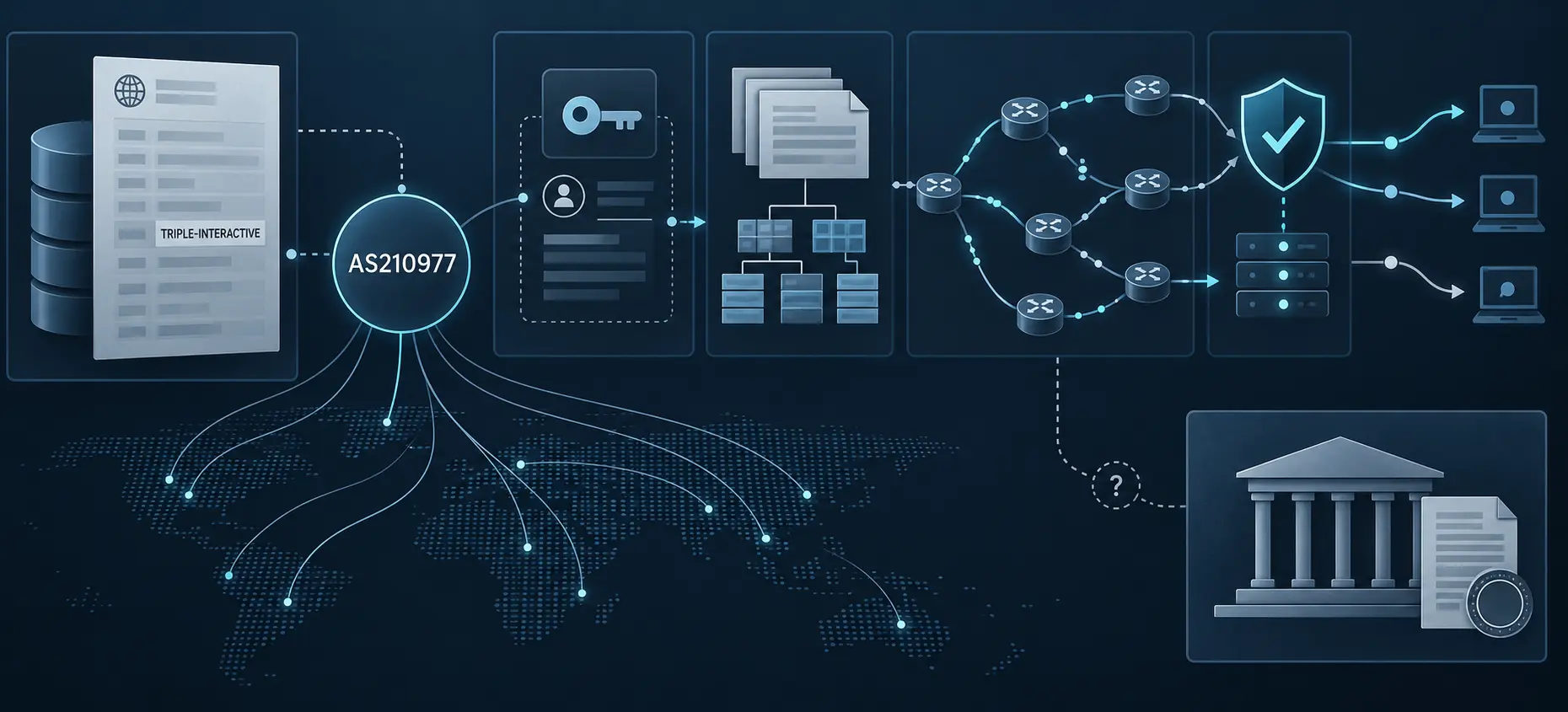
That distinction matters because an autonomous system number sits at the intersection of several systems that answer different questions. A registry object can describe an identifier. A maintainer can be authorized to change a database object. An Internet Routing Registry object can express an intended route origin. BGP collectors can observe announcements and paths. RPKI can record a route-origin authorization. None of those layers alone identifies the legal person responsible for every action associated with the number.
This investigation therefore treats AS210977 as a control-surface problem. Which instrument grants each power? Which actor is identified by that instrument? What is the scope of the power? And if the public record is wrong, who can challenge it and through which remedy?
The name is a registry field, not a legal conclusion
The starting point is the RIPE RDAP record for autonomous system 210977 and the corresponding RIPE Database aut-num object. Those records are the primary place to examine how the number is represented, which organisation references and contacts are attached, which maintainers protect the object, and when the record was created or modified. RIPE’s RDAP record for AS210977 and the native RIPE aut-num object can establish the contents and history of those registry fields at the time they are retrieved.
But “TRIPLE-INTERACTIVE” is an as-name: a registry identifier associated with the autonomous system. It should not automatically be converted into “the incorporated company Triple Interactive,” “the beneficial owner,” or “the network operator.” The record may reference an organisation, a maintainer, an administrative contact and a technical contact. Those roles can overlap, but public database semantics do not allow them to be collapsed without corroborating evidence.
This is a general governance problem, not a semantic technicality. Institutional legitimacy depends on traceable authority: an identifiable instrument, an identifiable actor and a defined scope. A name in an aut-num object supplies an important lead. It does not, by itself, supply the full chain.
The same caution applies to the number’s place in the global allocation system. IANA’s autonomous-system-number registry describes the regional registry delegation framework for number blocks. RIPE NCC’s delegated-resource statistics can provide assignment or delegation context. Neither source turns a regional allocation chain into evidence of a particular company’s incorporation, ownership or commercial contract.
Database authority is a distinct control layer
A maintainer reference answers a narrow but consequential question: which authenticated authority may create or modify protected database objects under the RIPE Database’s rules? RIPE’s documentation on protection of database objects explains why maintainer authorization matters and how it helps prevent unauthorized changes.
That authority is real, but bounded. The ability to modify a public registry object is not the same as the ability to configure a router, control an address block, sign a transit agreement or represent a legal entity. A maintainer can be a service provider, a sponsoring organisation, an administrative intermediary or another party with delegated database privileges. The public object must be read field by field rather than treated as a single ownership certificate.
This distinction also clarifies what a future dispute would involve. A party challenging an inaccurate database record might seek correction through database procedures. A party challenging an unauthorized route would face a different technical and institutional process. A party seeking contractual damages or corporate accountability would need yet another forum and evidence set. The public record reviewed here does not document a single remedy that resolves all three problems at once.
IRR intent is not the same as live routing
A RIPE inverse-origin query can identify route and route6 objects that declare AS210977 as an origin. The inverse-origin result is useful evidence of what has been entered into the RIPE Internet Routing Registry under its authentication rules.
It is not conclusive evidence that a prefix is currently visible in BGP. Nor does it prove address ownership, physical control of the announcing equipment or a paid commercial relationship. An authenticated route object records registry intent. It can help routers and network operators construct policy, and it can show which database authority was used. It does not itself show that the intended route was announced, accepted or reachable.
The difference is operationally important. A stale IRR object can outlive a route. A route can be visible without a corresponding object in the particular IRR source queried. The two records may corroborate one another, but they answer different questions.
BGP observations show activity, not legal identity
RIPEstat provides several ways to examine whether AS210977 has been visible in the routing system. Its AS Overview can report a holder label and an announced status at query time. Its announced-prefixes data can enumerate prefixes observed as originated by the ASN. Routing Status and Routing History can help distinguish current visibility from earlier observations. ASN-neighbour data can identify autonomous systems seen adjacent to AS210977 in collected paths. Routing Consistency can compare observed routes with registry information.
These are valuable signals, but they are observations made by particular collectors over particular time windows. A current “announced” result is not a permanent operational status. A first-seen or last-seen date is not proof of who configured the network at that moment. An adjacent ASN is not automatically a paid upstream, customer, peer or agent. Relationship labels displayed by third-party services are analytical classifications, not contractual documents.
Independent aggregators can provide useful corroboration. BGP.Tools’ view of AS210977 and Hurricane Electric’s BGP Toolkit view may show names, prefixes, neighbours and visibility from different collection and presentation systems. Agreement can strengthen the conclusion that a routing signal was publicly observable. Disagreement is not necessarily evidence of misconduct; it may reflect collector coverage, update latency, filtering or different observation windows.
The proper conclusion is therefore narrow: routing services can show what was observed, when and by which system. They cannot, without additional evidence, identify the person or company that exercised operational control.
RPKI adds authorization evidence, not a complete ownership chain
RPKI changes the evidentiary picture, but not the basic boundary. RIPEstat’s RPKI-by-origin data can identify route-origin authorizations or validated relationships associated with AS210977. A covering ROA can be stronger evidence that a certified resource holder authorized the ASN to originate a prefix than an unauthenticated announcement alone.
Yet a ROA authorizes a route origin. It does not prove that the ASN holder owns the prefix, operates the routers or is the same legal entity named in the aut-num object. It also does not establish the terms of any commercial arrangement between a resource holder and an operator. RPKI can narrow one uncertainty—whether a resource holder authorized an origin—without resolving the broader questions of identity, agency and accountability.
This is why the layers must remain separate. Registry naming, maintainer authorization, IRR intent, BGP observation and RPKI authorization each add information. None should be treated as a substitute for the others.
Directory and corporate searches are leads, not matches
A public member directory or corporate-name search can help locate a possible institutional counterpart. The RIPE NCC member directory may show whether a matching name appears as a member or Local Internet Registry. An OpenCorporates search for “Triple Interactive” may surface candidate entities and jurisdictions.
Neither result independently establishes that a candidate is connected to AS210977. A defensible match would require corroborating identifiers such as an organisation handle, registration number, address, website, officers or an explicit link from the RIPE organisation object. Names can be shared, traded under, changed or used by entities in different jurisdictions.
The absence of a public match is therefore also bounded. It does not prove that no legal entity exists, that the ASN is inactive or that no sponsoring relationship exists. It means that the reviewed public sources do not establish the match.
What the public record establishes—and what it leaves open
The evidence supports several bounded conclusions.
First, RIPE records associate AS210977 with the registry label TRIPLE-INTERACTIVE. Second, the RIPE Database and RDAP layers can show the object’s fields, references, maintainers and event dates. Third, IRR, RIPEstat, RPKI and independent BGP systems can provide distinct evidence about intended routing, observed announcements, path adjacency, historical visibility and route-origin authorization.
The evidence does not, by itself, establish the jurisdiction or incorporation of TRIPLE-INTERACTIVE, its beneficial owner, the current operational controller of AS210977, the complete sponsorship or contractual chain, or the remedy available to an affected party in every possible dispute. RIPE’s number-resource policy context explains the institutional basis and eligibility framework for autonomous-system-number assignment, but the public policy material does not disclose the specific current contract or signatories for this ASN.
That gap should not be inflated into an allegation. It is a finding about the visibility of authority. Public records can be technically rich while remaining legally incomplete.
The accountability question is procedural
For operators, the practical lesson is to avoid treating a registry label as a complete identity check. Before relying on an ASN as evidence of a counterparty, an operator may need to corroborate the organisation object, confirm relevant contacts through an independent channel, examine IRR and RPKI state, and distinguish current BGP observations from historical records.
For institutions, the question is whether the relevant challenge paths are legible. Who can correct an inaccurate aut-num field? Who can contest an allocation or sponsorship decision? Who can revoke or amend a route-origin authorization? Who can provide contractual or legal redress when the public record does not identify the responsible actor? These are different questions, and each requires a named process and a defined evidentiary threshold.
For researchers and journalists, the central discipline is not to choose between “the registry is authoritative” and “the registry is meaningless.” The registry is authoritative about what its protected object records. It is not automatically authoritative about facts outside that object’s institutional scope.
Conclusion: a map of authority, not a verdict on the operator
AS210977’s public footprint is best understood as a set of linked but non-identical records. TRIPLE-INTERACTIVE is a registry label. A maintainer is a database-change authority. An IRR object is a declaration of routing intent. BGP services record observations. RPKI can record authorization by a resource holder. A legal entity, beneficial owner, operator and contracting party remain separate propositions until the evidence connects them.
That separation is the article’s main finding. The public record can map several technical control surfaces around AS210977, but it does not disclose a complete identity and remedy chain. The responsible conclusion is consequently limited: the records establish association and signals, not the full legal or operational story.
Future verification should focus on the referenced RIPE organisation object, current maintainer and contact relationships, any sponsoring-LIR or assignment documentation, timestamped routing and RPKI responses, and an official corporate-register record that can be matched by more than name. Until those links are documented, the unanswered question is not whether the registry contains information. It is whether the information is sufficient to identify who can be held accountable for each layer of control.
Sources
- RIPE RDAP record for AS210977
- RIPE Database aut-num object
- RIPE inverse-origin search
- RIPE NCC delegated-resource statistics
- IANA autonomous-system-number registry
- RIPEstat AS Overview
- RIPEstat announced prefixes
- RIPEstat Routing Status
- RIPEstat Routing History
- RIPEstat ASN Neighbours
- RIPEstat AS Routing Consistency
- RIPEstat RPKI by Origin
- PeeringDB network lookup
- BGP.Tools AS210977
- Hurricane Electric BGP Toolkit
- RIPE NCC member directory
- OpenCorporates company search
- RIPE Database protection documentation
- RIPE autonomous-system-number policy
Member Briefing
Deeper Profile Context
Sign in with the right membership level to unlock the full briefing and source notes.
Only for Strategic Circle
Strategic Circle
Open to all readers. Unlock profile briefings after joining and signing in.
Join Strategic CircleOnly for Leadership Alliance
Leadership Alliance
For qualified IP-asset owners and management; sign in to unlock alliance briefings.
Join Leadership Alliance