
North America Institutional Trends
North America Institutional Trends
Institutional trend intelligence tracks institutional market trends, regulatory pressure, standards activity, public-sector digital policy, governance reform, and infrastructure funding in North America, giving readers a fuller view of the demand shifts, capacity constraints, platform strategies, capital timing, regulatory pressure, and operating assumptions behind the market.

Latest Coverage
Latest from North America Institutional Trends
314 articles

North America Institutional
The Coast Guard grades the world's fleets with a number no row of its table contains
Liberia's row prints 1,553 examinations, 20 detentions and a 2023-2025 detention ratio of 1.44 per cent. Those two numbers divide to 1.29. The verdict is three years long, the operands are one year long, and the Coast Guard joins them only for the whole world.

North America Institutional
The $1,000 question has two boxes and no number
Texas decides whether a crash exists on paper by asking one police officer an opinion about money, and by giving it nowhere to write a figure. The driver's own version of that report was repealed nine years ago. The reports that come back for a wrong answer go into a return loop…

North America Institutional
A derailment that costs $12,600 exactly does not count
The American railroad admits an accident to its national count only when the damage clears a dollar line, and that line is re-priced every year from railway wages and an equipment index. Union Pacific prints the resulting rate to one decimal place and publishes neither of the…

North America Institutional
Ninety days from a day nobody wrote down
The National Transportation Safety Board publishes the finding, the addressee's answer and its own grade on the answer. The clock that makes the answer compulsory starts on a date its database has no field for.

North America Institutional
Verisign raised the .com fee on 1 November. The revenue will not arrive with it.
On 1 November 2026 the wholesale price of a .com name went from $10.26 to $10.97. Verisign's quarterly report, filed twelve days earlier, could not show it, and its next one will show only part of it — because a registry sells a year at a time and books the money across the year…

North America Institutional
Micron sells bits. Nine documents, and not one prints how many.
Micron's fiscal 2026 Form 10-K explains a $100.68 billion DRAM year in a single sentence: prices up, bits up, sales up 252%. Multiply those two percentages and the printed dollar ratio comes back to within two-thirds of one percent. Divide either one by the other and you get a…
North America Institutional
The machine has 133 qubits. The score is measured on 100 of them.
Every performance figure IBM prints today for a quantum processor is cut to a 100-qubit profile, or to a 100-by-100 circuit, while the devices in its own benchmark paper carry 127 and 133 qubits — and the metric this replaced measured a square whose width equalled its depth.…
North America Institutional
The percentage is on a fact sheet, the cap in a court filing, the count in a 2019 slide
Qualcomm's fiscal 2025 annual report prints $5,582 million of licensing revenue and the royalty formula in the same paragraph, then stops: no rate, no cap value, no device count. Each of the three sits in another document, and the divisor that would make the total recomputable…

North America Institutional
Broadcom's AI number balances to the dollar. Ask it what it counts.
On 2 September 2026 Broadcom said its AI semiconductor revenue reached $16.7 billion in the quarter ended 2 August and would climb to $21.7 billion in the next one. Fifteen documents published around that sentence — three quarterly earnings releases, the Form 8-K that furnishes…
North America Institutional
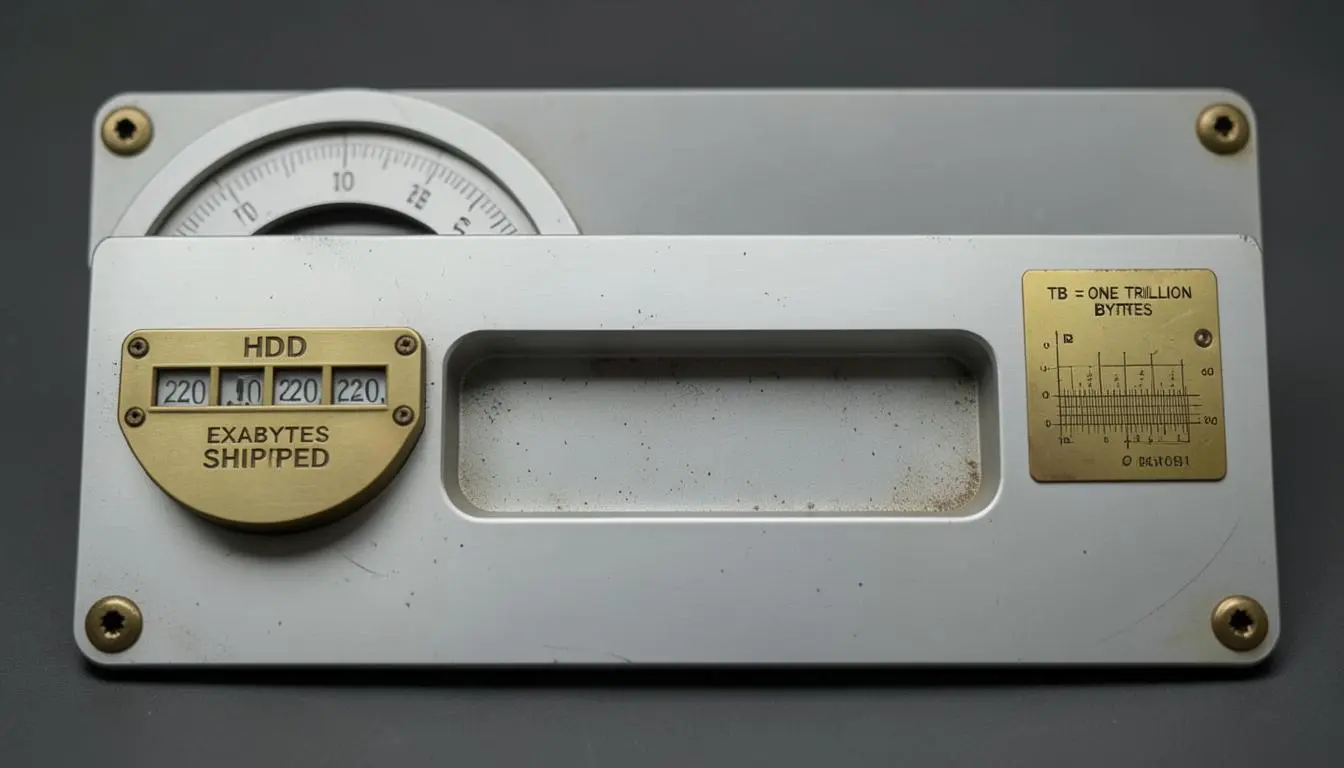
Seagate's 220 exabytes have no denominator, and the calculator is yours
Seagate tells a buyer to the byte what a terabyte is. It then tells a shareholder that it shipped 220 exabytes of HDD capacity in a quarter, without naming which exabyte, counting the drives, or printing an average capacity per drive. The multiplier between those two published…

North America Institutional
Dominion prices the 30-minute peak its own forecast never bills
Virginia Electric and Power Company now defines its largest customers by a monthly half-hour maximum and a floor on the kVA of the facilities built to serve them. Its own filings to PJM compute a data-centre billing peak, then convert it into a coincident system peak, and no…

North America Institutional
Eighteen ways to qualify for a .ca name, and nobody named to change the list
Ask a registry a plain question and you find out what it thinks a rule is. For .ca the question is this: holding only what the Canadian Internet Registration Authority publishes, can a stranger decide whether a given applicant was allowed to hold a name — and what the registry's…

North America Institutional
SFMIX prices the port, then lets a note price the bundle
San Francisco's member-owned exchange prints an annual fee for three port speeds and, in the same table, a note permitting four ports in one LAG. Read one way 40 Gbit/s costs $2,995 a year; read the other, $11,980. The page does not choose, the minutes that set the rates do not…

North America Institutional
The .org ceiling was a 1.10 multiplier. In 2019 the staff removed it without a vote.
Section 7.3(a) of the 2013 .org agreement printed a maximum service fee and a multiplier anyone could work with. The agreement entered into on 30 June 2019 prints a notice clock and a registrar renewal window instead. Everything between those two clauses has a date, and the last…

North America Institutional
The .com ceiling has two multipliers and one number nobody prints
On 1 November 2026 the wholesale fee for a .com name becomes US$10.97 for each annual increment of an initial or renewal registration and for each transfer between registrars. Every document that authorises that figure is published. The figure that finishes the arithmetic is not.

North America Institutional
CISA's KEV catalog prints the deadline in twelve fields and the ending in none
Every entry in the Known Exploited Vulnerabilities catalog carries a remediation instruction and a due date. What the record never carries is a way for an entry to say how it ended.
North America Institutional
The FCC publishes the outage share and withholds the guest list
A Tennessee county row in the Commission's own daily disaster report reads 0.8%. The cell sites inside that percentage are the ones a provider chose to describe. The rest of the network is not a number in the file — and on the same reading day, the Commission's DIRS page still…
North America Institutional
ARIN fulfilled 483 requests from 577 blocks. No unit joins them.
On 7 October 2026 ARIN cleared its IPv4 waiting list again and printed two numbers in one sentence. One counts requests. The other counts blocks. The notice never says what a block is, and six weeks later a policy proposal arrived that exists precisely because those blocks cannot…
North America Institutional
Seattle Internet Exchange's price list multiplies to $2,060,800; its accounts show $303,525
One number is a stock of one-time port fees across every installed port the exchange prints. The other is a year of total income from the exchange's own cash-basis management statement, published 13 April 2026. Both are SIX's own arithmetic, and neither one confirms the other.

North America Institutional
NVD Counts the Queue to the Record and Never Dates the Wait
The National Vulnerability Database grades every vulnerability record and prints the grade in a word. Read its definitions, its dashboard and its API documentation side by side and the same seven states appear under thirteen different names, a total that reconciles to the record…