Summary
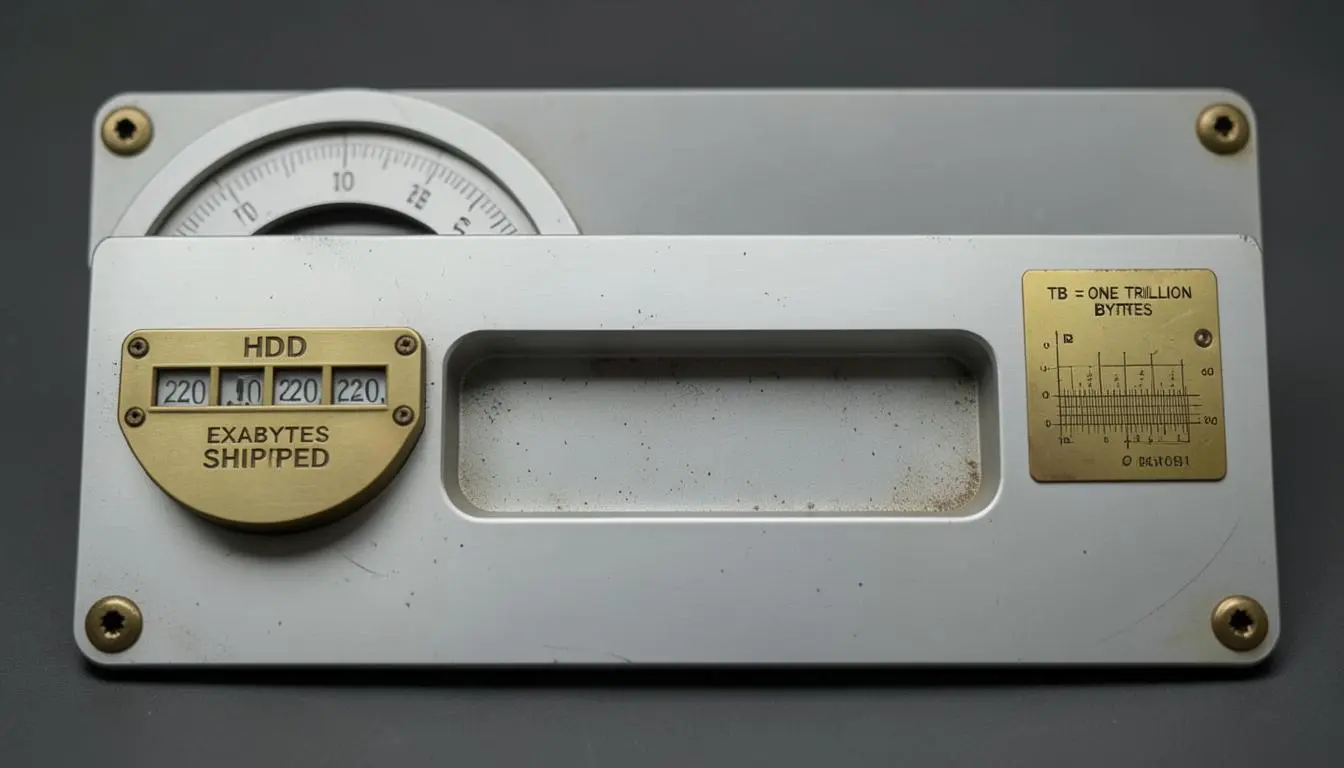
- Seagate's Form 10-Q for the quarterly period ended 2 October 2026 prints 220 exabytes of HDD capacity shipped, split 198 nearline and 22 non-nearline, in a table whose only footnote attaches to the geography rows.
- Its buyer-facing documents fix the noun precisely: the Exos M data sheet says one terabyte equals one trillion bytes and that formatting and other functions consume some of the listed capacity, and the product manual heads its capacity table "Formatted capacity".
- Across the twelve documents read on 24 November 2026, none states the byte convention of the shipment aggregate or prints a drive count for the quarter, so converting 220 exabytes into units means dividing by a capacity the reader picks: about 6.9 million drives at the printed 32 TB, about 9.2 million at 24 TB. That band is my arithmetic, not a Seagate figure.
The sentence sits in the filing's opening summary and is unambiguous about everything except the unit: "During the September 2026 quarter, we shipped 220 exabytes of HDD storage capacity" (Form 10-Q for the period ended 2 October 2026).
Deeper in, the revenue discussion introduces a single table with the words "The following table summarizes information regarding consolidated revenues by channel, geography, and market and HDD exabytes shipped:". Under HDD Exabytes Shipped the rows read nearline 198, 195, 160; non-nearline 22, 23, 22; total 220, 218, 182, for the three months ended 2 October 2026, 3 July 2026 and 3 October 2025 respectively.
The table carries exactly one footnote — "(1) Revenue is attributed to geography based on the bill from location" — and it belongs to the geography rows. The exabyte rows stand inside the same table without a qualifier of their own. In the retrieved text, no sentence says whether an exabyte here is 10^18 bytes or 2^60, and no sentence defines nearline or non-nearline.
What the buyer is told, to the byte
Set the two sides beside each other and the asymmetry stops being a subtlety. It is a policy.
The Exos M data sheet, DS2045.4-2504US, prints capacities of 32, 30, 28 and 24 TB and adds: "When referring to drive capacity, one gigabyte, or GB, equals one billion bytes and one terabyte, or TB, equals one trillion bytes. Your computer's operating system may use a different standard of measurement and report a lower capacity. In addition, some of the listed capacity is used for formatting and other functions, and thus will not be available for data storage." (Exos M data sheet).
The SATA product manual for the same family, 210048100 Rev D dated 2025-08, repeats that footnote, adds "Actual quantities will vary based on various factors, including file size, file format, features and application software.", and heads its capacity table "Formatted capacity" with entries labelled "Formatted (512 bytes/sector)" (Exos M SATA product manual).
And the support knowledge base names the fork in the road: "there are two different number systems which are used to express units of storage capacity; binary, which says that a kilobyte is equal to 1024 bytes, and decimal, which says that a KB is equal to 1000 bytes. The storage industry standard is to display capacity in decimal." (Storage capacity measurement standards).
A buyer therefore holds three things a shareholder does not: a decimal definition, a warning that the headline number is not all host-visible, and a rule that explains why the operating system reports something smaller.
What the shareholder is given
The filing's aggregate arrives with none of that. The earnings release of 27 October 2026 does not fill the gap either: its retrieved text reports revenue of $4,233 million against $2,629 million a year earlier, GAAP gross margin of 57.3% (57.8% non-GAAP), diluted EPS of $7.59, net income of $1,761 million and second-quarter guidance of $4.8 billion plus or minus $100 million, refers to exabyte demand only qualitatively, carries no shipment figure and no unit count, and points readers to a separate Supplemental Financial Information document (earnings release).
That document, at the exact URL on 24 November 2026, returned no readable text, so I do not quote it. Third-party transcriptions of the deck report a slide-6 row of 220 total and 198 nearline, and a slide-6 footnote that defines Data Center and Edge IoT rather than the exabyte (one transcription, a second). Those are transcriptions, not Seagate's filed language, and this piece treats them that way.
The division nobody printed
If a reader wants drives, the reader chooses a capacity and does the work. At the four printed Exos M CMR capacities, 220 exabytes works out to roughly 6.9 million drives at 32 TB, 7.3 million at 30 TB, 7.9 million at 28 TB and 9.2 million at 24 TB — a band of about 6.9 million to about 9.2 million, mine from end to end, printed by no document I read.
The noun is a second unwritten choice. Decimal and binary exabytes differ: 2^60 divided by 10^18 is 1.1529, so a binary exabyte holds about 15.3% more bytes, and that figure is again my arithmetic rather than a disclosure. The same printed 220 exabytes therefore denotes two byte totals about fifteen percent apart, and the record I read never says which one the aggregate counts.
Two cautions keep this honest. The printed per-drive capacities are not usable capacity: the buyer-facing documents say formatting and other functions consume part of what is listed. And the band is a sensitivity, never a shipment estimate — it says what arithmetic produces under an assumed capacity, not what Seagate produced.
Two shares, two bases
The filing prints 81% Data Center and 19% Edge IoT as shares of revenue. Nearline's 198 of 220 is 90.0% of shipped capacity — my division, on the filing's own rows. Same company, same quarter, different denominators: dollars on one side, bytes on the other. They should not be substituted for each other, and a mix story told in exabytes is not the mix story the income statement tells.
What can be subtracted safely is a row against itself: 220 minus 182 is 38 exabytes added year over year, because both cells are the same metric in the same table.
And the quotient that looks like a price is not one: 4,233 divided by 220 is about $19.2 million of recognised revenue per printed exabyte. The numerator is money booked, the denominator is capacity shipped, and no reviewed document says the two cover the same transactions. No document I read states a price per terabyte at all.
Why the drive count left the building
Seagate has explained the reporting shift, in a third-party quotation: "As demand has transitioned away from unit centric markets (i.e. consumer, client) and towards cloud data centers, customer focus has centered on exabytes with selling motion conducted on a per TB (vs per unit) basis among these large players. This has been the impetus for providing exabyte vs unit metrics which aligns with our nearest competitor disclosure (also absent units)." That is Forbes quoting the company on 5 November 2025 (Forbes); I did not inspect the underlying statement.
The closest thing to a unit figure in the record is a subset: on the year-earlier earnings call, per a third-party transcript, Seagate said it "shipped over 1,000,000 Mosaic drives in September" (FQ1 FY2026 call transcript). Mosaic drives are one HAMR family, in a different quarter, and cannot be divided into 182 exabytes to produce an average. On the most recent call the same transcript service records "we shipped a record 198 exabytes nearline capacity into data center customers", with no unit count and no average capacity per drive (FQ1 FY2027 call transcript).
What this is, and what it is not
This is a documentation finding. The precision sits on the side where a customer can test it; the bare aggregate sits on the side where an owner has to assume it. Definition control above, verification burden below.
Nothing here says the 220 is wrong, that any disclosure is improper, or that the arrangement was chosen for a reason. The record carries no motive, and I am not inventing one. It carries something narrower and more useful: a fleet total, a unit capacity, and no printed multiplier between them.
What I read on 24 November 2026
Twelve documents, listed so the scope of every absence above is checkable: the Form 10-Q, the earnings release, the Supplemental Financial Information PDF that produced no readable text, two transcriptions of that deck, the FQ1 FY2027 call transcript, the Exos M data sheet, the Exos M SATA product manual, the capacity measurement support page, the press-resources page whose "Produced 550EB of Storage in 2024" line belongs neither to the filing nor to the shipment metric, the FQ1 FY2026 call transcript and the Forbes article. Seagate Technology is tracked in the BTW directory.
220 exabytes is not the problem. The missing denominator is, because everyone who quotes the number supplies his own — and then treats the result as if the company had printed it.
Member Briefing
Read the full trend briefing
Members read the full briefing with the source notes behind every finding.
Strategic Circle
A daily briefing in your language, built from changes we have verified.
Join for USD 20/monthCancel anytime.
Members also get the full research library, a daily briefing on the networks they follow and the private forum.