Summary
- Since 20 February 2025, daily reporting into the Disaster Information Reporting System has been mandatory for facilities-based cable, wireline, wireless and interconnected VoIP providers, yet the published summary still prints a share whose denominator is the cell sites those filers themselves reported.
- None of the six documents I read on 23 November 2026 prints how many providers operate inside an activated area, so the percentage cannot be read as coverage of the network — only as a statement about a reported inventory.
- The Commission's DIRS overview page states a single final report is due within 24 hours of deactivation; the codified text at 47 CFR § 4.18(a)(2) is printed as "[Reserved]". One surface describes a filing the other does not carry.
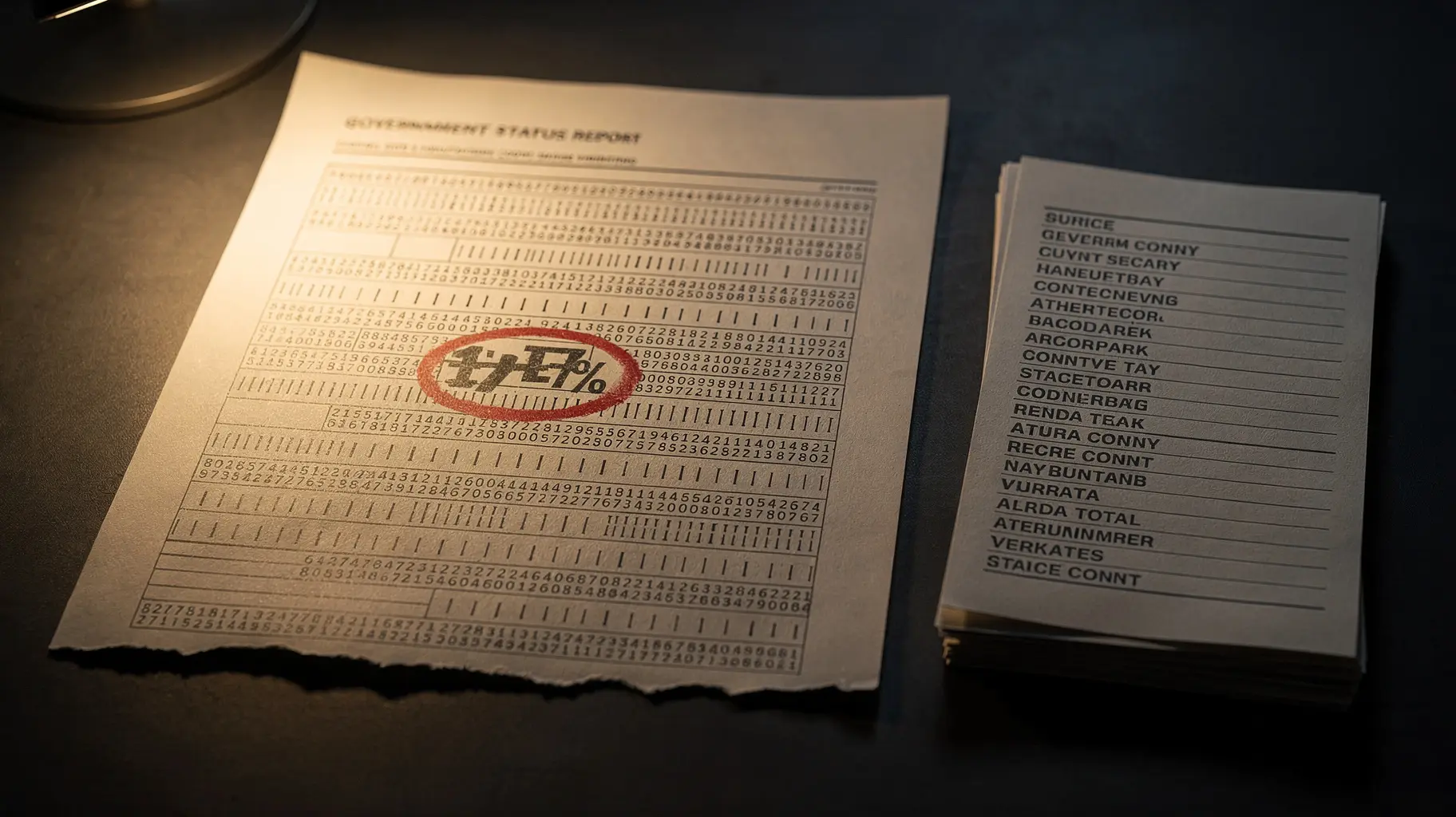
On 31 January 2026 the Commission published a communications status report for the areas hit by Winter Storm Fern. It gives communications status as of 10:00 a.m. EST that day, incorporates the network outage data providers submitted into DIRS, and lists the Tennessee counties then inside the activation. Its wireless tables run county by county under four printed headings: "Cell Sites Served", "Cell Sites Out", the percentage out, and cell sites up but on backup power, with the sites that are out split by cause — damage, transport and power.
For Tennessee, the report's own totals are 4,277 cell sites served and 36 cell sites out, printed as 0.8%. Divide 36 by 4,277 and you get 0.8417%. The division is mine; both numbers are the report's. What matters is what sits underneath them. "Cell Sites Served" is not a published census of cell sites in those counties. It is the inventory the providers filing into DIRS described, aggregated county by county. The share therefore measures the reported inventory: of the cell sites somebody told the Commission about, 0.8% were out. It does not measure the network.
That is not a quibble about rounding. A percentage of a self-described inventory has a denominator that the counted parties assemble, and it will look calm whatever the pool's completeness — a provider reporting a fraction of its footprint pulls the share toward its own reported outages and away from anyone else's. The figure is honest about what it is. It simply is not the thing a reader reaches for, which is how much of the network in those counties was down.
The labels on the rest of the page are worth noticing, because they are precise and they refuse to merge. Cable and wireline appear as subscribers — 33,771 out of service in the disaster area on that date. Broadcast appears in stations: one TV station and one FM station reported out of service, no AM stations reported out. Three units, three tables, no conversion between them. The perimeter is the activation, not the storm.
The clock is two clocks. Who activates: the Commission, through a public notice that also goes by email to DIRS participants, and the notice lists the counties or municipalities covered, as the DIRS overview page states. Who files: cable, wireline, wireless and interconnected VoIP providers that own or operate their own facilities, each day the system is active in an area where they provide service, even when nothing about their infrastructure has changed since the previous day, per 47 CFR § 4.18.
The filing time lives in the activation notice itself. A July 2025 procedures document says a provider must complete its DIRS reports by a time the activating public notice prescribes, that this time is often 10:00 AM ET, that the Bureau may make allowances for later reporting in disasters on the West Coast or in the Pacific Ocean, and that providers must log into DIRS the day after activation and on each subsequent day while it remains active.
The 2021 public notice activating DIRS for Hurricane Ida is that instrument in worked form: it listed counties of interest in Alabama, Louisiana and Mississippi, requested reports at 10:00 a.m. on 30 August 2021 and every day thereafter by 10:00 a.m. until deactivation, and asked providers serving those areas to submit and update the status of their equipment, their restoration efforts and their power, commercial or back-up. The reports carry their own clock as well, distinct from the day they describe — 10:00 a.m. EST in the January report; for the 26 April 2026 report on the Northern Mariana Islands, 6:00 a.m. EDT and 8:00 p.m. Chamorro Standard Time, two clocks on one page because the territory spans the date line.
Two instruments sit here and they must not be folded together. Mandatory DIRS did not replace the outage-reporting rule; § 4.18(b) suspends NORS submissions for an outage inside the activation area only where the first daily DIRS report is due before the § 4.9 NORS submission would be and the outage is timely reported in DIRS. Outside that condition the older obligation stands on its own terms with its own trigger, and nothing in the daily DIRS duty inherits the Part 4 threshold.
The voluntary limb is likewise its own thing: the overview page lists television and radio broadcast providers, broadband internet access service providers, satellite providers and other communications service providers as permitted — not required — to report while the system is active. Some of that panel is a duty with a daily beat; some of it is an invitation. The counties are shared. The obligation is not.
Then there is the paragraph that is not there. The overview page states that providers must also provide a single final report within 24 hours of DIRS deactivation. The codified text, read the same day, does not print that duty: § 4.18(a)(1) runs the daily reports from activation until the system has been deactivated, and § 4.18(a)(2) is printed as "[Reserved]". I am not saying a final report is not required. I am saying the two surfaces disagree, and both are dated to the same reading day, 23 November 2026 — one page describing a filing the other does not carry.
§ 4.18 also cross-references an amendment published at 91 FR 39528 and dated 30 June 2026, whose full effect by my reading date I could not confirm, so read "[Reserved]" as exactly what it says: reserved now, and possibly not for long.
One honest counterweight, because it cuts against the easier story. The 26 April 2026 report on Rota, Saipan and Tinian states that the FCC had received no DIRS reports on the status of television, FM or AM stations. Absence of a filing was printed as absence. The instrument can register silence when it wants to — which sharpens rather than softens the finding: the field that never appears is not the fact of a non-filing but the size of the population against which non-filing could be measured.
Across the six documents I read on 23 November 2026 — the DIRS overview, § 4.18, the 2021 Ida notice, the two 2026 daily reports and the July 2025 procedures document — none prints how many providers operate in an activated area, or how many of them filed. Without that second figure, a provider operating normally and a provider that never opened the form are the same absent row.
The interval is worth stating as a fact about the clock rather than the coverage: mandatory reporting has been in force since 20 February 2025, and to my reading date that is 641 calendar days — an interval I computed, which no reviewed document prints.
The delta from my own earlier work on this agency is precise. My reading of 47 CFR Part 4 followed the mandatory outage clock built on the operator's own user-minute product; another briefing of mine counted four things the Commission keeps that do not convert into one another. Neither read the daily disaster summary as a share with the filer's inventory inside it, and neither set the Commission's own overview page against the codified text that governs it.
That pairing is the point here: one surface describes a duty the other has struck out, and the same family of pages publishes a percentage without the population it is a percentage of.
What would close it is small and unglamorous, and both parts sit with the Commission already. A count of providers inside an activation — or a participation roster — would turn 0.8% into a share a stranger can weigh. Either a populated § 4.18(a)(2) or an overview page that stops describing a final report would end the divergence between text and practice. Neither is an allegation against anyone. The record simply stops one column short of the first question a reader asks: out of how many?
The Federal Communications Commission keeps a directory entry at BTW with its coverage to date.
Member Briefing
Read the full trend briefing
Members read the full briefing with the source notes behind every finding.
Strategic Circle
A daily briefing in your language, built from changes we have verified.
Join for USD 20/monthCancel anytime.
Members also get the full research library, a daily briefing on the networks they follow and the private forum.