
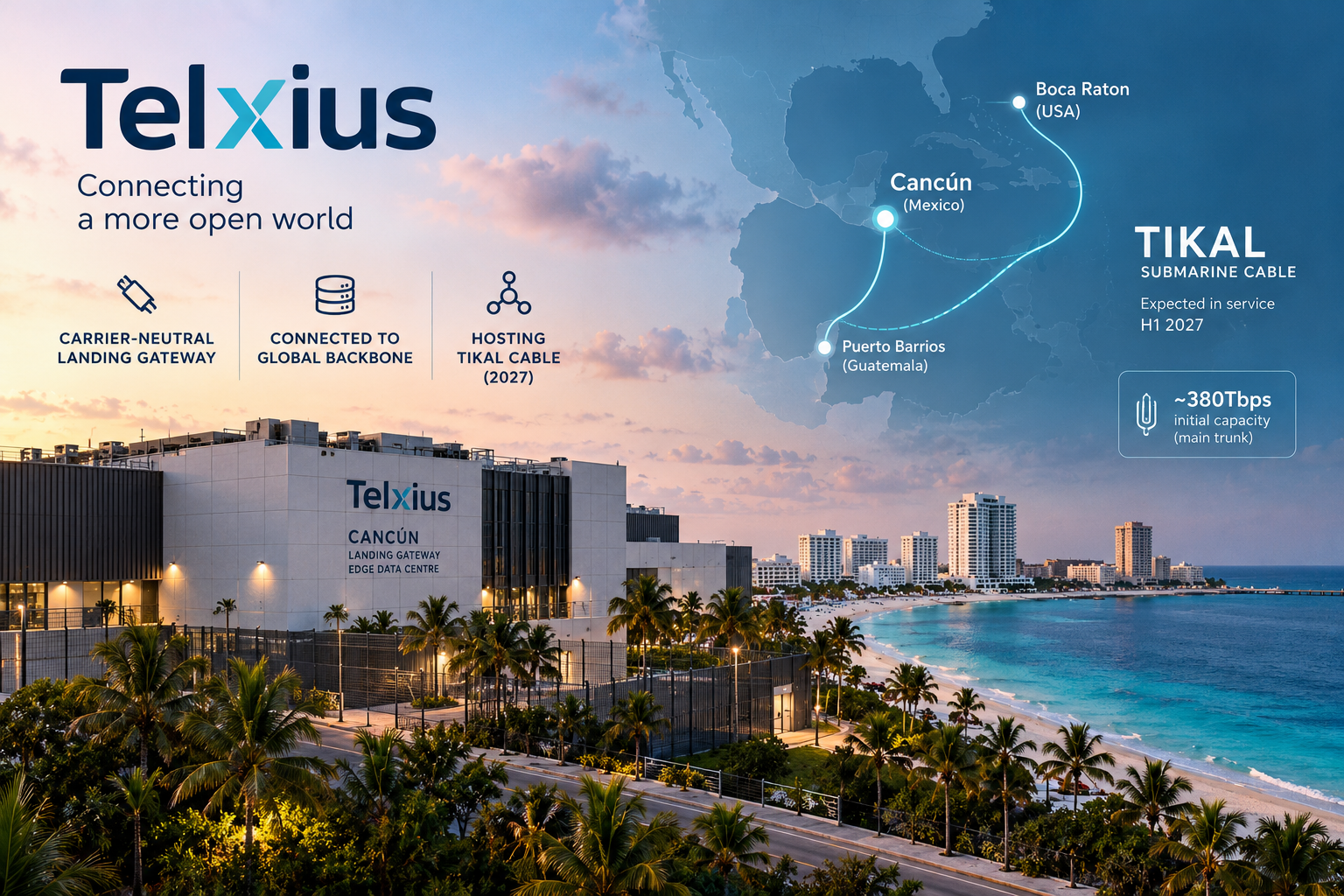
- Telxius says its carrier-neutral Cancún gateway is already connected to its global backbone and provides an alternative route towards Querétaro
- Tikal is expected to enter service in the first half of 2027, giving the facility separate current and future connectivity stages
The fact
Telxius said on 3 September that it had built a carrier-neutral landing gateway and edge data centre in Cancún, Mexico, and that the facility was ready to support customers. The site is connected to Telxius's existing global backbone and offers an alternative route towards Santiago de Querétaro.
The facility is also planned as the Mexican landing point for Tikal, the submarine cable connecting Puerto Barrios in Guatemala with Boca Raton in Florida. Telxius and América Móvil are developing the main system together, while Telxius has previously said the Cancún extension is its own project.
Telxius expects Tikal to enter service in the first half of 2027. Its September announcement estimates 380Tbps of initial capacity on the main trunk. A separate Telxius Tikal page currently lists 190Tbps, so the 380Tbps figure should be treated as the specification given in the latest announcement rather than capacity already available through Cancún.
The assessment
Customers should treat the opening of the Cancún facility and the arrival of Tikal as two separate milestones. Telxius says the site is already connected to its existing backbone, so carriers, content providers and other customers can use services there without waiting for the new submarine cable.
Tikal adds a different route later. Customers whose network plans specifically depend on the new submarine connection still need the cable to enter service and need details on the capacity, ports, and commercial services available through the Cancún branch. Existing backbone connectivity does not mean Tikal capacity is already available.
For BTW readers, the new gateway has an immediate role through Telxius's current network, while Tikal remains a separate 2027 dependency. Buyers can deploy earlier if existing routes meet their requirements, but any service designed around the new submarine path still depends on the cable becoming operational.
What to watch
Watch for the first customer deployments at the Cancún facility and for Telxius to confirm Tikal's ready-for-service date. Commercial details for the Mexican branch, including available capacity and routes, will show what the new cable adds beyond the existing backbone. Telxius may also need to reconcile its currently published 190Tbps and 380Tbps main-trunk capacity figures.
Member Briefing
Deeper Profile Context
Sign in with the right membership level to unlock the full briefing and source notes.
Only for Strategic Circle
Strategic Circle
Open to all readers. Unlock profile briefings after joining and signing in.
Join Strategic CircleOnly for Leadership Alliance
Leadership Alliance
For qualified IP-asset owners and management; sign in to unlock alliance briefings.
Join Leadership Alliance