
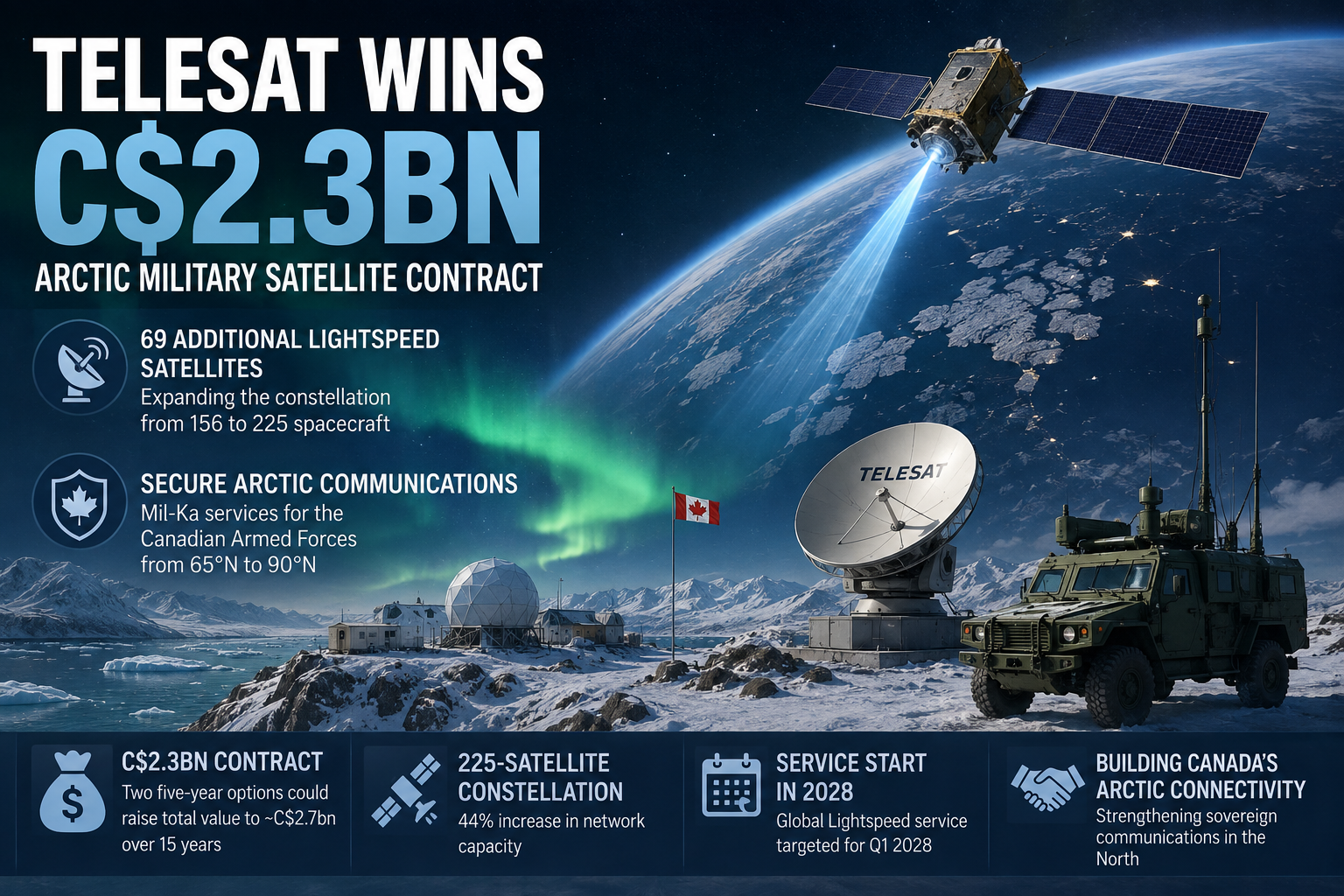
- The contract includes two five-year options that could raise its total value to about C$2.7 billion over 15 years
- Canada will fund 69 additional Lightspeed satellites, expanding the planned constellation from 156 to 225 spacecraft
The fact
Canada's Defence Investment Agency awarded Telesat LEO ULC an initial C$2.3 billion contract on 4 August to provide secure Military Ka-band satellite communications for the Canadian Armed Forces in the Arctic. The contract includes two five-year options worth about C$214 million and C$218 million. Service is due to begin in 2028 and will cover latitudes from 65 to 90 degrees north under the Enhanced Satellite Communications Project – Polar.
The contract will fund 69 additional Lightspeed satellites, increasing the constellation from 156 already in production to 225. The new spacecraft will carry both commercial and military capacity and will be built by MDA Space. Canada will fund the expansion through milestone payments beginning in the third quarter of 2026. SpaceX will provide Falcon 9 launches, with one additional rocket still subject to a launch-services agreement. Terminals, ground and control infrastructure, training and support will be covered separately. Telesat's global service target remains the first quarter of 2028.
The assessment
Canada's contract increases the size of the network Telesat is building, not just its customer base. It funds 69 additional satellites that Telesat says will carry both commercial and military capacity. The defence programme is therefore financing infrastructure that will also form part of the wider Lightspeed network.
The additional satellites must still be built, launched and integrated before that capacity becomes available. MDA Space will manufacture them, SpaceX will provide the launches, while terminals, ground infrastructure and control systems will be covered under a separate agreement. Canada will fund the expansion through milestone payments tied to delivery.
For BTW readers, the contract gives Telesat funding for a larger Lightspeed network while its Q1 2028 global service target remains unchanged. Satellite production, launches and ground-system delivery will show whether the additional capacity can be brought into service without affecting that timetable.
What to watch
Watch MDA Space’s production of the additional satellites, Falcon 9 launch arrangements and the separate agreement covering terminals, ground infrastructure and control systems. Progress in spacecraft completion, launches and ground-system commissioning will indicate whether Telesat remains on track for service in 2028. Any change to its Q1 2028 global service target would point to pressure on the delivery schedule.