Summary
- Telegarden opened in June 1995, letting web users tend real plants through an industrial robot arm.
- Planting and watering came with membership rules and recorded activity; returning gardeners also used the chatroom to ask for holiday watering.
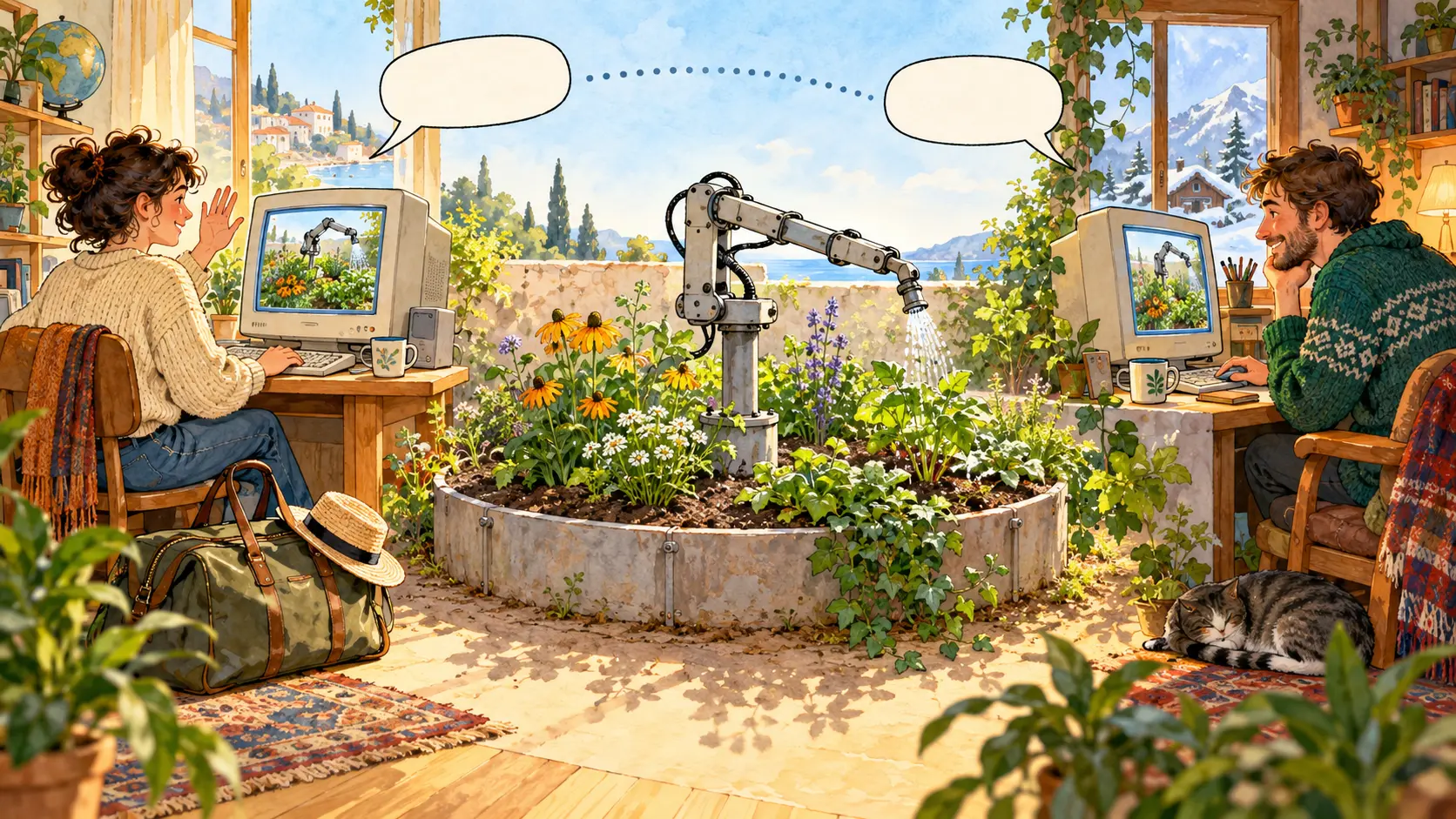
The plants were reachable over the internet. They still needed somebody to look after them while their gardener went on holiday.
Ken Goldberg recalled those requests in a 2014 account of Telegarden: people used its chatroom to ask others to water their plants while they were away. An ambitious experiment in remote robotics had acquired a familiar neighbourhood chore.
Telegarden, co-directed by Goldberg and Joseph Santarromana, put living seedlings under the care of web users. The project's own history dates its launch at University of Southern California to June 1995. An industrial arm let participants plant, water and watch growth at a distance. The soil occupied one place; the people tending it could be far apart.
Watching was easy. Watering made you a neighbour.
Goldberg's 1996 text for Ars Electronica set out a distinction between spectators and gardeners. Anyone could look as a guest. Planting and watering rights went to members who agreed to share their email addresses with the cooperative's other members.
That condition gave the people changing the garden a way to reach one another. Their activity was also recorded in logs, which the project described as a means of supporting self-government. A click had company: other people had an interest in the same patch of soil.
The document was wonderfully plain about the physical side. Equipment broke. Insects appeared. Some plants died for lack of water. Moving the controls onto a website left the horticulture intact. The garden had no particular respect for the glamour of being online.
Those details explain why the holiday requests matter. An interface could transmit a command; it could not make an absent member remember the next day's watering. The chatroom allowed a person to hand that responsibility to another person.
The installation needed a home
In September 1996, Telegarden moved to Ars Electronica Center in Austria, where it stayed online until August 2004. The museum's 2021 retrospective describes two cameras, a robot able to place seeds in soil and users responsible for daily watering. It also recalls members meeting in person in Linz.
The machine made distant action possible. The installation's host supplied a physical place for it, and the gardeners supplied repeated attention. Shared contact details and visible activity were small pieces of that arrangement, but they sat close to the practical question: who would do the next bit of work?
Goldberg's later account also recalls an overgrown garden. More participation could mean more living material in the same finite space. Growth was both the attraction and another thing to manage.
Telegarden gave the early Web something unusually concrete to share. A visitor could close a browser and leave the room. Somewhere else, the plant remained in its soil, waiting for the next gardener.
Member Briefing
Deeper Profile Context
Sign in with the right membership level to unlock the full briefing and source notes.
Only for Strategic Circle
Strategic Circle
Open to all readers. Unlock profile briefings after joining and signing in.
Join Strategic CircleOnly for Leadership Alliance
Leadership Alliance
For qualified IP-asset owners and management; sign in to unlock alliance briefings.
Join Leadership Alliance