
Summary
- Telcomnet is not a paper reseller. Its own service pages, RIPE records and public routing views point to a Moscow operator with business internet, telephony, data-centre, telehousing and public-sector connectivity offers, backed by AS33904, a small IPv4 footprint, Moscow contact infrastructure and evidence of repeated maintenance on core IP and central-node equipment. That gives it a defensible local operating surface, especially where building access, local support and telephone-number continuity matter more than national advertising.
- The harder question is contribution. Public accounts show a company with material but not large revenue, thin net profit, a small workforce, public-sector contract exposure, regulated communications licences, upstream and facilities dependencies, and a Russian equipment market made more awkward by sanctions and vendor withdrawals. The judgment is that Telcomnet can remain economically relevant if recurring access and voice invoices are priced to include renewal capital, but its public evidence does not yet prove that the installed base throws off enough surplus to fund the next equipment cycle without supplier credit, owner tolerance or selective customer repricing.
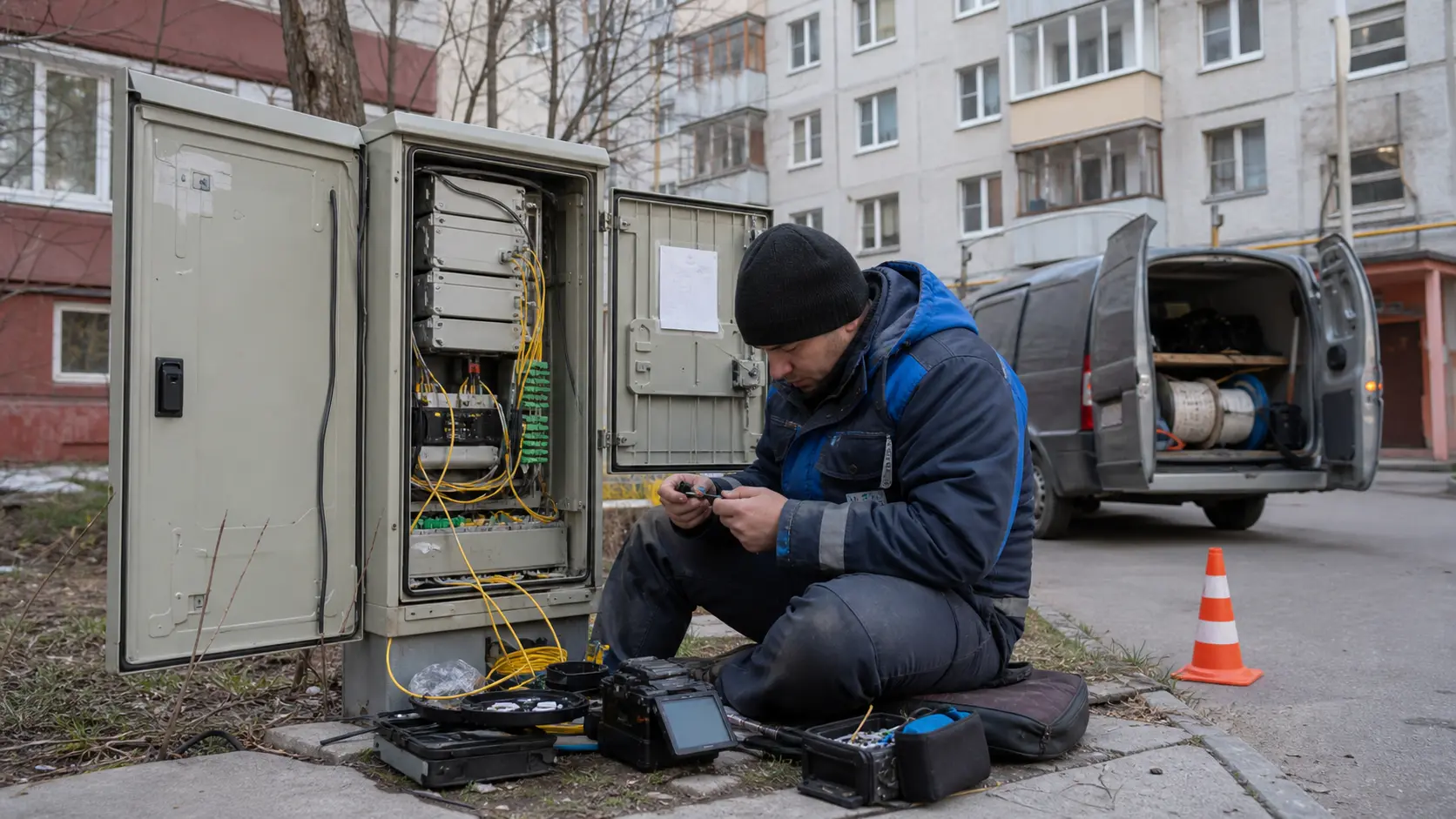
Begin with one active port, not with the company logo. A live Telcomnet port in a Moscow business centre, public institution or suburban settlement has to carry more than packets. It has to carry the cost of the fibre or copper path into the building, the access switch, the upstream blend, the telephone platform if the customer takes voice, the support queue, the installer, the bill collector, the regulatory storage burden and the reserve for replacement equipment. The customer sees one monthly service charge and, in many cases, a bundle of internet access, local telephone numbers, intercity calling, virtual PBX functions or hosting.
The operator sees a stack of costs that arrive on different clocks. Transit and facility charges arrive monthly. Support labour arrives every shift. Regulatory equipment and storage arrive in chunks. Core routers, switches, optical modules, power systems and software maintenance arrive in cycles. The economic test is whether enough cash remains after ordinary service costs to finance those chunks before customer churn, equipment age or regulatory pressure forces the issue.
That is why Telcomnet is a useful case. The public record does not present a polished national carrier. It presents a regional Moscow operator with a real autonomous system, a small but visible address base, public communications licences, a website aimed at companies and institutions, and a set of accounts that show growth but low final profitability. The facts are narrow, but they are not empty. Telcomnet describes itself as a communications operator in Moscow and Moscow Oblast, serving business centres, settlements, public institutions, management companies and medium or large business customers.
It offers internet, telephony, television and data-centre services. Its history page widens the offer to traditional telephony, broadband internet, private corporate networks, channels, hotspots, IP telephony, colocation, hosting and system integration. That range is exactly the range that can make a regional ISP durable: the customer does not merely buy raw bandwidth; the customer buys a local communications stack and someone who can enter the building when the stack fails.
The danger is that this same range can flatter the economics. A broad service menu does not mean each product has attractive contribution. IP telephony can carry high gross margin once the platform is installed, but it brings numbering, billing, support and regulatory obligations. Data-centre and telehousing services can deepen customer attachment, but they consume power, cooling, racks, diesel backup, security, monitoring and engineering time.
Business access can be sticky inside a property where Telcomnet already has plant, yet it is price-tested whenever a national operator can bring an alternative fibre, a mobile backup or a managed bundle. Public-sector connections can validate service quality and keep a base level of revenue, but a customer concentration around one ministry-linked institution can also turn a local ISP into a subcontracted access utility with little pricing power. The question is not whether Telcomnet has services. The question is whether the installed customer base produces enough contribution after those services are kept alive.
The legal and control boundary is reasonably clear. Public business registries identify the Russian legal entity as Limited Liability Company "Telcomnet", registered in Moscow in October 2018 with the tax identifier and state registration number now associated with the company. Current aggregator records name Maria Lysenko as general director and sole owner after a 2025 change, though older sources still show a previous founder and manager. The difference matters because control changes can alter pricing discipline, credit tolerance and capital allocation.
A regional ISP is often less a software business than a collection of access rights, facility relationships, licences, customer contracts and engineer knowledge. When control changes, the real question is whether the new controller treats that collection as a cash-yielding utility, a platform for expansion, or a business to be kept alive while obligations are worked through.
The public accounts suggest a business that has scaled beyond the hobby stage but has not earned the margin profile of a protected local monopoly. Saby reports 2025 revenue of 184.657 million rubles and 2025 profit of 2.681 million rubles. TBank gives a similar 2025 revenue figure near 184.65 million rubles and profit near 2.68 million rubles. RBC reports 2024 revenue of 162.707 million rubles and profit of 2.651 million rubles, with 2024 cost of sales at 158.286 million rubles. Those figures imply a plain observation: revenue rose into 2025, but net profit remained low in relation to turnover.
On the Saby numbers, net margin is roughly one and a half percent. That does not mean Telcomnet is distressed. Thin accounting profit can coexist with owner remuneration, depreciation, leased assets or planned capex. It does mean the company has little publicly visible error margin if access prices are under pressure, if a large public customer delays payment, if replacement hardware must be bought at a poor exchange rate, or if an upstream or facility supplier tightens credit.
The port-level economics therefore need discipline. Suppose a customer port is active in a building where Telcomnet already has an access presence. The monthly invoice can look attractive because the marginal physical work is limited. But the invoice is not free cash. First comes value-added tax and collection friction. Then comes the wholesale or backbone component, whether it is paid directly as transit, folded into a facility arrangement or embedded in a relationship with a larger carrier.
Then comes the cost of local support: the phone call, the remote diagnostic, the engineer visit, the replacement optical module, the billing dispute and the occasional bad debt. Then comes the compliance layer: customer identification, subscriber records, communications secrecy obligations, data-retention equipment and traffic-management requirements. Finally comes replacement reserve. The port is profitable only if the operator prices the service high enough to cover this reserve before the next switch, router, UPS battery or monitoring server is needed.
Telcomnet's public service catalogue points to a business model that tries to raise that contribution by stacking products on the same access relationship. The homepage describes a full spectrum of telecom services and stresses fast connection, reliable internet, quality television and telephony, around-the-clock support and cooperation with large operators. The history page adds consulting, equipment supply, leasing options, network design and systems integration.
The data-centre page describes a facility in Moscow's South-Western Administrative District with security, power backup, climate control, fire suppression, diesel backup, high-speed access, other operators present, MSK-IX connectivity and support. Its telehousing language offers operators space to place nodes and connect to other networks. If these claims translate into real utilisation, the access port becomes more valuable: the same customer can buy internet, numbers, virtual PBX, hosting and perhaps equipment work. The installed port then becomes an account relationship rather than a commodity line.
The same catalogue also exposes capital intensity. Data-centre language is not cheap language. Security, power, cooling, fire suppression, diesel backup and operator interconnection are fixed-cost commitments. Even if the facility is modest, the equipment must be maintained continuously. Planned-work notices make the cycle visible. In October 2024 and February 2025 Telcomnet announced central communications-node modernisation windows with possible service interruption. In December 2025 it announced a software upgrade on routers in its Moscow M9 IP network, warning of short interruptions to internet access and telephony.
In June 2026 it announced planned works on IP-network equipment at Moscow M9 with possible partial or full service unavailability for up to thirty minutes. These notices are operationally healthy because they show maintenance rather than denial. Economically, they are reminders that the network has a renewal calendar. If monthly contribution is not reserving for this calendar, the business can look solvent until one core refresh consumes several years of thin profit.
The routing evidence fits a local operator rather than a large carrier. RIPE records for AS33904 identify Telcomnet's autonomous system, a Moscow description, the organisation object, a registered Russian company number and the NOC role at the Zyuzinskaya address. IPinfo reports 3,072 IPv4 addresses and no IPv6 addresses visible for the ASN, with a Russia-only geography and an ISP classification. BGP tools show thirteen IPv4 originated prefixes and no IPv6 originated prefixes. Cloudflare's RPKI view reports all thirteen prefixes in unknown status rather than valid ROA-covered status for the observed period.
That does not mean the network is broken. It means the public routing posture is small, IPv4-heavy and not yet demonstrating the kind of route-origin hygiene now expected from operators that want counterparties to treat them as low-risk interconnection partners.
Upstream and adjacency views should be read carefully because collectors and registries present different cuts of the same network. RIPE's aut-num object records import from AS20764 and from AS9134, with export to AS20764 and AS9134. BGP.tools and Hurricane Electric show observed peers including CJSC RASCOM, StormWall and Storm Networks; CIDR Report also sees upstream adjacency to RASCOM and StormWall and a downstream relationship to AS9134. GIBIRNet's view is narrower, listing RASCOM and AS9134. The stable point is not the exact peer count on a given collector.
The stable point is that Telcomnet is not publicly visible as a richly multihomed regional network with large peering density. Its economics therefore depend on maintaining a small set of upstream and interconnection relationships at acceptable price and reliability. If one upstream becomes more expensive, less cooperative or less reachable, the company has fewer public signs of spare routing optionality than a larger provider.
AS9134 is particularly important as evidence because it appears both as a routing downstream in several public views and as a customer theme in Telcomnet's business evidence. AS9134 belongs to the federal scientific centre for expertise of medical application products. Telcomnet's own government-institutions page names the same medical-products expertise centre among served public-sector objects, and public procurement aggregators identify that institution as Telcomnet's main public customer.
Companium reports fourteen contracts with that customer worth 57.3 million rubles out of 57.7 million rubles in its government-procurement summary. B2B House reports a total supplied-services amount above 58 million rubles and identifies the same centre as the largest buyer. TBank lists twenty 44-FZ contracts, including international telephone service, broadband internet over wired networks and intercity telephone service. This is not proof that the customer dominates total revenue; public contracts are only part of the base. It is enough to treat public-sector concentration as a live risk.
Concentration changes the active-port calculation. A large institutional port, or cluster of ports, can make a small operator's utilisation look efficient. It can justify a route, a building presence, a monitoring circuit and a dedicated support pattern. But it can also lower bargaining power. Public procurement tends to specify service categories, contract periods and tender discipline. A customer with visible alternatives can re-tender, demand continuity, and expect regulatory paperwork to be clean.
If the customer is also visible in routing as a downstream ASN, losing it would not simply remove a monthly invoice; it could remove traffic, reputation, and a reason to maintain some network relationships. Telcomnet's management therefore has to price public-sector stability against the risk that the same stability is rented from one or two large accounts.
The retail and business-customer side is more diffuse. Telcomnet's website speaks to business centres, management companies, corporate users, operators, developers and settlements in Moscow Oblast. Its local telephony page offers numbers in the 495 and 499 codes and says all numbers are multichannel. The virtual PBX page presents IVR, call forwarding, conferencing, call recording and other office-phone functions. The virtual-number page says incoming calls can be received on any phone or static IP address and includes three simultaneous incoming calls in the basic service set.
The intercity and international call page stresses cheaper calls over internet channels and multiple authorisation methods. The unlimited Moscow and unlimited Russia pages sell predictability: the customer knows the invoice rather than auditing every call. That is the right commercial instinct for a small operator, because predictable bundles reduce collection noise and make contribution easier to forecast.
The problem is that voice no longer protects access economics the way it once did. Every Moscow business customer can substitute mobile corporate bundles, cloud PBX services, over-the-top calling and national-operator fixed offers. Telcomnet's advantage is not that voice is scarce. It is that number continuity, a local install team, a working access circuit and one invoice still matter to small and medium-sized customers. A business that has printed numbers, configured IVR, tied cash registers or alarms to fixed connectivity, or settled a building access route with Telcomnet will not move for a trivial saving.
But it will move if outages become visible, if support slips, if a national operator bundles mobile, fixed and cloud services with a stronger service-level promise, or if a landlord favours another network. That is why the installed base is valuable but not captive.
The support labour dimension is easy to understate. Regional ISPs often survive because their engineers know the buildings. They know which basement route floods, which rack is mislabeled, which property manager answers the phone, which customer needs a temporary patch before morning, and which upstream trouble ticket needs escalation. That knowledge produces economic value, but it is carried by people. Public records suggest a small workforce.
RBC reports average headcount of fifteen for 2024; Companium reports fourteen employees according to 2025 tax data; B2B House shows historical average headcount moving from three in 2019 to the mid-teens in later years. With revenue near 185 million rubles, that headcount implies high revenue per employee, but it also implies limited slack. A handful of simultaneous faults, a major public-customer support demand, a data-centre incident and a billing cycle can consume the organisation quickly.
Collections are another unglamorous economic variable. Court records involving MGTS show why. Two appellate decisions describe disputes in which MGTS sought unpaid sums and penalties from Telcomnet under a contract for placement in MGTS line-cable facilities. Both decisions are tied to the same contract number and similar debt and penalty amounts, though the periods described differ. The safe reading is not to sum the cases mechanically; the safe reading is that Telcomnet has had material disputes with a facilities supplier whose infrastructure can matter to last-mile economics.
A regional ISP that relies on ducts, cable facilities, rooftops, racks or third-party lines is exposed not only to wholesale prices but to payment discipline. If a customer delays payment while a facilities supplier expects monthly settlement, the operator finances the gap. Thin net margin gives little room for many such gaps.
Supplier dependence now has a geopolitical edge. Russian telecom operators operate inside a market where Western vendors have exited or constrained new business, where support for legacy equipment is more difficult, and where parallel imports and domestic substitutes have become more important. Nokia publicly announced its exit from Russia in 2022. Reuters reporting described the expected deterioration risk from Nokia and Ericsson leaving the market, especially around software updates, spare parts and long-term network quality.
DGAP's 2024 analysis argues that Russia has been adapting through grey imports, little-known brands and pressure to use domestic hardware, while still facing repair and support problems for previously purchased Western equipment. These facts do not say what exact vendors Telcomnet uses. They do say the replacement cycle is less forgiving for every small Russian operator. A large national carrier can spread procurement teams, spare pools and vendor negotiations across millions of customers. Telcomnet has to make its smaller customer base pay for the same market shock.
Regulation adds another fixed-cost layer. Communications-law obligations in Russia are not only about holding a licence. Operators must protect subscriber data, maintain records and comply with storage and security duties. Public legal summaries of the Yarovaya storage rules describe requirements for operators providing telematic and data services to store communications content and increase storage capacity over time. Freedom House's Russia report links rising operator costs to the Yarovaya law and sovereign Runet obligations, including data-retention equipment and DPI systems. These rules are not optional price noise.
They push an operator toward more equipment, more storage, more power, more monitoring and more compliance work. A small ISP cannot divide those costs over a national subscriber base. The active port has to carry a larger regulatory burden per customer unless the company can keep utilisation high.
That burden makes utilisation the centre of the thesis. Telcomnet's IPv4 footprint is small enough that the company cannot waste address space, racks, ports or support cycles. IPinfo, BGP.tools and Cloudflare all show a compact ASN. That compactness can be a strength if the customer base is dense in Moscow buildings and public institutions. Dense access lowers truck rolls, concentrates spare parts and makes support knowledge more effective. It can be a weakness if customers are scattered across suburban settlements, public objects and bespoke corporate projects that each require custom plant.
The company's own language reaches across business centres, settlements, state institutions and enterprise projects. Management needs to know which of those segments actually funds replacement capital. A rural or suburban settlement can be attractive if take-up is high and support visits are predictable; it can destroy contribution if a few ports consume long routes and repeated field work.
Pricing evidence is partial. Telcomnet's main site gives product descriptions more readily than a transparent tariff book for every access product. The IP-telephony page advertises Russia calls from 0.40 rubles per minute, global calls from 0.60 rubles per minute, unlimited Russia calls for 2,000 rubles per month, and a broader service set including callback, conference calls, voicemail, multichannel numbers, IVR, fax to email and call recording.
The separate virtual PBX landing page says connection for certain multichannel numbers can be free under promotion, virtual PBX subscription can be 320 rubles per month, and a multichannel city number can cost 460 rubles per month with included mobile minutes. These numbers are useful not because they determine total company economics, but because they show the commercial problem: customer-facing voice prices are modest. The margin has to come from scale, bundling, low failure rates and keeping the same customer on multiple services.
Competition limits how much Telcomnet can simply raise prices. MTS's Moscow business-internet page offers business internet, guest Wi-Fi, IoT connectivity, static IP, VPN and DDoS-related add-ons, and advertises national coverage, 24-hour support and availability guarantees. Beeline and other national brands present mobile and business connectivity alternatives. Rostelecom, MTS, MegaFon, Beeline, ER-Telecom and local building providers are credible substitutes in different parts of Moscow and Moscow Oblast.
Telcomnet can beat them only where it has local access, faster installation, better building relationships, bundled telephony, a responsive engineer or a price that reflects lower overhead. It cannot assume that a customer will pay a premium merely because Telcomnet is already present. The customer will compare downtime, support, number migration risk, installation disruption and total invoice.
There is also a reputational signal in the maintenance notices. Operators that publish planned work are admitting interruption risk, but they are also doing the responsible thing. Telcomnet's notices specify windows, expected service categories affected and maximum or likely interruption. The June 2026 notice was limited to a six-hour window with possible unavailability up to thirty minutes; the December 2025 notice covered router software upgrades in the M9 IP network; the earlier central-node notices warned of up to sixty minutes or broader service unavailability.
For a customer, that pattern can support trust if actual incidents match the notices. For an investor or creditor, it says the network is not frozen. Work is being done. The unresolved issue is whether the work is funded by current operating cash or postponed until equipment risk forces it.
Unofficial signals should be handled with discipline. IPinfo labels at least one address in AS33904 as VPN-detected and says the ASN has recent BitTorrent and VPN tags. A specific IPinfo page for a Krasnogorsk address also identifies SSH, webserver and VPN signals. Those are not proof that Telcomnet sells VPN services, tolerates abuse or has a particular customer mix. They are market signals about observed traffic and address use inside the ASN. For an operator, such signals matter because abuse complaints, reputational filters, payment processors and transit partners may care about how address space is used.
Telcomnet's RIPE role and IPinfo pages show an abuse contact, which is necessary but not sufficient. If the company wants stronger upstream optionality, it should keep abuse handling visible, route-origin hygiene improved and customer segmentation clear.
The official website itself carries another unofficial signal: the virtual PBX landing page claims Telcomnet is a licensed federal communications operator, says engineers work in major Russian cities, and states a 99.783 percent availability figure. Treat that as marketing, not audited service-level performance. Still, marketing tells management's chosen posture. Telcomnet wants to sell reliability, nationwide-number reach and business-process savings, not only cheap access. That posture is sensible if the company can deliver enough support quality to make the customer stay.
It is dangerous if the support organisation is too thin, because every reliability claim creates a higher expectation and a sharper churn trigger.
The strongest positive case is therefore narrow and practical. Telcomnet has a real Moscow operating base, its own ASN, a visible address pool, communications-service licensing, public-sector references, a service mix that can bundle access and voice, and evidence of continuing network maintenance. Its 2025 revenue level is meaningful for a small operator, and public accounts do not show a loss.
If the company has dense building-level penetration in enough Moscow properties, if its public-sector customer base pays reliably, if voice and PBX services add high-margin revenue on top of access, and if management forces each new project to include a replacement reserve, then recurring access cash can finance the next equipment cycle. The company does not need to become a national carrier. It needs to keep the access base dense, the support loop short and the capex calendar funded.
The strongest negative case is also practical. Public financial traces show a thin net margin; public-procurement summaries point to reliance on a small number of institutional buyers; routing evidence points to an IPv4-only public posture with limited observed upstream diversity and no visible RPKI validation; supplier conditions in Russia make replacement equipment and software support harder; and court records show that facility obligations can become disputed cash claims. In that version, Telcomnet is real but financially tight.
It can keep customers connected, but only by stretching replacement cycles, negotiating supplier patience, or accepting profit so low that a bad contract, a forced upgrade or a lost public customer changes the balance.
The judgment depends on what cannot be seen publicly: port count, churn, gross margin by service, age of core equipment, exact transit cost, data-centre occupancy, public-contract payment timing, leased-asset obligations, and cash balances. Without those, the right conclusion is conditional rather than decorative. Telcomnet should be judged as an installed-base contribution story, not a generic broadband story. The installed base probably has value because business communications are sticky when numbers, access, PBX settings and building plant are already in place. But stickiness is not the same as surplus.
The company has to show that each class of port contributes to renewal capital, not merely to monthly survival.
The facts that would change the judgment positively are specific. A current contract schedule showing diversified commercial customers outside the main public-sector buyer would lower concentration risk. A capex plan showing funded replacement of M9 and central-node equipment from operating cash would strengthen the renewal case. RPKI ROAs for the originated prefixes, clearer IPv6 deployment or at least documented IPv6 readiness would improve operational credibility. A tariff and margin bridge showing that access, voice and PBX bundles produce contribution after support and compliance costs would answer the core economic question directly.
Evidence of data-centre utilisation, rack revenue or long-term telehousing customers would support the fixed-cost base.
The facts that would change the judgment negatively are equally specific. Loss or re-tendering of the main medical-products expertise centre contracts would expose the revenue base. A new supplier dispute over ducts, line-cable facilities, upstream services or equipment finance would show that thin accounting profit is becoming a cash problem. Repeated unplanned outages following the scheduled maintenance cycle would undermine the reliability promise. A regulator action affecting communications licensing, storage compliance or subscriber records would raise fixed costs or restrict service scope.
Evidence that core equipment is unsupported, that spares cannot be obtained, or that the company must rely on expensive emergency imports would weaken the ability of current cash flow to fund the next cycle.
The active-port test can be made more concrete without inventing Telcomnet's confidential tariffs. A healthy customer port has five checkpoints. It must cover the access segment into the property, including any duct, cable facility, rooftop, basement, building-management or cross-connect expense. It must cover upstream and interconnection cost, including the cost of maintaining a path that is good enough for business customers and public institutions. It must cover support, which includes not only help-desk time but after-hours escalation, field visits, replacement parts and the engineering attention needed to explain outages.
It must cover compliance, including subscriber records, data protection, storage obligations and the administrative burden of operating as a licensed communications provider. Only after those four layers does the port begin to fund replacement capital. A port that pays for bandwidth but not for future hardware is not profitable; it is borrowing from the next equipment cycle.
This distinction is especially important for Telcomnet because its public service mix contains both low-touch and high-touch products. A virtual number attached to an existing account may add margin if the platform is already running and the customer's call pattern is ordinary. A new building connection, a bespoke public-sector channel, a telehousing arrangement or a customer that requires repeated voice configuration can be much more labour intensive. The company can improve contribution by selling multiple services into the same customer, but only if the bundle reduces support cost per ruble of revenue.
If every added feature generates a separate support path, the bundle becomes complexity rather than margin. The public pages highlight IVR, call recording, forwarding, voicemail, conference functions, colocation, hosting and operator connections. Those are useful retention tools. They are also a warning that management has to understand product-level gross margin, not just total invoice value.
Utilisation is the second hard measure. The same switch, router, rack and support shift produce very different economics at different fill rates. In a dense building where many customers share the same access plant, incremental ports can be excellent. The operator has already negotiated entry, installed equipment, learned the premises and built a service routine. In a dispersed settlement or one-off institution, the same port can consume a long route, a truck roll, customer-specific documentation and a support burden that does not repeat across many accounts.
Telcomnet's own market language spans both density and dispersion: business centres on one side, settlements and public institutions on the other. That mixture can work, but only if the dense accounts subsidise shared infrastructure and the dispersed accounts are priced for their true cost. If management prices all access as if it were dense urban access, the company will win customers and lose replacement capital.
Churn needs to be understood in the same way. It is not enough to ask whether a customer can switch providers. The question is what the customer must disturb to switch. A customer using only commodity internet access can compare price, installation time and perceived reliability. A customer using Telcomnet for fixed numbers, PBX logic, call recording, data-centre placement, static addressing and building access faces a more complicated move. That is where Telcomnet's local model has value. But switching friction is not permanent.
If a national operator or another building provider offers a cleaner bundle, mobile backup, stronger online account tools, better SLA language or easier cloud PBX integration, the customer can justify the move. Telcomnet therefore has to convert friction into service quality before frustration accumulates. Sticky customers become fragile when they feel trapped by old configurations.
The capital cycle is not only about visible routers. It includes small failures that erode margin before they become strategic. Optical transceivers, access switches, UPS batteries, cooling components, disk capacity for storage obligations, monitoring systems, spare customer equipment and engineer tools all age. A small operator can defer some of this spending for a while, especially if engineers are skilled at repair. But deferred maintenance changes the shape of risk. Instead of a predictable reserve, the company faces clustered failures, rushed purchases and customer-impacting outages.
The planned-work notices show that Telcomnet is not ignoring its network. The open question is whether those works represent a planned replacement programme or reactive upgrades as equipment reaches its limit. The difference is decisive for valuation. Planned replacement is an operating expense of being a serious ISP. Reactive replacement is an emergency loan from future trust.
The best operating dashboard for Telcomnet would not start with total subscribers. It would start with contribution by site type. Business-centre customers should be measured by revenue per rack, port density, fault rate and contract renewal. Public institutions should be measured by payment timing, procurement renewal risk, support hours and reputational value. Voice and PBX accounts should be measured by gross margin after numbering, platform, support and collection costs. Data-centre and telehousing accounts should be measured after power, cooling, security, cross-connect and maintenance costs.
Routing should be measured by upstream cost, incident count, path diversity, abuse workload and route-origin hygiene. If those views are not separated, management can mistake a growing revenue line for a stronger company even while weak projects are consuming the surplus of strong ones.
Customer concentration also needs a behavioural interpretation. A public-sector anchor can be more valuable than a scattered set of small accounts because it tends to pay for defined services over defined periods and may value continuity. It can also discipline the operator, forcing documentation, availability and response standards that improve the whole network. But an anchor can quietly reset the business around itself. Engineers become trained on one customer's requirements; network paths are planned around one institution; procurement calendars shape cash flow; and management becomes reluctant to push necessary repricing.
If the anchor then changes supplier or procurement terms, the operator loses not only revenue but operating rhythm. Telcomnet's public evidence is not enough to say this has happened, but it is enough to put it on the monitoring list.
Supplier dependence has the same behavioural effect. When a small ISP relies on a limited group of upstreams, facilities, equipment sources and local access rights, the formal contract is only part of the relationship. Supplier patience can substitute for working capital until it disappears. A facilities owner that accepts late settlement for a period may eventually enforce more strictly. An upstream that has tolerated small traffic volumes may reprice. An equipment supplier working through constrained Russian import channels may require prepayment. A data-centre power or maintenance vendor may tighten terms.
In a thin-margin company, those changes arrive as operational decisions but act like capital calls. The reason the MGTS court records matter is not the size of one claim; it is that they show facilities cost is real enough to become a legal dispute.
Regulatory economics can also change faster than retail pricing. Storage and traffic-management obligations force operators to buy or operate equipment that customers rarely value directly. The customer wants access to work and calls to complete; the regulator wants records, storage, technical interfaces and compliance. For a national carrier, those obligations are expensive but spread widely. For Telcomnet, each new compliance requirement has to be recovered from a smaller base.
The rational response is to avoid uneconomic customers, standardise product bundles, keep clean subscriber records and avoid unmanaged address-use problems that raise abuse or regulatory attention. The irrational response is to keep headline prices low and hope growth absorbs fixed costs. Public profit margins make the irrational response risky.
The final capital question is whether Telcomnet should grow or harvest. Growth is attractive if it deepens existing sites, adds high-margin voice/PBX services to current customers, or fills existing data-centre and telehousing capacity. Growth is dangerous if it adds bespoke routes, low-margin tenders, customer-specific support promises or equipment commitments that cannot be recovered during the contract term. Harvest is attractive if it means disciplined renewal pricing, better route hygiene, stronger support processes and more cash reserve.
Harvest is dangerous if it becomes disguised decline, with management delaying upgrades while collecting invoices from an ageing installed base. The right answer is selective growth: more services to customers already inside Telcomnet's operating footprint, fewer vanity projects outside it, and a clear rule that any new port must carry replacement capital from the first year.
For now, Telcomnet's economics should be read with a hard rule: do not count a port as profitable until it has paid its share of replacement. Revenue growth is encouraging, but it is not enough when profit remains around low single digits of turnover. Public-sector contracts are encouraging, but they are not enough if one buyer carries too much of the procurement story. A real ASN is encouraging, but it is not enough if routing hygiene and upstream options lag. A data-centre and telehousing offer is encouraging, but it is not enough if power, cooling and security costs absorb the bundle margin.
The active port has to fund the network that will replace the port.
That is the operating challenge for Telcomnet. Its best market is not the customer who only wants the cheapest line. Its best market is the customer who values continuity: the office that wants one provider for internet and numbers, the public institution that wants an operator familiar with its site, the management company that wants a responsive building partner, the corporate user that wants PBX, hosting and access held together by a local team. Those customers can produce the contribution required for renewal if prices reflect total cost and if Telcomnet resists vanity expansion.
The installed base is likely good enough to sustain the company. The public evidence does not yet prove it is good enough to finance every next equipment cycle without tighter pricing, better route hygiene, customer diversification and visible capex discipline.
Sources
- https://telcomnet.su/#home
- https://telcomnet.su/kompaniya/
- https://telcomnet.su/nasha-istoriya/
- https://telcomnet.su/kontakty/
- https://www.telcomnet.info/
- https://telcomnet.su/data-centr/
- https://telcomnet.su/internet-i-telefoniya/gosudarstvennye-uchrezhdeniya/
- https://telcomnet.su/ip-telefoniya/
- https://telcomnet.su/sip-telefoniya/#section
- https://telcomnet.su/sip-telefoniya/virtualnaya-ats-umnyj-ofis/
- https://telcomnet.su/sip-telefoniya/virtualnyj-nomer/
- https://telcomnet.su/sip-telefoniya/mestnaya-telefonnaya-svyaz/
- https://telcomnet.su/sip-telefoniya/mgmn-telefonnaya-svyaz/
- https://telcomnet.su/sip-telefoniya/bezlimitnaya-rossiya/
- https://telcomnet.su/sip-telefoniya/bezlimitnaya-moskva/
- https://telcomnet.su/category/novosti/
- https://telcomnet.su/planovye-raboty-6/
- https://telcomnet.su/planovye-raboty-5/
- https://telcomnet.su/planovye-raboty-4/
- https://telcomnet.su/planovye-raboty-3/
- https://telcomnet.su/planovye-raboty-2/
- https://rest.db.ripe.net/ripe/aut-num/AS33904.json
- https://rest.db.ripe.net/ripe/organisation/ORG-LLC50-RIPE.json
- https://rest.db.ripe.net/ripe/role/NA6965-RIPE.json
- https://rest.db.ripe.net/search.json?query-string=217.174.176.0%2F21&type-filter=route&flags=no-filtering
- https://rest.db.ripe.net/search.json?query-string=217.174.184.0%2F22&type-filter=route&flags=no-filtering
- https://ipinfo.io/AS33904#summary
- https://ipinfo.io/AS33904/217.174.184.0/22
- https://ipinfo.io/AS33904/217.174.182.0/23
- https://ipinfo.io/217.174.185.218
- https://bgp.tools/as/33904
- https://bgp.he.net/AS33904
- https://www.cidr-report.org/cgi-bin/as-report?as=AS33904&view=2.0
- https://bgp.gibir.net.tr/as/33904
- https://whois.ipip.net/AS33904
- https://ipgeolocation.io/browse/asn/AS33904
- https://radar.cloudflare.com/routing/rpki/as33904
- https://radar.cloudflare.com/routing/as33904
- https://radar.cloudflare.com/traffic/as33904
- https://www.tbank.ru/business/contractor/legal/1187746887910/
- https://saby.ru/profile/7727395481-772701001
- https://companies.rbc.ru/id/1187746887910-ooo-telkomnet/
- https://b2b.house/company/OOO-TELKOMNET_bf2059a1-bbf6-45c1-a089-8beb8db8d46e/
- https://companium.ru/id/1187746887910-telkomneht
- https://base.garant.ru/65885862/
- https://base.garant.ru/65604718/
- https://poisktenderov.ru/item/0348300014719000059/
- https://business.mts.ru/moskva/internet-dlya-biznesa
- https://freedomhouse.org/country/russia/freedom-net/2023
- https://dgap.org/en/research/publications/impact-and-limits-sanctions-russias-telecoms-industry
- https://www.nokia.com/newsroom/nokia-to-exit-the-russian-market/
- https://www.euronews.com/next/2022/12/21/ukraine-crisis-russia-telecoms
- https://www.consultant.ru/document/cons_doc_LAW_305605/f119560d9ee6f613fb980760e83a64d7c74d511b/
- https://base.garant.ru/186117/9d6506b7354f91b33cd5839dca900db1/
Member Briefing
Deeper Profile Context
Sign in with the right membership level to unlock the full briefing and source notes.
Only for Strategic Circle
Strategic Circle
Open to all readers. Unlock profile briefings after joining and signing in.
Join Strategic CircleOnly for Leadership Alliance
Leadership Alliance
For qualified IP-asset owners and management; sign in to unlock alliance briefings.
Join Leadership Alliance